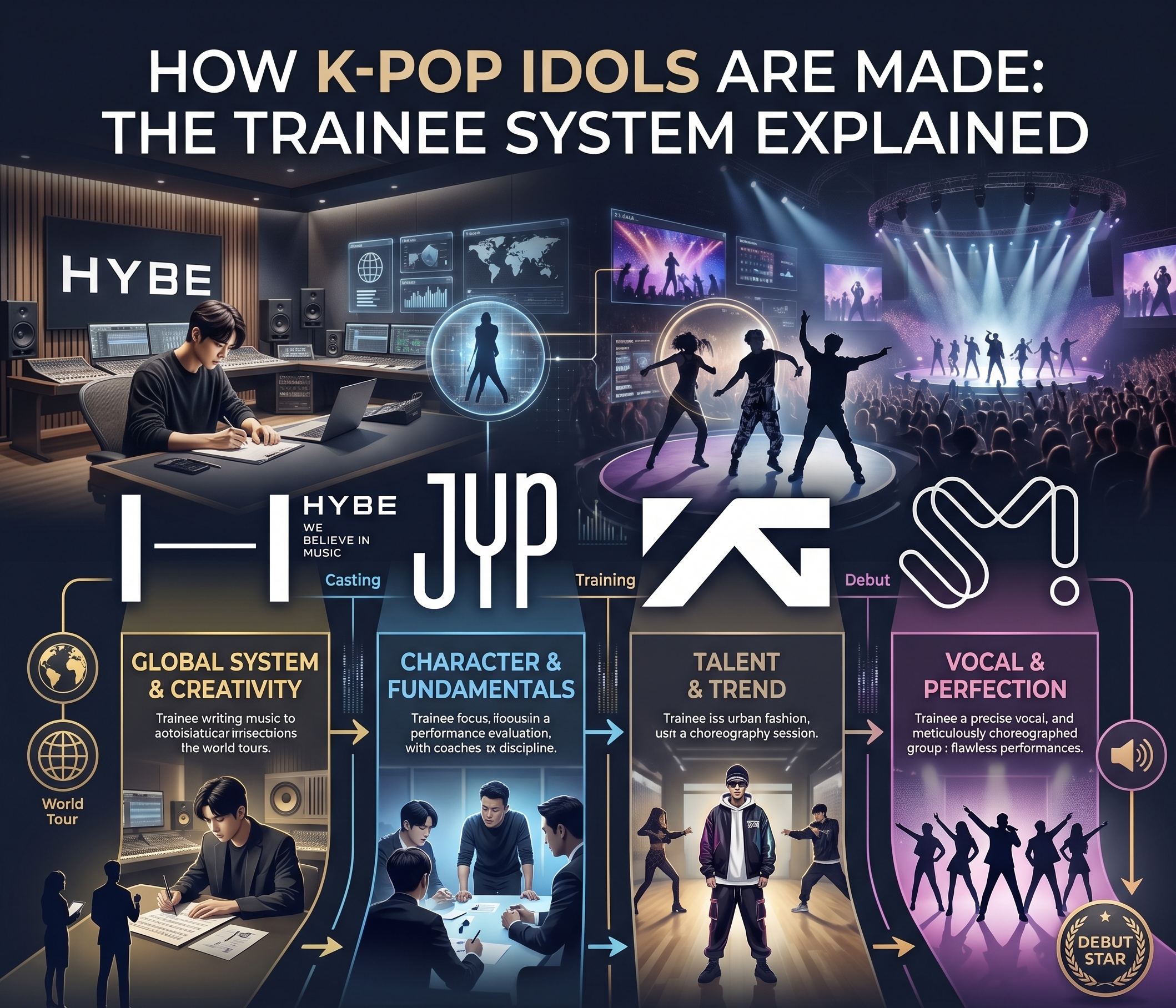
If you’ve ever watched a K-Pop group perform and thought — how are they this good? — the answer is the K-Pop trainee system: a structured, multi-year development pipeline unlike anything else in the music industry.
Western pop stars typically develop their careers organically: they write songs in their bedroom, post covers on YouTube, get discovered, sign a deal, and build from there. In K-Pop, there is really only one road to becoming an idol — and it runs through a highly demanding institution that transforms raw recruits into world-class performers. Understanding how to become a K-Pop idol means understanding this system first.
Key Takeaways:
- K-Pop trainees train 8–12 hours a day in vocals, dance, languages, and media skills
- The average training period ranges from 1.7 years (HYBE) to 3.2 years (SM Entertainment)
- Passing an audition is not a guarantee of debut — most trainees never debut at all
- The system was invented by SM Entertainment’s Lee Soo-Man in the mid-1990s and is now the global industry standard
📖 Quick Glossary
| Term | Meaning |
|---|---|
| Trainee (연습생) | A person under contract with an agency, training to potentially debut as an idol |
| Debut | A group’s official public launch — their first release and public performance |
| Big 4 | The four largest K-Pop agencies: SM, JYP, YG, and HYBE |
| Survival show | A TV competition where trainees compete for debut spots, voted on by the public |
| Cut | Being removed from training or a debut lineup |
| Street casting | Being approached and recruited by an agency talent scout in public |
Timeline: From Audition to Debut
| Stage | What Happens | Typical Duration |
|---|---|---|
| Audition | Evaluated on vocals, dance, visuals, potential | One day to several rounds |
| Trainee contract | Signed — no debut guarantee | 2–4 year contract |
| Training period | Daily vocal, dance, language, media training | 1.7 years (HYBE avg) to 3.2 years (SM avg) |
| Evaluation | Regular internal assessments — underperformers are cut | Ongoing |
| Group formation | Agency selects debut lineup based on skills + chemistry | Months |
| Pre-debut | Teasers, social content, sometimes survival shows | Weeks to months |
| Debut | Official release + first stage performance | — |
The Origin: Lee Soo-Man and the SM Blueprint (Mid-1990s)
The modern K-Pop trainee system was invented — not evolved, but deliberately invented — by Lee Soo-Man, the founder of SM Entertainment, in the mid-1990s.

Lee Soo-Man had studied in the United States and observed both the American pop production model and the Japanese idol system. He saw something neither culture had fully developed: a completely integrated pipeline from talent discovery to polished group debut, with the agency controlling every element along the way.
His blueprint was simple in concept and demanding in practice. Recruit young talent through open auditions. Train them intensively in singing, dancing, foreign languages, and performance. Evaluate them regularly. Debut only the best — as a carefully constructed group concept, not as individuals.
The debuts of H.O.T. in 1996 and S.E.S. in 1997 validated the model. Both became cultural phenomena. Within years, every major Korean entertainment company had adopted a similar structure. The trainee system became the industry standard — and has remained so for three decades.
Step 1: The Audition
The journey begins with an audition — but getting to that audition is already a competition.
The Big 4 agencies — SM, JYP, YG, and HYBE — hold auditions year-round, both in Korea and globally. Tens of thousands of applicants try each year. Some apply online with video submissions. Others show up to open auditions in person.
What are they looking for? The criteria vary by company, but typically include:
- Vocals — raw singing ability and tonal quality
- Dance — rhythm, body coordination, potential
- Visuals — appearance that fits the agency’s aesthetic standards
- Potential — how much can this person improve?
- Personality — can this person handle pressure, media, and team dynamics?
Notably, prior experience is not required. Many of K-Pop’s biggest stars were discovered with minimal training. EXO’s Sehun was street-casted at age 12 while eating tteokbokki near his school. BTS’s Jin was recruited on a bus. Girls’ Generation’s Yoona passed SM’s Saturday open audition at age 11.
Street casting — being approached by a talent scout in public — is a real and common entry point, particularly for visuals-first recruits.
Each of the Big 4 has its own audition culture:
- SM held its legendary Saturday Open Audition for over 20 years, though it has since moved largely online. Only 7 SM idols have debuted through this audition, including Heechul (Super Junior), Taemin (SHINee), and Seulgi (Red Velvet).
- JYP holds on-site auditions on the first and third Sundays of every month, open to anyone aged 12–25.
- YG runs a continuous online audition with no age or nationality restrictions.
- HYBE accepts online submissions from anyone born after 2003, notifying successful candidates within two weeks.
Step 2: The Trainee Contract
Passing an audition does not mean you’re debuting. It means you’ve been accepted as a trainee.
The trainee contract — typically lasting two to four years — is a formal agreement that the agency will invest in your development. In exchange, the agency gains significant control over your schedule, appearance, public behavior, and eventually, if you debut, your career.
Crucially: there is no guarantee of debut in a trainee contract. You can train for years, develop your skills, and still be cut before ever standing on a stage.
This is one of the most misunderstood aspects of the K-Pop system for international fans. Trainees are not signed artists. They are, in a sense, students — paying with their time, their youth, and their freedom for the chance to eventually earn the right to debut.
Step 3: The Training Life
Once signed, a trainee enters a world of structured, intense daily development. Training typically runs 8 to 12 hours a day, six days a week.
A typical day includes:
Vocal training — Not just singing lessons. Trainees develop tonal quality, breath control, and the specific vocal style that fits their planned group concept. SM, JYP, and HYBE each have distinctive sounds that their vocal coaches work to cultivate.
Dance training — From foundational technique to complex group choreography. K-Pop choreography is among the most technically demanding in commercial pop music, and mastering it takes years.
Language classes — Most major agencies require at minimum Korean (for non-Korean trainees) and Japanese, given the importance of the Japanese market. Mandarin Chinese is also common.
Media training — How to handle interviews, variety shows, fan interactions, and public appearances. How to maintain composure under camera pressure. How to be likable and memorable in brief interactions.
Acting and personality development — K-Pop idols are expected to be entertaining beyond their music. Variety show skills, facial expression awareness, and general screen presence are actively trained.
Academic school — Many trainees, particularly younger ones, continue attending school alongside their training schedule. Days can stretch to 15 hours. Some trainees drop out of school entirely or are homeschooled.
Training periods have shortened somewhat in recent years — HYBE reported an average trainee period of 1.7 years in their 2023 investor relations material, while SM Entertainment’s average is closer to 3.2 years. Historically, three to five years was standard, and some trainees spent nearly a decade before debuting or being cut.
Step 4: Regular Evaluations — The Constant Pressure
Throughout the training period, trainees face regular internal evaluations — monthly or quarterly assessments where they perform for company executives and are judged on their progress.
Poor evaluations can result in being cut from the training program entirely. Good evaluations open doors to more resources, better training slots, and consideration for upcoming debut projects.
This creates a permanently competitive environment. Trainees are simultaneously teammates and competitors. The person you practice choreography with today may be the person who takes your debut spot tomorrow.
Former trainees have described the psychological weight of this environment as one of the most difficult aspects of trainee life. Agencies have come under increasing scrutiny for the mental health conditions created by this structure. Progressive companies have implemented enhanced support systems including regular psychological counseling, mandatory rest periods, and anti-bullying protocols. HYBE’s 2022 company report highlighted their wellness program serving over 200 trainees and artists, while JYP Entertainment partnered with a major university hospital to develop specialized psychological support. However, standards remain inconsistent across the industry, particularly at smaller agencies.
Step 5: Group Formation — Who Gets to Debut?
When an agency decides it’s time to debut a new group, they select members from the current trainee pool based on a combination of factors:
- Individual skill levels in vocals, dance, and performance
- How well the trainees work together as a unit
- Visual balance and diversity within the group
- Marketability — what concept will this group embody, and who fits it?
- Global appeal — increasingly, agencies consider whether a lineup includes non-Korean members who can connect with international markets
The international dimension of group formation has grown dramatically. Japanese members have been a staple since the second generation. Chinese members became prominent in the early 2010s, though political tensions led many to depart after contract disputes. Thai, American, and European members have become increasingly common in the fourth generation.
The fourth and fifth generation has also seen a shift in how groups are formed. Groups like NewJeans (HYBE/ADOR) and ILLIT debuted with relatively short training periods compared to earlier generations, prioritizing concept fit and natural personality over years of intensive drilling. BABYMONSTER (YG) went through a public pre-debut elimination process. RIIZE (SM) debuted with members who had been SM Rookies for varying periods. The trend reflects a broader industry shift: speed to market and concept clarity have become as important as raw technical perfection.
Sometimes trainees who have been developing for years are passed over for a debut in favor of newer recruits who better fit a specific concept. Sometimes a near-final lineup is changed at the last minute. The process is opaque and, from the trainee’s perspective, often feels arbitrary.
Step 6: The Survival Show Route
Alongside the traditional agency-controlled path, a second route to debut emerged in the 2010s: survival shows.

Programs like Produce 101 (Mnet), MIXNINE (YG), and I-Land (HYBE) invited trainees from multiple agencies to compete publicly, with debut spots determined by audience votes. The format produced major groups including Wanna One, IZ*ONE, and Kep1er.
Survival shows offer trainees something the traditional system doesn’t: public visibility before debut, and a chance to build a fanbase before the group even officially exists. They also create enormous pressure — trainees’ rankings are publicly updated in real time, and elimination is broadcast to millions of viewers.
The survival show format has been controversial. Critics point to the emotional toll on young trainees whose fates are publicly decided. Supporters argue it gives fans genuine agency in shaping K-Pop’s landscape, and gives smaller-agency trainees a shot they’d never get otherwise.
Step 7: Pre-Debut and Debut
Once a group is formed, agencies typically invest months in pre-debut content: teaser photos, concept videos, social media launches, and sometimes reality show footage that lets fans follow the group’s journey before the music even drops.
This pre-debut period serves a crucial marketing function. By the time a group officially debuts, a dedicated fanbase has often already formed — people who have been following individual members for months and feel personally invested in the group’s success.
Debut itself is a single event: the release of a debut single or album, accompanied by a first stage performance on a music show like Music Bank, Inkigayo, or M Countdown. The debut stage is one of the most watched moments in a K-Pop group’s entire career.
How the Big 4 Differ
Each of the four major agencies has a distinctive philosophy that shapes how they train and debut artists:
SM Entertainment is known for its emphasis on performance precision and visual cohesion. SM groups — EXO, NCT, aespa — tend to have elaborate synchronized choreography, carefully constructed concepts, and a polished, almost architectural quality to their staging.
JYP Entertainment emphasizes natural personality and relatability alongside performance skills. JYP founder Park Jin-young is known for personally being involved in auditions and training. Groups like TWICE and Stray Kids are known for their genuine, warm public personas.
YG Entertainment historically emphasized self-expression and musical authenticity — Big Bang and BLACKPINK are known for having significant creative input into their own music, a relatively rare model in K-Pop.
HYBE (formerly Big Hit) built its identity around BTS’s model of artist-driven storytelling and emotional authenticity. HYBE has since expanded significantly through acquisitions, but continues to emphasize artist narrative and fan emotional connection.
The Criticism: A System Worth Questioning
The K-Pop trainee system produces some of the most skilled, versatile, and polished performers in the world. It also raises serious ethical questions.
Trainees are often recruited very young — sometimes as young as 10 or 11 years old. They sign contracts with agencies at ages when they may not fully understand the implications. Training schedules leave little room for normal adolescent development, friendships, or academic progression.
Restrictive contract clauses — sometimes called “slave contracts” by critics — have historically limited idols’ freedom to date publicly, change agencies, or pursue solo projects. High-profile legal battles between artists and agencies have periodically exposed the degree of control agencies exercise over their artists’ lives.
At the same time, the system has evolved significantly. Greater public awareness, landmark legal cases, and growing artist advocacy have pushed agencies toward more transparent and humane practices. The system that exists today is meaningfully different — though still demanding — from the one that existed in the early 2000s.
Is the Trainee System Worth It?
For the few who make it through — the answer is almost always yes, even when the path was painful. For the many more who train for years and never debut, the answer is more complicated.
What’s certain is this: the skills displayed by K-Pop idols — the synchronization, the vocal stamina, the stage presence, the effortless camera charisma — are not natural. They are built, deliberately and painstakingly, through a system unlike anything else in global popular music.
The next time you watch your favorite group perform and wonder how they make it look so easy — you’re watching the product of thousands of hours of work that started, for many of them, before they were teenagers.
Frequently Asked Questions
Can foreigners become K-Pop trainees? Yes. All four major agencies accept international applicants, and non-Korean members have become standard in major groups. Trainees are expected to become fluent in Korean, and often Japanese and Mandarin as well.
How young can you be to audition? Agencies typically accept applicants as young as 10–12 years old. The cut-off age for most major agency auditions is around 17–18 years old, though some agencies accept older applicants.
Do trainees get paid? Generally, no — or very little. Training costs are covered by the agency as an advance against future earnings. This is where Big 4 and smaller agencies differ significantly: major companies like SM, JYP, and HYBE have improved their settlement systems, and some now provide basic income to trainees even before debut. Smaller agencies, however, often require artists to fully repay all training costs before receiving any settlement — meaning newly debuted groups at small companies may see little to no income for years. This gap between large and small agency practices remains one of the industry’s most debated issues.
What happens to trainees who don’t debut? Most return to civilian life. Some move to smaller agencies for another attempt. A growing number participate in survival shows for a second chance. Some eventually debut in smaller groups years later than expected.

How long does training usually take? It varies significantly. HYBE’s average is approximately 1.7 years; SM’s is approximately 3.2 years. Some idols trained far longer before debuting — TWICE’s Jihyo trained for 10 years before debut, NCT’s Johnny for 9 years, and EXO’s Suho for approximately 7 years. Most famously, G-Dragon spent 5 years at SM as a child before joining YG, where he trained for another 6 years — a total of roughly 11 years before Big Bang debuted.
Want to understand more about how K-Pop works? Explore our Culture Explained series for more deep dives into the world behind the music.