Enlisted: The K-pop Idol and the Korean Military — Part 3 of 3 |← Part 1: Gunbaekgi — The K-pop Military Hiatus Every Fan Needs to Understand ← Part 2: Serve With Honor — Every Type of Military Service a K-pop Idol Can Choose
Parts 1 and 2 of this series covered the law, the culture, and the choices. They examined what mandatory military service actually means in South Korea, how the industry has learned to manage the gunbaekgi, and how individual idols have defined themselves through the manner of their service.
Part 3 covers something harder.
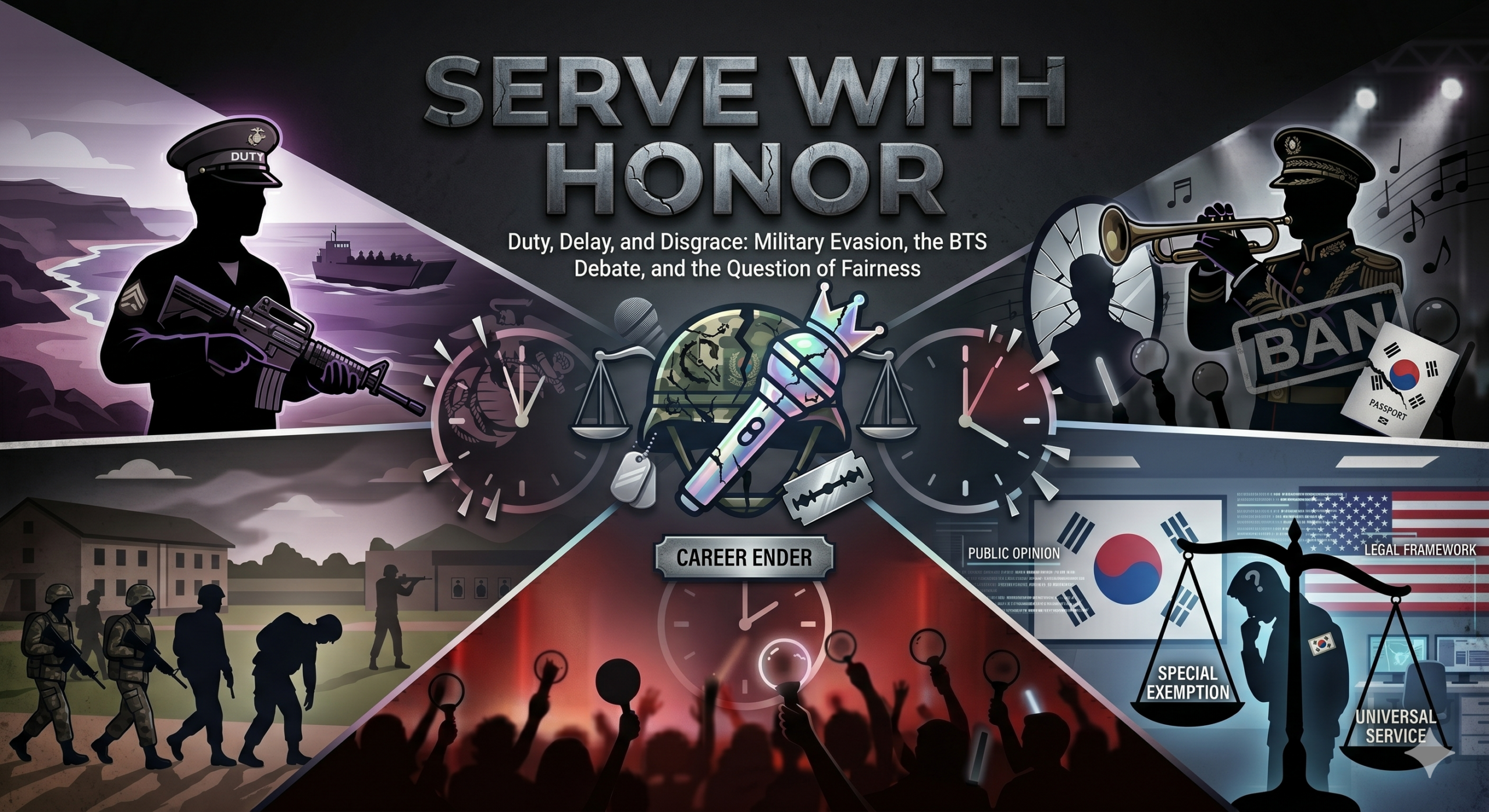
It covers what happens when the system breaks down — when fame is used as leverage against an obligation that Korean society considers non-negotiable, when the debate over fairness reaches the floor of the National Assembly, and when the gap between what the law requires and what celebrity sometimes attempts becomes a national conversation.
It also covers BTS. Because no serious discussion of K-pop and military service can avoid it.
The Weight of the Obligation
Before examining the cases where military service became controversy, it is worth restating something that can get lost in coverage aimed at international audiences.
In South Korea, military service is not simply a legal requirement. It is a moral one — embedded in a cultural framework that views the shared sacrifice of national defence as a foundational civic act. The man who serves is fulfilling something that every Korean male has faced or will face. The man who does not — or who attempts to avoid it through wealth, connection, or legal manipulation — is not simply breaking a rule. He is exempting himself from something his peers could not exempt themselves from. That distinction is felt personally, by millions of people, in a way that is difficult to convey to audiences for whom mandatory service is a historical or foreign concept.
This is why military evasion in Korea carries consequences that extend far beyond legal penalty. It is why a career can survive almost any other kind of scandal — and frequently does — but struggles to survive a confirmed attempt to avoid military duty. The offense is not against the state alone. It is against every Korean man who went when called.
The Architecture of Evasion: How It Has Been Attempted
Military evasion by Korean entertainers has taken several forms over the decades, each reflecting the particular legal and social landscape of its era.
Nationality Renunciation
The most dramatic — and most permanently damaging — form of evasion has involved the acquisition of foreign citizenship, which removes the holder from the scope of Korean military law. In cases where this has been done for the explicit or apparent purpose of avoiding service, the Korean public’s response has been categorical: permanent exclusion.
The operative word is “apparent.” Korean law does not require proof of intent in these cases. The Military Manpower Administration and the courts have consistently held that acquiring foreign citizenship during the years when military service would otherwise be required creates a strong presumption of evasion intent — a presumption that courts and public opinion alike have shown little inclination to look past.
Medical and Document Fraud
A separate category of evasion has involved the falsification of medical records to obtain exemption or reduced-duty classifications. Several high-profile cases in the 2000s — including actors who obtained fraudulent nephritis diagnoses to secure exemptions, only to face criminal proceedings and re-enlistment — established that this approach carried serious legal exposure and lasting reputational damage.
More recently, the 2022–2023 epilepsy diagnosis scandal brought this issue back into sharp public focus. Rapper Ravi (of VIXX) and rapper Nafla were prosecuted for working with a military service broker to fake epilepsy symptoms and manipulate medical evaluations in order to avoid active duty. Both were convicted: Ravi received a suspended sentence with community service, while Nafla received a one-year prison term. In court, both acknowledged that fear of losing career momentum — the gunbaekgi calculation made catastrophically wrong — had driven their decisions. The case was a direct demonstration that the medical fraud route, in the modern era, produces outcomes far worse than the service it was designed to avoid.
The Grey Zone: Legitimate but Perceived as Evasion
A third category is more complex: cases where the legal path taken was technically valid but perceived by a significant portion of the public as a form of advantaged avoidance. The entertainment soldier system, before its abolition, occupied this space — legal, but increasingly viewed as a mechanism by which fame translated into easier service. Medical reclassifications that were legitimate but publicly doubted fell into the same territory.
In Korean military culture, the perception of evasion carries almost the same weight as its reality. The burden of proof, in public opinion, rests with the individual to demonstrate that their service path reflected genuine obligation rather than strategic comfort.
The Cautionary Cases
Yoo Seung-jun: The Defining Case
No case in the history of Korean entertainment has defined the consequences of military evasion more completely than that of Yoo Seung-jun (유승준), known internationally as Steve Yoo.
In the late 1990s and early 2000s, Yoo Seung-jun was one of the most popular entertainers in South Korea — a singer and dancer whose crossover appeal and energetic stage presence made him a defining figure of his era. He had publicly and repeatedly stated his intention to fulfill his military duty, statements that were widely covered and that shaped his public image as a responsible public figure.
In 2002, days before he was scheduled to report for induction, Yoo Seung-jun acquired United States citizenship — rendering him ineligible for Korean military service. The Korean government’s response was immediate and absolute. He was banned from entering South Korea. That ban, challenged through the Korean legal system multiple times over more than two decades, has remained in force.
Yoo Seung-jun has not performed in South Korea since 2002. His case is cited, in every subsequent discussion of celebrity military service, as the benchmark consequence — the demonstration of what Korean society is prepared to do when it concludes that a public figure used their resources to escape an obligation that everyone else had to meet.
The case is also instructive for what it reveals about the nature of the breach. It was not simply that he avoided service. It was that he had publicly committed to serving — had built part of his public image on that commitment — and then did not. The combination of evasion and perceived deception produced a response from which, more than twenty years later, there has been no meaningful recovery.
The Pattern of Lesser Cases
Below the Yoo Seung-jun threshold, a recurring pattern emerges in Korean entertainment: an entertainer receives a medical classification that exempts them from active duty or reduces their service obligation; public skepticism follows; the entertainer faces sustained reputational damage regardless of whether the classification was legitimately obtained.
Several actors and singers navigated this territory in the 2000s, some of whom later re-enlisted voluntarily after their original classifications were questioned — a move that, in Korean public discourse, is understood as an attempt to restore credibility through demonstrated willingness to serve. Whether it succeeds depends on the specific circumstances and the public’s assessment of intent. Sometimes it does. Often, the original suspicion proves durable.
The pattern reveals something important: in Korean military culture, the benefit of the doubt is not automatically extended to public figures. The reverse is closer to the truth. Fame creates heightened scrutiny, not reduced scrutiny — because the public is alert to the possibility that resources and connections are being used to obtain outcomes that ordinary citizens could not access.
The BTS Debate: The Most Watched Conversation in K-pop History
No discussion of K-pop and military service — and no discussion of the exemption debate — is complete without examining BTS. Not because their case involved evasion. It did not. But because the public conversation around their service became the most visible, most internationally watched, and most politically charged military debate in Korean entertainment history.
The Scale of the Question
By the late 2010s, BTS had achieved something that had no precedent in Korean popular culture: genuinely global mainstream success, on a scale that was measurable in economic terms that the Korean government itself was citing in official reports. Their contribution to South Korean exports, tourism, and cultural influence was documented, quantified, and politically acknowledged.
This created a question that the existing legal framework had not been designed to answer: if South Korea grants military exemptions to Olympic gold medalists and classical music competition winners on the grounds of national prestige, what is the argument for not extending similar consideration to artists who have demonstrably generated more national prestige than almost any other category of achiever in the country’s history?
The question was not frivolous. It was raised by members of the National Assembly, debated in policy committees, and discussed in mainstream media for years. It also generated fierce opposition — from veterans’ groups, from the general public, and from people who argued that no achievement, however significant, should exempt a Korean male from a duty that millions of ordinary citizens had fulfilled without recognition or reward.
The 2020 Legal Change: Deferral, Not Exemption
The legislative resolution that emerged from this debate was carefully constructed to thread a very narrow needle.
The 2020 amendment to the Military Service Act — informally known as the BTS Law — extended the window for deferral of enlistment for recipients of the Order of Cultural Merit (화관문화훈장) and similar high-level cultural honors. Under this provision, qualifying individuals could defer active service until the age of 30, rather than the standard deadline.
This was not an exemption. The service obligation remained fully intact. The amendment gave qualifying artists additional time — time to continue promoting at the peak of their careers before the interruption of service — without reducing the obligation itself by a single day.
The distinction mattered enormously, both legally and politically. It allowed the National Assembly to respond to the legitimate economic and cultural argument being made about BTS without crossing the line that veterans’ groups and the broader public had made clear they would not accept: actual exemption from service for entertainers.
The Decision to Serve
In the years that followed the 2020 amendment, each BTS member made individual decisions about their service timeline. Jin enlisted first, in December 2022 — the first domino in a sequence that would play out over the following year. J-Hope followed in April 2023, enlisting ahead of his originally expected timeline by voluntarily cancelling his deferral. Suga began alternative social service in September 2023. By December 2023, the final four members — RM, V, Jimin, and Jungkook — had all enlisted, completing the full group’s entry into military service.
By the end of 2023, all seven members of BTS were serving. The gunbaekgi that followed — the longest and most globally watched in K-pop history — ended in stages throughout 2024 and 2025, with Jin discharging first in June 2024, J-Hope in October 2024, and the remaining members completing their service by June 2025.
The collective decision to serve — made without seeking or receiving exemption, in the face of years of public debate about whether they should — produced a specific kind of public response in Korea. It was not simply approval. It was relief. The debate had been long and loud, and its resolution through individual choice rather than legal exception carried a weight that a mandated outcome would not have.
The Fairness Question: Is the System Just?
The BTS debate made explicit a tension that had existed in Korean military policy for decades but had never been forced into public view so completely. The question it raised — what kinds of national contribution justify military exemption, and who decides? — does not have a clean answer. But it is worth examining honestly.
The Case for the Current System
The strongest argument for the current framework — full service required for entertainers, deferral available for high-level honorees — rests on the principle of equal sacrifice. Military service, in this view, derives its social meaning precisely from its universality. The moment it becomes negotiable on the basis of achievement or economic value, the shared nature of the obligation dissolves, and with it the civic compact that gives service its cultural weight.
The counterargument — that Olympic athletes are already exempt, so the principle of universality is already compromised — is answered by proponents of the current system with a distinction: Olympic medals are won in direct international competition that produces explicit, zero-sum national prestige. Cultural contribution, however significant, is harder to measure and more susceptible to special pleading. Drawing the line at direct international athletic competition keeps the exemption category narrow and relatively objective.
The Case for Reform
The reform argument begins with the observation that the exemption categories as currently drawn reflect choices made in a very different cultural and economic landscape. South Korea’s global cultural footprint in the 2020s — driven substantially by K-pop and K-drama — represents national soft power of a kind that the original exemption framework was not designed to accommodate.
The economic data is not ambiguous. Studies commissioned by Korean government agencies have quantified the export value, tourism impact, and brand premium generated by top-tier K-pop acts in terms that exceed the economic contribution of most Olympic medal performances. If exemption is justified by measurable national benefit, the argument that the current categories are drawn in the right place is increasingly difficult to sustain on purely economic grounds.
The unresolved tension is this: the argument for expansion is economically coherent but culturally risky. Expanding exemptions risks opening a negotiation that never closes — one in which every field of achievement eventually produces its own case for special treatment. The current framework, imperfect as it is, avoids that negotiation by holding a bright, if somewhat arbitrary, line.
What Military Service Reveals About Korea
This series has moved from law to culture to controversy. It has examined the gunbaekgi, the choices idols make about how to serve, and the cases where the system’s expectations were tested or broken.
The thread running through all of it is something that international K-pop fans sometimes struggle to fully absorb: in South Korea, military service is not a footnote to an idol’s story. It is a chapter — sometimes the most revealing one.
The idol who serves quietly in a standard unit, who earns a training instructor assignment through demonstrated ability, who volunteers for the Marines without announcing it as a brand decision — that idol is communicating something to the Korean public that no album or drama can replicate. They are demonstrating that they understand the terms of the civic compact they were born into, and that they are willing to meet those terms on equal footing with every other Korean man who did.
The idol who does not — or who is perceived not to — carries that perception for the rest of their career. In most cases, for the rest of their public life.
For international fans navigating the gunbaekgi — waiting through the silence, counting down the discharge dates, celebrating the returns — understanding this dimension of the service experience is essential to understanding what the waiting actually means. It is not just a pause in a career. It is a test of character that the Korean public administers to every public figure, without exception, and grades without sentimentality.
That is what military service is in South Korea. And now you know why it matters.
K-Military Glossary
K-Military Glossary
군백기 (Gunbaekgi)
Military white period — the career blank space created by mandatory service.
고무신 (Gomusin)
The waiting fan — one who stays devoted through the entire service period. From “고무신을 거꾸로 신다” — to wear rubber shoes backwards, meaning to leave someone while they’re away.
꽃신 (Ggotsin)
The reward of waiting — successfully seeing an idol through to discharge. From the tradition of gifting flower shoes to a returning soldier: a symbol of devotion honored and completed.
군입덕 (Gun-ipdok)
Becoming a new fan of an idol during their military service.
전역 (Jeonyeok)
Discharge — the completion of mandatory military service.
현역 (Hyeonyeok)
Active duty — full military service as an enlisted soldier.
사회복무요원 (Sahoe Bongmu Yowon)
Social service worker — alternative service for those with Grade 4 physical classification.
병역기피 (Byeongyeok Gipi)
Military evasion — the act of avoiding mandatory service obligation.
📌 This is Part 3 of 3 — the Enlisted series is now complete.
←Part 1: Gunbaekgi — The K-pop Military Hiatus Every Fan Needs to Understand
←Part 2: Serve With Honor — Every Type of Military Service a K-pop Idol Can Choose
Do you think K-pop idols should be eligible for military exemption? Share your perspective in the comments below.