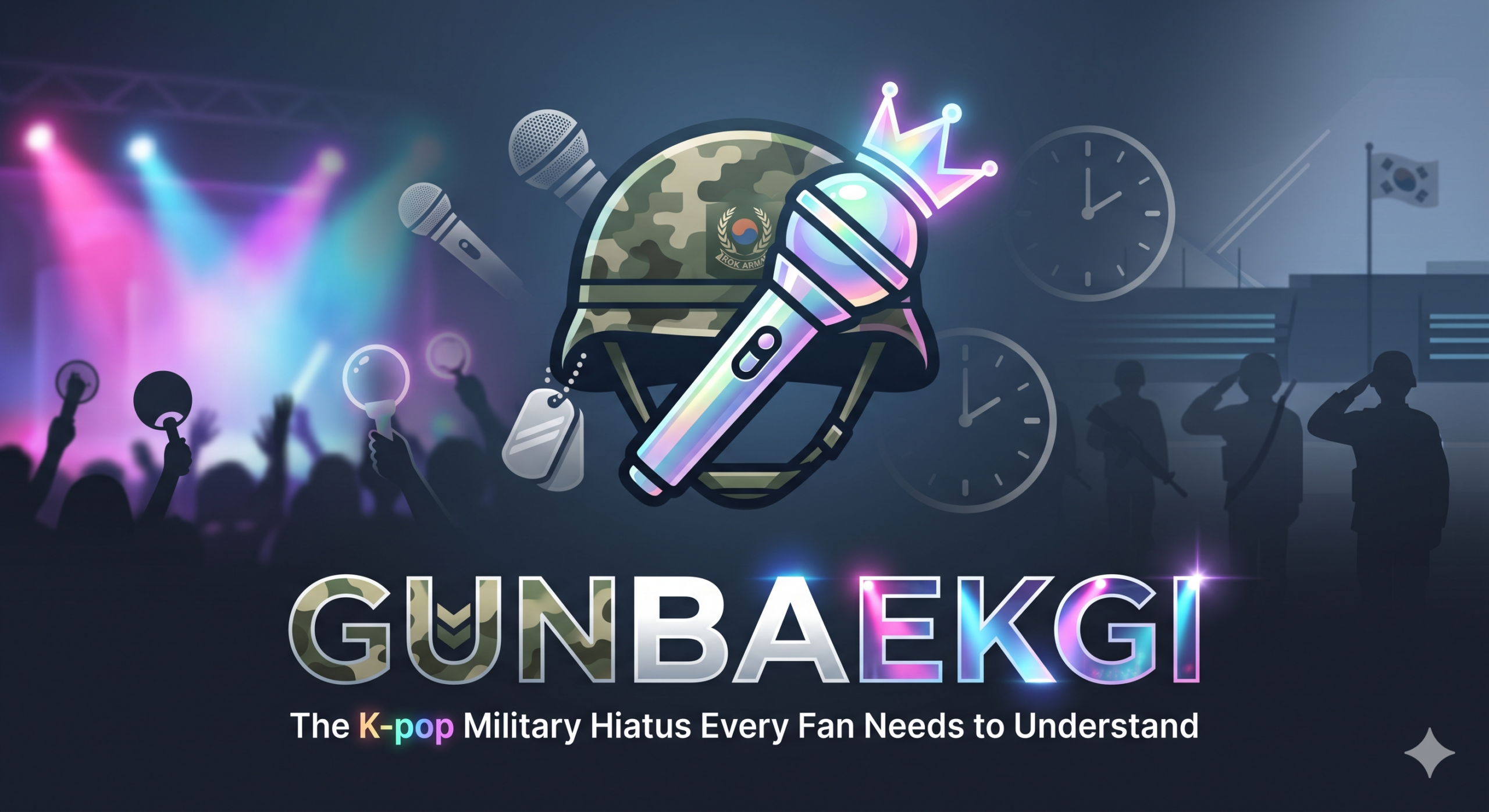
Enlisted: The K-pop Idol and the Korean Military — Part 1 of 3
There is one thing no K-pop agency can schedule around, no management team can negotiate away, and no amount of global fame can delay indefinitely.
Not a world tour. Not a comeback album. Not a Netflix deal.
The Korean military draft.
At some point — no matter how big the group, no matter how full the arena, no matter how many countries are watching — every male K-pop idol born a South Korean citizen will put on a uniform, pick up a rifle, and disappear from public life for approximately eighteen months.
No exceptions. No exemptions for chart performance. No special treatment for cultural impact.
This is not a crisis. It is not a scandal. It is simply the law — and understanding it is essential to understanding K-pop itself.
The Law of the Land: What Military Service Actually Means in Korea
South Korea maintains one of the few remaining mandatory military conscription systems in the world — and for good reason. The country remains technically at war with North Korea, with only an armistice agreement (not a peace treaty) in place since 1953. The threat, however distant it may feel in peacetime, is constitutionally and legally treated as real and ongoing.
Under the Military Service Act (병역법), every South Korean male citizen is required to complete active military duty. The basics, as of 2024:
- Eligible age: Registration at 18, with active service typically completed between ages 18–28 (Note: South Korea fully adopted the international age system in 2023, making it easier for global fans to track enlistment timelines without converting from the traditional Korean age system.)
- Service length: approximately 18 months for the Army (육군) and Marines (해병대), 20 months for the Navy (해군), 21 months for the Air Force (공군)
- Deadline: Must be completed before age 30 in most cases — with limited exceptions
- Penalty for evasion: Criminal prosecution, imprisonment, and permanent reputational damage in Korean society
For international fans encountering this system for the first time, the scale of it can be surprising. This is not a voluntary program, a reserve duty, or a symbolic gesture. It is a legal obligation enforced without regard for career, income, or international profile.
Why It Hits K-pop Differently
Every South Korean male faces this obligation. But for K-pop idols, the stakes of that 18-month absence carry a weight that is difficult to overstate.
Consider what an idol stands to lose during active service:
The momentum window. K-pop operates on relentless album cycles, comeback schedules, and chart activity. An 18-month gap does not pause the industry — it keeps moving, with new groups debuting, new trends emerging, and audience attention shifting continuously.
The group dynamic. Most K-pop acts are multi-member groups, and members typically enlist at different times due to age differences. This means a group can spend years operating in a fractured state — some members promoting, others serving — before a full reunion becomes possible.
The global audience. International fans, unfamiliar with Korean military culture, sometimes interpret enlistment as a hiatus by choice or an industry decision. The emotional disconnect between a Korean domestic audience that views service as a proud civic duty and an international fanbase that simply experiences it as “my favourite artist disappeared” creates a unique communication challenge for every agency.
Enter the Gunbaekgi — and the Fans Who Wait
No discussion of K-pop military service is complete without understanding one word: 군백기 (Gunbaekgi).
Literally translated as “military white period,” gunbaekgi refers to the blank space in an idol’s career created by mandatory service — the months during which there are no stages, no releases, no schedules, and no content beyond the occasional permitted letter or phone call home.
The term originated in Korean fan communities and has since become standard vocabulary across international K-pop spaces. It captures something that a simple phrase like “military hiatus” does not quite reach: the particular quality of that waiting — stretched, uncertain, punctuated by rare glimpses, and ultimately finite.
Alongside gunbaekgi, two more words define the emotional landscape of the wait:
고무신 (Gomusin)
Go-mu-shin
The waiting fan. A fan (or partner) who remains devoted through the entire service period. The term comes from the expression “고무신을 거꾸로 신다” — to wear rubber shoes backwards — meaning to abandon someone while they are away. A gomusin is the one who does not.
꽃신 (Ggotsin)
Ggot-shin
The reward of waiting. To “give flower shoes” to someone returning from service is to honor the devotion that carried both parties through the separation. It is the completion of the wait — the moment the idol steps out of uniform and back into the world the fan held space for.
For international fans, these terms are not just vocabulary. They are a window into how Korean fan culture understands loyalty, time, and the particular kind of love that waits without guarantee of return.
The Industry’s Response: From Silence to Strategy
For most of K-pop’s early history, military enlistment meant something close to a full stop. An idol enlisted, the group paused, the agency went quiet, and fans waited with little to hold onto beyond old content and hope.
That era is over.
The modern K-pop entertainment machine has developed a sophisticated, deliberate response to the gunbaekgi — one that transforms what was once a dead zone in an artist’s career into something closer to a managed content arc.
The strategy is called 콘텐츠 비축 (Content Stockpiling), and it has become standard practice at every major label.
How Content Stockpiling Works
In the months before an idol’s enlistment date, agencies work intensively to pre-produce a volume of content designed to be released gradually throughout the service period. The goal is simple: maintain presence without requiring presence.
This can include:
- Pre-recorded video content — vlogs, behind-the-scenes footage, personal messages — scheduled for release at regular intervals
- Solo albums or EPs recorded in advance and released mid-service
- Variety show appearances filmed before enlistment and aired during service
- Social media content — curated posts, throwback material, milestone acknowledgments — managed by the agency on the idol’s behalf
The result, for fans, is an experience that bears little resemblance to the gunbaekgi of a decade ago. Rather than silence, the service period becomes a slow-burn content release schedule — carefully paced to keep the fanbase engaged, emotionally connected, and ready for the comeback.
The Jin Blueprint
No case study illustrates this evolution more clearly than Jin (Kim Seok-jin) of BTS, who enlisted in December 2022 as the first BTS member to enter active service.
In the weeks before his enlistment, HYBE released a steady stream of solo content. His solo single The Astronaut — co-written with Coldplay — served as both a farewell gift and a standalone artistic statement. After enlisting, pre-produced video messages were released on a monthly basis, maintaining a warm, personal connection with the global fanbase throughout his service.
His discharge in June 2024 was treated as a cultural event in its own right — coordinated content, fan gatherings, and a solo album release that demonstrated the full arc of the strategy: enlistment as transition, not interruption.
The agency had not simply waited out the gunbaekgi. It had programmed it.
Exemptions and Exceptions: What’s Possible, What Isn’t
One of the most persistent questions from international fans — and one of the most contentious debates in Korean public discourse — is whether K-pop idols should be eligible for military exemption.
The current answer, under Korean law, is essentially: no.
South Korea does grant exemptions to certain categories of exceptional national contributors. Olympic and Asian Games gold medalists are exempt. Winners of specific international classical music and fine arts competitions are exempt. These exemptions are written into the law under the argument that these individuals bring the country measurable national prestige that justifies the exception.
K-pop artists, regardless of global impact or cultural contribution, do not currently qualify for full exemption.
What changed in 2020, however, was the introduction of a more nuanced provision — informally known as the BTS Law — that allows recipients of the Order of Cultural Merit (화관문화훈장) and other high-level cultural honors to defer enlistment until age 30. This is not an exemption. The service must still be completed. But the deferral window allows artists at the peak of their international careers to extend their active period before the clock forces a pause.
The distinction between exemption and deferral matters enormously — both legally and in terms of public perception. The debate over full exemption for K-pop artists remains unresolved and politically sensitive, touching questions of fairness, national identity, and the value Korean society places on different kinds of contribution.
We return to this debate in depth in Part 3.
A Rite of Passage, Not Just an Obligation
Here is something that often gets lost in international coverage of K-pop military service: for most Korean men, including most idols, service is not experienced primarily as a burden.
It is a rite of passage — a shared experience that cuts across class, profession, and fame. The soldier and the superstar stand in the same line at the induction center. They eat the same food, follow the same rules, answer to the same chain of command. For a country that places significant cultural value on collective experience and civic duty, that shared passage carries genuine meaning.
Many idols have spoken about their service in terms that surprised international fans — not as something endured, but as something that changed them. Time away from the industry. Physical challenge. A different kind of community. A temporary return to a version of themselves that existed before the cameras.
The gunbaekgi, for many, is not only about what the fan waits through. It is also about what the idol comes back from.
What Comes Next
Part 2 of this series moves from the law to the choices — examining the full range of military service types available to Korean men, from standard army service to the Marines, the KATUSA program, and the military band. And it looks at specific idols whose service choices shaped how the public saw them — sometimes dramatically.
Because in Korea, it is not just whether you serve. It is how you serve. And that difference carries more weight than most international fans realize.
📌 This is Part 1 of a 3-part series. → Part 2: Serve With Honor — The Choices Idols Make → Part 3: Duty, Delay, and Disgrace — Evasion, the BTS Debate, and the Question of Fairness