Enlisted: The K-pop Idol and the Korean Military — Part 2 of 3 | ← Part 1: Gunbaekgi — The K-pop Military Hiatus Every Fan Needs to Understand
In Part 1, we established the foundation: mandatory military service in South Korea is non-negotiable, universally applied, and carries a cultural weight that international fans often underestimate.
But here is something Part 1 only hinted at.
Not all service is the same.
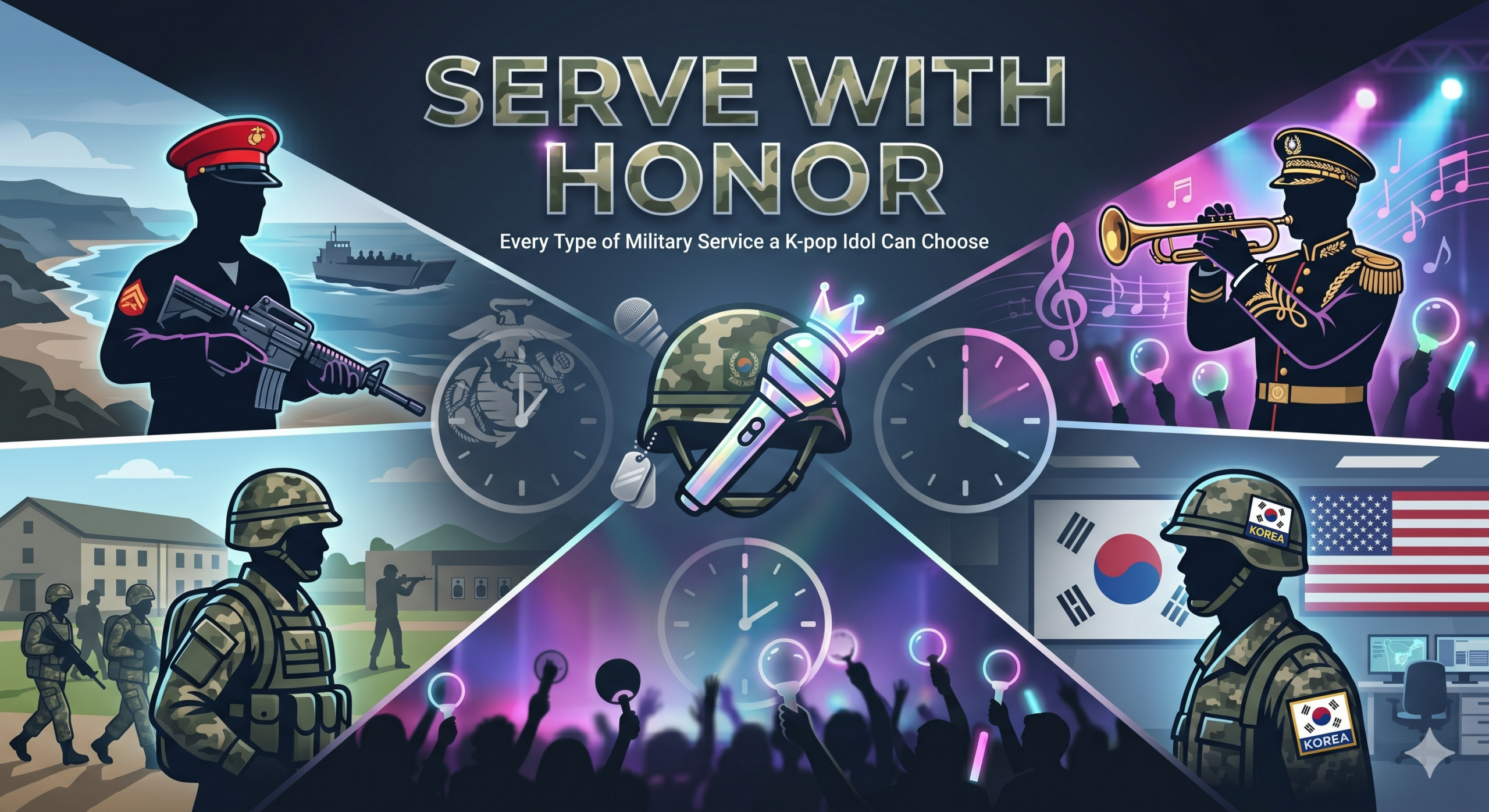
The Korean military offers several distinct paths — each with different training intensity, different day-to-day realities, and very different public images. And for K-pop idols, whose every move is scrutinized by millions of fans both domestically and internationally, the choice of how to serve can say as much as the music they make.
This is Part 2. This is where the choices live.
The Spectrum of Service: A Complete Guide
Before diving into individual cases, it helps to understand the full landscape of service options available to Korean men — and what each one actually involves.
The Spectrum of Service: A Complete Guide
| Service Type | Korean | Length | Key Feature |
|---|---|---|---|
| Army (Standard) | 육군 | ~18 months | Most common path |
| Marines | 해병대 | ~18 months | Voluntary, elite, high-intensity |
| Navy | 해군 | ~20 months | Maritime service |
| Air Force | 공군 | ~21 months | Technical specialization |
| KATUSA | 카투사 | ~18 months | Serves alongside U.S. Army; English required |
| Military Band | 군악대 | ~18 months | Performance role within the military |
| Training Instructor | 조교 | ~18 months | Trains new recruits; elite assignment |
| Social Service Worker | 사회복무요원 | ~21 months | Alternative service for Grade 4 physical classification |
| (Historical) Entertainment Soldier | 연예병사 | — | Abolished in 2013 |
Each of these paths carries its own meaning — in terms of physical demand, public perception, and what it signals about the person who chooses it.
Standard Army Service: The Common Ground
The majority of Korean men — and the majority of K-pop idols — serve as standard army enlisted soldiers (육군 병사). There is nothing glamorous about it by design. Basic training, unit assignment, rotating duties, and eighteen months of structured military life.
For idols who choose this path without seeking a specialized role, the message it sends is quietly powerful: I am not asking for special treatment. I am doing what everyone does.
In a country where military service is a shared civic experience, that posture carries genuine respect. The idol who enlists quietly, without fanfare, without leveraging their fame for a more comfortable assignment, often emerges from service with a domestic reputation that is meaningfully stronger than the one they left with.
The Marines: Chosen Difficulty
What the Marines Actually Are
The Korean Marine Corps (해병대) is a volunteer branch — meaning no one is assigned there. You have to ask to go.
That distinction matters enormously. Marine training is widely regarded as the most physically demanding service experience available to Korean conscripts. The curriculum is intense by design, the culture is disciplined and rigorous, and the reputation the Corps carries in Korean society is one of earned toughness.
When a K-pop idol voluntarily enlists in the Marines, they are not simply completing their service obligation. They are making a statement — one that the Korean public reads clearly and responds to with a specific kind of respect that other service paths do not automatically generate.
The Idol Cases
Hyun Bin enlisted in the Marines in 2011, at the peak of his popularity following Secret Garden. The decision was voluntary and unprompted by any public pressure. His enlistment photos — the close-cropped hair, the uniform, the expression that suggested he had left the actor entirely at the gate — became some of the most widely circulated celebrity military images in Korean entertainment history. He emerged from service with a domestic reputation that had shifted in a specific way: from popular actor to something the Korean public describes with a particular quiet approval. Not more famous. More respected.
Minho (SHINee) is the modern benchmark for idol Marine service. Enlisting voluntarily in April 2019 — by his own account, out of a personal desire for challenge — he approached the experience with the same intensity he brought to everything outside the military. He became a squad leader candidate, ranked first in the unit for running, shooting, and bayonet drill, and earned commendation that had nothing to do with his fame. Most remarkably, when his discharge date arrived, he chose to forfeit twenty days of his remaining leave in order to participate in the unit’s annual national defence exercises — an experience he had wanted to complete alongside his fellow soldiers. He discharged in November 2020. The Korean public’s response was unambiguous: this was not an idol doing his time. This was someone who had genuinely shown up.
Lee Chanhyuk (AKMU) added an entirely different dimension to the story of idol Marine service. A songwriter by instinct and training, he did not set aside his creative work when he enlisted — he redirected it. During his service, he composed a military marching song that was formally adopted by the Korean armed forces as an official military song. The result was singular: an idol who left the entertainment industry for service and, in the process, produced work that will outlast his military service entirely.
The Training Instructor: Captain Korea
What the Role Involves
The 신병교육대 조교 (Training Instructor) assignment places a soldier in charge of training incoming recruits at a basic training center. It is an elite assignment — not because it is comfortable, but because it demands a level of physical fitness, discipline, and leadership capability that most recruits do not reach.
The role has accumulated an unofficial nickname in Korean pop culture: “캡틴 코리아” (Captain Korea) — a nod to the Marvel character, yes, but also a genuine reflection of the image the assignment projects. These are the soldiers who shape the next generation of Korean military personnel. The responsibility is real. The physical standard is high. And the public image that comes with it is, in Korean cultural terms, about as unambiguous as it gets.
The Idol Cases
Several of the most high-profile idol enlistments in recent K-pop history have resulted in training instructor assignments — a fact that has not gone unnoticed by fans or by the Korean public.
Jin (BTS) served as a training instructor following his December 2022 enlistment. For a global superstar of his stature, the assignment communicated something clearly: he had met the physical and military standard required for an elite role without any accommodation for his fame.
J-Hope (BTS) similarly served as a training instructor — notable both for the role itself and for the fact that he enlisted ahead of his originally expected timeline, voluntarily moving his service date earlier than required.
Taecyeon (2PM) completed his service as a training instructor and did so in the regular army rather than seeking any specialized or lighter assignment, despite being under no obligation to take the harder path.
D.O. (EXO) also served as a training instructor — completing his service quietly and returning to acting work that, as Part 2 of our Beyond the Stage series examined, had already established him as a credible screen presence independent of his idol career.
The pattern across these cases is consistent: the training instructor assignment, chosen or earned, signals to the Korean public that the idol did not use their fame as a cushion. That signal resonates — domestically, durably, and in ways that fan communities sometimes underestimate.
The Military Band: Serving on Stage
What the Role Involves
The 군악대 (Military Band) is exactly what it sounds like — musicians who perform official military functions, ceremonies, and events throughout their service period. For idols with strong musical foundations, it is a natural fit, and one that carries a specific appeal for fans: it is one of the only service roles where an idol may continue to perform publicly, in uniform, during active duty.
Military band appearances are occasional and ceremonial rather than concert performances — but for fans in the middle of a gunbaekgi, even a glimpse of their idol on a public stage, in any context, carries enormous emotional weight.
The Idol Cases
RM (BTS) served in a specialized unit with participation in military band activities during his service — a role that aligned with his artistic background while fulfilling his military obligations in full.
V (BTS) served in a military police special unit, with some participation in military performance events — a service path that generated significant fan attention for the contrast between his unit assignment and his occasional ceremonial visibility.
Yook Sungjae and Lee Changseob (BTOB) both served in military band roles and are frequently cited as among the most active and visible idol military band members in recent K-pop history. Their appearances in military performances during the gunbaekgi period gave fans consistent, if ceremonial, glimpses of their favourite artists — and both completed their service without complication. For fans navigating a long hiatus, those moments carried a weight that is difficult to quantify but easy to understand.
KATUSA: The English-Language Path
What KATUSA Actually Is
카투사 (KATUSA — Korean Augmentation to the United States Army) is one of the most distinctive and competitive service options available to Korean men. KATUSA soldiers serve embedded within United States Army units stationed in South Korea, functioning as a bridge between Korean and American military personnel.
The requirements are demanding in a specific way: a high score on the TOEIC English proficiency test is essentially mandatory, as KATUSA soldiers must communicate effectively in English on a daily basis. Selection is also competitive — not everyone who qualifies is chosen.
The day-to-day environment of KATUSA service is meaningfully different from standard Korean military life. Interaction with American military culture, English-language work environments, and the unique position of operating between two military systems makes it an experience that stands apart from any other service option.
For international K-pop fans, KATUSA is perhaps the most immediately relatable service path — and the one that most directly intersects with the global, English-adjacent world that many international fans inhabit.
The Idol Case: DAY6’s Young K
Young K (Brian Kang) of DAY6 became the first K-pop idol to serve as a KATUSA soldier — a milestone that generated significant attention both domestically and internationally.
His English fluency — he grew up partly in Canada — made him a natural fit for the assignment. But the significance of his KATUSA service extended beyond the personal. It demonstrated, for the first time with a high-profile idol, that the KATUSA path was not just available to K-pop artists in theory — it was achievable in practice, and it produced a service experience that connected meaningfully with the international fan communities that follow K-pop most closely.
For DAY6’s global fanbase, many of whom are native English speakers, the image of Young K operating in a bilingual military environment carried a particular resonance. The gunbaekgi, in his case, felt — in a small way — slightly less foreign.
The Entertainment Soldier: A Closed Chapter
No discussion of K-pop military service is complete without acknowledging a path that no longer exists — and understanding why it was closed.
The 연예병사 (Entertainment Soldier / Culture and Public Relations Soldier) program allowed a small number of performers, actors, and entertainers to complete their military service in a specialized cultural unit. Rather than standard combat training and unit assignments, these soldiers performed in official government productions, public events, and military entertainment programs.
The program was not without legitimate purpose — the Korean military has a genuine use for cultural programming — but its application to celebrity entertainers generated increasing public skepticism over the years. The perception, fair or not, was that fame was functioning as a mechanism for obtaining easier service. In a society where the shared sacrifice of military service carries deep cultural meaning, that perception was corrosive.
The program was abolished in 2013. Since then, no idol has had access to it. The closure is broadly viewed, in Korean public discourse, as a correction — a restoration of the principle that service should be equal regardless of public profile.
The abolition also changed the cultural calculus around idol enlistment permanently. With the entertainment soldier path closed, every service choice an idol makes now carries clearer meaning. There is no soft option. There is only the full spectrum of legitimate service — and the public watches which part of that spectrum each idol chooses.
What Service Reveals
Across all of these paths — the Marines, the training instructors, the military band, the KATUSA — a consistent theme emerges.
In Korean society, military service is not simply an obligation to be discharged. It is a public character statement, made under conditions that strip away the performance of celebrity and leave something more fundamental visible.
The idol who volunteers for the Marines is saying something. The idol who earns a training instructor assignment is saying something. The idol who serves quietly in a standard unit, without fanfare or leverage, is also saying something.
International fans sometimes focus on the gunbaekgi — the absence, the waiting, the content gap. Korean audiences tend to focus on something different: not the fact of service, but its quality. Not whether the idol went, but how they went, and what they carried with them when they came back.
That distinction is the lens through which Part 3 examines the other side of this story — the cases where service became controversy, where exemption debates consumed public discourse, and where the gap between what the law requires and what fame sometimes attempts opened into genuine national argument.
📌 This is Part 2 of a 3-part series. ← Part 1: Gunbaekgi — The K-pop Military Hiatus Every Fan Needs to Understand → Part 3: Duty, Delay, and Disgrace — Evasion, the BTS Debate, and the Question of Fairness