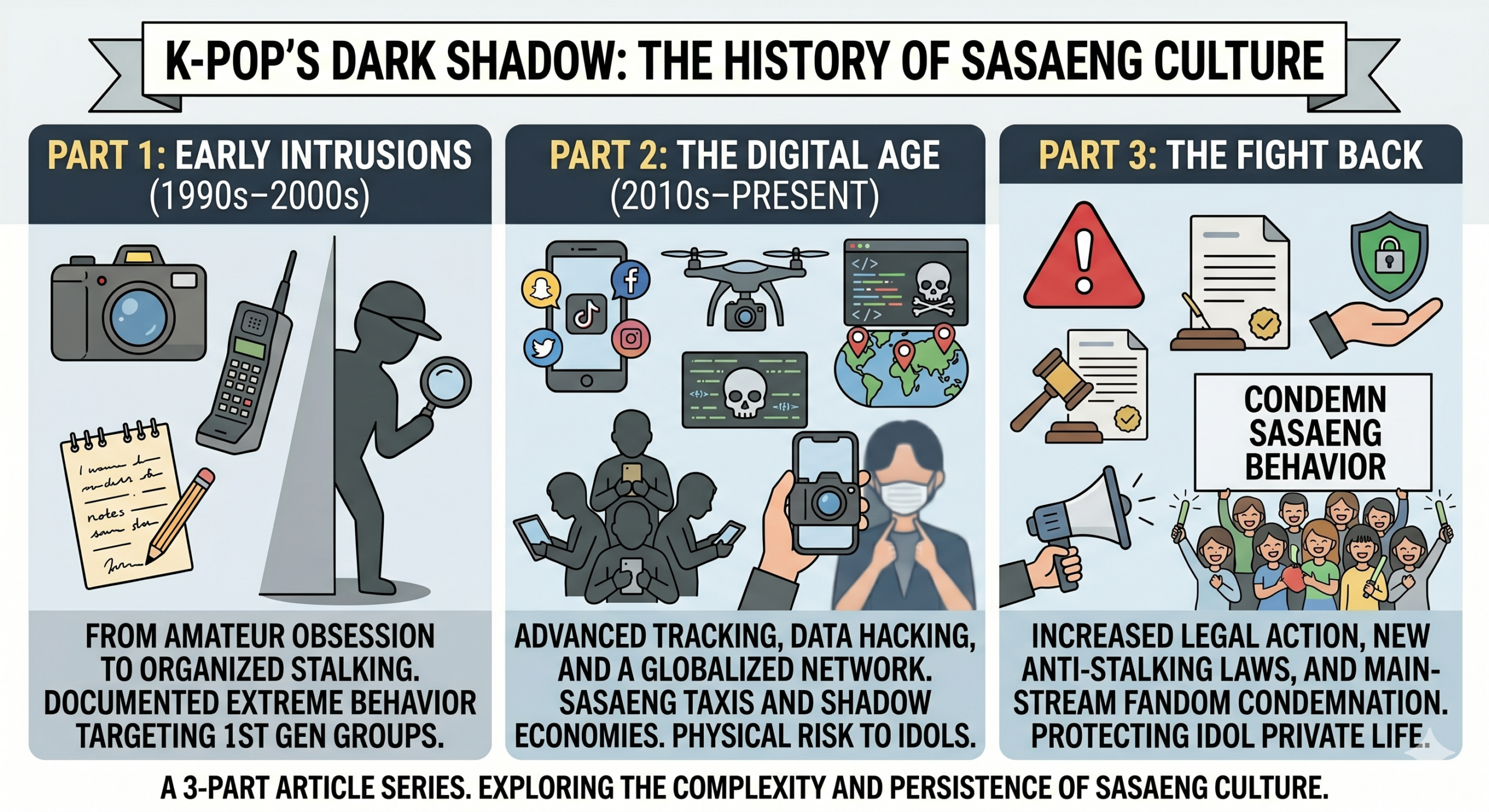
This is Part 1 of a three-part series on K-Pop’s sasaeng culture.
Every fandom has its extremes. But K-Pop has something that no other music culture has quite replicated: a term, a taxonomy, and a decades-long history for a specific type of fan whose behavior crosses from devotion into something far darker.
They are called sasaeng fans (사생팬) — and understanding them means understanding one of the most uncomfortable truths about the K-Pop industry’s rise to global dominance.
This is not a story about normal fans. The vast majority of K-Pop fans worldwide are passionate, creative, and deeply respectful of the artists they love. This is a story about what happens at the extreme edge — and why that edge has existed since the very beginning.
📖 Key Terms
| Term | Meaning |
|---|---|
| Sasaeng (사생) | Literally “private life” — used to describe obsessive fans who invade idols’ privacy |
| Sasaeng taxi | Taxis hired specifically to follow idol vehicles, charging 2–3x normal rates |
| Anti-fan | Distinct from sasaengs — fans whose goal is to harm or destroy an idol’s career, not seek contact |
| Hallyu (한류) | The “Korean Wave” — the global spread of Korean pop culture |
| Sasaeng record | Audio recordings of private phone calls or personal moments, sold within sasaeng networks |
What Is a Sasaeng?
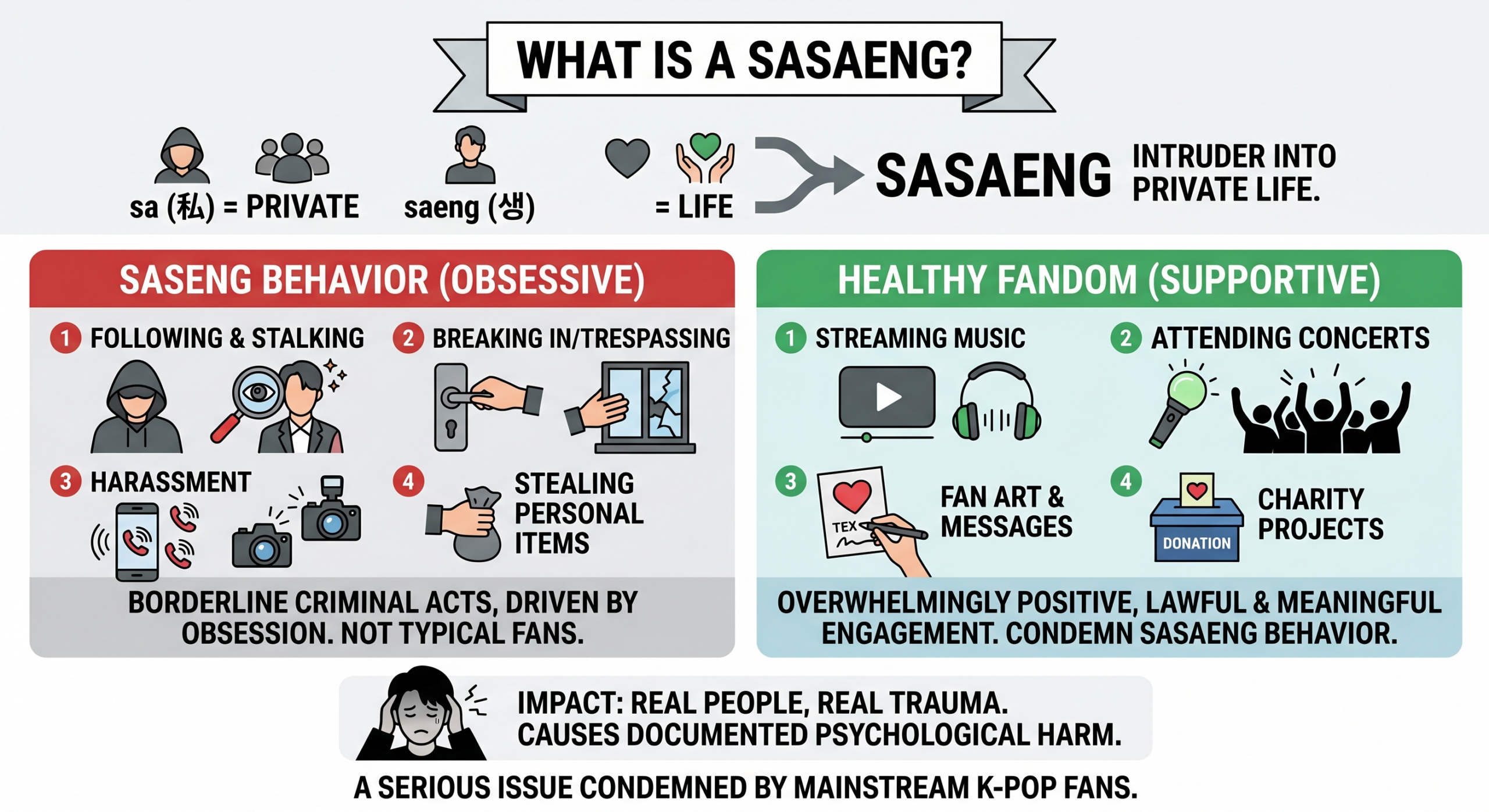
The word sasaeng combines two Korean characters: sa (사, 私) meaning “private,” and saeng (생, 生) meaning “life.” Together, they describe someone who intrudes into a celebrity’s private life — not as a casual fan, but as an obsessive presence who treats access to that private life as the central goal of their existence.
Sasaeng fans are predominantly female, aged 13 to 22, and may be driven to commit borderline criminal acts in order to gain attention from celebrities. But reducing sasaengs to a simple demographic profile misses the complexity of what drives the phenomenon — and why it has proven so persistent despite decades of public condemnation.
It’s critical to be clear about one thing from the start: sasaengs are not representative of K-Pop fandom. The global K-Pop community is overwhelmingly made up of fans who engage with their favorite artists in healthy, lawful, and deeply meaningful ways. Sasaeng behavior is condemned — vocally and consistently — by mainstream K-Pop fans everywhere.
But the phenomenon is real, it is serious, and it has caused documented, lasting psychological harm to real people.
The Origins: Before the Word Existed (1990s)
Although the term sasaeng was coined much later, the obsessive, disruptive fan behavior it designates emerged with the very rise of K-Pop idol groups in the 1990s.
The first generation of Korean idol groups — H.O.T., Sechskies, g.o.d, S.E.S., Shinhwa, Fin.K.L — created something genuinely new in Korean popular culture: the idol. Not just a musician, but a carefully constructed public persona designed to inspire intense emotional attachment. The idol was accessible enough to feel personal, aspirational enough to inspire devotion, and managed in ways that kept fans perpetually hungry for more contact.
That hunger, in a small but significant number of fans, curdled into something obsessive.
In the early days, the behavior looked relatively benign — at first. Fans would gather outside dormitories. They would track schedules and show up at recording studios. They would follow agency vehicles from event to event. Industry veterans and first-generation idol members have described these early followers as a persistent, low-level background presence — unnerving but not yet understood as the serious problem it would become.
First-generation idol singers Eun Ji-won of Sechskies and Moon Hee-joon of H.O.T. have both admitted to developing paranoid feelings as a result of extreme fans during this period. Eun Ji-won stated that he developed an addiction to video games — staying indoors out of fear of being accosted the moment he stepped outside. Moon Hee-joon described a similar sense of never feeling truly alone, even in spaces that should have been private. These were young men at the peak of Korean stardom who found themselves psychologically retreating from the very public life their careers required.
How the Industry Made It Worse
One of the most troubling chapters of the sasaeng story is also one of the least discussed: the role the industry itself played in enabling early extreme fan behavior.
In the early days of K-Pop, management staff would inform fans about the whereabouts of their favorite groups and even encourage fans to follow them. The logic was straightforward — and, from a pure marketing standpoint, not entirely irrational. Crowds of fans at airports, outside studios, swarming around agency vehicles: in the pre-social media era, these scenes were visible proof of an idol’s popularity. They generated word-of-mouth, photo coverage, and the kind of organic visibility that money couldn’t easily buy.
Agencies of the 1990s often mistakenly viewed the intense and persistent tracking by sasaengs as evidence of the idol’s massive popularity rather than as a warning sign. The fans who showed the most extreme dedication were, paradoxically, treated as the most loyal — sometimes rewarded with access and information that made their tracking easier.
This created a perverse incentive structure. Fans who wanted to be seen as truly devoted had a model to follow: show up everywhere, know everything, be impossible to ignore. The line between “super fan” and “stalker” was, in the industry’s early framing, deliberately and commercially blurred.
The consequences of that blurring would take decades to fully reckon with.
The Sasaeng Taxi: An Industry Within an Industry
As the 1990s gave way to the 2000s and K-Pop’s first generation gave way to its second — TVXQ, Super Junior, Girls’ Generation, SHINee, 2PM — the infrastructure around extreme fan behavior became more organized and, strikingly, more commercial.
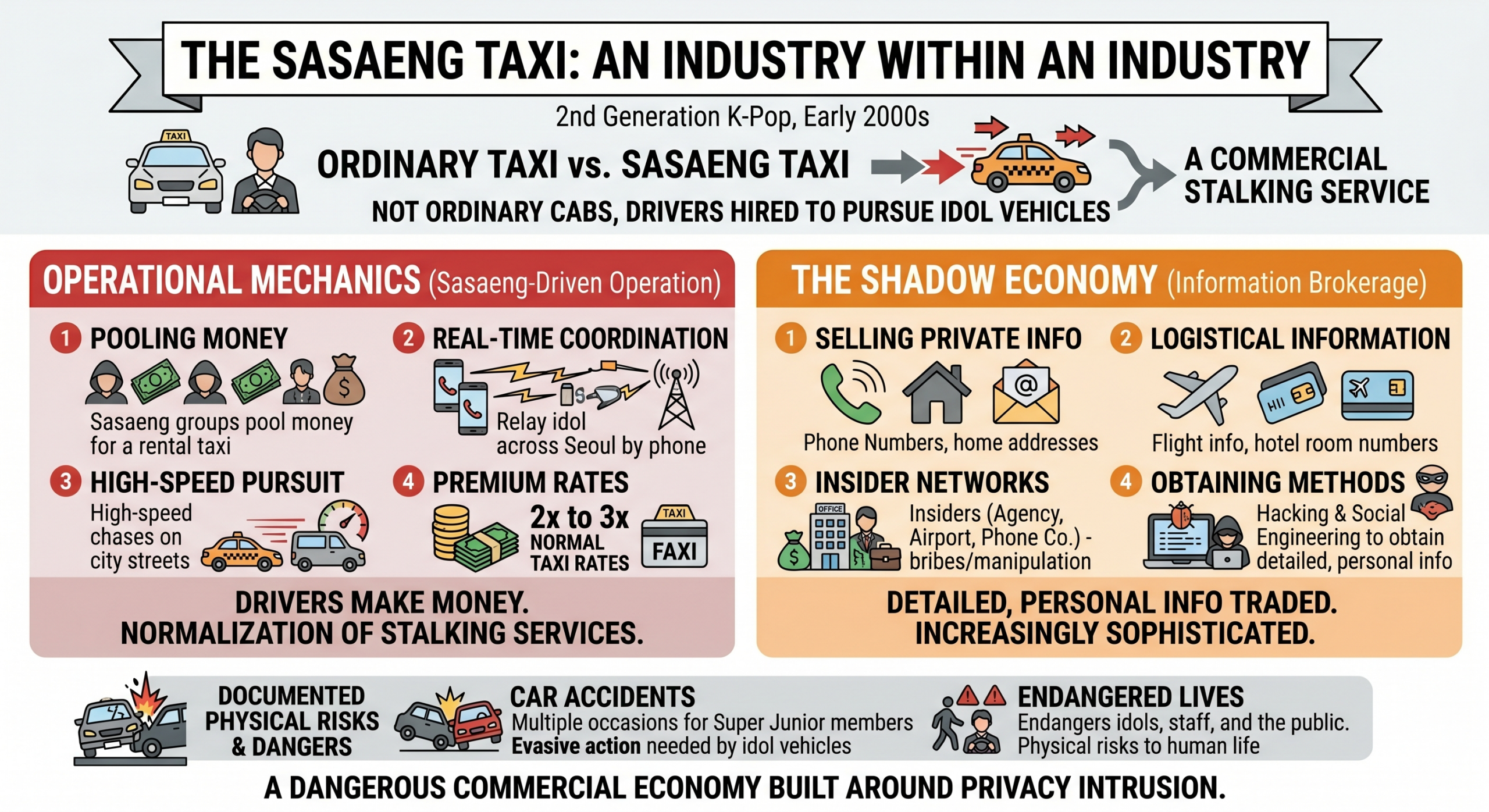
The most infamous example is the sasaeng taxi.
These weren’t ordinary cabs. They were drivers who understood exactly what they were being hired for — to pursue idol vehicles through city streets at high speed, maintaining visual contact no matter where the target went. Groups of sasaengs would pool money to rent a taxi for the day, coordinating by phone to relay an idol’s movements across Seoul in real time. Charges ran two to three times the normal taxi rate.
The sasaeng taxi represented something deeply significant: the normalization of a service economy built around stalking. Drivers made money. Information brokers made money. The networks through which idol schedules and private details were bought and sold became increasingly sophisticated — and increasingly dangerous.
The vehicles being pursued frequently had to take evasive action. Super Junior members were involved in car accidents on multiple occasions while their drivers attempted to shake pursuing sasaeng taxis — high-speed chases through city streets that endangered not just the idols and their staff, but other drivers and pedestrians. These were not metaphorical dangers. They were documented, physical risks to human life.
A full shadow economy existed around K-Pop sasaeng culture by the mid-2000s: people selling idol phone numbers, home addresses, flight information, and hotel room numbers. People working inside agencies, at airports, at phone companies — all potentially susceptible to bribes or manipulation. The information traded within these networks was detailed, personal, and obtained through means that ranged from social engineering to outright hacking.
TVXQ and the Reality of Dorm Invasions
The second generation of K-Pop brought with it a sharpening of sasaeng behavior. The fame was bigger, the infrastructure more organized, and the incidents more extreme.
TVXQ, who debuted in 2003 and became one of the most successful K-Pop acts in history, were among the most targeted artists of the mid-2000s. Their level of fame — particularly in South Korea and Japan — attracted a sasaeng network of significant size and organization.
Dorm invasions became a documented feature of this era. Sasaeng fans broke into the residential buildings where idol groups lived, sometimes making it as far as the actual dormitory units. Accounts from first-generation and second-generation idols describe waking up to find strangers in spaces that should have been completely private — a violation that goes beyond the merely unsettling into something genuinely traumatic.
TVXQ members spoke publicly about the experience of receiving relentless calls on their private phone numbers from fans who had obtained those numbers through the sasaeng information networks. The calls would come at any hour. The numbers would be changed, and then somehow obtained again. The sense of there being no truly private space — no number, no address, no schedule that could not be discovered and sold — became a defining feature of what it meant to be a major K-Pop idol in the 2000s.
Distinguishing Sasaengs from Anti-Fans: An Important Line
No account of extreme K-Pop fan behavior in the 2000s would be complete without addressing the TVXQ Yunho incident of 2006 — but it’s important to situate it correctly.
In 2006, Yunho was hospitalized after accepting a drink laced with glue from someone who appeared to be a fan. The person responsible later confessed to being an anti-fan — someone whose obsession had taken the form not of a desire for contact with the idol, but of a desire to see that idol harmed or destroyed.
Anti-fans and sasaengs are distinct phenomena with different psychological motivations. Sasaengs are driven by a desire for recognition and proximity — a twisted intimacy. Anti-fans are driven by something closer to hatred, often targeting idols they perceive as threats to their preferred groups.
Both represent extreme, dangerous ends of fan behavior. Both caused real harm in this era. But conflating them obscures what makes each troubling in its own specific way. The Yunho incident is best understood as a marker of how extreme anti-fan culture had become by the mid-2000s — a parallel story to the sasaeng phenomenon, not the same one.
What the sasaeng incidents of the same period look like is the Super Junior vehicle pursuits, the TVXQ dorm invasions, the relentless private number harassment: a sustained campaign of intrusion motivated not by hatred but by a desire for contact so intense it had become indistinguishable from threat.
Why Did It Happen? Understanding the Structural Roots
Sasaeng culture didn’t emerge from nowhere. Several structural features of K-Pop’s early industry created conditions that made extreme fan behavior more likely — and more organized — than it might have been otherwise.
The parasocial architecture of idol culture. K-Pop idols are, by design, constructed to feel personal. Fan letters are read. Members speak directly to fans through fan cafes. The “relationship” between idol and fan is actively cultivated as intimate — because that intimacy drives sales, album purchases, concert attendance, and merchandise revenue. Some researchers say that sasaengs are the result of an excessive and competitive fandom culture in South Korea, where fans want to demonstrate loyalty and devotion in increasingly extreme ways.
The competitive fandom hierarchy. K-Pop fandom has always had internal status structures. Knowing more, being closer, having greater access — these things confer status within fandom communities. For a small subset of fans, the competitive dynamic drives escalation beyond any reasonable limit.
The legal vacuum of the 1990s–2000s. For most of this period, South Korea had no specific anti-stalking legislation. The first meaningful legal amendment — adding “persistent harassment” as an offense — did not come until 2011. For nearly two decades, extreme fan behavior existed in a legal gray zone where agencies and idols had limited formal recourse. Committing what amounted to stalking carried minimal legal risk.
Agency ambivalence and commercial calculation. Agencies feared that aggressive legal action against sasaengs could backfire. Sasaeng networks had access to sensitive information about artists that could be damaging if released. The fans within those networks were also, paradoxically, significant consumers of merchandise and content. Some agencies calculated that the costs of confrontation outweighed the benefits — a calculation that, in retrospect, helped the problem grow far larger than it needed to.
The Turning Point: A Problem Too Big to Ignore
By the late 2000s, the conversation around sasaeng culture had reached a critical mass within the Korean entertainment industry. A series of increasingly serious incidents — vehicle accidents caused by sasaeng taxis, dorm invasions, physical altercations between sasaengs and idol staff — combined with growing international awareness of Korean pop culture to bring the issue into a wider spotlight.
The mainstream K-Pop fandom — the vast majority of fans who had nothing to do with sasaeng behavior — began organizing more explicitly around the distinction between genuine fans and sasaengs. The label sasaeng became, within fandom culture, not just a description but a serious accusation. Real fans policed their own communities, calling out and distancing themselves from extreme behavior.
But the infrastructure of sasaeng culture — the taxi networks, the information brokers, the private phone number markets — had become deeply entrenched. Dismantling it would require more than fan community norms. It would require legal change, institutional will, and a fundamental rethinking of how the industry managed the relationship between idols and their fans.
That reckoning would come in the 2010s and 2020s — and it would be driven, in no small part, by the arrival of K-Pop’s biggest global phenomenon yet.
What Comes Next
Part 2 covers the digital revolution that transformed sasaeng tactics, the global spread of the phenomenon beyond Korea, the major incidents of the 2010s and 2020s involving groups like BTS, TWICE, and BLACKPINK — and the landmark legal changes that finally began treating sasaeng behavior as the crime it always was.
Part 2 coming soon.
Frequently Asked Questions
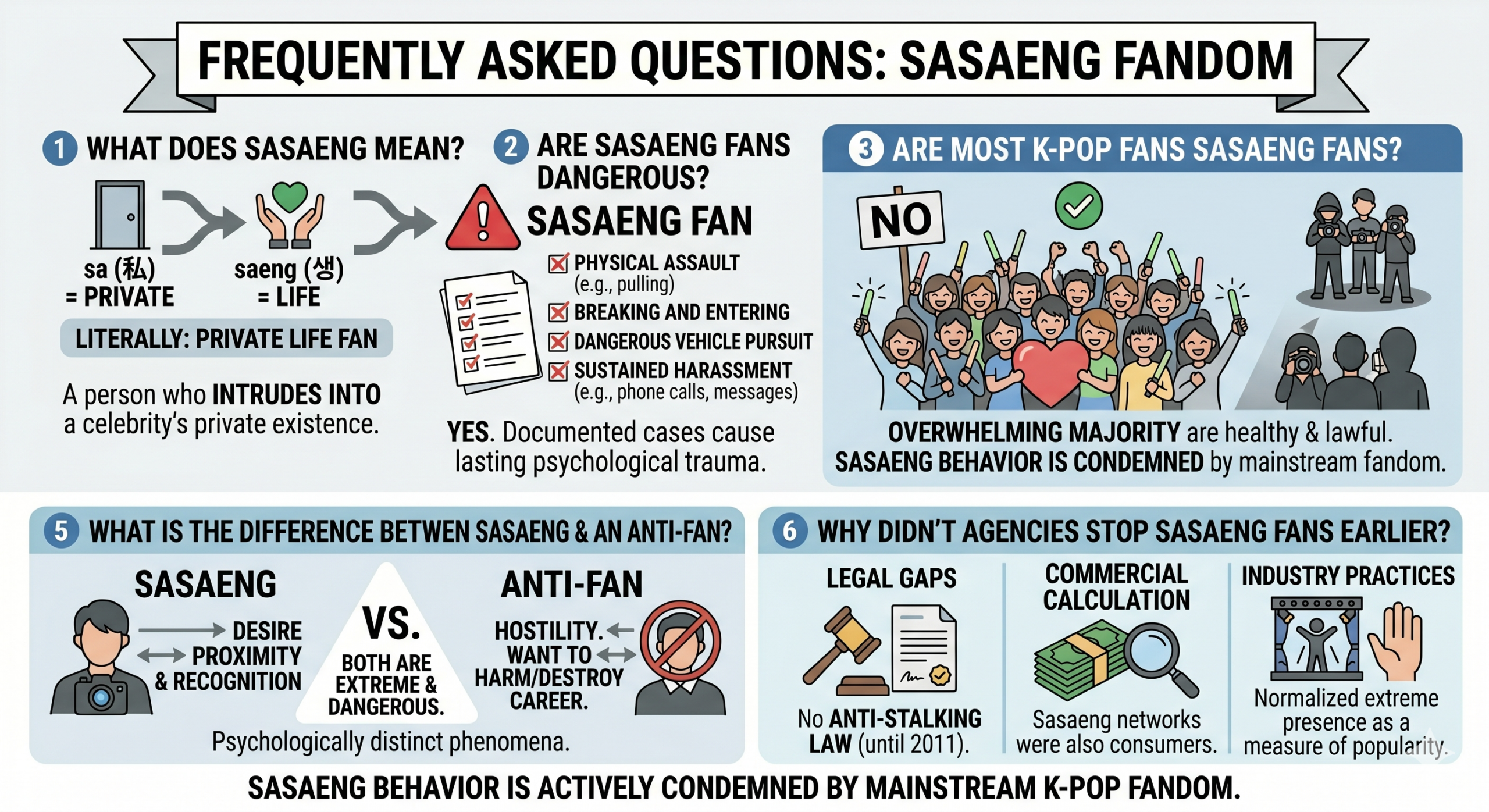
What does sasaeng mean in Korean? Sasaeng (사생) combines the Korean words for “private” (사, sa) and “life” (생, saeng). The full term sasaeng fan (사생팬) literally means “private life fan” — someone who intrudes into a celebrity’s private existence.
Are sasaeng fans dangerous? Yes, in documented cases. Incidents have included physical assault, breaking and entering, vehicle pursuit at dangerous speeds, and sustained psychological harassment that caused lasting trauma to affected idols.
Are most K-Pop fans sasaengs? No — and this distinction matters enormously. The overwhelming majority of K-Pop fans worldwide engage with their idols in healthy, lawful ways. Sasaeng behavior is actively condemned by mainstream fandom culture.
When did sasaeng culture start? The behavior predates the term itself. Extreme fan behavior targeting first-generation K-Pop groups like H.O.T. and Sechskies was documented in the mid-to-late 1990s. The word sasaeng entered common use during the early 2000s Hallyu wave.
What is the difference between a sasaeng and an anti-fan? Sasaengs are motivated by a desire for proximity and recognition from their idol. Anti-fans are motivated by hostility — they want to harm or destroy the career of the idol they target. Both are extreme and dangerous, but they are psychologically distinct phenomena.
Why didn’t agencies stop sasaengs earlier? A combination of factors: legal gaps (no anti-stalking law until 2011), commercial calculation (sasaeng networks were also consumers), and early industry practices that inadvertently normalized extreme fan presence as a measure of an idol’s popularity.
This is Part 1 of a three-part series. Part 2: The Digital Age (2010s–Present) → Part 3: The Fight Back →
For more K-Pop culture deep dives, explore our Features section.