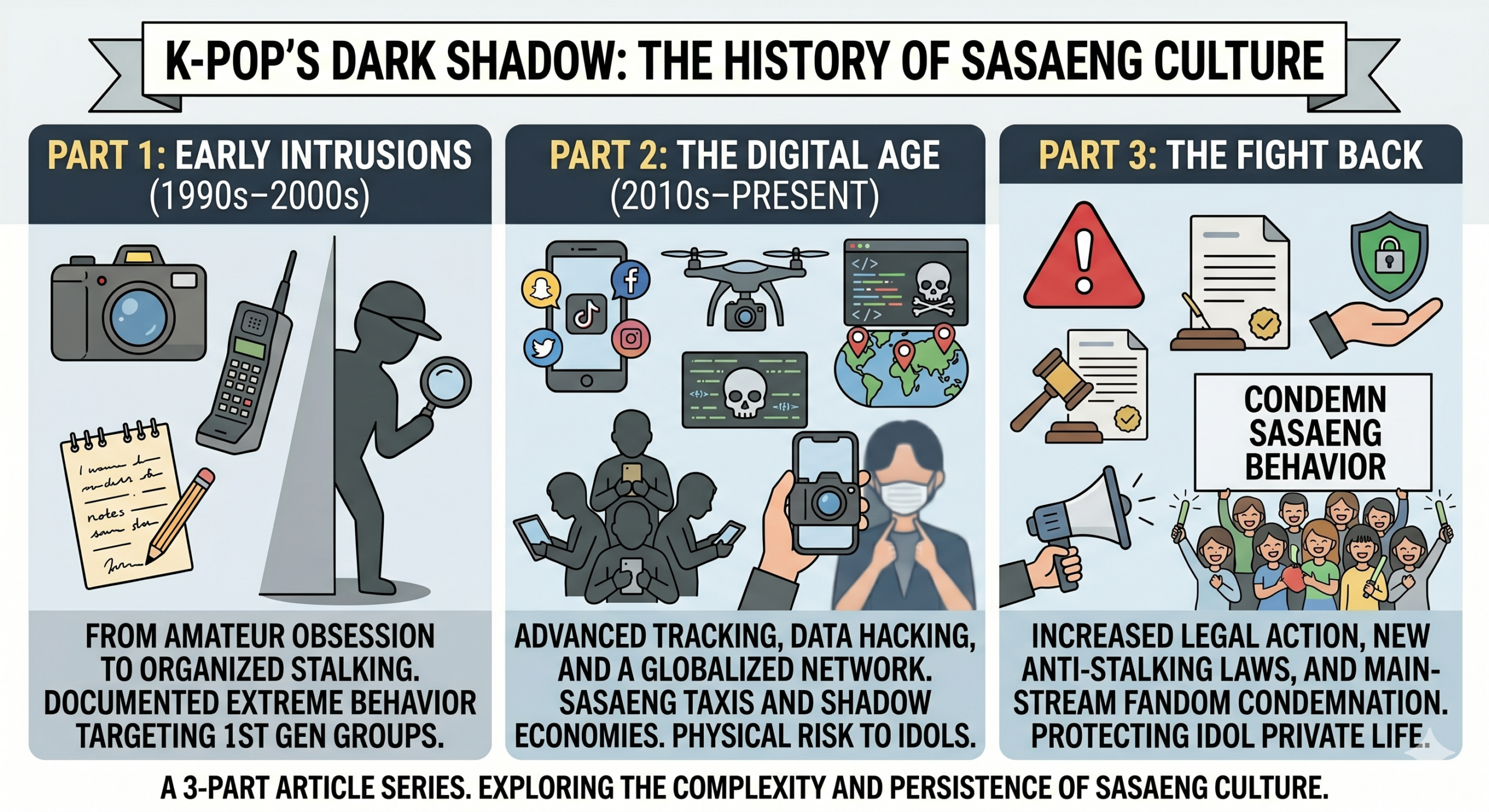
This is Part 2 of a three-part series. ← Read Part 1: The Origins (1990s–2000s) | Part 3: The Fight Back (Legal Reform & Industry Response)
In Part 1, we traced how sasaeng culture emerged from the idol factories of 1990s Korea — how organized stalking became a shadow industry, how sasaeng taxis turned pursuit into a commercial service, and how a legal vacuum allowed extreme behavior to flourish for nearly two decades.
By the time the 2010s arrived, something had changed.
K-Pop was no longer a Korean phenomenon. It was a global one. And the tools that were reshaping the world — smartphones, social media, encrypted messaging apps — were reshaping sasaeng culture along with it. The physical infrastructure of the 2000s (taxis, information brokers, dorm stakeouts) didn’t disappear. It evolved. It went digital. And in going digital, it went global.
This is the story of what happened next.
The Digital Revolution: How Smartphones Changed Everything
The introduction of smartphones and the rise of social media platforms between 2009 and 2012 transformed virtually every aspect of modern life. For sasaeng culture, the transformation was profound — and deeply troubling.
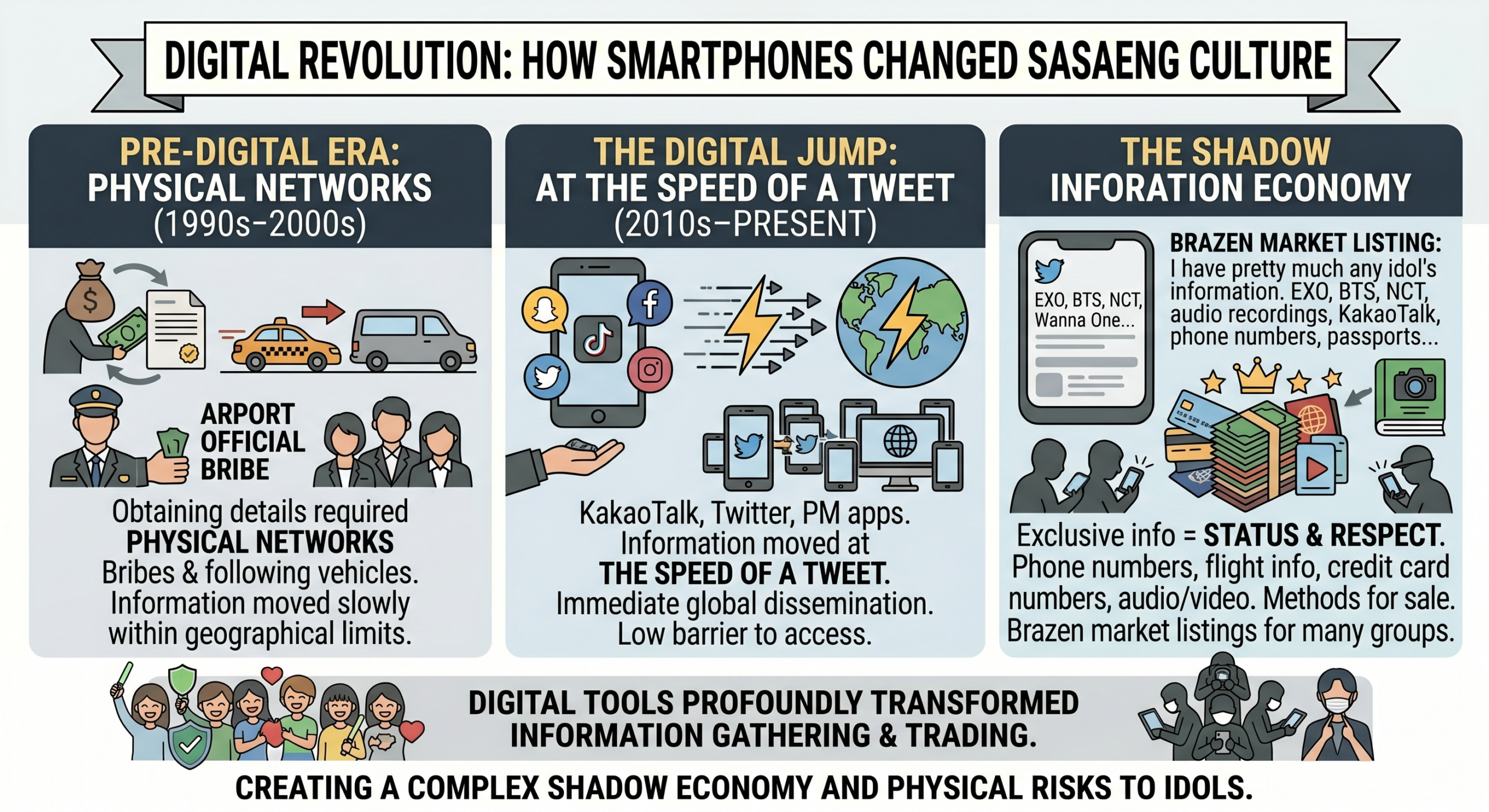
In the pre-digital era, obtaining an idol’s private phone number or home address required physical networks: people inside agencies, airport workers willing to accept bribes, taxi drivers willing to follow vehicles. Information moved slowly, through trusted channels, within geographically limited communities.
After 2010, information moved at the speed of a tweet.
KakaoTalk, Twitter, and private messaging apps became the primary infrastructure for sasaeng information trading. Some sasaengs have access to wide-ranging personal information, including home addresses, cellphone numbers, flight details, personal social media accounts, credit card account numbers, audio recordings, and videos. Some sellers also offer to sell the methods they use to obtain this information. One seller’s tweet, widely circulated as evidence of how brazen the market had become, offered: “I have pretty much any idol’s information. EXO, BTS, NCT, Wanna One… audio recordings, KakaoTalk, phone numbers, passports, Twitter accounts, dormitories, private Instagram accounts, and videos.”
That tweet was not an anomaly. It was a market listing.
The digital information economy around sasaeng culture has its own hierarchy and currency. The sasaeng who possesses exclusive information — a private number no one else has, flight seat details obtained from airline staff, hotel room numbers — holds status within the community. The sasaeng who can get closest to an idol, or who can acquire private information no one else has, gains greater respect among other sasaengs.
The Phone Number Problem
Of all the invasions that define the digital sasaeng era, none captures the psychological horror more precisely than the private phone number.
Idols’ private numbers — the numbers they used to call family, text friends, communicate with staff — were bought, sold, and used relentlessly. The calls would come at any hour. During meals. During sleep. During rehearsals.
EXO’s Sehun described receiving approximately 100 calls to his personal cell phone daily from sasaengs. His response was strikingly resigned: he stated that he stopped changing his number, because even after changing it, sasaengs would obtain the new one within days. The cycle of change and re-discovery had become so exhausting that simply enduring the calls felt less disruptive than the futile attempt to escape them.
BTS’s Jin revealed that group member Jungkook had to change his number so frequently that Jin himself stopped saving it — because by the time Jin had updated his contacts, the number had already been obtained and burned by sasaengs.
NCT’s Renjun spoke publicly about the calls in April 2024, stating plainly: “Sasaengs are nothing but scary stalkers to me. They follow me, sit next to me on planes, and take photos of me while I sleep. It’s a huge burden for me.” The following month, Renjun announced a break from activities citing health reasons. He continued to receive calls during his break.
The phone number problem illustrates a fundamental asymmetry of the digital era: information, once obtained, cannot be un-obtained. A leaked number cannot be unleaked. Even changing a number only delays the inevitable, because the networks that obtained the first number are still operating, still buying, still selling.
Digital Stalking Tactics: Voice Phishing, In-Flight Manipulation, and Hotel Intrusions
As the 2010s progressed, sasaeng tactics evolved to exploit every vulnerability that digital connectivity created.
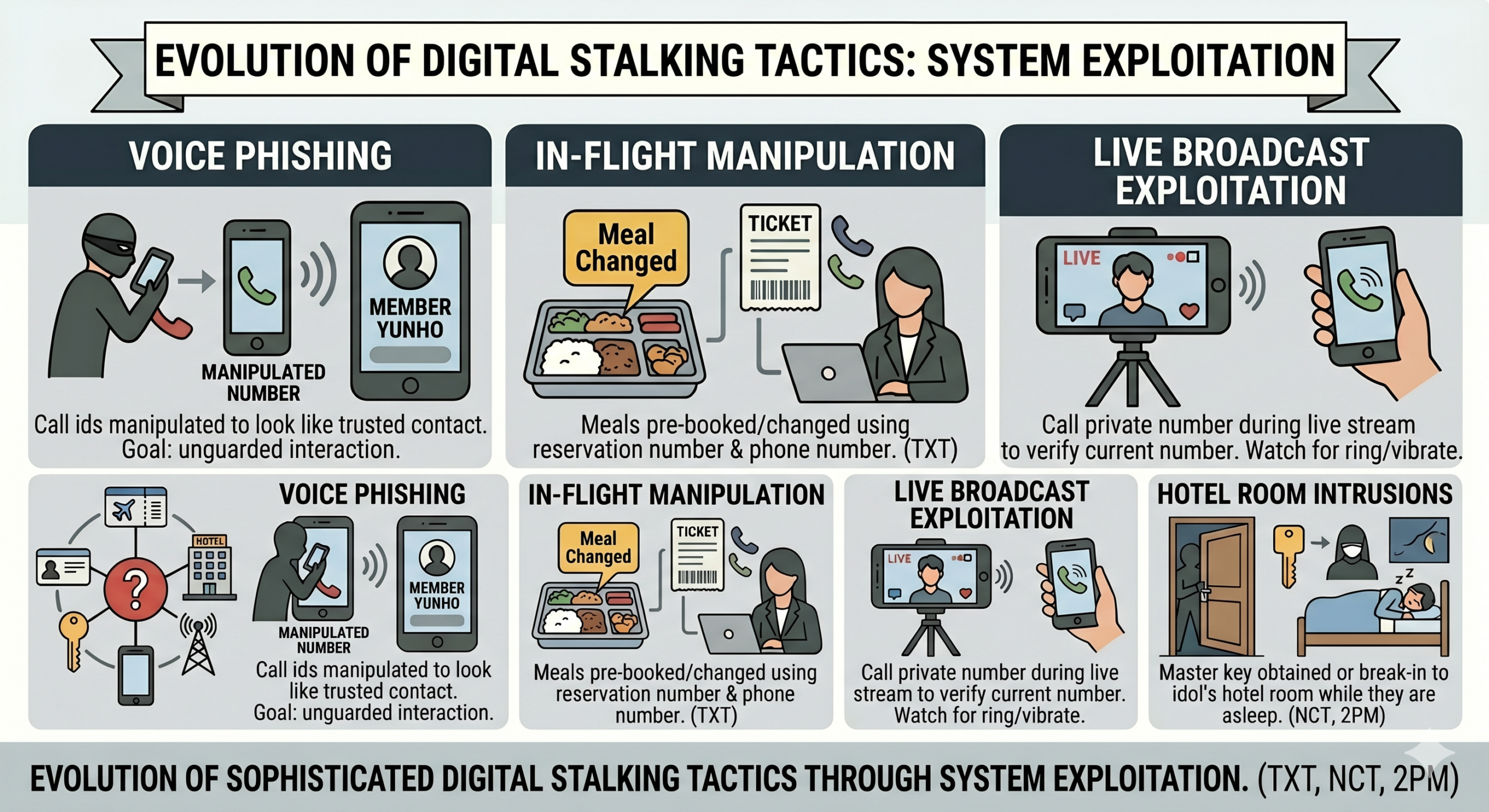
Voice phishing techniques — the same methods used by financial scammers — were adapted for sasaeng use. Fans would call idols using manipulated numbers that appeared on the recipient’s screen as the number of a fellow group member or trusted contact. The goal was to get the idol to answer, to hear their voice, to have a moment of unguarded interaction before the deception was discovered.
In-flight meal manipulation became a documented tactic. TXT’s Taehyun revealed that on a return flight to Seoul, someone had pre-booked and changed the in-flight meals for the members’ seats — an act requiring access to the ticket reservation number and the personal phone number on the booking. That information had been obtained through the sasaeng information network.
Live broadcast exploitation became a standard verification method. Sasaengs would call an idol’s private number during a live stream, watching the broadcast for any sign of a phone vibrating or ringing — confirmation that the number they possessed was current.
Hotel room intrusions escalated significantly. NCT’s Jaehyun had a fan break into the hotel room where he was staying during the group’s US tour in October 2022. 2PM’s Ok Taecyeon shared that when he and member Hwang Chansung were asleep in a hotel room in Singapore, fans had found the master key to their room and entered while they slept.
The common thread across all these tactics is the exploitation of systems — airline booking systems, hotel key systems, phone networks — that were not designed to defend against obsessive fans with time, money, and motivation.
The Global Spread: When Sasaeng Culture Crossed Borders
For most of K-Pop’s first two decades, sasaeng culture was a Korean phenomenon. The geography of idol life — dormitories, studios, schedules — was concentrated in Seoul, and the people who could engage in physical tracking were, by necessity, physically present in Korea.
The Korean Wave changed that.
As K-Pop’s global audience grew through the 2010s — accelerated by YouTube, streaming platforms, and BTS’s historic international breakthrough — so did the international dimension of sasaeng culture. International fans who had previously only been able to follow their idols online gained real-world access whenever K-Pop groups toured abroad.
The results were documented and alarming. When BTS arrived in Indonesia during their tour, sasaengs proceeded to swarm and attempt to mug the band of their belongings before being stopped by ARMYs and airport security. In Sweden, BTS were chased through streets by fans while attempting to move between locations. In multiple countries, the scenes at airports — crowds pressing in on idols, blocking vehicles, following tour buses — replicated in international cities what had previously been a distinctly Korean problem.
The international sasaeng phenomenon revealed something uncomfortable: the behavior was not a product of Korean culture specifically. It was a product of extreme parasocial attachment combined with opportunity and access. Give any fandom access to their idol in an unfamiliar country where local security infrastructure isn’t calibrated to K-Pop’s demands, and some fraction of that fandom will behave in ways indistinguishable from what happened in Seoul in the 1990s.
When celebrities visit international fans, the prejudice against sasaengs almost becomes non-existent as avid fans turn into sasaengs because idols rarely visit their countries. The scarcity of access, paradoxically, intensifies the impulse toward extreme behavior.
The Airport: A New Battleground
If there is one location that came to symbolize the sasaeng problem in the digital age, it is the airport.
K-Pop idols travel constantly — between domestic schedules, Japanese promotions, international tours, and award shows across Asia. Airport appearances became, over the 2010s, one of the primary sites of sasaeng activity: crowded, difficult to control, and offering the possibility of sustained proximity to idols in a public space where excessive behavior was harder to remove.
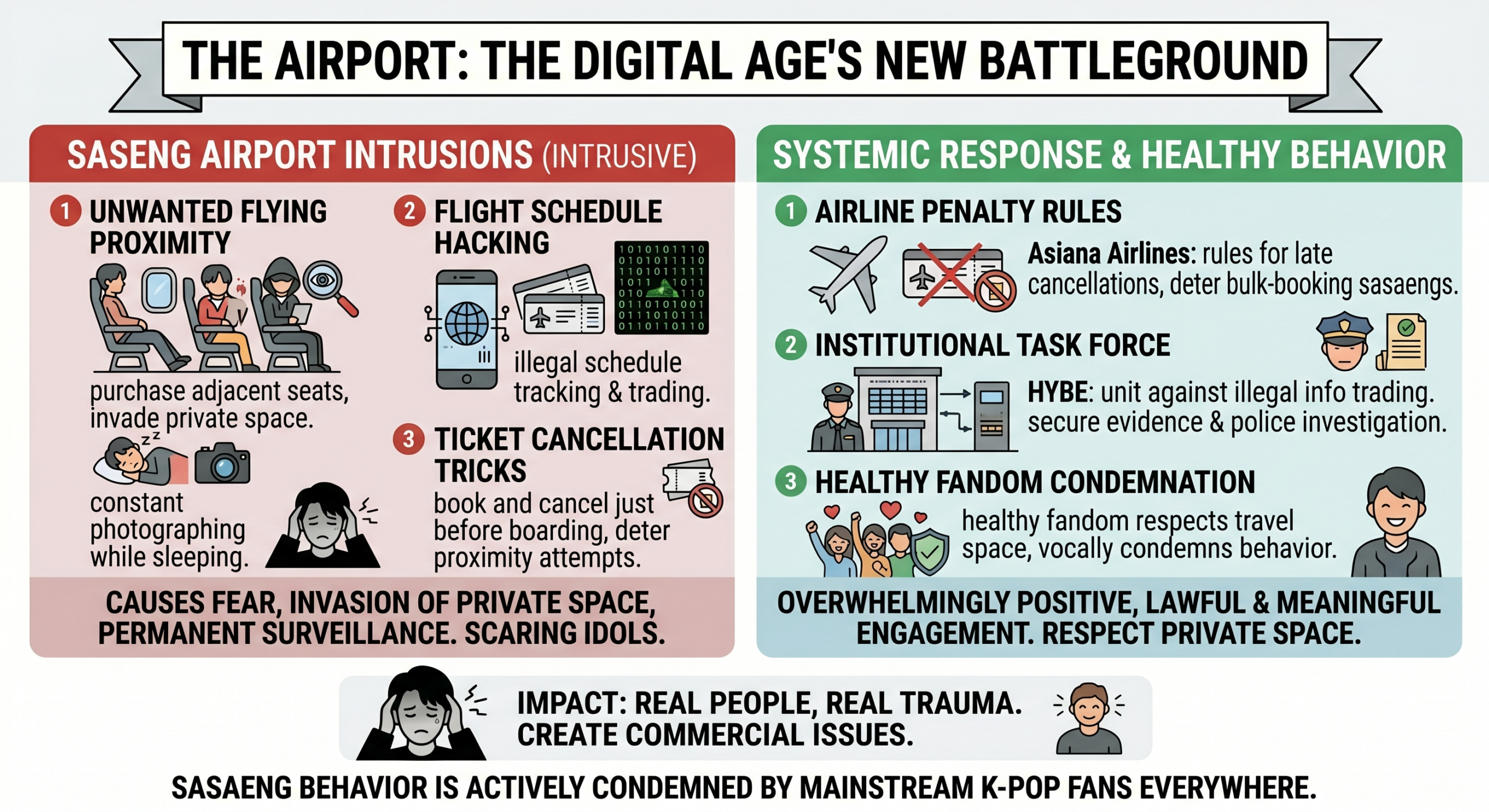
BTS’s V revealed during a 2019 Naver V Live broadcast that BTS uses private flights due to sasaeng issues. “We would like to fly on regular flights, but some people figure out our flight schedule and sit next to us. It’s very uncomfortable because we can’t relax in our private space. It scares me a lot and I wish it would stop,” he said.
That statement — one of the most famous K-Pop idols in the world explaining that he cannot fly commercially because fans will purchase the seat next to him and photograph him while he sleeps — is worth pausing on. The airport, a space of transit that most people experience as anonymous and temporary, had become for major K-Pop artists a site of permanent surveillance and potential threat.
An Asiana Airlines official confirmed the company had to institute penalty rules for ticket cancellations made just before boarding due to troubles with sasaeng — fans who would book seats on an idol’s flight and cancel only after the idol had boarded and the opportunity for proximity had been realized.
HYBE, in 2023, established a dedicated task force to tackle the illegal trading of artists’ flight information. The task force identified social media accounts trading this information, secured evidence, and submitted it to police for investigation — a level of institutional response that would have been unimaginable in the 2000s.
The Idol Speaks Back: A New Era of Direct Confrontation
One of the notable shifts of the 2010s and 2020s was the willingness of idols themselves to speak publicly and directly about the impact of sasaeng behavior — and, increasingly, to name and shame it in real time.
Earlier generations of idols largely suffered in silence, discouraged by agencies from speaking out for fear of alienating even extreme fans. The calculus changed as the legal environment shifted and as the global K-Pop audience provided idols with direct communication platforms that bypassed traditional media.
Jaejoong of JYJ/TVXQ, who debuted in 2003 and has been targeted by sasaengs for over twenty years — making him perhaps the single most documented long-term victim in K-Pop history — shared in a 2024 interview: “Being stalked was so painful that I felt like I wanted to die. What’s even scarier is that even if they serve their sentence and are released, it’s still a problem. You have to leave the area because you’re afraid of retaliation.” He also posted photographs of the sasaeng taxis following his vehicle, publicly identifying surveillance camera evidence and announcing legal action. That a veteran idol with two decades of career still cannot move freely through Seoul without being tracked is perhaps the starkest proof that the problem has not been solved.
NCT’s Renjun went further in one of the most emotionally raw moments of idol-fan communication in recent memory. In April 2024, after months of harassment, he posted publicly that sasaengs were ruining his life and announced a temporary break. Then in June 2024, in a moment of sheer desperation on a fan platform post, he attempted to share what he believed was a sasaeng’s phone number publicly — it turned out to belong to an uninvolved person. The resulting controversy, and Renjun’s subsequent apology, illustrated the psychological state to which sustained sasaeng harassment had driven him: a point where a measured, private person made an impulsive public decision out of pure exhaustion and distress.
BTS’s Jungkook issued a stern public warning after sasaengs sent food to his private residence and tracked him to his personal gym, stating directly that he would take legal action if it continued.
These public statements represented a fundamental shift: the idol as passive victim, absorbing harassment in silence, was being replaced — slowly, imperfectly, with genuine legal risk — by the idol as someone with both the platform and the institutional backing to push back.
The Information Market: Who Profits?
One of the most disturbing aspects of digital sasaeng culture is the commercial ecosystem that sustains it.
The people who sell idol information are not always themselves obsessive fans. They are, often, opportunists: employees at telecommunications companies who can access account records, staff at airlines who can pull booking information, hotel workers who can provide room numbers, even people inside agencies who can sell schedule details. The sasaeng network creates demand, and where there is demand, there will be supply.
Until recently, CBS radio show “Kim Hyun Jung’s News” captured the dilemma that kept most agencies silent: “If you catch a sasaeng selling idol’s information, then the buyers also become criminals — however, those buyers are considered to be ‘fans.’ If you make too strong of a legal response, it could have effects beyond what the agency wants.”
The commercial logic was perverse: agencies calculated that the cost of aggressive enforcement — the potential loss of fan spending, the risk of information retaliation — outweighed the benefit of protection. The idol’s safety became, in this calculation, a line item weighed against commercial exposure. That calculation defined the industry’s posture for nearly two decades.
It has been changing — but it has not disappeared entirely.
The Psychological Architecture of the Digital Sasaeng
Why does someone become a sasaeng in the digital age? The question matters, because understanding the motivation is essential to addressing the behavior.
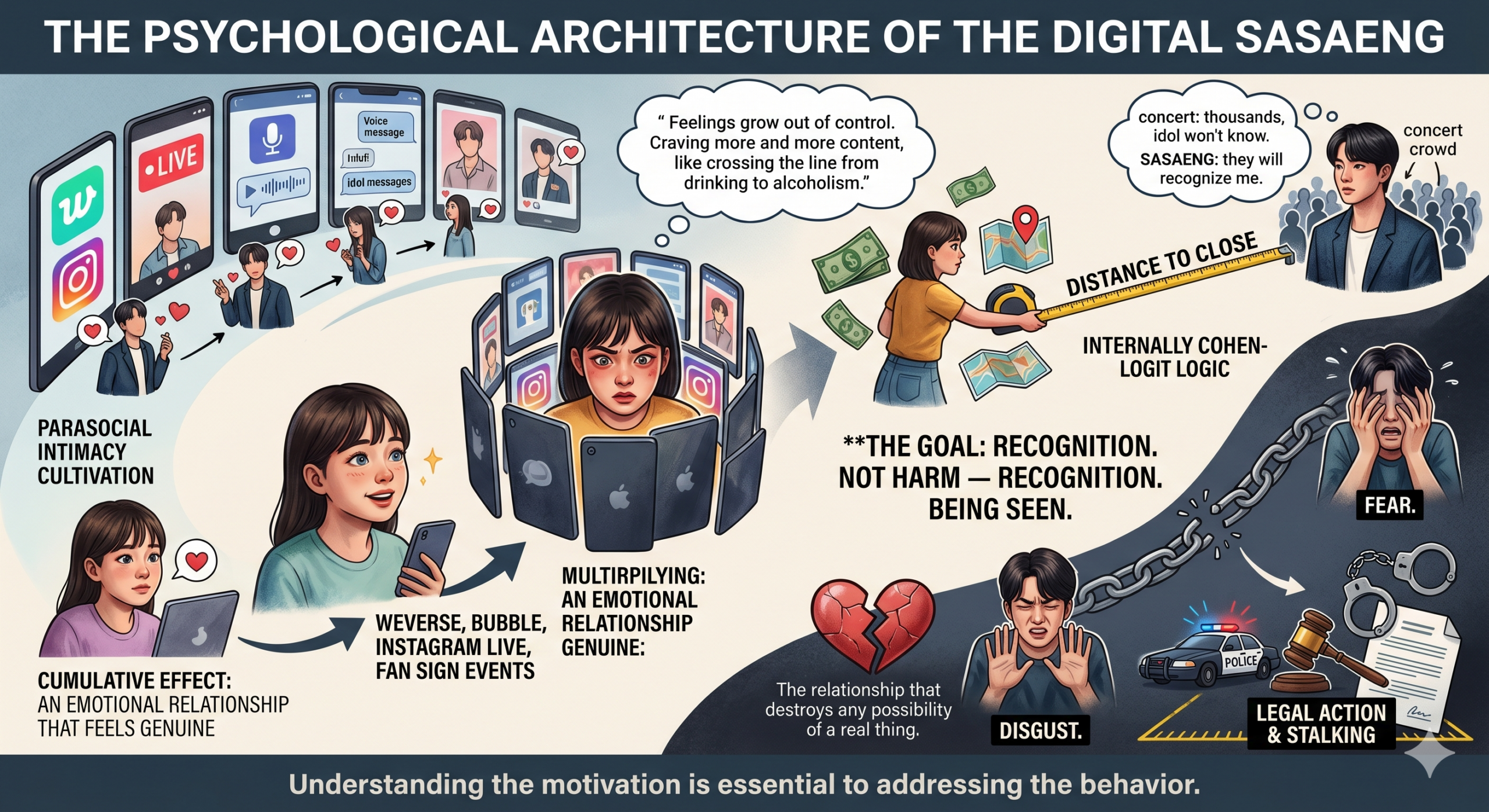
The digital era has intensified a dynamic that K-Pop’s idol system deliberately cultivates: parasocial intimacy. Fan communication apps like Weverse and Bubble give fans direct access to idol messages, photos, voice notes, and Instagram Live-style broadcasts. Fan sign events allow physical proximity. The cumulative effect, for some fans, is the creation of an emotional relationship that feels — experientially — genuine.
One commenter described it this way: “When you become super attached to one person or group from constantly consuming up close personal content but it can never actually turn into anything real, I think your feelings can easily grow out of control. You crave more and more, so you turn into a sasaeng — like crossing that line from a person who drinks often into a person who is an alcoholic.”
For the sasaeng, the logic is internally coherent: the intimacy they have been sold is real, the desire for more of it is understandable, and the only thing standing between them and that intimacy is distance — distance that can, with enough effort and resources, be closed. One sasaeng fan explained: “If I go to a concert, there are thousands of people, so the idol would not know who I am. But if I become sasaeng, they will recognize me.”
Recognition. That is the goal. Not harm — recognition. Being seen by someone who has been made to seem, through the machinery of the idol industry, to be a kind of intimate.
The tragedy of this psychology is that the recognition, when it comes, is invariably the wrong kind: fear, disgust, or legal action. The connection that was sought is the connection that destroys any possibility of the real thing.
What Part 3 Will Cover
The legal reckoning that Part 2 has built toward — the Stalking Punishment Act of 2021, its strengthening in 2023, the agencies’ shift to zero-tolerance, and the ongoing question of whether punishment alone can address a phenomenon with deep structural roots — is the subject of Part 3.
[Part 3: The Fight Back — Legal Reform, Agency Response, and Whether It’s Working → Coming Soon]
Frequently Asked Questions
How did social media change sasaeng culture? Social media transformed information trading from a slow, geographically limited process into a near-instantaneous global market. Private phone numbers, flight details, and home addresses that once required physical networks to obtain could now be traded instantly via Twitter, KakaoTalk, and encrypted apps.
Do international fans become sasaengs? Yes, documented cases exist. The behavior is not limited to Korean fans. International fans have been involved in airport incidents, hotel intrusions, and online information trading in multiple countries. The scarcity of access during international tours can intensify extreme behavior among fans who rarely have physical proximity to idols.
Why do idols keep changing their phone numbers if sasaengs always get the new ones? Many have stopped, precisely because the cycle proved futile. EXO’s Sehun explicitly stated he stopped changing his number because the new number would be obtained within days regardless. The information networks are faster than the ability to establish new private contact details.
Have any sasaengs been arrested? Yes, increasingly so — particularly after South Korea’s Stalking Punishment Act came into effect in October 2021. HYBE/BigHit Music has filed multiple criminal complaints resulting in restraining orders and ongoing prosecutions. SM Entertainment announced a zero-tolerance policy and legal action following NCT incidents in 2022.
What is a “sasaeng record”? A sasaeng record is an audio recording of an idol’s private phone calls or personal moments, obtained illegally and sold within sasaeng networks. These recordings have been circulated online, exposing private conversations between idols and family members, friends, or staff.
This is Part 2 of a three-part series. ← Part 1: The Origins (1990s–2000s) Part 3: The Fight Back →
For more K-Pop culture deep dives, explore our Features section.