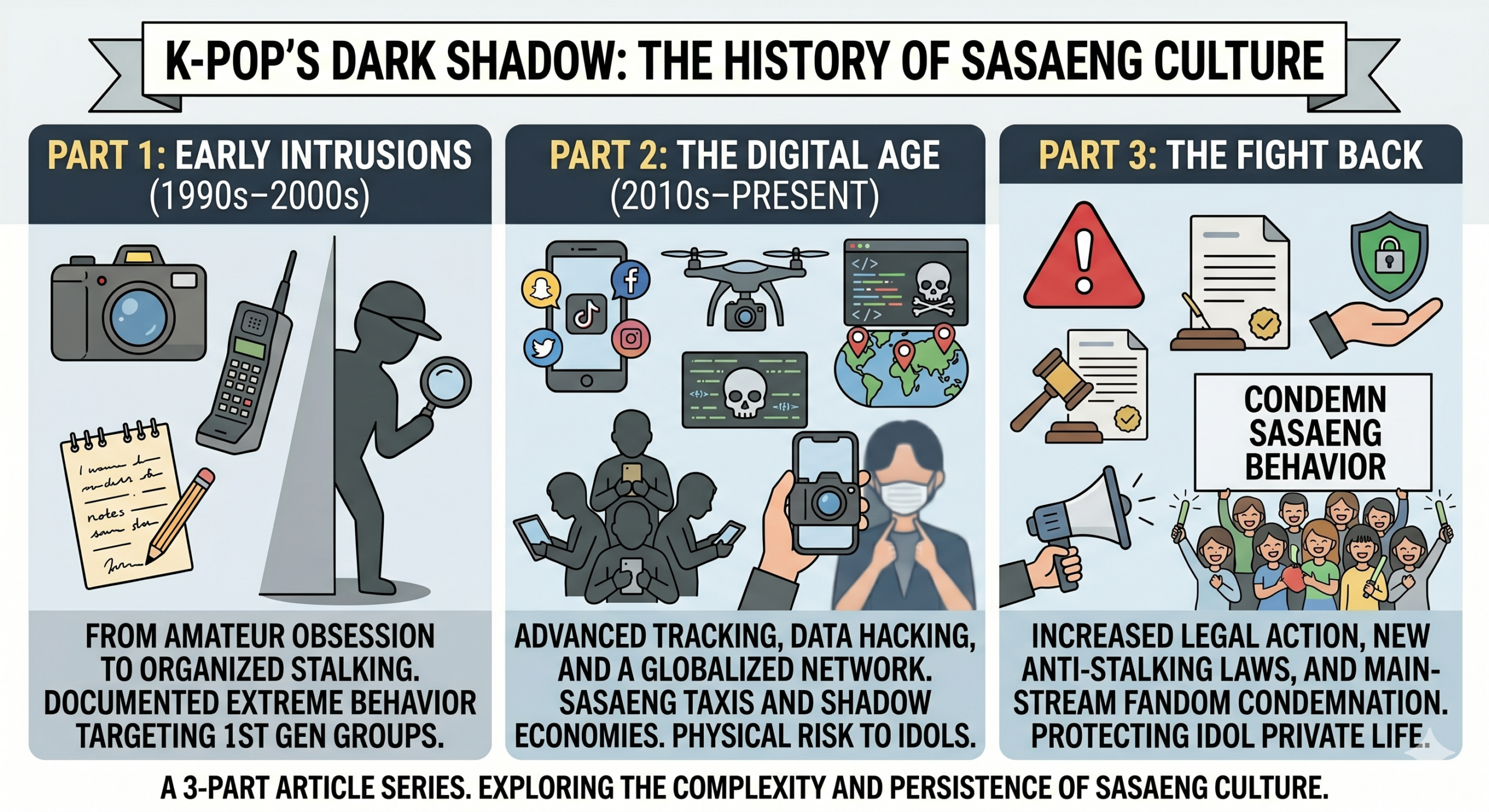
This is the final part of a three-part series. ← Part 1: The Origins (1990s–2000s) ← Part 2: The Digital Age (2010s–Present)
For nearly three decades, the K-Pop industry operated without a meaningful legal framework to address what everyone inside it knew was happening. Sasaeng behavior — stalking, trespassing, harassment, information trafficking — existed in a space where the law offered only the most superficial remedies, agencies calculated silence as the safer business choice, and idols absorbed the consequences in private.
That began to change in 2021.
This final part covers the legal reckoning that transformed how South Korea treats stalking, the industry’s belated shift toward genuine zero-tolerance enforcement, and the hardest question of all: has it been enough?
📖 Legal Timeline at a Glance
| Year | Development |
|---|---|
| 2011 | “Persistent harassment” added to Minor Offenses Act — fine only, no criminal charge |
| 2013 | Minor Offenses Act revised — KRW 80,000 fine for stalking conviction |
| October 2021 | Act on Punishment of Crime of Stalking enacted — up to 3 years prison, 30M KRW fine |
| 2022 | HYBE/BigHit Music begins filing criminal complaints; SM Entertainment announces zero-tolerance policy |
| July 2023 | Law strengthened — offenders can be prosecuted without victim’s consent; electronic monitoring added |
| 2024 | First major arrests under the strengthened law; agencies file hundreds of complaints |
Before the Law: Twenty Years Without Recourse
To understand what the 2021 law meant, you have to understand what existed before it.
Prior to October 2021, South Korea had no specific legislation criminalizing stalking. None. A country that had produced the most systematically stalked entertainers in modern pop culture history — documented across three decades of first, second, and third-generation idol groups — had no law that treated the act of stalking as a criminal offense in itself.
Because stalking was not recognized as a standalone crime, victims were forced to wait until their stalkers committed a secondary offense — trespassing, assault, property damage — before police could meaningfully intervene. The act of systematically destroying another person’s sense of safety, if done carefully enough to avoid triggering those narrow existing offenses, carried essentially no legal risk.
The Catalyst: Violence That Made Inaction Impossible
The push for dedicated anti-stalking legislation came not primarily from the K-Pop industry but from a series of real-world tragedies that demonstrated, with terrible clarity, where the legal vacuum led.
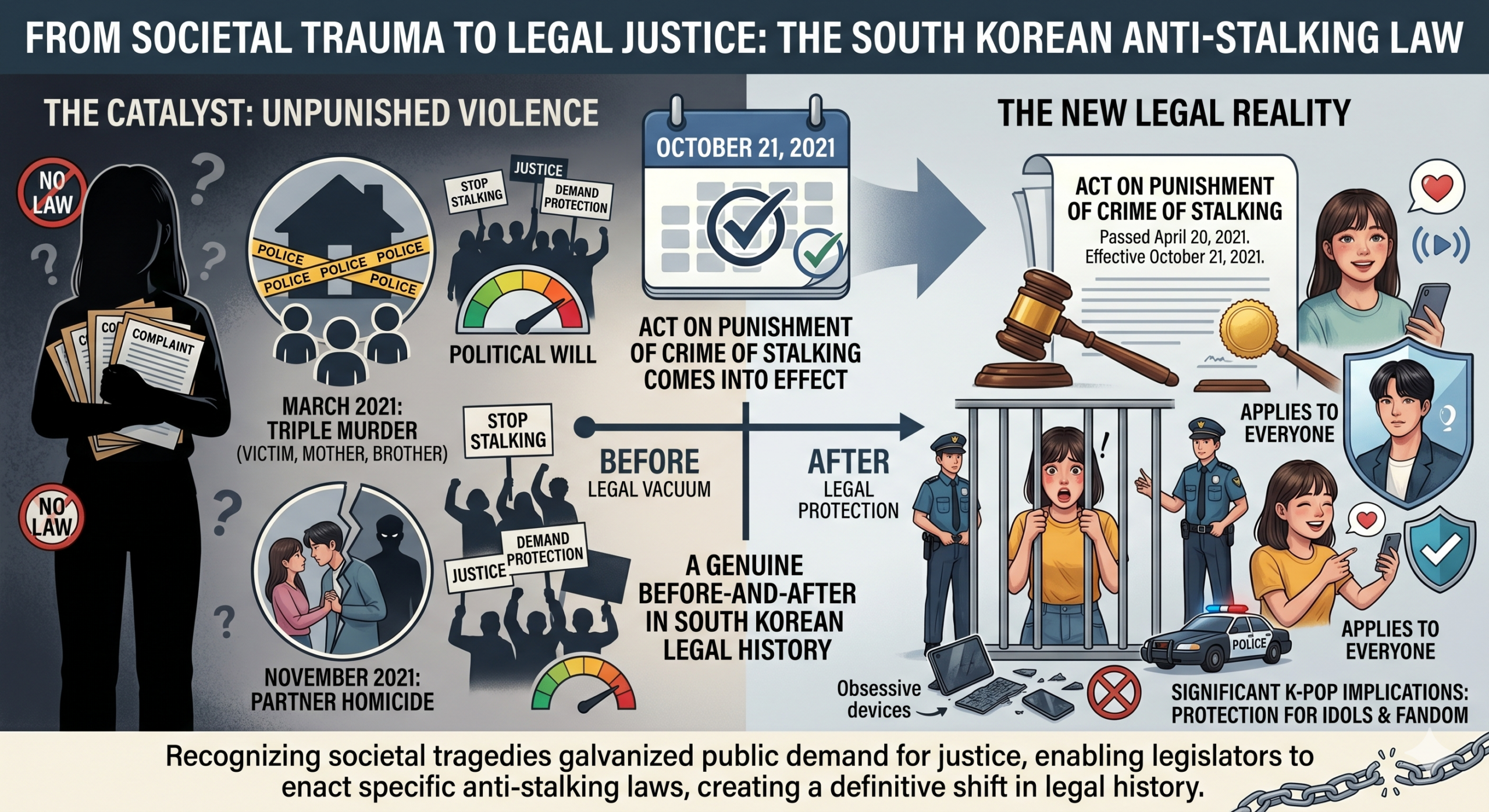
In March 2021, a man murdered a woman he had been stalking — along with her mother and younger brother who were present. The victim had been under police protection after filing four complaints against the perpetrator. In November 2021, another woman was murdered by her ex-boyfriend who had stalked her for months following their separation.
These cases, and others like them, catalyzed public outrage that finally gave legislators the political will to act. The Act on Punishment of Crime of Stalking was passed on April 20, 2021, and came into effect on October 21, 2021 — a date that marks a genuine before-and-after in South Korean legal history.
The law applied to everyone, not just K-Pop idols. But for the K-Pop industry, its implications were immediate and significant.
The 2021 Law: What It Actually Said
The Act on Punishment of Crime of Stalking established, for the first time, that stalking is a crime — not a nuisance, not a misdemeanor, but a criminal offense carrying real consequences.
Key provisions:
Penalties: Stalking carries up to three years in prison or a fine of up to 30 million Korean won (approximately $21,500). If weapons or dangerous objects are involved, penalties increase to up to five years and 50 million KRW.
Emergency measures: Police responding to active stalking situations can issue emergency protective orders, separating the stalker from the victim, with penalties for violation.
Scope: The law covers not just physical following but also electronic communication, delivery of objects, monitoring of whereabouts, and damage to property — capturing the full range of tactics that sasaeng culture had developed over decades.
The immediate effect was visible in the numbers. Only 406 stalking cases were reported in the final three months of 2021, after the law came into effect. By 2022, reported cases reached 7,626. By 2023, they exceeded 10,000. The rise was not evidence that stalking had increased — it was evidence that victims now had a law worth reporting to.
The 2023 Strengthening: Closing the Loophole
The 2021 law had a significant flaw that became apparent almost immediately: it contained a provision allowing stalking offenders to avoid prosecution if the victim withdrew their consent to be prosecuted — or, in practice, if the offender pressured or threatened the victim into withdrawing it.
This clause created exactly the dynamic it was supposed to prevent. Offenders often threatened the victim and forced them to reach a settlement outside the courtroom to avoid conviction. Under extreme circumstances, victims were subject to retaliatory crimes by the very stalking offenders who were supposed to be facing charges.
The high-profile Sindang Station murder case of September 2022 — in which Jeon Joo-hwan stabbed a former coworker to death at her workplace in retaliation for her refusal to drop stalking accusations against him — made the flaw impossible to ignore. He had been due to be sentenced for stalking the day after he killed her.
In July 2023, the National Assembly revised the law to remove the victim-consent clause entirely. Stalking offenders can now be prosecuted regardless of whether the victim forgives them or withdraws their complaint. The revision also added electronic monitoring devices for offenders under restraining orders, extended restraining order periods from six to nine months, and widened the definition of stalking to include online harassment and the exposure of personal information with intent to intimidate.
The Industry Responds: From Tolerance to Zero Tolerance
The legal change gave agencies something they had never previously had: a viable enforcement tool with real consequences. The industry’s response — slow, imperfect, but real — followed.
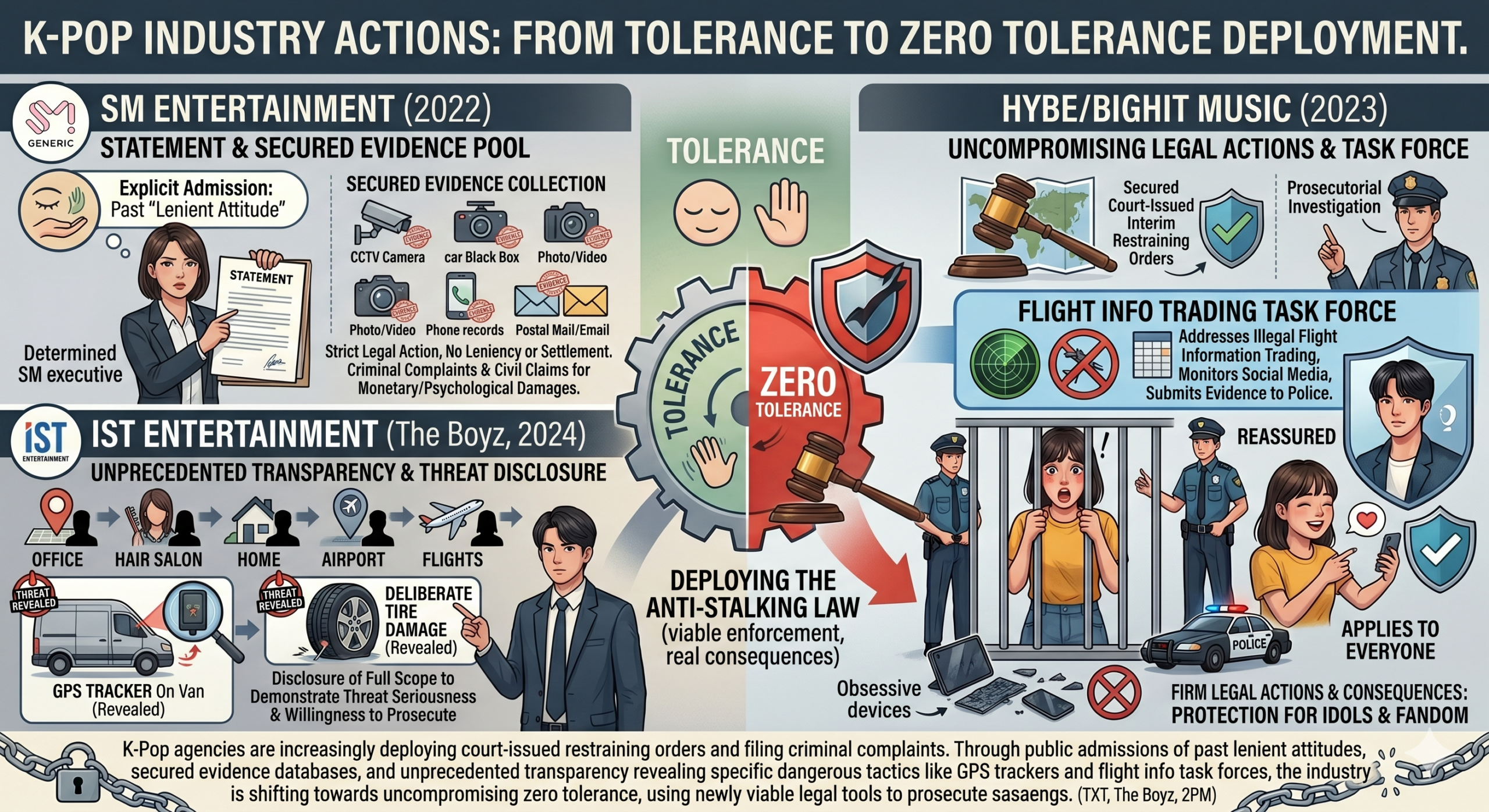
SM Entertainment issued one of the most significant agency statements in K-Pop history following a series of NCT incidents in 2022. The statement read in part: “To protect our agency’s artists, we will let go of the lenient attitude we have held towards sasaengs until now and will take firm and strict legal action without leniency or settlement. We have already secured a considerable amount of related evidence including CCTV and car black box footage, photos and videos, phone call records, postal mail, and emails. We will not only file criminal complaints but also take all possible civil and criminal actions, including claims for psychological and monetary damages.”
The phrase “lenient attitude we have held towards sasaengs until now” was significant. It was the first time a major agency had publicly acknowledged — explicitly — that the industry had previously been tolerant of behavior it now declared intolerable. It was, in its way, an admission of institutional complicity in allowing the problem to persist.
HYBE/BigHit Music released a detailed public statement in September 2023, disclosing the scope of its legal actions. The statement confirmed that the company had filed multiple criminal complaints, secured court-issued interim restraining orders, and was engaged in ongoing prosecutorial investigations. It stated: “We remain committed to an uncompromising, zero-tolerance policy in addressing stalking crimes that infringe on the privacy and safety of our artists.”
HYBE also established a dedicated task force in 2023 specifically to address the illegal trading of artists’ flight information — one of the most persistent and dangerous aspects of the digital sasaeng infrastructure.
IST Entertainment, representing The Boyz, went further in transparency than most agencies when Sunwoo was ambushed by a sasaeng in a stairwell in 2024. The agency revealed publicly not just the assault, but the full scope of the harassment: sasaengs showing up at their office, hair salons, home, airports, and flights. They also disclosed that a GPS tracking device had been hidden on one of the group’s vans, and that another vehicle’s tires had been deliberately damaged. The level of detail was unprecedented — and clearly intentional, designed to demonstrate both the seriousness of the threat and the agency’s willingness to prosecute.
The Numbers: Is It Working?
The data tells a complicated story.
On one hand, the legal shift has produced real results. Reported stalking cases jumped from 406 (Q4 2021) to over 10,000 in 2023 — reflecting not an explosion in stalking, but an explosion in reporting by people who now had a law that meant something. Arrests have been made. Restraining orders have been issued. Court cases have proceeded.
Kim Jae-joong’s 2024 declaration of legal war against his sasaengs produced an immediate behavioral response: according to his agency, the sasaengs who had been a constant presence outside his home and agency disappeared shortly after he publicly announced legal action. The deterrent effect of real legal consequences, when credibly communicated, appears to work — at least for the portion of sasaengs rational enough to respond to incentives.
On the other hand, the problems persist in ways that law alone cannot address.
In December 2024, a man broke into NewJeans’ dormitory twice — on December 18th and again on December 21st — stealing clothes hangers and banners, and filming the interior to upload online. The group had already vacated the dorm that month after announcing their contract termination with ADOR. The case went to trial in 2025, and despite prosecutors requesting a 10-month prison sentence, the court ultimately imposed a fine of approximately $7,200 — a sentence that industry observers widely criticized as insufficient to deter future incidents. In July 2025, Billlie member Haruna was at her Seoul residence when a man used physical force to break down her front door and threatened her directly. Her agency, Mystic Story, immediately relocated her, filed a police report, and announced strict criminal and civil legal action. Haruna required psychological treatment and a temporary hiatus from group activities. In June 2025, a Chinese woman in her 30s was arrested while attempting to enter BTS Jungkook’s home, repeatedly trying to input his door password before a neighbor reported her to police.
These incidents — occurring years after the 2021 law came into effect — make clear that the legal infrastructure, while dramatically improved, still faces real gaps in sentencing consistency and physical security.
Industry sources consistently point to the same concern: the punishments being handed down are not strong enough to act as genuine deterrence for the most obsessive offenders, for whom no cost-benefit calculation applies in the way it does for rational actors.
The Structural Question No Law Can Answer
Here is the uncomfortable truth at the center of the sasaeng problem: the legal reforms of 2021 and 2023 are necessary, but they are not sufficient. They address symptoms without addressing the structural condition that produces them.
K-Pop’s idol system is, by design, an intimacy machine. It cultivates emotional attachment — specifically the kind of intense, personal, parasocial attachment that makes fans feel they know their idols, that the relationship is real, that they matter to the person on stage. That feeling is the product K-Pop sells. It drives concert attendance, merchandise purchases, streaming numbers, and the entire economic ecosystem of the industry.
One thoughtful observer described the dynamic: “They shouldn’t have been given a different name (sasaeng) — they should have been named and treated as the criminal stalkers that they are. The agencies have created this situation by making and enforcing the idol image. They can’t spend half their time telling their fans how much they love them, encouraging an intense parasocial relationship, and then expect to be left alone.”
This critique is uncomfortable because it is not entirely wrong. The sasaeng is, in some sense, a product of the same system that produces the devoted fan — just one in whom the attachment mechanism has malfunctioned catastrophically. The idol industry has, for decades, profited from manufactured intimacy while declining to take full responsibility for what that manufacturing occasionally produces.
There are signs this is changing, slowly. The idol system of 2025 looks meaningfully different from that of 2005: more legal infrastructure, more institutional willingness to prosecute, more public acknowledgment from agencies that the problem is real and their past tolerance was complicit. Fourth and fifth generation groups and their agencies appear, on balance, more aggressive in pursuing legal remedies from the beginning of careers rather than waiting for crises to force action.
But the underlying architecture — the parasocial intimacy, the manufactured accessibility, the idol-as-almost-boyfriend-or-girlfriend construction — remains largely intact. It is too profitable to abandon. And as long as it remains, there will be a small fraction of people for whom the manufactured intimacy becomes indistinguishable from something real, and who pursue that something real in ways that destroy the people they believe they love.
What Real Fans Can Do
It would be wrong to end this series without speaking directly to the people who make up the overwhelming majority of K-Pop fandom: fans who love their artists genuinely and lawfully, and who are as disturbed by sasaeng behavior as the idols themselves.
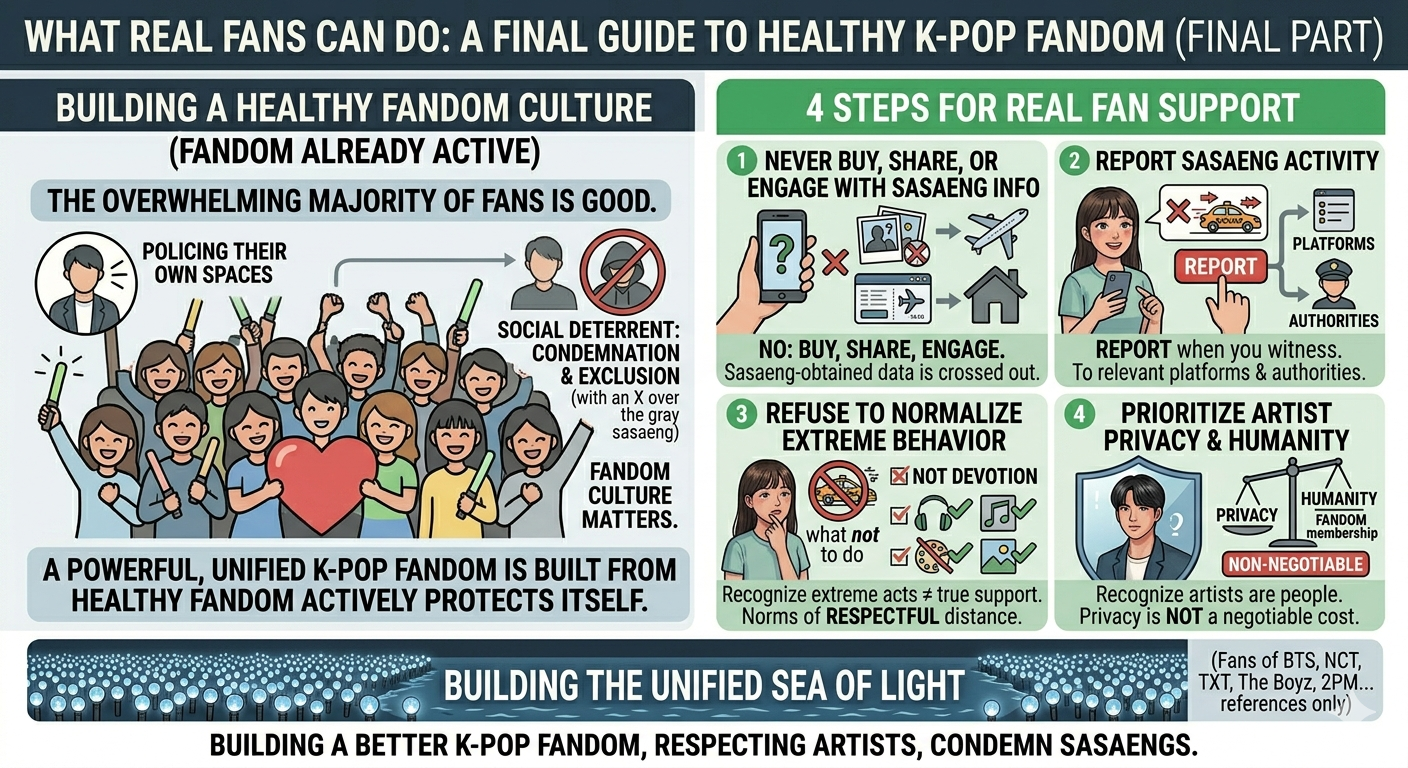
The K-Pop fandom community has, in many ways, been ahead of the industry in treating sasaeng behavior as unacceptable. Fan communities actively police their own spaces, calling out and reporting sasaeng activity, refusing to engage with content obtained through stalking, and maintaining clear internal norms about what constitutes real fan support.
That culture matters. The social cost of being labeled a sasaeng within fandom — the condemnation, the exclusion, the loss of community standing — is a real deterrent for people who care about their reputation within the fandom they belong to.
Real fan support means:
- Never purchasing, sharing, or engaging with information obtained through sasaeng networks — phone numbers, private photos, flight details, home addresses
- Reporting sasaeng activity when you witness it, both to platforms and to relevant authorities
- Refusing to normalize extreme behavior as evidence of devotion
- Understanding that artists’ humanity and privacy are not negotiable costs of fandom membership
The ocean — the beautiful, unified sea of light that represents K-Pop fandom at its best — is built by people who love their artists from a respectful distance. It cannot exist alongside the darkness that sasaeng culture represents.
Conclusion: A Shadow That Has Not Lifted
Three decades after Moon Hee-joon of H.O.T. retreated into his home out of fear, after TVXQ members changed their phone numbers only to have them burned again, after Renjun broke down on a fan platform in 2024 — the problem of sasaeng culture has not been solved.
It has, however, been named. It has been legislated against. It has been declared, formally and publicly, a crime by the country that produced it. Agencies that once tolerated it as a business calculation have begun to treat it as the violation it always was. Idols who once suffered in silence have begun to fight back, publicly and legally, with the institutional support to do so credibly.
That is not nothing. For people who have spent years living with the weight of hundreds of phone calls a day, of waking to find strangers in their homes, of never knowing whether the person sitting next to them on a flight chose that seat deliberately — the existence of a law that treats their experience as real is not nothing.
It is a beginning. But only that.
The shadow is still there. It will be there for as long as the machinery that casts it keeps running.
Frequently Asked Questions
When did South Korea criminalize stalking? The Act on Punishment of Crime of Stalking came into effect on October 21, 2021. Prior to this, stalking was treated as a minor offense punishable only by small fines — not as a criminal act.
What are the current penalties for sasaeng behavior in South Korea? Under the 2021 law (strengthened in 2023), stalking carries up to three years in prison or a fine of up to 30 million KRW (approximately $21,500). If weapons are involved, penalties increase to five years and 50 million KRW.
Can sasaengs be prosecuted even if the idol forgives them? Yes, since the July 2023 revision. The original 2021 law allowed offenders to avoid prosecution if the victim withdrew consent. That clause was removed after the Sindang Station murder case demonstrated how the loophole was being exploited by offenders to threaten victims into silence.
Which agencies have taken the strongest action against sasaengs? HYBE/BigHit Music and SM Entertainment have been the most publicly aggressive, filing multiple criminal complaints and securing restraining orders. IST Entertainment (The Boyz) was notable in 2024 for the detailed transparency of its disclosures about the scope of harassment its artists faced.
Is the problem getting better or worse? Better in legal terms — significantly so. Worse in absolute numbers of reported cases, though this reflects increased reporting confidence rather than increased stalking. The core structural issues that produce sasaeng behavior remain unresolved.
What can I do if I witness sasaeng behavior? Report it. To platform moderators if it occurs online. To police or security if it occurs in person. Never purchase, share, or engage with information obtained through stalking. The social norms of the fandom community — its active condemnation of sasaeng behavior — are a genuine and important deterrent.
This concludes our three-part series on K-Pop sasaeng culture.
← Part 1: The Origins (1990s–2000s) ← Part 2: The Digital Age (2010s–Present)
For more K-Pop culture deep dives, explore our Features section.