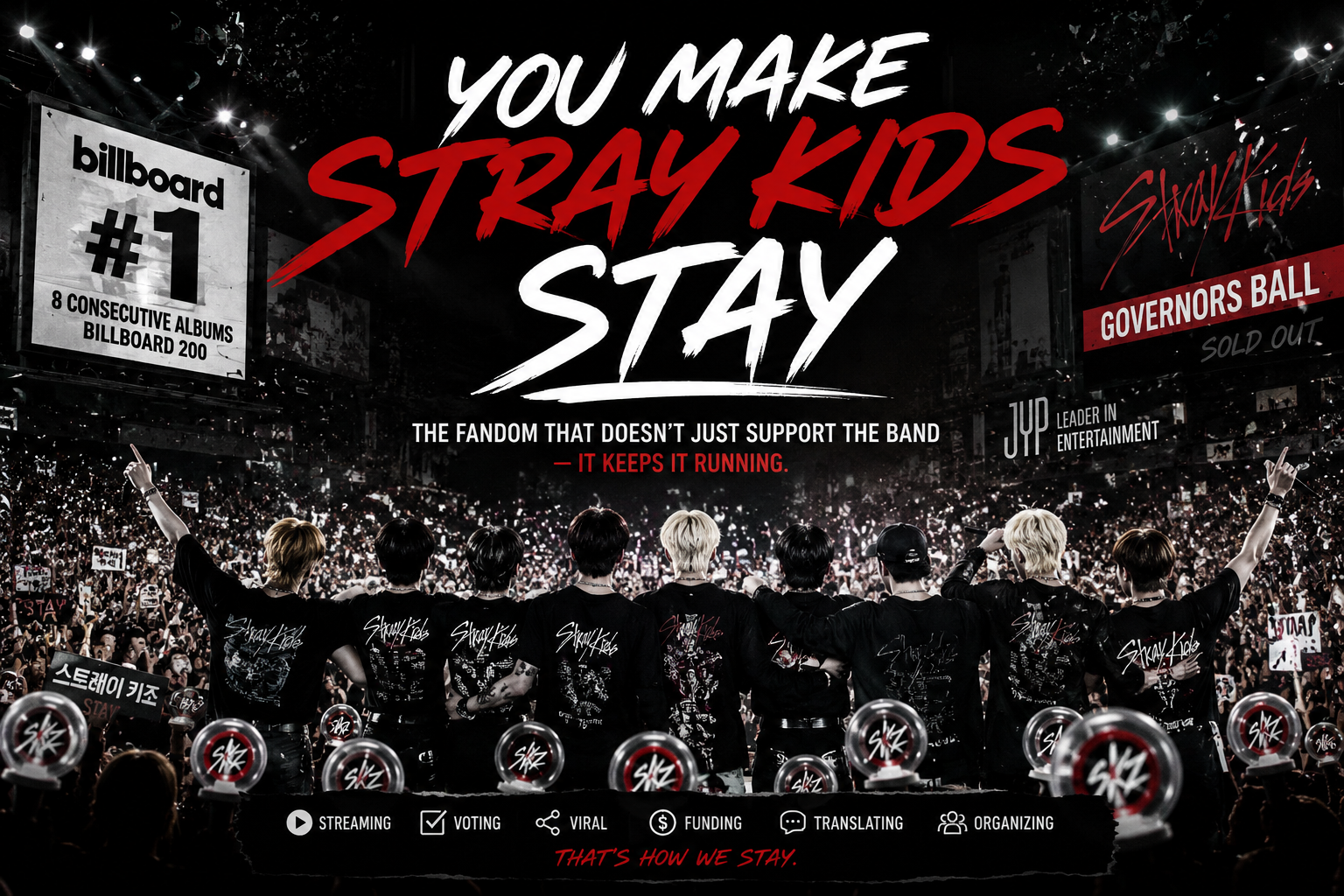
The fandom that doesn’t just support the band — it keeps it running.
Forty-five thousand people stood in front of Stray Kids at Governors Ball last Friday. Most of the headlines were about the band. The more interesting story was the crowd.
Not because it was large — festival crowds are always large. But because a significant portion of that crowd knew precisely which streaming platform counted toward the Billboard charts. They knew the difference between a physical album unit and a digital stream equivalent. Some of them had been coordinating hashtag campaigns for the past seventy-two hours. They had not been paid to do this. Nobody had asked them to.
They did it because they are STAY — the official fandom name of Stray Kids — and because that is simply what STAY does.
Chapter One
The Machine Behind the Machine
Every time Stray Kids releases new music, a second operation begins — one that runs in parallel, is entirely unpaid, and is, by most measures, more sophisticated than what many mid-size record labels deploy.
There are streaming teams that publish hourly dashboards tracking platform performance. There are voting teams that have memorized the rules of every music show in Korea and Taiwan. There are translation accounts — dozens of them — that convert member interviews, behind-the-scenes captions, and live broadcast moments into English, Spanish, Portuguese, and Japanese within minutes of publication. There are clip accounts that splice and format content specifically for TikTok’s algorithm. There is the Stray Kids Comeback Guide, a fan-run website that consolidates streaming guides, voting tutorials, retailer links, and pre-save instructions into a single organized resource — described plainly on its own homepage as “made by STAYs for STAYs.”
None of this is unusual for a large K-pop fandom. What is unusual is the scale at which STAY operates it, and the results that follow.
Consecutive Billboard 200 No. 1 debuts — a record in the chart’s 70-year history
Most talked-about music act on X globally in 2025 — nearly 4× the second-ranked artist
Spotify streams — third K-pop act to reach this, after BTS and BLACKPINK
The eight consecutive Billboard 200 number-one debuts — every charting album since 2022, beginning with Oddinary — represent a streak unmatched in nearly seventy years of the chart’s history. The previous record holder was DMX, who debuted five consecutive albums at number one between 1998 and 2003. Stray Kids did not simply break that record. They nearly doubled it.
This does not happen without music. Stray Kids write and produce most of their own catalog — Bang Chan, Changbin, and Han (collectively 3RACHA) hold a combined 629 credits on KOMCA’s official songwriter registry, making the trio the three most credited fourth-generation idols in Korea. The music earns its audience.
But music alone does not debut an album at 295,000 equivalent units in a single week. Before a song can chart, somebody has to teach thousands of strangers how to chart it. And STAY has been doing exactly that, systematically, for years.
Chapter Two
You Make Stray Kids STAY
The official slogan of Stray Kids is four words: You make Stray Kids STAY.
On the surface, it reads like most idol-fandom affirmations — warm, reciprocal, uncomplicated. But spend any time inside the fandom, and the weight of that sentence shifts.
The name STAY is not arbitrary. It comes from the word stray with the letter R removed — because the R, in the fandom’s own interpretation, stands for “reason.” STAYs are, literally, the reason Stray Kids remain. The fans are why the group stays together. The group stays because STAY stays.
KpopWave Editorial
This is not a small distinction. In the conventional K-pop contract — parasocial, transactional, carefully managed — the fan is a consumer. They purchase. They stream. They attend. The artist, in return, performs and produces. The relationship is affectionate but asymmetrical.
What STAY describes is something structurally different. The slogan encodes a dependency that runs both directions. And the fandom has internalized it fully. At the sixth fanmeeting in March 2026 — four nights at Seoul’s Inspire Arena — the official event hashtag across social media was #YouMakeStrayKidsSTAY. Not a promotional tag assigned by the label. The fans themselves chose it, organically, as the language that best described what they believe they are doing.
They are not wrong to believe it. The math supports them. Stray Kids’ consistent commercial dominance in the United States — a market where they have almost no radio presence, no mainstream media push, and limited English-language output — is built almost entirely on fandom-driven consumption. STAY buys albums in quantities that baffle Western industry analysts. They stream with discipline. They vote with coordination. The infrastructure they have built is, in every functional sense, what keeps the numbers moving.
The fandom doesn’t support the machine. The fandom is the machine.
Chapter Three
When the Machine Pushes Back
On January 23, 2026, JYP Entertainment announced the details of the sixth-generation STAY membership — the official fan club renewal that tens of thousands of fans purchase each year. The new kit was priced at 22,000 Korean won, significantly higher than previous generations. The album originally included in the kit, REPLAY : STAY WITH YOUR WINGS, was bundled separately, with an additional cost attached.
The reaction was immediate and organized. Within hours, criticism flooded every platform STAY occupies: the FANS app, X, Weverse community boards, Reddit. It was not the disorganized noise of casual disappointment. It was the coordinated pushback of a fandom that had spent years learning how to move together.
Jan 23: JYPE announces 6th-generation STAY membership kit at ₩22,000 — more than double some previous generations’ kit pricing.
Jan 24: Member Hyunjin goes live on Instagram. He acknowledges fans’ concerns, confirms he personally raised the issue with the company — and implies the decision was largely out of the members’ hands.
Jan 25: JYPE releases an official statement. The kit price is reduced to ₩10,000. The physical album is removed entirely from the package; tracks will be released as digital singles instead.
JYP Entertainment — one of the four major K-pop labels, publicly listed, managing one of the highest-revenue acts in their portfolio — reversed a commercial decision in under forty-eight hours. The proximate cause was fan pressure.
Hyunjin’s live broadcast added a layer of complexity. He was not a company spokesperson delivering a message. He was a member of the group going on record, in real time, to say that he had heard his fans and had gone to bat for them — and that the outcome, regardless, had not been fully in his control. It was a rare moment of visible friction between artist and management, played out in front of the people whose trust both parties needed.
What STAY took from the episode was a specific kind of clarity: they were not customers. They were stakeholders. And unlike a typical customer who can only walk away, a stakeholder with sufficient organizational capacity can apply pressure in a direction that a company is actually forced to acknowledge.
This is what years of fandom infrastructure building looks like when it turns inward.
There is a question worth sitting with after all of this, and it is not a comfortable one: at what point does participation become labor?
STAY translates. STAY clips and formats and distributes. STAY runs streaming campaigns with the analytical rigor of a media buying desk. STAY organized a protest that reversed a corporate decision. These are not passive acts of appreciation. They are skilled, time-intensive contributions to a commercial enterprise — and they are performed, overwhelmingly, for free, sustained by affection and a sense of collective purpose.
There is nothing cynical in pointing this out. The fans themselves are clearly aware of it — the January incident demonstrated that they understand the leverage they hold. And Stray Kids, as self-producing artists who have fought for and won better contract terms, are not passive recipients of that labor either. The relationship is more reciprocal than most.
But the music industry has never had a clean answer to the question of what it owes the people who build its audiences from the ground up. K-pop, with its unusually explicit fandom architecture, just makes the question harder to avoid.
You make Stray Kids STAY. It’s a beautiful slogan. It’s also, if you look at it long enough, a fairly accurate description of an economic arrangement — one that nobody signed a contract for, and that everyone involved seems to prefer not to examine too directly.
At Governors Ball last Friday, forty-five thousand people stood in a park in Queens and screamed every word back. The band was spectacular. The fans were more interesting. And the machine, as always, kept running.