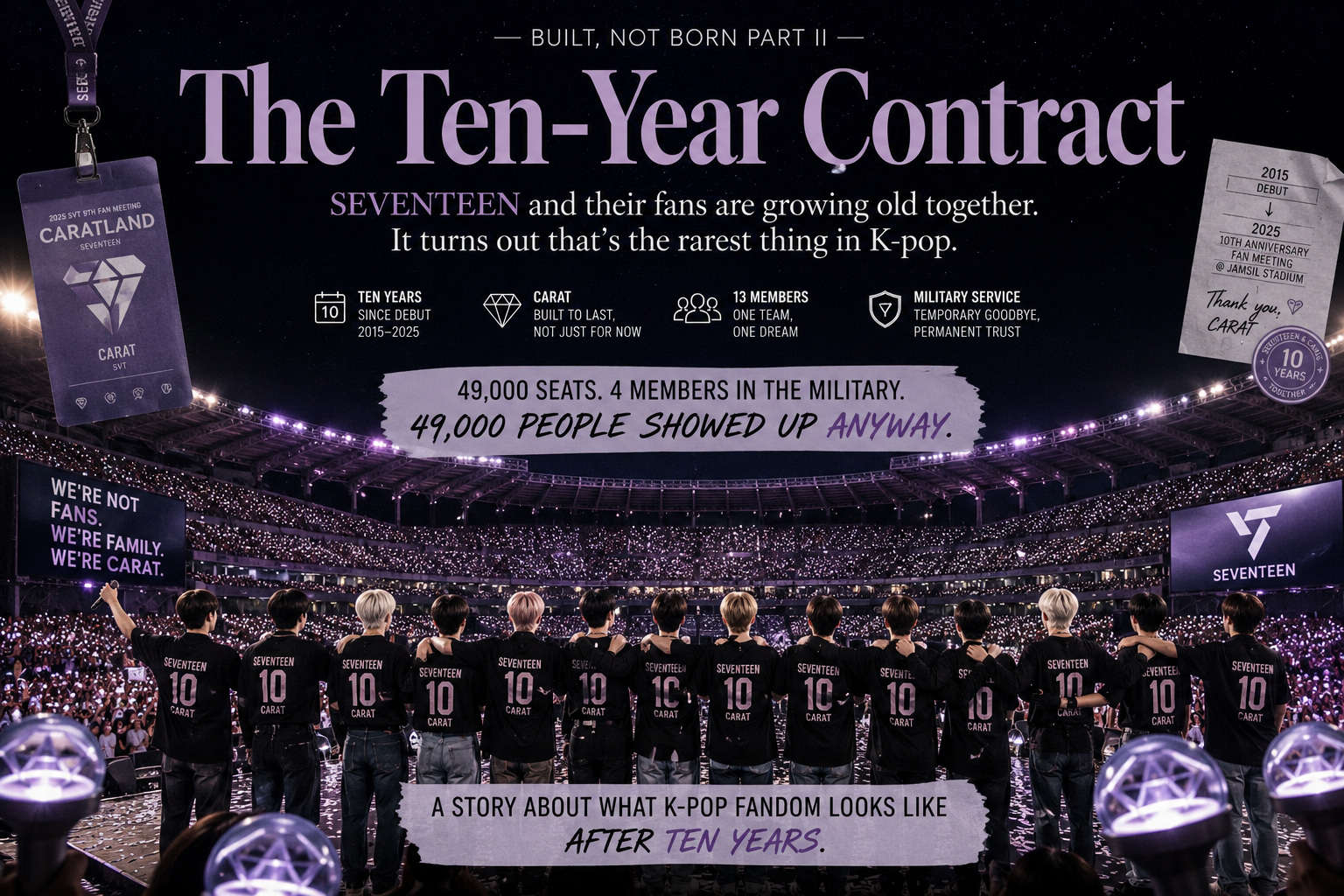
SEVENTEEN and their fans are growing old together. It turns out that’s the rarest thing in K-pop.
In March 2025, SEVENTEEN held a fan meeting at a stadium. Not a concert — a fan meeting. The Incheon Munhak Main Stadium seats 49,000 people. It sold out.
This is unusual enough to be worth pausing on. Fan meetings in K-pop are typically intimate affairs — small venues, close proximity, the illusion of access. They are the format a group uses before it’s big enough for arenas, or after it’s too old to pretend it still needs them. SEVENTEEN is neither. They fill arenas on world tours. They have performed at Lollapalooza and Tecate Pa’l Norte. They have a cumulative live audience of 1.5 million. And yet they chose to mark their tenth year together not with a stadium concert, but with a stadium fan meeting — an event whose entire purpose is to spend time with the people who have been paying attention longest.
That choice says something. Understanding what requires going back to the beginning.
Chapter One
The Architecture of Thirteen
SEVENTEEN’s name is a formula: 13 members plus 3 units plus 1 team equals 17. Hip-Hop Unit, Vocal Unit, Performance Unit — each with distinct creative responsibilities, each capable of releasing music and performing independently while remaining part of the whole. It reads like a marketing concept. It functions like an organism.
The three-unit structure means that when SEVENTEEN cannot be fully present — and lately, it often cannot — there is always something to sustain. While Jeonghan served his mandatory military service from September 2024, the remaining twelve members continued touring. When Wonwoo, Hoshi, and Woozi followed in 2025, the group reconfigured rather than paused. Units promoted independently. Pre-recorded content maintained connection. S.Coups, medically exempt following knee surgery, became the anchor holding the remaining active members together.
Korean military service runs 18–21 months depending on branch. For a 13-member group with members born across 1995–1999, the enlistment window spans roughly five years. SEVENTEEN has not enlisted in waves. They have enlisted in a carefully sequenced stagger — no more than a few members absent at any one time — that appears less like coincidence and more like planning.
The result: SEVENTEEN has never gone fully dark. There has always been a version of SEVENTEEN active, releasing, performing. The group did not disappear into the military. It transformed around it.
This architecture did not happen by accident. SEVENTEEN have been self-producing since before they debuted — Woozi has songwriting credits on over 80% of the group’s catalog going back to their first mini-album in 2015, and was the youngest recipient of the Producer of the Year award at the Asia Artist Awards at age 25. The group’s creative infrastructure is internal, which means it is not dependent on any single member’s presence to continue. When members leave, the machine does not stop. It adapts.
For CARAT — the official fandom name, chosen by fans themselves through a vote in February 2016 — this architecture has produced something unusual: a group that has remained present, continuously, for a decade. Not every member, not every week. But always something. Always someone. Always SEVENTEEN.
Chapter Two
The People Who Stayed
K-pop has a fandom churn problem that nobody likes to discuss. Groups debut, generate intense devotion, and then — gradually, then all at once — the audience moves on. The idol industry is structured around this cycle. New groups are manufactured at regular intervals precisely because yesterday’s fans become today’s casuals and tomorrow’s nostalgics. The machinery requires fresh devotion to run.
CARAT is an anomaly in this system.
SEVENTEEN debuted in May 2015 with almost no label infrastructure behind them — Pledis Entertainment was small enough that, by Woozi’s own account in the group’s debut documentary, the company could not afford to hire outside songwriters, which is why a nineteen-year-old had to write the music himself. The fans who found SEVENTEEN in those early years found them without the machinery of a major label push. They found them because of the music, the variety show content, the visible relationships between thirteen people who had grown up together in a dormitory. That is a different entry point than a billion-dollar debut campaign, and it produces a different kind of fan.
KpopWave Editorial
Those fans are still here. They were in Berlin at Lollapalooza in September 2024, the night Jeonghan took his last bow before enlisting. When the set ended, thousands of them chanted his name in the dark. It was not a choreographed moment. It was the spontaneous act of people who had been paying attention for years, and who understood, without being told, that this particular ending mattered.
Jeonghan posted on Weverse the night before his enlistment. “I will not lose how grateful I am for the plentiful love that CARATs always send me,” he wrote. “I’ll be back.” It was not a press release. It was something closer to a private note made public — the kind of communication that only makes sense between people who have been in a relationship long enough to have a shorthand for what they mean to each other.
CARAT’s defining characteristic is not volume. It is not the organizational discipline of STAY, which deploys streaming campaigns with the precision of a media buying desk. It is duration. CARAT is a fandom that does not shed its oldest members. It accumulates them. The 2025 CARATLAND stadium fan meeting was attended by people who had first seen these thirteen men perform in a small club in 2015. Ten years later, they were in a 49,000-seat stadium, and they were the same people.
Chapter Three
When the Clock Runs
Right now, in June 2026, SEVENTEEN exists in pieces.
The full OT13 reunion — all thirteen members on a stage together — is projected for late 2027 at the earliest. By that point, SEVENTEEN will have been navigating staggered enlistments for three years. And CARAT will have been waiting, and watching, and staying, for the entirety of it.
At CARATLAND in March 2025, Hoshi stood on stage and told the crowd that he and Woozi had received their enlistment schedules. He said they planned to stay through the group’s tenth anniversary before they left. Then he said: “People say nothing lasts forever. SEVENTEEN is going to take on that challenge. We’ll need your support to do it.”
S.Coups cried. Several other members cried. The crowd cried. And then, because this is what CARAT does, they came back the next night and did it again.
This is not grief. It is something more complicated — a fandom that has agreed, collectively and without being asked, to hold space for a group through a long institutional interruption, trusting that what waits on the other side is worth the wait. That agreement requires a level of sustained investment that has no real parallel in Western pop fandom. It requires believing, after ten years, that you have not yet seen the best of what this group can do.
K-pop is, at its structural core, an industry that monetizes youth — the youth of its artists and the youth of its audience. Groups debut young, peak fast, and are replaced. Fans are teenagers when they arrive and are expected to age out by the time they are not.
SEVENTEEN is running a different experiment. They debuted at an average age of seventeen, they are now in their late twenties and early thirties, and their fandom has aged with them. CARAT is full of people in their mid-twenties who have been fans since high school. The relationship has not thinned with age. If anything, it has thickened — accumulated sediment, shared history, the specific weight of having watched someone grow up.
What SEVENTEEN has demonstrated is that K-pop fandom does not have to be disposable. It can compound. A fan who stays for ten years is not the same as ten one-year fans. They have seen more, forgiven more, waited more. They know the difference between a member’s debut performance and what that same member sounds like a decade later, and they have an opinion about which is better. That depth of knowledge is not replaceable by scale.
The ten-year contract was never signed. No one agreed to it in writing. But at a stadium fan meeting in Incheon, with four members absent and two more preparing to leave, 49,000 people showed up to affirm it anyway. They did not come because SEVENTEEN is currently at full strength. They came because they remember what full strength looked like, and they intend to be there when it returns.
That is a different kind of fandom than the one we usually talk about when we talk about K-pop. It is slower, quieter, and more durable. It does not trend. It endures. And if the music industry is paying attention — which it rarely does until something has already worked — it might consider what it means that the loudest thing about CARAT is not its noise. It is its patience.