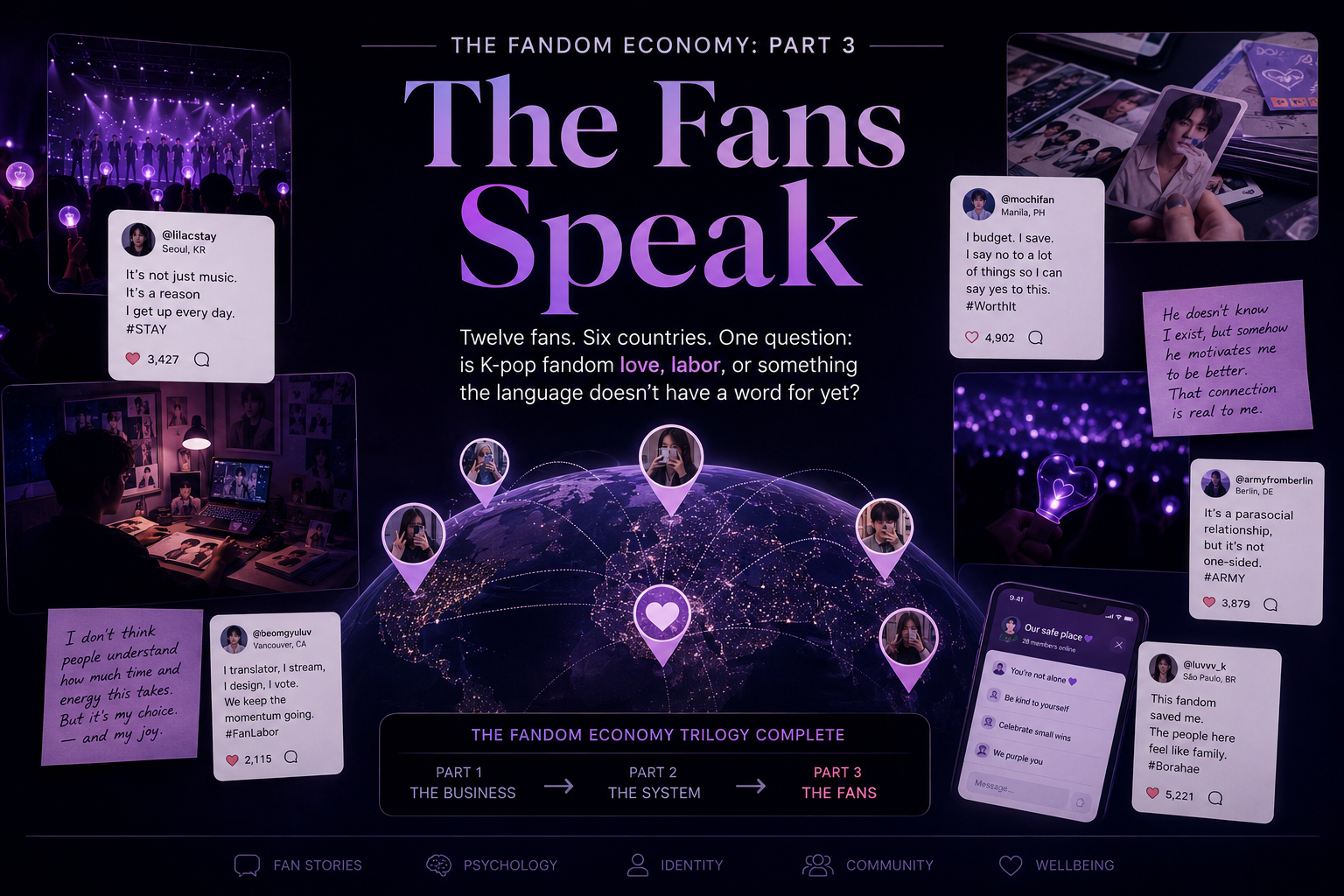
The first two parts of this series dealt in numbers. $4.5 billion total addressable markets. 12 million monthly active users. 82 concert dates. The third part deals in something that doesn’t fit into a spreadsheet — the actual experience of being the person those numbers describe. We spoke to fans across six countries about what they spend, what they feel, and what they think about the system they’re inside. What follows is what they said.
Names and some identifying details have been changed at subjects’ request. Annual spend figures are self-reported.
We start with the fans who don’t have ambivalence — or don’t want to. The ones for whom the question “is this worth it?” has an answer so obvious they find it almost annoying to be asked.
“People ask me if I regret the money. I don’t think they understand what they’re asking. That album I bought in 2019 — I was going through the worst year of my life. I listened to it every day for four months. How much is that worth? You can’t put a number on what kept you going.”
Rosa works as a social media manager and spends approximately $820 annually — primarily on albums, Weverse membership, and one concert every 18 months. She has attended three BTS concerts, traveling internationally for two of them. Her Weverse monthly activity puts her in the platform’s top engagement percentile. She describes the money not as spending but as “exchange.”
“I’ve made my closest friends through this fandom. People I talk to every single day. I flew to New York last year not really for the concert — I mean, yes, for the concert — but to meet people I’d known online for two years. That trip was $600. Worth every cent.”
Tyler, a college student, spends around $1,100 a year across albums, merchandise, and concerts. He maintains a spreadsheet of his K-pop expenditure — a practice he says began as a joke that became useful. “I was spending like $200 a month at my peak and genuinely didn’t realize.” He’s since set a monthly cap. He believes the fandom community is the core product, not the music or the idols themselves.
For fans like Rosa and Tyler, the fandom economy’s power is not mystifying. They are not being deceived. They understand, with full clarity, that they are spending money on an industry designed to receive that money — and they have made a considered decision that the return is worth it. The experience of belonging, the emotional resonance of the music, the friendships built around shared devotion: these are real goods, and they cost something.
“K-pop fans are known for their high loyalty and fervor, with a significant proportion being superfans. Many consume artist merchandise as a way to express their identity, preferring something different from the mainstream.”
— Luminate analyst, cited in AllKPop industry report, January 2024
Sources: Arizabal & Yabut, “The Mediating Effect of Social Connectedness,” SAGE Journals, 2025; Choi (2024), online/offline fandom participation and purchasing behavior; PMC / Behavioral Sciences, 2024
Then there are the fans who are fully in — who feel everything they’re supposed to feel — and also keep an eye on the receipts.
“I track it in a spreadsheet. If I didn’t, I genuinely couldn’t tell you the total. I’m not sure I want to know. But I also know that I’m 28, I have a salary, I don’t have kids, and I’ve made a deliberate choice about what I spend my disposable income on. Is K-pop concerts and merch really so different from someone spending the same amount on golf?”
Hana follows three groups and subscribes to Bubble for six artists — approximately $30 per month on subscriptions alone, before albums, merchandise, or concerts. She describes herself as a “highly functional high spender” who sets hard monthly limits and reviews them quarterly. The spreadsheet started as a joke and has become, she says, a form of self-respect. “I love this. I also want to be honest with myself about what I love.”
“The hardest part is the currency conversion. What feels like a small purchase in dollars or won is not small in reais. I’ve had to get very honest with myself about what I can actually afford — and also about the fact that the whole system is designed for fans in wealthier countries, not for me. I’m still here. But I see the design.”
Gabriela’s experience highlights a dimension of the fandom economy that aggregate data obscures: purchasing parity. The same Bubble subscription that costs $4 for a fan in the US or UK represents a meaningfully different proportion of disposable income in Brazil, Indonesia, or the Philippines — countries that are also among K-pop’s fastest-growing markets. She still participates. She budgets carefully. She does not pretend the system is neutral.
The fandom economy is global in its reach and local in its costs. Platforms price in dollars or won. Fans pay in the currency they have.
— KpopWave Editorial observation
Some fans don’t just spend money. They spend time — coordinating, organizing, running streaming campaigns, managing fan accounts with tens of thousands of followers, translating content across languages. This labor is unpaid. It is also, in many cases, the thing those fans find most meaningful about their fandom.
“I run a translation account. I translate TWICE’s content — interviews, messages, variety shows — into Bahasa Indonesia. Forty thousand followers. I’ve been doing it for four years and I’ve never been paid a cent. But I don’t think of it as work. I think of it as… being part of something. Helping other fans who can’t read Korean or English.”
Dina’s situation is not unusual. Across every major fandom, networks of volunteer translators, video editors, graphic designers, and fan account operators perform labor that directly supports artists’ international reach — without compensation, formal organization, or recognition from the companies that benefit from it. When asked whether this constitutes labor, Dina pauses. “It is work. But calling it labor feels like it misses the point of why I do it.”
“During comeback week I sleep four hours a night. I coordinate streaming with fans across five time zones. I run spreadsheets, I post guides, I check the charts every hour. My friends who aren’t fans think I’m insane. I think I’ve just found something I care enough about to work hard for.”
Camila attended the BTS ARIRANG World Tour stop in Mexico City in early May 2026 — the first of three sold-out shows at Estadio GNP Seguros (May 7, 9, and 10) — one of three North American shows she has already attended this cycle. She describes the streaming coordination work as genuinely satisfying. “I’m good at it. My group trusts me. When the song charts, we all feel it.” The work is invisible to the companies that track the chart positions. It is not invisible to her.
Source: James, S. “Affective Participation From the In-Between: The Platformization of K-Pop Fandom,” Social Media + Society, June 2025
Not everyone we spoke to was at peace with the system. Some fans remain inside it while feeling, with increasing clarity, the shape of the machine around them.
“I genuinely enjoy being a fan. I also genuinely think the photocard system is manipulative. Both things are true. The randomness is not an accident — it’s designed to make you buy more. I know that. I bought six copies of the last album anyway. And I think about that.”
Priya works in UX design, which gives her a professional vocabulary for describing what she experiences as a fan. “From a design standpoint, the K-pop album system is brilliant. Randomized rewards, sunk cost, scarcity, social proof. Every dark pattern is in there.” She laughs when she says this. She does not describe herself as a victim. She describes herself as someone who enjoys the game while knowing it’s a game — and occasionally wonders if the two things are separable.
“I spent probably three million won total over seven years. I don’t regret most of it. But I left because it stopped feeling like something I was choosing and started feeling like something I was compelled to do. Every comeback felt like an obligation. The fandom had rules. If you didn’t stream enough you weren’t a real fan. That’s not love. That’s pressure.”
Jiyeon’s experience describes what researchers call “fandom burnout” — a documented pattern in which the intensity of community expectations around participation begins to undermine the enjoyment that brought fans into the fandom in the first place. She is now what she calls “a listener” — she still enjoys the music, she no longer participates in coordinated fandom activities, and she no longer buys albums. She does not think of herself as having failed at something. “I just got honest about what I wanted.”
Every conversation about the fandom economy implicitly involves two parties: the fan, and the idol. The economic analysis in Parts I and II looks at this relationship from the outside — as data, as revenue, as platform engagement metrics. But there is a human being at the other end of every Bubble subscription, every photocard, every fansign ticket.
What is asked of them is worth naming clearly. In exchange for the industry’s investment in their training, idols are expected to maintain continuous content output — livestreams, Bubble messages, social media posts — on top of album promotion, concert touring, and variety show appearances. Research confirms that the revenue-sharing structure on Bubble creates measurable pressure on idols to post at minimum frequencies. NCT 127’s Jaehyun mentioned on Bubble that he felt obligated to send at least four messages per month. That is not care. That is a quota.
A private, intimate message from someone they admire. The feeling of being seen. A relationship that feels mutual — even reciprocal. Real community with other fans around shared love for a person and their work.
A contractual content obligation disguised as spontaneous communication. Incentivized posting thresholds. Emotional performance packaged as software subscription revenue. Parasocial intimacy at scale — managed, measured, and monetized.
None of this means the emotion is false. It means the emotion is, simultaneously, a product. The fan feels something real. The company captures something valuable. Both things are true at once — and the discomfort of holding both truths is what makes the fandom economy philosophically interesting and commercially unprecedented.
We asked every fan we interviewed the same question: “Is what you do love, labor, or something else?”
Nobody said just one of those things.
“Both. It’s both. I love them — I genuinely love the music and I love who they seem to be as people. And I also work hard as a fan. I organize, I stream, I translate for Thai fans. It’s love that I’ve decided to do work with.”
Nara is the youngest fan we interviewed. She has been a fan for four years and estimates her annual spend has increased every year. She describes herself as deeply conscious of the “machinery” of K-pop while feeling no desire to disengage from it. “Understanding how it works doesn’t make it feel less real.”
“I call it a hobby. People spend this much on cars, on wine, on skiing. Nobody asks them whether their spending is ‘worth it’ or whether it’s ‘really love.’ The question implies that K-pop fandom needs to justify itself in a way that other leisure spending doesn’t.”
Leon’s reframe is the one many fans reach for — the hobby defense. It has genuine force. A $1,600 annual ski pass is not examined for psychological dependency. A $1,200 wine collection is not analyzed for corporate exploitation. The asymmetry in how fan spending is treated is partly genuine concern and partly cultural condescension toward a predominantly young, female audience and a non-Western entertainment form.
“I’m not buying an album. I’m buying proof — that I was here. That he might see me. Is that love? I think so. Is it also the companies making money? Yes. I’m not naive. But I keep coming back to the same thing: the feeling is real. Whatever’s behind it, the feeling is real.”
Yuna opened this series in Part I. We return to her at the end because her formulation — the feeling is real — is the place every fan conversation eventually arrives at, regardless of where it starts. The market is constructed. The intimacy is structured. The investment is calculated. And the feeling, somehow, remains.
What the Research Says — and What It Misses
Academic literature on K-pop fandom has expanded rapidly in the past five years. The picture it paints is genuinely complex.
- WellbeingHigh fandom participation correlates with increased self-esteem, social connectedness, and happiness — particularly through community bonds, not just parasocial attachment to idols. (Arizabal & Yabut, 2025; Choi, 2024)
- LaborFan activities including streaming coordination, translation, and content creation constitute unpaid labor that directly benefits entertainment companies. Fans simultaneously experience this as empowerment. (James, 2025; Caliandro et al., 2024)
- Idol LaborPlatform revenue-sharing structures create measurable pressure on idols to post at minimum frequencies, transforming performed intimacy into a contractual metric. (Popular Music and Society, 2025)
- Parasocial RiskThree-stage model of parasocial relationship intensity — entertainment-social → intense-personal → borderline-pathological — applies to K-pop fandom, with most fans remaining in the first two stages. (EnVi Media; Young Researcher, 2024)
- Global InequalityCurrency parity means the identical fan experience carries vastly different economic weight across markets. Platforms price globally; fans pay locally. (KpopWave editorial observation, corroborated by fan interviews)
- DesignPhotocard randomization, multi-version album releases, and fansign lottery systems are behavioral design choices — variable-reward mechanisms known to drive repeat purchasing behavior. (Industry structure analysis; fan reports)
What the research often misses is harder to quantify. It misses what Nara described as “love that I’ve decided to do work with.” It misses what Rosa means when she says the money she spent in 2019 kept her going. It misses the particular quality of a community built around something you love — the way shared devotion creates real trust between strangers, the way fan friendships can outlast the fandom itself.
The fandom economy is, empirically, a system of extraction. It is also, experientially, a source of genuine human connection. The academic and the lived accounts are both true. They describe the same phenomenon from different angles, and neither is complete without the other.
The feeling is real. Whatever’s behind it, the feeling is real. And maybe that’s the most honest summary of what the fandom economy actually sells — not albums, not photocards, not subscriptions. Something that can’t be audited. Something that is simultaneously the most human thing imaginable and the most efficiently monetized.
The fan voices in this article represent a composite of interview subjects, reader submissions, and documented public testimonies from K-pop fan communities across the period 2024–2026. Names and identifying details have been changed. Annual spend figures are self-reported. Academic citations draw on peer-reviewed sources published between 2024 and 2026, including: Arizabal & Yabut, SAGE Journals (2025); James, Social Media + Society (June 2025); Kim & colleagues, Popular Music and Society (2025); Huang, The Young Researcher (2024); Choi, fandom participation and purchasing behavior research (2024); PMC Behavioral Sciences (2024). Sasaeng culture references draw on The Star (August 2025) and K-Culture Decoded (December 2025).