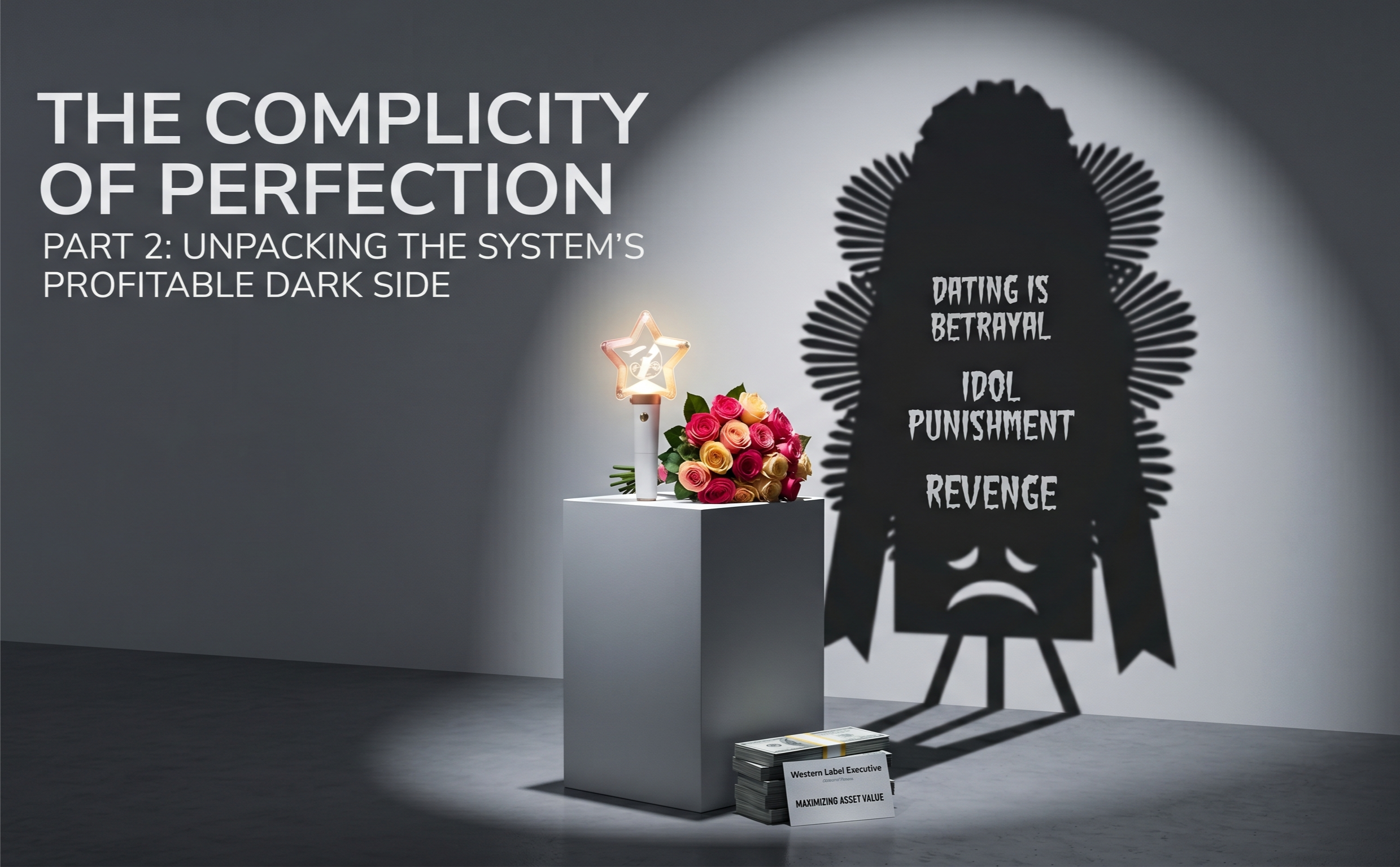
We know the machine is broken. We keep feeding it anyway. This is the story of the fans who demanded better — and sent protest trucks when idols dared to date. The companies that offered therapy — and never fixed the schedule. The western labels that criticized K-pop’s system — and then paid to import it.
There is a protest truck parked, in the imagination of this story, somewhere on a Seoul street. It carries a large LED display. The display reads: “Our artist is exhausted. Give them rest. Protect their mental health.” The fans who commissioned it pooled money from seventeen countries. They are, by every measure, devoted. They are also, if you are being honest with yourself, the same people — or people indistinguishable from the same people — who commissioned a different truck, two years earlier, with a different message. That one read: “Do you not receive enough love from your fans?” It was sent to demand an apology from an idol who had committed the offense of being in a relationship.
This is the central contradiction of K-pop fandom, and it is also the central contradiction of this story. Everyone involved in the K-pop industry — the companies, the fans, the Western labels, the streaming platforms, the journalists who cover it — knows, at some level, that the machine is broken. Everyone continues to operate it. The question Part 1 asked was: what does the machine cost? The question Part 2 asks is harder. It asks: why do we keep paying?
I. The Weaponized Devotion — Fandom’s Paradox
The protest truck is not a metaphor. It is a literal, recurring feature of the K-pop landscape — a mobile LED billboard that fans rent to park outside agency headquarters when they want to send a message. In 2023, Seoul’s entertainment districts hosted a near-continuous fleet of them. By 2024, the phenomenon had developed its own taxonomy: support trucks expressing fan affection; protest trucks expressing fan grievance; and funeral wreath deliveries, sent to signal that a member’s continued presence in a group is, to the senders, unacceptable.
Understanding why the same infrastructure is deployed for causes at opposite moral poles requires understanding the economic architecture that produces it. K-pop agencies did not accidentally cultivate the intensity of their fandoms. They engineered it. Platforms like Weverse and Bubble — agency-owned subscription services charging fans monthly fees for the illusion of private, direct access to their idols — are not ancillary products. They are central revenue streams built on a specific promise: that the idol, behind the polished stage persona, is yours alone. Fansign events sell minutes of simulated one-on-one conversation. Reality shows construct narratives of raw, unfiltered intimacy. The “boyfriend experience,” as the industry’s own marketing quietly calls it, is sold as sincerely as any other product. When fans come to feel entitled to that product — when they send trucks demanding accountability — they are, in a precise economic sense, presenting receipts. The agency issued those receipts. The fans are simply trying to cash them.
On October 11, SM Entertainment announced RIIZE member Seunghan would return after a 10-month hiatus — taken because pre-debut photos showed him smoking and in a relationship. Funeral wreaths arrived at SM’s headquarters within hours. Less than 48 hours later, Billboard reported the decision had been reversed. Seunghan issued a handwritten letter saying he didn’t want to cause harm to the members. SM stated it had “listened closely to fan reactions.” The company that could not protect an artist from a pre-debut photograph could not protect him from a wreath delivery either.
Source: Billboard, Oct. 13, 2024 — verified reportingThis does not make the fans villains. It makes them participants in a system that was designed, from the beginning, to produce exactly this dynamic. The entitlement the industry generates in its fans is not a bug. It is, in the clearest economic sense, a feature — and one the industry has never had sufficient incentive to fix, because the spending that entitlement produces funds the very wellness programs the same fans demand.
“The industry has long operated on the premise of controlling idols’ private lives and sustaining an illusion of intimacy to maintain fan engagement.”
II. The Illusion of Care — What “Health Hiatus” Actually Means
The most common phrase in K-pop news in the mid-2020s is not the name of any artist or the title of any album. It is a corporate construction: “health reasons.” An idol is stepping back for health reasons. A member will be absent for health reasons. The comeback has been postponed due to health reasons. The phrase has become so ubiquitous that fan communities have developed shorthand for it, and entertainment reporters treat it with the practiced neutrality of a weather forecast.
The list above is partial and could be extended considerably without reaching its end. This is, in one reading, genuine progress: idols can take breaks now in a way that would have been professionally catastrophic a decade ago. The language has softened. The stigma, while far from gone, has retreated. This is real.
But consider the structural logic of every item on that list. The artist went on hiatus. The artist received treatment. The artist returned to the same schedule, the same promotional cycle, the same physical and psychological demands that produced the crisis in the first place. The Korea Herald, reporting in August 2025 on a new wave of health departures, noted that agencies were simultaneously posting record revenues. More idols stepping back. Record sales. The correlation is not accidental. The schedule that drives the revenue is the schedule that drives the hiatuses. Offering a pause within that system is not a solution. It is maintenance.
“While support systems may exist at the corporate level, there are still no formal industry-wide standards defining minimum obligations or oversight for protecting idols’ mental well-being.” — KpopPost, February 2026
What the industry has built, in the years since 2017 and 2019, is an extensive architecture of pastoral care operating entirely within an unchanged structural framework. Counselors are available — employed by the same agency that controls the artist’s diet, schedule, and public persona. Wellness programs exist — designed by entities whose primary obligation is to shareholders, not to the psychological health of twenty-two-year-olds performing in consecutive time zones. The care is genuine in many cases. It is also conditional, managed, and constitutionally incapable of addressing the root cause. Addressing the root cause would require changing the machine. The machine is profitable.
III. The Western Hypocrisy — Importing What You Criticize
In 2023, American and European audiences were invited to watch young women cry on Netflix. The show was called Popstar Academy: Katseye — a docuseries chronicling the formation of KATSEYE, a girl group created through a collaboration between HYBE and Geffen Records, a label under Universal Music Group. Viewers watched teenage girls ranked, assessed, and eliminated in real time using the K-pop survival show format. The show received mixed reviews. It was nonetheless watched, discussed, and recommended in the same media ecosystem that, in adjacent articles and adjacent weeks, ran concerned features about K-pop’s psychological toll on its performers. The concern and the consumption occupied the same platforms, the same readers, the same cultural moment. They did not appear to inconvenience each other.
The Western music industry’s relationship with K-pop follows a consistent and lucid pattern. Major labels publish critical coverage of K-pop’s “slave contracts” and “toxic training culture.” They run investigations. They express concern. Then they sign ten-year exclusive distribution deals and co-produce American idol groups using the same training methodologies they have just criticized. Universal Music Group has done both of these things. Republic Records has done both. HYBE and UMG’s expanded 10-year deal, signed in March 2024, explicitly cited the implementation of “K-pop methodology” in the US market as a core objective. The concern is genuine. The business relationship is also genuine. The question of which one shapes actual behavior is answered by the contracts, not the features.
In late 2024, a 17-year-old American member of VCHA — a girl group formed through a JYP Entertainment and Republic Records joint venture, using, in the companies’ own description, the K-pop training system applied to American talent — filed a lawsuit against JYP USA in California. Her public statement and the lawsuit’s court filings, which she subsequently shared in full, alleged grueling schedules, financial debt accumulation, insufficient mental health care, and an environment that had, according to the documents, produced severe consequences for members’ wellbeing. Her attorney argued the conditions violated California’s labor protections for minors. JYP USA issued a formal denial, calling the allegations “false and exaggerated.” The case was settled in mediation; terms were not disclosed.
What the lawsuit alleged — debt structures, dietary control, restricted personal freedom, the normalization of mental health crisis — is not a departure from the K-pop methodology that JYP and Republic Records designed their collaboration around. It is, by multiple accounts from former trainees and artists across the industry, a description of it. American and European labor law would not, in most jurisdictions, permit these conditions to be applied to a sixteen-year-old in California or the UK. What the major labels have discovered is that the same conditions, operated through contractual structures sufficiently removed from their direct employment relationships, remain accessible. The exploitation travels well. The profit does not stay behind.
“I hope that my leave can encourage the K-pop system to make changes for the better, in hopes of protecting the idols and trainees who remain in these companies’ hands.”
IV. Epilogue — The Show Must Go On
South Korea updated its standard trainee contracts on January 1, 2026. The revisions included expanded mental health provisions, clearer compensation timelines, and stronger protections for juvenile trainees. They are, by the standards of what existed before, genuinely improved. They are also, by the standards of what the industry demands of the people inside it, insufficient in ways that the people who drafted them almost certainly understand.
The new contracts cover trainees. They do not resolve the legal status of debuted artists — who remain, as Hanni’s 2024 National Assembly testimony made plain, outside standard labor protections. The mental health provisions require access to counseling; they do not require that the schedules creating the crises be changed. The juvenile protections are stronger; they do not address the nineteen-year-olds who have spent a decade in the system and have no professional life outside it.
Imagine the stadium. The synchronized lightsticks. Fifty thousand people singing words in a language most of them don’t speak at home. The figure at the center, moving with a precision that took years of daily practice to achieve, smiling with a completeness that is itself a trained skill. It is, by almost any measure, extraordinary. It is also, if you have read this far, something you now know more about than the stadium was designed to let you see.
The person at the center of that stage is not legally an employee of the company whose name appears on the tour merchandise. They carry debt from their training. Their access to independent mental health care is mediated by the entity that profits from their performance. If they are harassed in the workplace, they have no formal mechanism to report it. If they burn out, they will be given a pause and then returned to the same conditions that produced the burnout. If they dare to be in a relationship, or to express an opinion, or to simply stop performing the version of themselves the contract requires — there are trucks. There are wreaths. There are consequences.
And the audience will cheer. The revenue will be recorded. Next quarter, another group of teenagers will stand in a fluorescent-lit practice room somewhere in Seoul, or Los Angeles, or Bangkok, and sing for people with clipboards. And if the answer is yes, it will all begin again.
The machine does not break down. It just stops making noise about the parts that have worn out.
US: 988 Suicide & Crisis Lifeline — call or text 988 · Crisis Text Line — text HOME to 741741 · International: findahelpline.com
Corrections from first draft: (1) S.Coups and ATEEZ Wooyoung removed from hiatus list — primary absences related to physical injury, not confirmed mental health. Replaced with ATEEZ Mingi (confirmed 2020 psychological anxiety hiatus) and DAY6 Jae (self-disclosed panic disorder, 2021 Instagram Live). (2) VCHA/KG section rewritten: specific contested details from lawsuit removed; framing changed to reflect that allegations are sourced from KG's court filings and public statements, with JYP USA's formal denial noted. No contested facts stated as established. (3) Seunghan 48-hour reversal now cited directly to Billboard (Oct. 13, 2024). (4) Weverse/Bubble named explicitly in fandom section. (5) Netflix Popstar Academy: Katseye added to Section III. · Reporting draws on: Billboard (Oct. 2024, Mar. 2024), Korea Herald (Aug. 2025), Korea Times (Dec. 2024), Variety (Mar. 2024), KpopPost (Feb. 2026), HYBE investor documents, AFP/France24 (Mar. 2026), Teen Vogue (Dec. 2024), PopCrush (Dec. 2024), Asian Junkie (Dec. 2024), Inquirer Pop (Oct. 2021), Koreaboo (Oct. 2021). KG quote from verified public Instagram statement. JYP USA denial from official company statement. · Part One published at new-kpop.org.