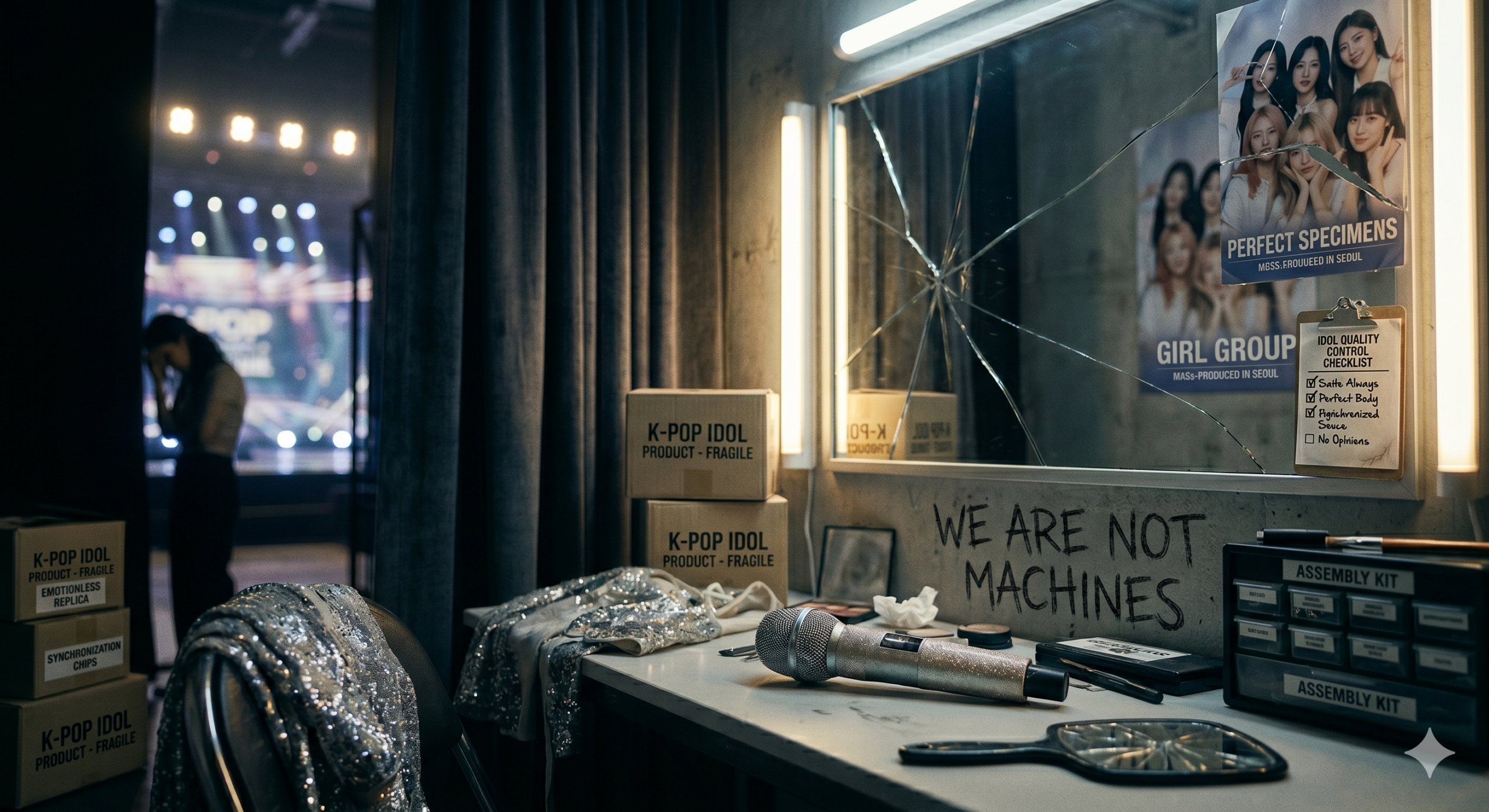
Jonghyun said he was broken from the inside. Sulli asked the internet to stop. Goo Hara held on for six weeks after losing her closest friend, then couldn’t anymore. Wheesung just wanted to sleep. This is the story of what K-pop costs — and why the bill keeps coming due.
The audition tape is always the same. A teenager — fifteen, sometimes twelve — stands beneath fluorescent light in a practice room somewhere in Seoul, or Los Angeles, or Bangkok, and sings a song they have rehearsed for months. Behind a table sit three people with clipboards. They are looking for something the industry calls star quality, something they can identify but not name. The teenager sings. The clipboard people write. And if the answer is yes — if it comes — a life begins that bears almost no resemblance to what the teenager imagined it would be.
K-pop is, by any reasonable measure, one of the most successful cultural phenomena of the twenty-first century. It generates billions in annual revenue. It has turned Korean language lessons into a global growth industry, filled stadiums on six continents, and produced a group in BTS whose fan ecosystem is studied by economists and sociologists alongside their music. And yet, woven through this extraordinary story of cultural reach and commercial dominance, there is another story — one the industry has preferred not to tell. It is the story of what the machine costs the people inside it. It is the story of what happens when you build a system that runs on human beings and treat maintenance as optional.
This is that story. It begins, as so many K-pop stories do, with a training contract and a dream. It passes through a chemical coping mechanism, a hotel room in Seoul, two apartments found silent, and a National Assembly hearing room in 2024. It ends, as of this writing, without resolution. The machine is still running.
I. The Machine
To understand what happened to Jonghyun, and Sulli, and Goo Hara, and Wheesung, you first have to understand the machine that made them. The K-pop trainee system is — depending on your perspective, and where you sit in relation to it — either a marvel of systematic talent development or one of the most psychologically concentrated pressure environments in the modern entertainment industry. It is, with some honesty, both.
Aspiring idols are recruited as young as eleven or twelve, signed to multi-year exclusive contracts, and entered into a regimen of daily practice running twelve to sixteen hours. They train in singing, dance, multiple languages, and what the industry calls media training — a term meaning, in practice, the sustained rehearsal of a persona that is at all times pleasant, physically precise, and emotionally available to the public while revealing nothing that has not been pre-approved. They are weighed regularly. Their diets are monitored. Their romantic lives are frequently contractually restricted or forbidden. They carry the financial debt of their own training, advanced by the agency, which must be repaid through future earnings before they see meaningful income.
The legal architecture surrounding this system has, historically, been minimal in ways that matter. K-pop trainees and debuted artists exist in a legal gray zone: not quite employees, and therefore not covered by the labor protections that would apply to a factory worker or an office staff member in Seoul. They are bound by contract to entities that control not just their professional output but their physical appearance, their public relationships, and in many cases their access to independent legal or medical counsel. The system, at its best, produces performers of genuinely extraordinary discipline and range. At its worst, it produces something closer to a sealed pressure vessel — no release valve, no emergency exit, no one whose job it is to ask whether anyone inside is okay.
“Who is trained to go from a normal person to all of a sudden being loved and at the same time criticized by people all over the globe?”
II. The Chemical Coping — Sleep as a Luxury
On the morning of March 11, 2025, K-pop learned it had lost another one. Choi Whee-sung — known universally as Wheesung — was found in cardiac arrest at his apartment in Seoul’s Gwangjin district. He was forty-three years old. His final social media post, five days earlier, had read: “Weight loss completed. See you on March 15.” He had a concert scheduled.
Wheesung was, to anyone who followed Korean R&B in the 2000s, something close to a standard of excellence. His 2002 debut album won multiple major awards. He wrote songs for Twice, Super Junior, T-ara, and a long list of artists who came up after him — he was, in the industry’s language, a maker as well as a performer. He played Elvis Presley in a Seoul musical. He covered Craig David’s “Insomnia” in a version that became, for a generation of Korean listeners, the definitive one.
The word insomnia matters here. In the pop music of the English-speaking world, a star’s relationship with drugs tends to be narrated as excess — as the baroque side effect of too much money and too much sensation. The story of Wheesung and controlled substances is a different kind of story. In 2020, within days of each other, he was found unconscious in public restrooms, near syringes containing etomidate — a surgical sedative, a chemical cousin of propofol — not a party drug but a sleep-inducing anesthetic used in operating rooms. His agency, at the time, issued a statement. It said he had been going through an incredibly difficult period following the deaths of his father and close friends. It said he was suffering from depression and panic disorder. It said he had been receiving psychiatric treatment.
What it did not say, and what the statement’s careful language implied without stating, was the central fact: a man whose entire professional identity was built on the quality and endurance of his voice — who had spent two decades performing at a standard that left Korean music critics reaching for superlatives — had reached a point where the only way he could find sleep was with a surgical anesthetic, administered alone, in a commercial bathroom.
In 2021, Wheesung received a one-year suspended prison sentence for the illegal procurement and use of propofol. He paid fines. He entered treatment. He continued to perform, though never again to the audiences he had once commanded. In the aftermath of his death in March 2025, a Yale School of Medicine psychiatrist who had loved his music wrote publicly that what troubled him most was not the death itself but what it represented: that South Korea’s addiction rehabilitation infrastructure remained, in his words, “absurdly insufficient.” The country that built the world’s most sophisticated pop music machine had not built the support system for the people the machine consumed.
The Michael Jackson parallel is one that Western readers will recognize: propofol, sleep deprivation weaponized against its own remedy, a career built on a kind of physical perfection that leaves no room for the body to simply rest. What is distinctive about Wheesung’s story is not the substance. It is the reason. This was not excess. This was a man trying to turn himself off — trying to achieve, by chemical means, the basic recovery that the industry’s schedule did not permit.
“The machine doesn’t break down. It just stops making noise about the parts that have worn out.”
III. December 18, 2017
To understand Jonghyun, you have to understand what it meant, in the K-pop of 2008, to be an idol who also wrote your own songs. The industry ran on a factory model: composers and lyricists in one building, trainees in another, the output assembled and delivered with the efficiency of a production line. Artists who arrived with their own creative voice were an anomaly, and the system’s tolerance for that anomaly was conditional on commercial returns.
Kim Jong-hyun was SHINee’s lead vocalist from the group’s debut at seventeen, and for a decade he was, by any professional standard, one of the most complete performers in Korean pop. He had the voice — the range and the emotional intelligence to use it — and he had something else: he could write. His solo work and the songs he contributed to SHINee’s catalog were not committee pop. They were personal. His radio show, Blue Night, which he hosted for five years, became a quiet landmark in Korean broadcasting: a late-night program in which an idol spoke honestly to his listeners about loneliness, about mental states, about the texture of inner life. Fans understood that he was describing real experience. They did not fully understand how literal he was being.
This is the tension at the center of Jonghyun’s story: that the same quality that made him exceptional — his emotional permeability, his insistence on translating internal states directly into music and words — was the quality the industry had no architecture to support. He was, in the machine’s terms, a premium component that required unusual handling. The machine did not provide it.
On December 18, 2017, Jonghyun sent a text message to his sister. Authorities were alerted. He was found unconscious in a hotel room in Mapo, Seoul. He was twenty-seven years old. The farewell letter he left — shared publicly, with his family’s consent, by a close friend — has been read by tens of millions of people. Its most-quoted line is the most direct: “I am broken from the inside.” Less quoted, and more devastating in its specificity, is what he wrote about his experience of treatment: that a doctor had told him his depression was a function of his personality. That it was simply who he was. That there was not, in the clinical view he was offered, a problem with a solution — only a person with a nature.
His final concert had been held eight days before his death. His posthumous album was released the following month, in January 2018. He had titled it Poet / Artist. The profits went to a charitable foundation established in his name. The title was his own choice, made before he died — an artist naming himself, in the end, on his own terms rather than the industry’s.
IV. The Year of Two Funerals
If Jonghyun’s death was a warning, 2019 was the year the industry declined to hear it.
Choi Jin-ri — Sulli — had been one of the most publicly scrutinized figures in Korean celebrity culture for years before her death, and the nature of that scrutiny requires examination that the phrase “cyberbullying” does not adequately provide. What Sulli experienced was not random cruelty directed at a public figure. It was organized, sustained, and ideologically coherent. It was the enforcement mechanism of a specific set of rules about what a female idol is permitted to be.
Those rules, in the K-pop of the 2010s, were unusually precise. Female idols were expected to project a particular kind of femininity: soft, available, sexually innocent, non-threatening, and above all compliant. The fan relationship with female idols carried an explicit transactional element — a parasocial investment that required, in return, the performance of an idealized persona at all times. When Sulli chose to stop performing it — when she posted photographs of herself without a bra, when she expressed support for abortion rights, when she said in a television interview that she wore what was comfortable and saw no reason to explain herself — the response was not disappointment. It was rage. Organized, targeted, relentless online rage, directed at a woman in her twenties for the offense of refusing to be the product people had decided she owed them.
She joined a television program called The Night of Hate Comments, in which celebrities read the worst things strangers had written about them. She had been given, by the show’s producers, the informal title of “nuclear bomb of hate comments” — a label that captured both the volume of abuse directed at her and, with grotesque irony, the show’s implicit suggestion that her distress was entertainment. She spoke on camera about having to take small alleyways because she feared being filmed. She said she had been living under surveillance. She reported the harassment repeatedly to her agency. She asked for intervention. It did not come in any form adequate to what she was facing.
On October 14, 2019, she was found dead in her home in Seongnam. She was twenty-five years old.
Six weeks later, Goo Hara — a former member of KARA, and one of Sulli’s closest friends — was found dead in her apartment. Goo Hara’s story carried a different dimension of the same underlying dynamic: the use of female sexuality as both accusation and punishment. An ex-boyfriend had threatened to release intimate footage of her and had physically assaulted her. The legal case that followed was a case in which the victim became, in the logic of Korean public discourse, partly culpable — in which her private life was treated as relevant evidence of her character, and her character as relevant to whether she deserved sympathy. She had survived a suicide attempt earlier that year. She had appeared on camera after Sulli’s death, weeping, and said she would live more diligently, for Sulli’s sake. She held on for six weeks.
“The idol contract doesn’t just buy your time. It buys the right to define who you are allowed to be.”
What happened to Sulli and Goo Hara was not incidental to their careers — it was produced by the structure of those careers. The K-pop industry’s commercial model requires female artists to inhabit personas of radical innocence while simultaneously cultivating parasocial intimacy with fans who feel entitled to those personas. When artists deviate from the persona — when they age, when they date, when they express opinions, when they wear what they choose — the industry’s own architecture produces the conditions for what follows. The agencies are not blameless. The fans are not blameless. The platforms that hosted and amplified the abuse are not blameless. And the culture — South Korean and global — that still locates the responsibility for sexual harassment in the behavior of its targets is not blameless either.
V. What Changed — and What Didn’t
After Jonghyun, after Sulli, after Goo Hara, the industry moved. Agencies hired counselors. Legal teams pursued the worst of the online abusers. The Korea Creative Content Agency published mental health guidelines in 2021. HYBE reported a wellness program serving over 200 trainees and artists. JYP Entertainment partnered with a university hospital for specialized psychological support. The conversation, at minimum, became louder and less apologetic.
But the conversation and the structure are different things. And the structure did not change.
The proof arrived in October 2024, in a hearing room of South Korea’s National Assembly, in the form of a twenty-year-old Vietnamese-Australian woman named Hanni — a member of NewJeans, one of the most commercially successful K-pop groups of its era — who sat before the Labor Committee and described, with the measured precision of someone who had decided they had nothing left to lose by telling the truth, what it had felt like to be systematically ignored and demeaned within one of the industry’s most powerful corporate structures.
The specific incident she described was, by the standards of workplace abuse, relatively minor: a manager for another HYBE act had instructed that group’s members, in Hanni’s presence, to pretend she didn’t exist. What made it devastating was the response when she reported it — which was to be told there was no evidence, that nothing could be done, that the CCTV footage had expired before anyone thought to check it. “I was honestly convinced that the company hated us,” she told lawmakers, her voice breaking.
The Labor Ministry’s ruling, delivered a month later, was technically correct and substantively damning: Hanni’s harassment allegations did not qualify as workplace harassment under Korean law because Hanni did not qualify as an employee. Her contract classified her otherwise. The protections that any office worker in Seoul — any barista, any data entry clerk, any person punching in and out — would have been entitled to invoke were not available to her, because the legal category that would have activated them had been carefully avoided in the architecture of the contract she signed as a teenager.
This is what the years of counselors and guidelines and wellness programs had not changed: the fundamental legal status of the people the industry runs on. Jonghyun sought treatment and was told his depression was his personality. Sulli reported her harassment and was given insufficient protection. Goo Hara survived assault and found her victimhood questioned. Hanni reported bullying and was told she was not, legally, a worker. The throughline is not cruelty — it is structural indifference. A system that has, at every point where intervention was possible, found a reason why the particular form of protection required did not technically apply.
VI. A Generation That Speaks
Something has shifted, and it would be dishonest not to name it. The generation of idols who grew up after Jonghyun’s death — who were teenagers when Sulli’s Instagram posts became national controversies — speak differently about their interior lives than their predecessors did. BTS addressed therapy, loneliness, and self-acceptance in their music and in public interviews at a scale and with a frankness that would have been professionally dangerous a decade ago. Hanni walked into a government building and testified on camera about power, and what it does to the people subject to it, and she did not stop speaking even when she was crying.
These are not small things. They are, however, incomplete ones. Mental health counseling provided by the same agency that controls your diet and your dating life and your public image is not the same as independent mental health care. A wellness program offered within a framework of total institutional dependency is not protection — it is management. The reforms so far have been additive: new services layered onto an unchanged architecture. The architecture — young people, recruited before they have legal or emotional tools to evaluate what they are agreeing to, indebted to entities that control their public existence, legally categorized in ways that deny them standard labor protection — remains.
Jonghyun’s last album was called Poet / Artist. He named it himself, before he died. It is the title of someone who knew, in the end, what he was — and who found that the industry that had built his career had no adequate space for the wholeness of the person he actually was. Sulli knew what she was, too. Goo Hara held on as long as she could. Wheesung just wanted to sleep.
The machine is still running. It will run tomorrow. The names of the people it has consumed do not slow it down. They should.
Reporting draws on verified sources including ABC News, CNN, NPR, Billboard, The New York Times, and NME, as well as primary sources: Jonghyun's farewell letter (published with family consent, Dec. 2017); Hanni's National Assembly testimony (Oct. 15, 2024); South Korean Ministry of Labor ruling (Nov. 20, 2024); Wheesung's agency statement (Mar. 10, 2025); and peer-reviewed academic literature on the K-pop trainee system. Statistics reflect 2023–2024 industry survey data. The anonymous quote attributed to a former K-pop industry manager was obtained on condition of confidentiality; identifying details have been withheld.