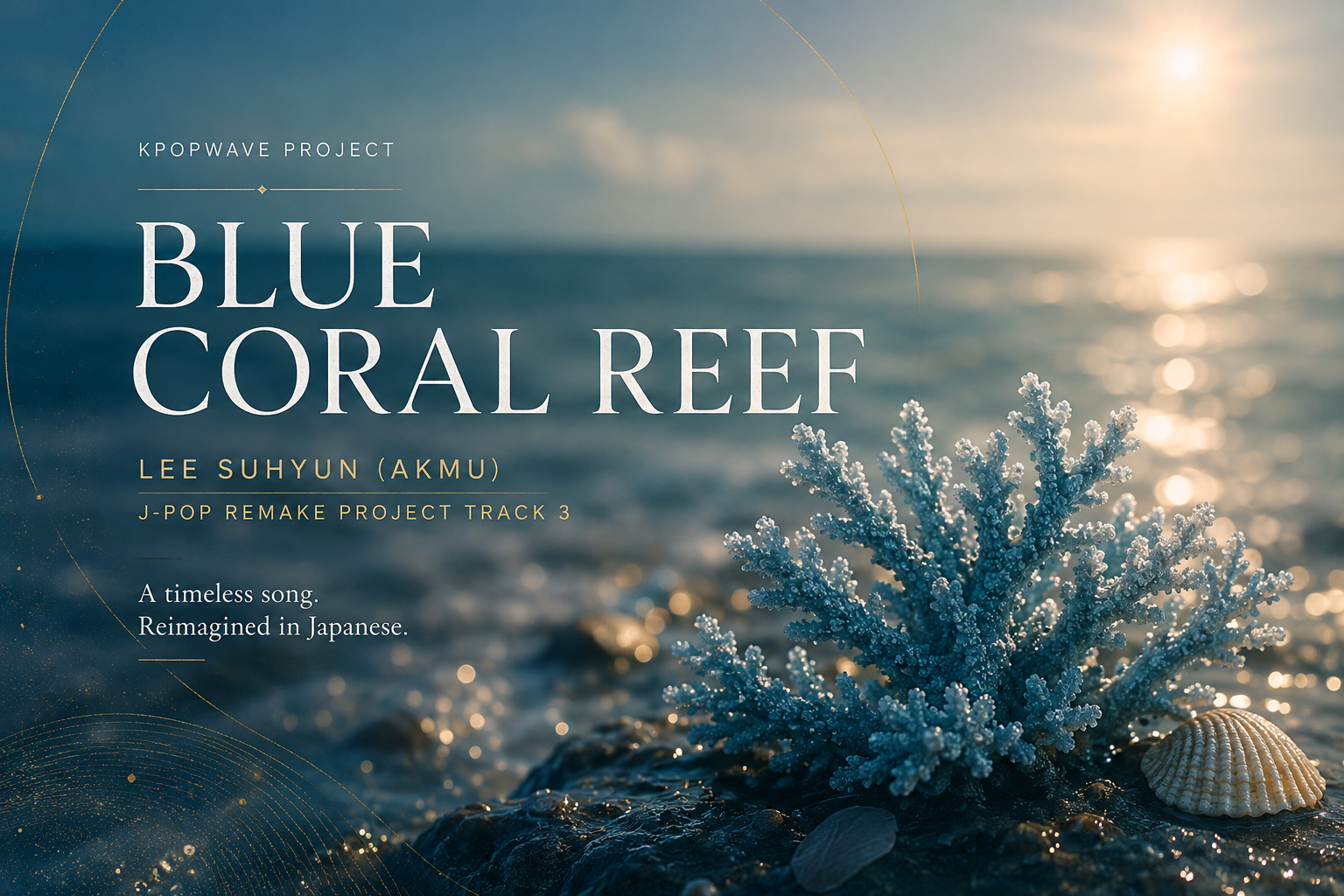
01The Original — Matsuda Seiko and 1980
Before the remake can be understood, the original needs context. 青い珊瑚礁 was released on July 1, 1980 as Matsuda Seiko’s second single — just months after her debut — and became one of the best-selling singles in Japanese pop history. It defined a specific register of Japanese summer pop: clear-voiced, unambiguously joyful, built around the physical sensation of wind and heat and ocean proximity rather than emotional complexity.
Matsuda Seiko’s voice in the original is often described as having a breathy, slightly girlish quality that was simultaneously widely imitated and impossible to replicate — what Japanese music critics call アイドル声 (idol voice), a specific timbre associated with young femininity and bright affect that was central to J-pop idol culture of the late 1970s and 1980s. The song’s emotional register is almost entirely surface-level in the best possible sense: it doesn’t ask to be read deeply. It asks to make you feel the heat of a particular kind of summer afternoon.
The J-POP REMAKE project’s artist selection follows a consistent logic: each performer is chosen for a specific vocal quality that matches the original’s emotional register, not simply for general popularity. TAEYEON’s crystalline control suited the grandeur of 만찬가 (Feast Song). Hanroro’s genre-fluid aesthetic suited the theatricality of 잔혹한 천사의 테제 (Cruel Angel’s Thesis). Lee Suhyun’s selection for 푸른 산호초 is the most natural fit of the three: her voice carries the same quality of effortless warmth and bright clarity that made the Matsuda Seiko original feel like sunlight rather than song.
02The Remake — What Changed, What Stayed
A remake of a song with a well-known original is always doing two things simultaneously: honoring what made the original work, and making choices that justify the remake’s existence. Every lyric kept, changed, or rewritten is a decision about what the song is fundamentally about — and which elements of the original are structural versus incidental. The Korean lyric version of 푸른 산호초 is remarkably faithful in some respects and quietly specific in others.
Verse 1 — Side by Side
あゝ私の恋は
南の風に乗って走るわ
あゝ青い風
切って走れあの島へ
아 이런 나의 사랑은
불어오는 남쪽 바람 타고 달리죠
아 푸르른 바람 사이로
달려가 저 섬을 향해
あなたと逢うたびに
すべてを忘れてしまうの
はしゃいだ私は little girl
熱い胸聞こえるでしょう
나 그대를 만나러 갈 때면
모든 것을 잊어버리고 말아요
설레이는 나는 마치 little girl
두근대는 소리 들리나요
Verse 2 — The Emotional Shift
涙がこぼれるの
やさしい目をして見ないで
うつ向き加減の little rose
花びら触れて欲しいの
맺혀 있던 눈물이 떨어져요
사랑스런 눈으로 보지 마요
고개 숙인 나는 마치 little rose
다정한 손길을 원해요
渚は恋のモスグリーン
二人の頬が近づいてゆくのよ
あなたが好き!
해변가의 사랑은 모스 그린
서로의 두 뺨이 자꾸만 좁혀져 가네요
당신이 좋은 걸
The chorus line about coral — 素肌にキラキラ珊瑚礁 (on bare skin, sparkling coral reef) in the original — becomes 맨 살 위로 반짝이는 산호초 in Korean. This is nearly a direct translation, keeping the original’s specificity intact: skin, sparkle, coral. The image of the coral reef glittering on bare skin is the song’s most sensory image — combining the physical sensation of sunlight and water with the visual of the reef below the surface — and the Korean doesn’t change it. This is where the two versions are most alike. The image was too precise to improve on.
03이수현 — Why Her Voice Was the Right Choice
Younger half of the sibling duo AKMU (악동뮤지션). Debuted 2014 on K-pop Star Season 2, which AKMU won. Known for a voice described consistently as 맑고 따뜻한 (clear and warm) — clarity without coldness, warmth without softness.
Mukho is a small port town on Korea’s east coast known for its unspoiled coastal scenery — a deliberate choice for a song about summer, the sea, and the specific feeling of moving toward something you love in full sunlight.
The production keeps the original’s melodic structure intact while updating the arrangement — contemporary sonic elements layered onto the 1980 original’s bones, letting Suhyun’s voice carry the emotional work rather than competing with it.
The official description of Suhyun’s approach to the cover. In a song where the original worked through brightness and effortlessness rather than technical complexity, restraint is the correct choice — and it’s the choice that matches what AKMU, as a duo, has always stood for.
What makes Lee Suhyun specifically suited to this remake is a quality her voice shares with Matsuda Seiko’s original, despite being technically very different: both sound like they aren’t trying very hard, and both produce the impression of warmth without any particular effort to manufacture it. Matsuda Seiko’s voice is breathy and slightly girlish; Suhyun’s is cleaner and more sustained. But both carry the same absence of strain that the song requires. A cover of 青い珊瑚礁 that sounds labored would contradict its own premise — a song about the effortlessness of summer love, performed with obvious effort, would be its own kind of mistake.
The choice not to add excessive vocal runs or demonstrate range — described in press materials as choosing “natural and delicate over technical display” — is precisely the choice that honors what Matsuda Seiko’s original was doing. The original was never about vocal acrobatics. It was about a specific kind of openness, a voice that sounds like it belongs outdoors, near the water, in summer. Suhyun’s restraint is the right form of fidelity to the source.
04The J-POP REMAKE Project — Three Artists, Three Songs
한로로 — 잔혹한 천사의 테제 (Cruel Angel’s Thesis)
Original: Evangelion OST / Yoko Takahashi
이수현 — 푸른 산호초 (Blue Coral Reef)
Original: Matsuda Seiko (1980)
The project’s three tracks span different eras and genres of J-pop: 만찬가 is from 1977, a folk-influenced ballad associated with deep emotional gravity. 잔혹한 천사의 테제 is from 1995, an anime opening theme that became a karaoke and cultural touchstone. 青い珊瑚礁 is from 1980, summer idol pop at its most archetypal. Together they represent the range of what “J-pop classic” means across five decades — and each artist was chosen for the specific quality that matches their particular assignment.
The project’s decision to remake these songs with Korean lyrics rather than simply releasing Korean-artist vocal covers of the Japanese originals is itself a statement about what the project is doing. This isn’t a tribute series. It’s a translation series — asking what these songs mean when they exist in Korean, sung by Korean voices, for a Korean audience that may or may not know the originals. The answer, in each case, depends on what gets carried across and what gets reimagined in the crossing.
05What the Translation Reveals
Comparing the Japanese and Korean lyrics closely reveals a consistent pattern of choices: the Korean version slightly softens the original’s physical directness, adds temporal and emotional specificity where the Japanese was more immediate and declarative, and replaces a few of the original’s most culturally Japanese images with equivalents that carry the same emotional weight in Korean.
Physical → Auditory
熱い胸 (hot chest — the heat of the heartbeat as physical sensation) becomes 두근대는 소리 (the sound of the heartbeat). The Japanese version makes you feel the heat; the Korean version makes you hear it. Neither is more or less emotional — they’re simply different sensory channels for the same feeling. The Korean version is also slightly more restrained in its physicality, which is consistent with how Korean popular music tends to handle the same emotional territory.
Immediate → Accumulated
涙がこぼれるの (tears spill — present tense, sudden) becomes 맺혀 있던 눈물이 떨어져요 (tears that had been gathered finally fall — pluperfect, the tears were already there). The Korean version adds an entire unspoken history to the same moment. The tears in the original simply appear; the tears in the Korean remake were waiting. That difference changes the emotional register: the original is spontaneous, the remake is accumulated.
Declaration → Admission
あなたが好き! (I like you! — exclamation, sudden declaration) becomes 당신이 좋은 걸 (I just can’t help liking you — soft admission, almost involuntary). The -걸 ending in Korean carries the specific quality of something acknowledged despite itself, as if the narrator is slightly surprised to be admitting it. The Japanese original shouts the feeling as a conclusion; the Korean version whispers it as a recognition.
| Substitution | Japanese → Korean | Effect of the Change |
|---|---|---|
| Love word | 恋 (koi) → 사랑 (sarang) | Slightly broader; 恋 is specifically romantic longing, 사랑 is more encompassing love |
| Self-description | 私の恋は → 이런 나의 사랑은 | Added 이런 (this kind of) — the narrator already knows her love has a specific quality |
| Physical sensation | 熱い胸 (hot chest) → 두근대는 소리 (pounding sound) | Physical heat → auditory experience; slightly less bodily, more inward |
| Tear image | 涙がこぼれるの (tears spill) → 맺혀 있던 눈물이 떨어져요 | Adds accumulated history to the moment — the tears were already there |
| Touch image | 花びら触れて欲しいの (I want the petals to touch me) → 다정한 손길을 원해요 | Sensual flower imagery → warm hand gesture; gentler and less ambiguous |
| Declaration | あなたが好き! → 당신이 좋은 걸 | Exclamation → soft admission; the Korean ending -걸 makes the feeling seem involuntary, acknowledged despite itself |
06What “Blue Coral Reef” Is Really About — Across Both Versions
The differences between the Japanese original and the Korean remake are real, but they don’t change what the song is fundamentally about — and identifying that core helps explain why a 46-year-old Japanese summer pop song still works when sung in Korean in 2026.
The song is about motion toward someone you love. Not being in love — being on the way there. The chorus is built on verbs of movement: running on the south wind, running through the blue wind, heading toward that island. The beloved is always slightly ahead, always at the destination rather than here. The lover is always in transit. The coral reef, sparkling on bare skin, is the world you move through on your way to them — present, sensory, beautiful, but not the destination itself.
That’s why the song doesn’t age. The specific sensory details — coral reef, south wind, moss green at the water’s edge — are anchored in a specific kind of summer geography. But the emotional structure — the particular joy of being in motion toward someone, of the journey being its own kind of love — is not anchored in any particular time or language. Lee Suhyun’s Korean version keeps that structure intact. The details are slightly different. The motion is the same.
당신이 좋은 걸. I just can’t help liking you. Running through the blue wind toward that island. The south wind carries the feeling. The coral reef sparkles on bare skin. Both versions say exactly this, in different words, from different coasts, forty-six years apart. Both of them get it right.