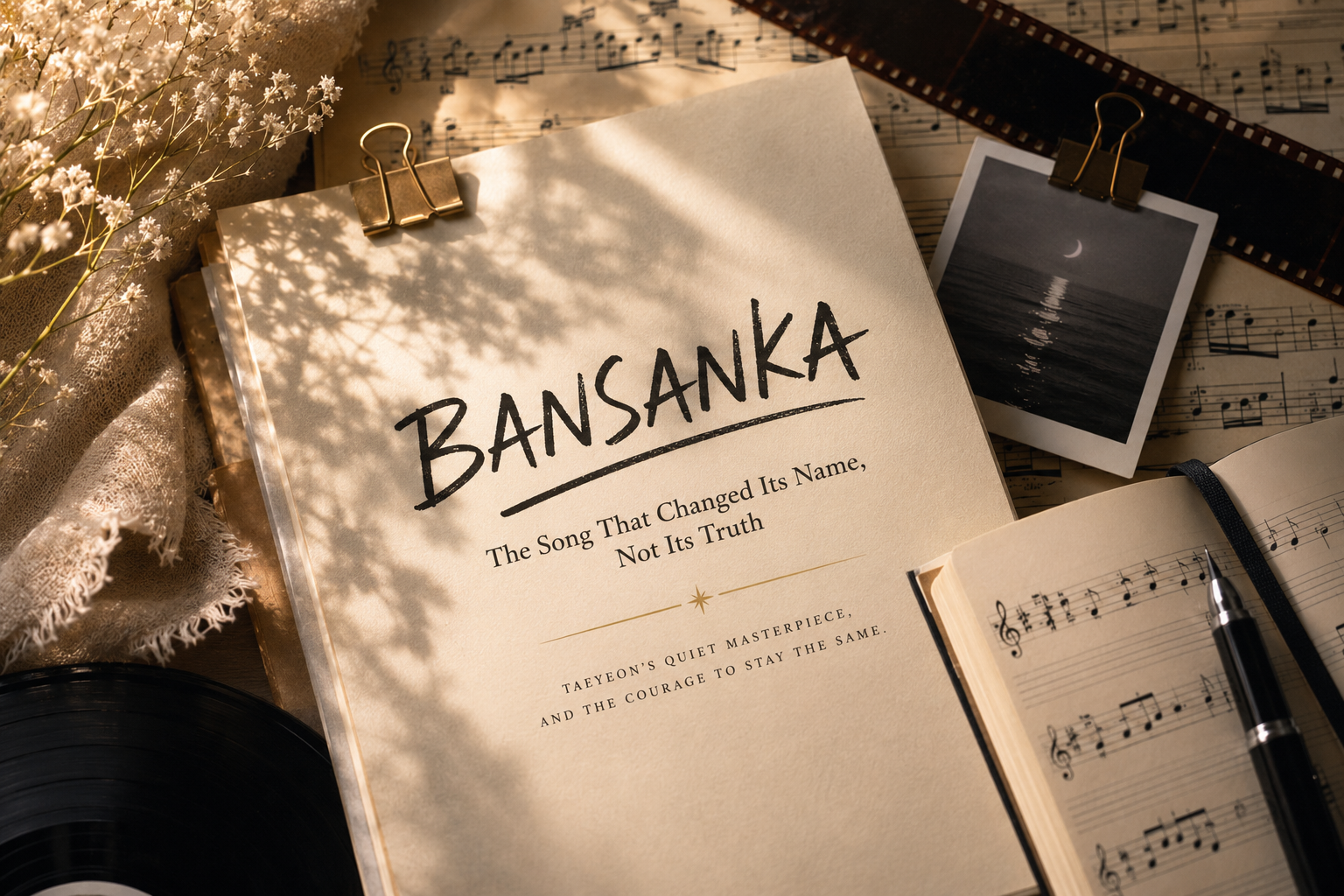
A Japanese singer-songwriter wrote it at fifteen and called it “Full Course.” Somewhere between Tokyo and Seoul, it became a funeral hymn for a feast — and TAEYEON picked up where she left off.
TAEYEON’s “Bansanka (晩餐歌)” has an original. But even that original didn’t arrive with the title it now carries. This song has changed names twice, and worn two different voices. What we’re covering today isn’t a translation — it’s the act of renaming itself.
Before release, this song’s working title was the borrowed English phrase “Full Course.” Casual, consumable, faintly self-mocking. Then, right before the official drop, the title changed to “Bansanka (晩餐歌).”
That swap isn’t a cosmetic tweak. “Full Course” evokes a fixed set-menu at a chain restaurant — something ordered, eaten, forgotten. “Bansan (晩餐)” is a heavier Sino-Korean word for a formal banquet, and the closing character “ga (歌)” follows the naming convention of classical Korean court songs — poem-titles built to mourn or address someone directly.
The final title stacks three layers on top of each other: the residue of English (“Full Course”), the formality of Sino-Korean (“Bansan”), the grammar of classical verse (“ga”). A song that began in the vocabulary of a casual relationship was ultimately renamed into the language of a solemn goodbye ritual.
- Had it stayed “Full Course” — this song would likely have been consumed as a breezy anthem about a fickle, two-timing heart.
- As “Bansanka” — the same words carry different weight. It reads instead as a table set one last time for someone, and everything that vanishes once the meal ends.
The person who wrote this song, tuki., was fourteen or fifteen at the time. The song is widely said to trace back to something her father told her — that a human life adds up to roughly 30,000 days. Subtract the days already spent, and what’s left isn’t as generous as it sounds.
Once you know that, the original title “Full Course” takes on an entirely different meaning. A course meal runs on a fixed sequence, a fixed number of dishes. You cannot simply ask for more. The narrator’s admission that she sometimes craves “something else” — while insisting nothing else means anything without one particular person — isn’t fickleness. It reads closer to the anxiety of trying to make the best possible combination inside a menu that’s already been decided for you.
Which is to say: this song was never really about wandering affection. It’s about finitude — the sense that relationships, life itself, even the chance to say what you feel, are not an all-you-can-eat proposition. It’s the most precocious form of fear a fifteen-year-old could put into words.
The full course was never a menu. It was the number of days she had left.
Rather than quoting the lyrics directly, here’s the emotional architecture the song keeps rebuilding, verse after verse. (For copyright reasons, we do not reproduce the original text.)
- Prophecy without power — the narrator already knows she’ll be the one to eventually break this person’s heart. And still, she admits she can’t summon the courage to end it first. It’s the logic of someone who repeats a beginning while already certain of its ending.
- Desire for something else, and its failure — she concedes that the wider world holds other options. But nothing else “tastes like anything” without this one specific person. Freedom of desire and emotional dependency sit inside the same breath.
- Escalating arithmetic — with each returning chorus, the number of nights the narrator claims she’d endure multiplies (tens, then hundreds, then thousands, then tens of thousands). It’s a structural device: the longer time goes on, the further the confession drifts from ever being finished.
All three contradictions collapse into one question: if love itself is finite, what does it even mean to give it your best? A question a fifteen-year-old asked first — now sung back by a voice thirty years further along.
Same melody, same structure. But the emotional texture the two versions deliver is not the same instrument.
The Raw Confessional
- Teenage immediacy — feeling exposed before it’s been calculated
- Near bedroom-production minimalism, a verseless melody that never lets go
- Lyrics that read like a diary entry, first-person and unfiltered
The Finished Reinterpretation
- Full production arrangement — a remake-scale sonic expansion
- A seasoned vocal, dynamically controlled to shape the song’s rise and fall
- The lyrics tilt from “confession” toward “retrospective” — a narrator looking back on who she used to be
What’s striking is that the original’s unfinished rawness didn’t disappear in the remake. Rather than polishing the song smooth, TAEYEON’s vocal seems to choose translating a fifteen-year-old’s anxiety into an adult’s vocabulary — not erasing it.
The person behind this project is Kangnam, formerly of the boy group M.I.B. “Bansanka” is the first release under J-POP REMAKE, a series run by SHgold Networks.
The key detail is that this wasn’t a one-off cover — it was designed as a series from the start. Kangnam has described the effort as a kind of cultural-envoy exercise, aiming to bridge the emotional register between the two countries. K-pop remaking a foreign original isn’t new in itself, but branding it as a recurring project — and choosing, as its opening statement, a song by a then-largely-unknown teenage songwriter rather than an established J-pop standard — is a notable choice.
Why tuki. instead of a proven J-pop staple? The likeliest answer is that this project isn’t chasing the recycling of an already-verified hit. It’s importing an emotional register Korean audiences haven’t discovered yet. tuki.’s original has, in fact, already cleared that bar in Japan — its YouTube view count passed 100 million, then climbed past 170 million, building an independent fandom within the J-pop scene. In other words, this wasn’t an unverified song. It was a song unverified only in Korea.
This song has no clear boundary between verse and hook — it runs as a single unbroken emotional line from start to finish. That means a flashy arrangement has nowhere to hide the song’s flaws. A song built like this asks one vocalist to carry its entire narrative alone.
From her Girls’ Generation days through her solo work and international collaborations, TAEYEON has repeatedly shown a specific vocal instinct: interpreting a song on her own terms without breaking its original grain. A remake this dependent on the original songwriter’s autobiographical confession doesn’t call for technical flourish. It calls for restrained immersion. Seen that way, the casting reads less like a tier-matching decision and more like a precise read of what the song itself was asking for.
(day after release)
(within 30 days)
Korea trending
cumulative YouTube views
I think this song offers a quiet, different answer to the old question of whether a remake betrays its original or completes it. “Bansanka” doesn’t imitate its source material. Instead, it picks up the exact question the original first asked — what it means to give your best to love inside a finite life — and asks it again, in a different voice, from a different decade of living.
The moment the title moved from “Full Course” to “Bansanka,” this song may have already been announcing the remake that awaited it. It chose a name meant to be called again, not one built to be consumed and forgotten. Whether Kangnam’s J-POP REMAKE project can keep finding songs like this — unfamous, but emotionally deep at the root — is the thing worth watching next.
* This article cross-checked release details, the original song’s background, the project’s production context, and chart performance across multiple public sources. Original and remake lyrics are not directly quoted for copyright reasons; all lyric-related descriptions are the KpopWave editorial team’s interpretive summary. Real-time figures such as YouTube view counts reflect the time of verification and may have since changed.