In 2017, BTS released “Spring Day” — a song about missing someone. That’s the English-language summary, and it is technically accurate the way “the ocean is wet” is technically accurate. It tells you almost nothing.
The song stayed on Korea’s largest streaming chart, Melon, for over 400 consecutive weeks. Not as a nostalgia play, not as a catalog deep-cut — it charted continuously, every week, for more than seven years. No Western song has achieved anything remotely comparable. The question worth asking isn’t why “Spring Day” is popular. The question is why it refuses to leave.
The answer lives somewhere in the first line: 보고 싶다. “Bogo sipda.” Translated, it means “I miss you.” But that translation flattens something important. 보고 싶다 is literally “I want to see you” — the longing isn’t for an abstract absence, it’s for the physical presence of someone’s face. The English word “miss” is emotionally inert by comparison. It’s a placeholder. 보고 싶다 is a reach toward something just out of grasp.
This is where K-pop’s deeper story begins. Not in the choreography or the production budgets or the fandom mechanics — though all of those matter — but in the fact that Korean is a language that has spent centuries giving precise names to emotional experiences that other languages leave nameless. And K-pop, whether by design or accident, has spent thirty years exporting that precision to listeners who feel it before they can name it.
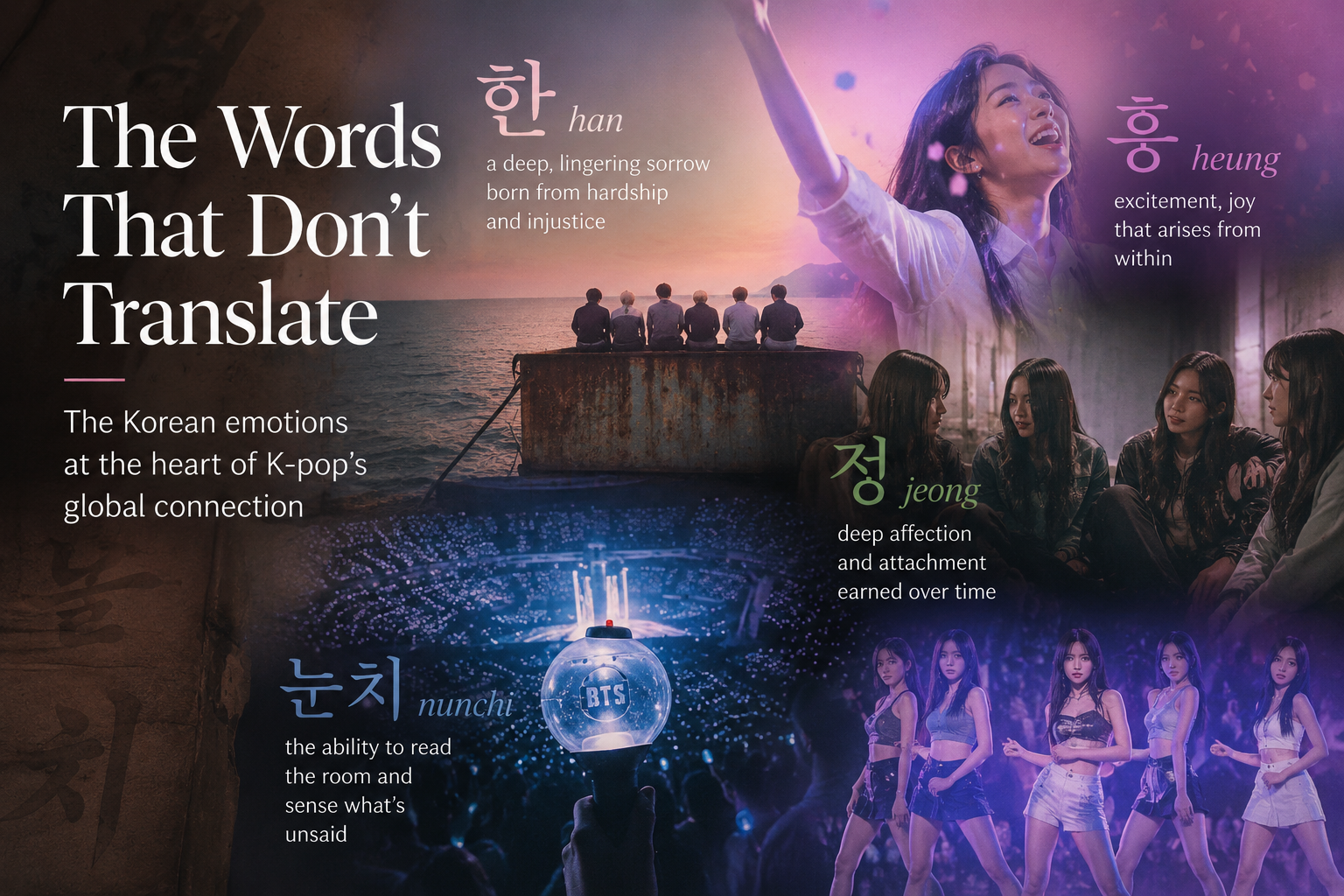
The feelings themselves are universal. Grief, collective joy, deep attachment, the frustration of being unseen — every culture experiences these. What varies is whether a language has bothered to build a house for them. Korean has. Four in particular have quietly powered the genre’s global reach, mostly unnoticed and almost never credited.
Chapter One
Every culture has grief. What makes han distinct is its relationship to powerlessness: it emerges in conditions where expressing pain would be dangerous or futile, so it turns inward instead. Korean historians trace its roots through centuries of occupation and subjugation — not the grief of someone who lost a fight, but of someone who was never permitted to enter the ring. The feeling is universal. The vocabulary for it is specifically Korean.
Consider what “Spring Day” is actually doing when Korean audiences hear it. By 2017, the song arrived in a country still carrying the weight of the Sewol ferry disaster — a 2014 catastrophe in which 304 people, most of them high school students, drowned while a delayed rescue response failed to reach them in time. The subsequent years of suppressed investigation and official deflection left Korea in a state of collective, unresolved grief with no adequate public channel for it.
BTS never formally confirmed what the song was about. RM has said the music video “can be interpreted in many ways,” and in a 2020 Esquire interview, Jin described the song as being about “a sad event” and “longing” — language that is deliberately open. What the record shows is this: Korean audiences received the song as a container for grief that had nowhere else to go, and it stayed on the charts for seven years because that grief didn’t go anywhere either.
On the Sewol interpretation: The yellow ribbons, the shoes by the shore, the motel named “Omelas” — these visual details in the MV align with documented symbols of Sewol remembrance. Whether placed as deliberate tribute or received that way by a grieving public, the effect was the same: the song became a vessel for han at a national scale. KpopWave’s full breakdown of the MV symbolism is linked below.
Related · Lyrics & Meaning
BTS “Spring Day” (봄날) — Full Meaning & Sewol Symbolism Explained
→
The point isn’t that “Spring Day” is a protest song in disguise. It’s that Korean listeners heard han in it — that quality of grief that doesn’t ask to be resolved, that simply asks to be witnessed — and that resonance made the song permanent. International fans, many of whom had never heard the word han, reported feeling something overwhelming in the song without being able to explain it. They were feeling the weight of a word they didn’t know existed.
“They were feeling the weight of a word they didn’t know existed.”
Chapter Two
Where han turns inward, heung bursts outward. Ancient Korean records describe communal festivals lasting several days — the eating, drinking, singing, and dancing that released accumulated tension and rebuilt collective bonds. Heung is not just fun. It’s the specific quality of energy that arises when a group of people stops being separate individuals and starts moving as one. The experience is universal. The word is Korean.
Watch a fan cam of any K-pop arena concert — the coordinated light sticks, the fan chants that fill silences before the artist can, the synchronized audience movement — and you are watching heung in action without knowing its name. The specific quality of that energy isn’t the same thing as Western concert excitement. It’s more organized, but not manufactured. Communal without feeling choreographed.
This is why certain K-pop performances translate globally so effortlessly even when the lyrics don’t. BIGBANG’s stage presence, 2NE1’s defiant collective energy, SHINee’s almost telepathic choreographic unity — these groups were channeling something that predates K-pop by centuries. The genre didn’t invent heung. It industrialized it, packaged it, and shipped it around the world wrapped in production value and synchronized choreography.
BTS named it explicitly on their own terms: the B-side “Boyz with Fun” renames the group “흥탄소년단” — the Heungtan Boys, the Boys of Heung — as a self-aware joke that is also a genuine self-description. The word was always underneath the music. Someone just finally put it in the title.
Chapter Three
The closest English approximation might be “attachment,” but that word carries clinical distance. Jeong is warmer, and stranger: you can feel it for a neighborhood you’re leaving, for a person you argue with constantly, for a job you hated. It is not chosen. It accumulates the way sediment does — slowly, almost imperceptibly — and then one day you realize it’s structural.
The K-pop industry did not consciously design its parasocial architecture to produce jeong. The daily Bubble messages, the fan signs, the concert rituals, the collective streaming — these systems were engineered for revenue and engagement. But the byproduct of years of small accumulated moments between fan and idol is precisely what jeong describes. Not friendship. Not fandom. Something that sits between and below both, and is in some ways more durable than either.
When SHINee’s Jonghyun died in December 2017, the grief that swept through K-pop fandom globally surprised observers watching from outside the community. It wasn’t celebrity grief — the detached sadness of losing someone admired from a distance. Fans who had never been to Korea, who spoke no Korean, who had experienced Jonghyun only through screens and mediated performances, were inconsolable in ways that required a different vocabulary to understand.
That vocabulary was jeong. Accumulated years of small moments: a particular gesture in an interview, a lyric that felt written for their exact situation at their exact hour. None of it was direct relationship. All of it was real bond. Jeong doesn’t require reciprocity. It just requires time and presence — and K-pop had given those fans years of both.
Chapter Four
Nunchi is the operating system for jeong. You build connection through accumulated small moments only if you are paying close attention to what those moments mean to the other person. Korean culture — a high-context culture in which much is communicated through implication rather than explicit statement — developed nunchi as a fundamental social competency, not a personality trait.
K-pop idol training is, among other things, an institutional curriculum in nunchi. The ability to read a camera lens, to sense what a specific fan needs from a fansign moment, to calibrate a live performance to the emotional temperature of a particular room — these are skills that Korean trainees spend years developing. The attentiveness that fans describe as “genuine” in their favorite idols is usually something more specific: exceptional nunchi.
And when nunchi is violated — when someone in authority acts as though the unspoken context doesn’t exist, as though the emotional reality of the people around them is irrelevant — there is a specific Korean word for the suffocation that results.
답답하다. Dapdapha-da. Sometimes translated as “frustrated,” but the Korean version is more visceral: a pressure in the chest, a stifled feeling, like something wrong is happening and the usual channels for addressing it have been blocked. It is the emotional consequence of living inside a high-context culture and watching context be deliberately ignored.
At the NewJeans press conference in 2024, as the group demanded the reinstatement of their creative director and described what they called institutional neglect, member Minji said — directly to the cameras, to the entire industry watching — “답답하다.” Korean audiences understood immediately. Not frustration exactly, not anger exactly, but the specific anguish of a situation that is wrong in a way that cannot be adequately spoken, inside a system that has stopped reading the room. Western media filed the story as a corporate dispute. What Korean audiences witnessed was the precise moment when nunchi — and everything built on it — broke down entirely.
In 2026, K-pop is moving aggressively toward English. LE SSERAFIM’s recent all-English title tracks, KATSEYE and other globally assembled groups, the deliberate softening of Korean lyrical content for accessibility — the commercial logic is sound. English opens markets. English removes friction.
But these four words — han, heung, jeong, nunchi — are not words. They are emotional architectures built over centuries and encoded into the music almost without effort, because Korean artists grew up inside them. They cannot simply be translated. They have no English equivalents because English-speaking cultures never built those particular houses.
The genre’s global reach was powered, in large part, by audiences feeling something they couldn’t name. The question the industry hasn’t answered: what happens to that feeling when you remove the language that made it possible?
The Editor’s Take
There is a fashionable theory in music industry analysis that K-pop’s global appeal is fundamentally formal — a matter of production precision, performance quality, and fandom architecture that any sufficiently resourced industry could replicate. Japan has tried. China has tried. The United States is trying with projects like KATSEYE. The theory is that if you master the system, the emotional response follows.
The evidence does not support this cleanly. Production precision and fandom architecture are necessary. They are not sufficient. The thing that keeps a 2017 ballad on a streaming chart for seven unbroken years is not production quality. Production quality is everywhere now. What is not everywhere is a word like han — the specific emotional weight of grief accumulated across centuries, encoded into artistic expression as naturally as breathing, and felt by listeners who have never heard the word and don’t know why they can’t stop playing the song.
This is not an argument that K-pop belongs to Korea and no one else can access it. The feelings are universal. The grief, the collective joy, the deep attachment, the frustration of being unseen in a system that has stopped looking — every culture knows these. What Korea did was name them precisely, build institutions around them, and then — perhaps unintentionally — put those names to music and send them around the world.
Audiences in São Paulo and Osaka and Los Angeles felt something real. They were right to feel it. They were responding to emotional architecture that had been built over a very long time, in a very particular place, for very specific reasons. The architecture traveled. The vocabulary stayed behind.
The English-language pivot now underway across the industry risks optimizing for the thing that’s easy to measure — market accessibility, streaming numbers in English-speaking territories — while quietly dismantling the thing that’s hard to explain. If that tradeoff is being made consciously, with full understanding of what’s being traded, that’s a legitimate business decision. The evidence suggests it mostly isn’t.
“The architecture traveled. The vocabulary stayed behind. And hundreds of millions of people felt something enormous in the gap between the two.”
— KpopWave Editorial