Beyond the Stage — Part 1 of 3
On a Tuesday evening, a K-pop idol performs a high-energy comeback stage on a music broadcast, earning a perfect score. By Thursday, she’s on set filming a Netflix original series. The following weekend, she’s photographed front-row at Paris Fashion Week as a luxury brand ambassador. Come Sunday, a clip of her guesting on a variety show goes viral on TikTok. Same person. Four different industries. One very deliberate design.
This is not a coincidence. And it is not an accident. The modern K-pop idol is one of the most strategically engineered entertainment products in the world — built, from the ground up, to operate across multiple platforms, genres, and industries simultaneously. To understand why today’s idols are appearing in dramas, films, musicals, and on global fashion runways, you first need to understand how they were trained.
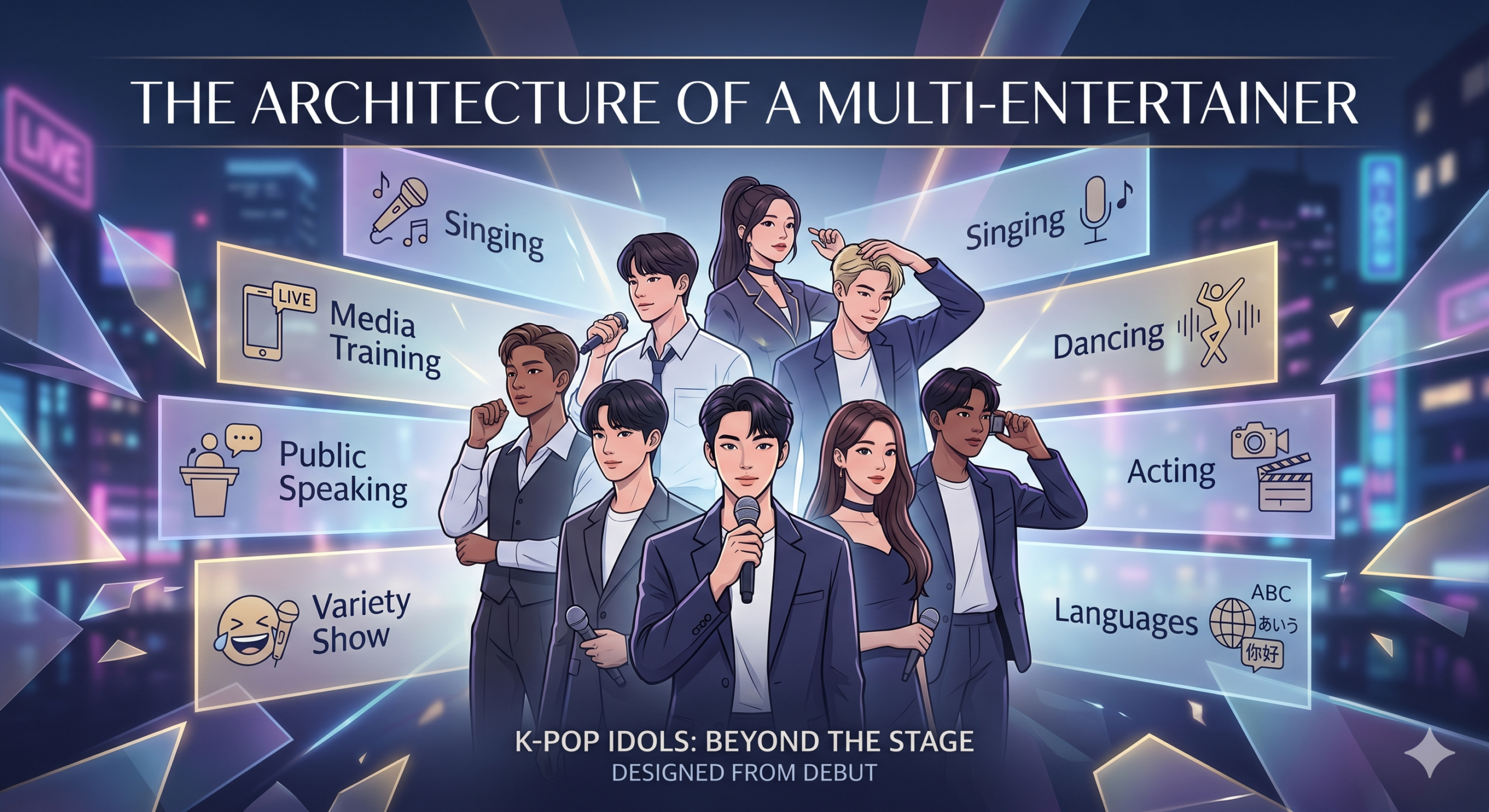
The Architecture of a Multi-Entertainer
Walk into any major Korean entertainment company’s trainee program, and you will find a curriculum that goes far beyond singing and dancing. Language classes — English, Japanese, Mandarin — are standard. So are acting workshops, public speaking drills, and media training. The idol factory, as critics sometimes call it, has always been building more than musicians. It has been building entertainers in the broadest possible sense.
This was not always the case. First and second-generation K-pop idols — groups that defined the 1990s and early 2000s — largely treated acting, variety appearances, and other outside activities as retirement planning. The prevailing logic was simple: a singer’s career has a shelf life, so you branch out when the music slows down. H.O.T., g.o.d., and early-era BoA pursued side activities after their peak years, not during them.
The shift began quietly with the third generation, accelerated dramatically with the fourth, and by the time the fifth generation arrived, the crossover strategy had become the default. Today’s idols are not transitioning into multi-entertainers. They are deployed as multi-entertainers from debut.
“If older generations learned to act as a way to extend a fading career, today’s idols are designed to conquer every stage before their debut anniversary.”
Generation Shift: From Retirement Strategy to Launch Strategy
| Generation | Era | Crossover Approach |
|---|---|---|
| 1st – 2nd Gen | 1992–2007 | Post-peak diversification. Acting and variety as a soft exit from music. |
| 3rd Gen | 2012–2017 | Selective crossovers by established members. Acting as a prestige move. |
| 4th Gen | 2018–2022 | Simultaneous group and solo activities. Crossovers built into group strategy. |
| 5th Gen | 2023–present | Multi-entertainer status from debut. Solo IP built in parallel with group identity. |
The Platform Revolution That Changed Everything
The rise of global OTT platforms — Netflix, Disney+, Amazon Prime Video — fundamentally rewired the economics of K-drama production, and in doing so, created a powerful new incentive for casting K-pop idols in leading roles.
Why Streamers Love Idols
The math is not complicated. A drama starring a globally recognized idol arrives with a built-in audience distributed across dozens of countries. That audience will watch the first episode out of loyalty alone.
Whether they stay depends on the quality of the content — but getting them to click play in the first place is a solved problem. For a streaming platform competing in a saturated global market, that guaranteed initial viewership is enormously valuable. It reduces the marketing burden, increases click-through rates on recommendation algorithms, and seeds the kind of social media chatter that money cannot easily buy.
The result is a system where casting an idol is not just a creative decision — it is a financial instrument. Production companies use idol attachments to secure investor backing. Streaming platforms use them to guarantee cross-border buzz. Advertisers use them to align with pre-existing fan loyalty.
The Webtoon Factor
One specific driver worth examining is the explosive growth of webtoon-to-drama adaptations. South Korea’s webtoon industry has produced hundreds of source properties now in active adaptation pipelines, and these stories share a distinctive visual aesthetic: characters drawn with exaggerated beauty, dramatic styling, and a heightened, almost unreal physical presence.
Idols fit these roles in a way that traditionally trained actors sometimes do not. The phrase “만찢남/녀” — literally, “someone who tore themselves out of a manhwa” — has become a genuine casting criterion. Physical and visual alignment with source material has elevated idol casting from a marketing convenience to a creative argument.
There is another, less obvious advantage at play here. Webtoon characters arrive with a pre-existing image already fixed in the audience’s mind. That means the initial measure of success is not deep psychological portrayal — it is visual and physical embodiment of a character the audience already loves. For idols trained in precise stage performance, controlled facial expression, and camera-ready presentation, this is a far more familiar skillset than the kind of raw emotional interiority demanded by original screenplays. The webtoon format, in other words, lowers the acting barrier at exactly the point where idol strengths are strongest.
The Crossover Landscape: Where Idols Go and Why
Not all crossovers are created equal. The four major territories — variety shows, acting, musical theatre, and brand ambassadorship — each serve a different strategic function, carry different risk levels, and demand different skill sets.
Variety Shows: The Low-Risk Entry Point
Variety programs remain the most accessible crossover territory for idols. They require personality and presence over trained craft. The failure ceiling is low: a flat appearance gets forgotten quickly. The upside, however, can be significant. A breakout variety moment can introduce an idol to an entirely new domestic audience segment that was never part of their fan base.
Drama and Film: The High-Stakes Arena
Acting is where the stakes become real. A drama role is long-form exposure — eight to sixteen episodes of close-up scrutiny by audiences who are not necessarily fans and do not extend the same goodwill. A weak performance in a high-profile drama does lasting damage to an idol’s broader public perception, while a strong one can permanently recalibrate how the public sees them.
Musical Theatre: The Credibility Crucible
Of all the crossover fields, musical theatre occupies the most complex social position. It plays directly to idols’ existing strengths — vocal performance, stage presence, physicality. But the musical theatre community in Korea has a legitimate and well-documented tension with idol casting, rooted in a simple fairness argument: professionally trained stage actors can lose high-profile roles to idols whose primary draw is ticket sales rather than technical ability. (We examine this in detail in Part 3.)
Brand Ambassadorship: The Invisible Crossover
Often underestimated in cultural analysis, global brand deals have become one of the most consequential crossover territories for top-tier idols. For some, it represents the clearest demonstration that their cultural capital has transcended music entirely.
But the effect doesn’t stop at the individual level. When an idol is seated front-row at a Chanel show or named a Dior global ambassador, that luxury association feeds back into how the group’s music is perceived. The aesthetic of the brand and the aesthetic of the act begin to inform each other — a feedback loop that gradually repositions the group’s entire identity upmarket. It is one of the quieter, more sophisticated mechanisms by which K-pop labels manage long-term brand equity, and it rarely gets the analytical attention it deserves.
The Entertainment Company’s Calculus
Behind every idol-turned-actor is a layer of corporate strategy. The major Korean entertainment companies — HYBE, SM, JYP, YG — are not simply music businesses. They are IP management companies, and the idol is the core asset.
The logic of maximizing that asset across platforms is the same logic that drives any IP franchise. An idol who is only a musician leaves potential revenue, potential audience, and potential cultural reach unrealized. The crossover strategy is not a distraction from the core business — it is the core business’s maturation.
“An idol who is only a musician leaves potential revenue, potential audience, and potential cultural reach unrealized. The crossover is the core business’s maturation.”
What This Means for Fans
For international K-pop fans, the multi-entertainer era represents both an expansion of content and a new set of critical demands. Following a group now means potentially engaging with their acting work, their musical theatre debuts, their variety appearances, and their brand campaigns — each requiring a different evaluative framework.
It also means navigating a more complicated emotional terrain. The loyalty fans feel toward an idol as a performer does not always translate cleanly to evaluating that same person as an actor. When a beloved idol delivers a flat performance, fans face a genuine internal conflict between honesty and loyalty.
Part 2 of this series examines the idols who got it right — the ones who earned genuine critical respect, expanded their audience beyond their fandoms, and demonstrated that the multi-entertainer path, done correctly, can produce artists of real and lasting significance.
📌 This is Part 1 of a 3-part series.
→ Part 2: The Idols Who Earned Their Place on Screen and Stage
→ Part 3: When Fame Isn’t Enough — The Cost of the Unprepared Crossover