Beyond the Stage — Part 3 of 3 | ← Part 1: Why K-pop Idols Are Designed to Do It All ← Part 2: The K-pop Idols Who Earned Their Place on Screen and Stage
A note before we begin: this article examines patterns, structural dynamics, and industry-wide phenomena. Where specific productions or situations are referenced, they are treated as case studies in broader trends — not as targeted criticism of any individual artist.
Part 2 of this series examined the idols who got it right — the ones who prepared, who started small, who measured themselves against professional standards rather than fan approval. Their stories are instructive and genuinely inspiring.
But they are not the norm.
For every IU who spent years building toward My Mister, there are productions where the casting announcement generated more excitement than the finished work ever could. For every D.O. who earned his leading role, there are idols who were handed one before they were ready. For every Kim Junsu who walked into a musical theatre community’s skepticism and dismantled it with genuine talent, there are idol musical casting decisions that the same community still discusses with barely concealed frustration.
This is the other half of the story. And it is the half that matters most for understanding where the industry goes from here.
The Anatomy of a Failed Crossover
Failed idol crossovers do not all look the same, but they tend to share a recognizable structure. Understanding that structure is more useful than cataloguing individual cases — because the pattern repeats, reliably, whenever the same set of conditions is present.
The Announcement Problem
The modern idol crossover typically begins with a casting announcement that functions more as a marketing event than a creative one. The idol’s name generates immediate social media coverage. Fan communities mobilize. Streaming platforms update their preview algorithms. The production secures its initial press cycle before a single frame has been filmed.
This dynamic creates a problem that is structural rather than individual. The production has already extracted its primary marketing value before the creative work begins. The idol, who may be genuinely committed to delivering a strong performance, enters a set where the financial logic has already been satisfied. The incentive to invest heavily in performance coaching, reshoots, or difficult creative conversations is diminished — because the numbers the production needed were already delivered by the announcement.
The result is a system that is, in a meaningful sense, indifferent to the quality of the performance. Not hostile to it. Not opposed to it. Simply indifferent. Quality, in this framework, is a bonus — not a requirement.
The Three Core Tensions
1. The Craft Gap: When the Camera Doesn’t Lie
The most visible tension is the one audiences discuss most directly: an idol in a significant role whose performance falls short of what the material demands.
The specific deficiencies vary — underdeveloped vocal projection and diction carried over from mic-assisted stage performance, a limited emotional register that reads as flatness on screen, a reliance on physical expressiveness that works in choreography but becomes mannered in close-up dramatic scenes. These are not character flaws. They are the predictable consequences of training for one discipline and being evaluated in another.
What makes this tension particularly damaging is the visibility of the evidence. A drama exists permanently. Unlike a live stage performance that can improve over a run, a filmed performance is fixed at whatever level it reached on shooting day. Every scene is available for clip and repost. The internet’s appetite for reaction content means that weak performances are not forgotten — they are archived, compiled, and periodically resurfaced.
“A live performance can grow. A filmed one is frozen at the moment it was made — and the internet has an infinitely long memory.”
The fan response to criticism of these performances follows a predictable pattern as well. Initial defensive mobilization — downvoting critical reviews, flooding comment sections with counter-narratives, reporting negative content — is followed, in cases where the criticism is broad enough, by a quieter acknowledgment within fandom spaces that the performance was not what had been hoped. The public record, however, reflects the defensive response more than the private admission.
2. The Musical Theatre Dilemma: Fairness and the Idol Casting Question
Of all the crossover territories examined in this series, musical theatre generates the most structurally complex tensions — and the most legitimate grievances.
The Korean musical theatre industry operates on a training pipeline that is long, demanding, and poorly compensated at its lower levels. A performer working their way toward a leading role in a major production might spend five to ten years in ensemble work, small roles, regional productions, and vocal coaching — accumulating craft and industry relationships at considerable personal cost. The path is not glamorous. The early years are often financially difficult. The reward, eventually, is the opportunity to compete for roles that reflect that investment.
When an idol is cast in one of those roles based primarily on ticket-selling power, the performers who have followed that path experience it as a direct displacement. Not a metaphorical one. An actual role, in an actual production, that is no longer available to them — given instead to someone whose primary qualification is the size of their fanbase.
The industry term that has emerged for this phenomenon — sometimes called “fandom casting” in critical discourse — captures the dynamic accurately. The idol is not being cast because the creative team believes they are the best available performer for the role. They are being cast because their presence guarantees a certain number of ticket sales that the production requires to be financially viable.
This is not an accusation. It is a description of an economic logic that the producers themselves rarely deny when pressed. The musical theatre industry in Korea runs on thin margins. Idol casting is a financial instrument, not just a creative one. The question of whether that instrument is being deployed fairly — at the expense of trained performers who have no equivalent commercial leverage — is one the industry has not resolved, and in many cases has not seriously attempted to resolve.
“Ticket power can fill a house. It cannot, by itself, fill a role.”
The more nuanced version of this argument — the one that is harder to dismiss — is not that idols should never appear in musicals. Part 2 of this series demonstrated clearly that when the right combination of genuine talent and preparation is present, idol casting can expand an audience and elevate a production. The argument is that casting decisions should be driven by artistic evaluation, not financial necessity — and that the current system does not consistently make that distinction.
3. The Fandom Shield: How Fan Loyalty Distorts Industry Feedback
The third tension is the least visible and, arguably, the most consequential for the industry’s long-term health.
When an idol delivers a weak performance in a high-profile project, the fandom response does not simply defend the artist. It actively suppresses the feedback signals that the industry uses to evaluate quality. Review aggregation sites are targeted. Critical journalists receive coordinated responses. Social media algorithms, sensitive to engagement volume, amplify the fandom’s counter-narrative above the critical one.
The result is a distorted information environment. Productions that should register as failures — creative failures, even if commercial ones — instead produce ambiguous data. The idol’s management team sees strong social engagement and interprets it as success. The production company sees the initial viewership numbers and calls the project viable. The next casting cycle begins with no meaningful corrective signal having entered the system.
This is not a problem that individual fans created intentionally. It is an emergent property of fandom culture applied to a context — professional creative evaluation — where its protective instincts produce distortion rather than support. The fans are doing what fan communities do. The problem is that the industry has not developed adequate mechanisms to separate fan-driven engagement metrics from genuine creative quality assessment.
The Industry’s Uncomfortable Calculation
Underneath all three tensions is a single uncomfortable truth that the Korean entertainment industry has not fully confronted: the system is not designed to optimize for quality. It is designed to optimize for initial engagement — and quality, when it occurs, is a welcome but non-essential byproduct.
Production companies face real financial pressures. Streaming platforms need click-through rates. Musical theatre producers need advance ticket sales to secure venue commitments. In each case, the idol’s fanbase solves an immediate financial problem that trained-but-unknown talent cannot. The decision to cast the idol is, within this logic, entirely rational.
The cost of that rationality is borne by multiple parties simultaneously. Trained performers lose opportunities. Audiences invest time and money in productions that underdeliver. The idols themselves — and this point is rarely acknowledged — are placed in situations where they are likely to fail publicly, in ways that damage reputations they have spent years building. The system that profits from the crossover announcement is not the same system that absorbs the consequences of the crossover’s failure.
What Needs to Change
The path forward does not require choosing between idol casting and artistic integrity. Part 2 demonstrated that these are not mutually exclusive. What it requires is a more honest alignment between the conditions that produce successful crossovers and the decisions that trigger them.
For entertainment companies: The multi-entertainer model is not going away — and it should not. But the preparation infrastructure needs to match the ambition. Idols who are being positioned for significant acting or musical theatre work need years of serious training before the casting announcement, not weeks of preparation after it.
For production companies and casting directors: The financial logic of idol casting is understood. What is less understood — or less consistently acted upon — is that the long-term brand value of a production depends on its creative quality, not its opening week metrics. An idol performance that becomes a punchline damages the production’s legacy permanently. That cost should factor into the casting calculation.
For the musical theatre industry: The fairness argument about idol casting is legitimate and deserves a structural response — not just a cultural conversation. Transparent audition processes, clearer criteria for casting decisions, and stronger industry advocacy for trained performers are practical steps that exist independent of any individual casting controversy.
For fans: This is the most delicate point, and it is offered with genuine respect for the intensity of fan investment. Protecting an idol from criticism is not the same as supporting their growth. An idol who is shielded from honest feedback about a weak performance has no external signal to work against. The fans who served the long-term interests of IU, D.O., and Kim Junsu were not the ones who defended every early stumble. They were the ones who kept watching as the work got better.
The Bigger Picture
This series began with an observation about the architecture of the modern K-pop idol — built from the ground up to operate across platforms, industries, and audiences simultaneously. That architecture is genuinely impressive. The system that produces it is, by global standards, extraordinarily sophisticated.
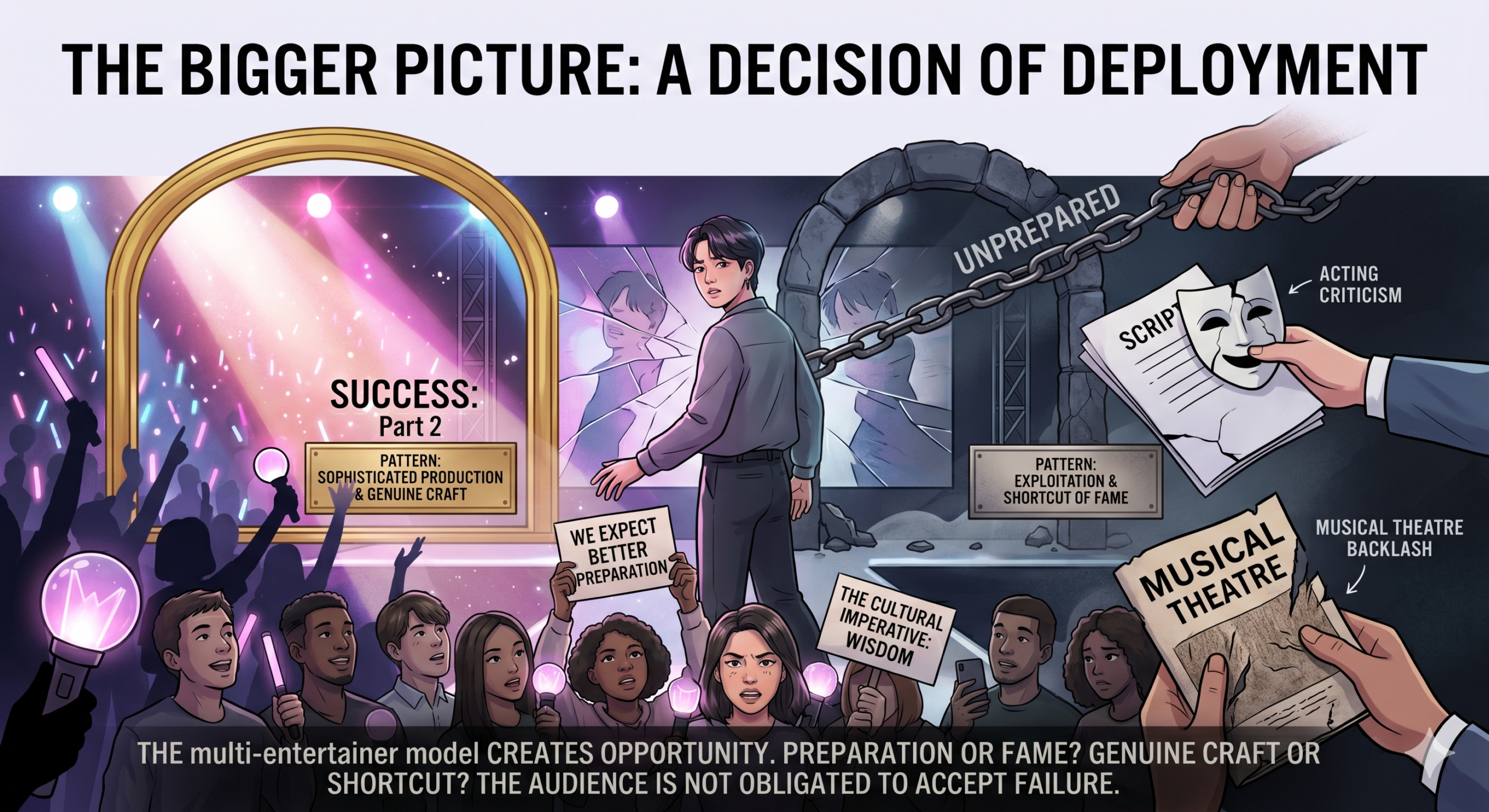
But sophistication in production does not automatically translate to wisdom in deployment. The multi-entertainer model creates opportunities. What fills those opportunities — preparation, humility, genuine craft, or the shortcut of fame — determines whether the crossover advances the culture or merely exploits it.
The cases in Part 2 show what is possible when the system works as it should. The patterns in this article show what happens when it doesn’t. Both are true of the same industry, operating at the same time, producing both its best work and its most avoidable failures simultaneously.
The audience — international fans included — is not obligated to accept the failures as the price of the successes. They are entitled to expect better. And increasingly, they do.
📌 This is Part 3 of 3 — the Beyond the Stage series is now complete. ← Part 1: Why K-pop Idols Are Designed to Do It All ← Part 2: The K-pop Idols Who Earned Their Place on Screen and Stage
What are your thoughts on the idol crossover system? Share your perspective in the comments below.