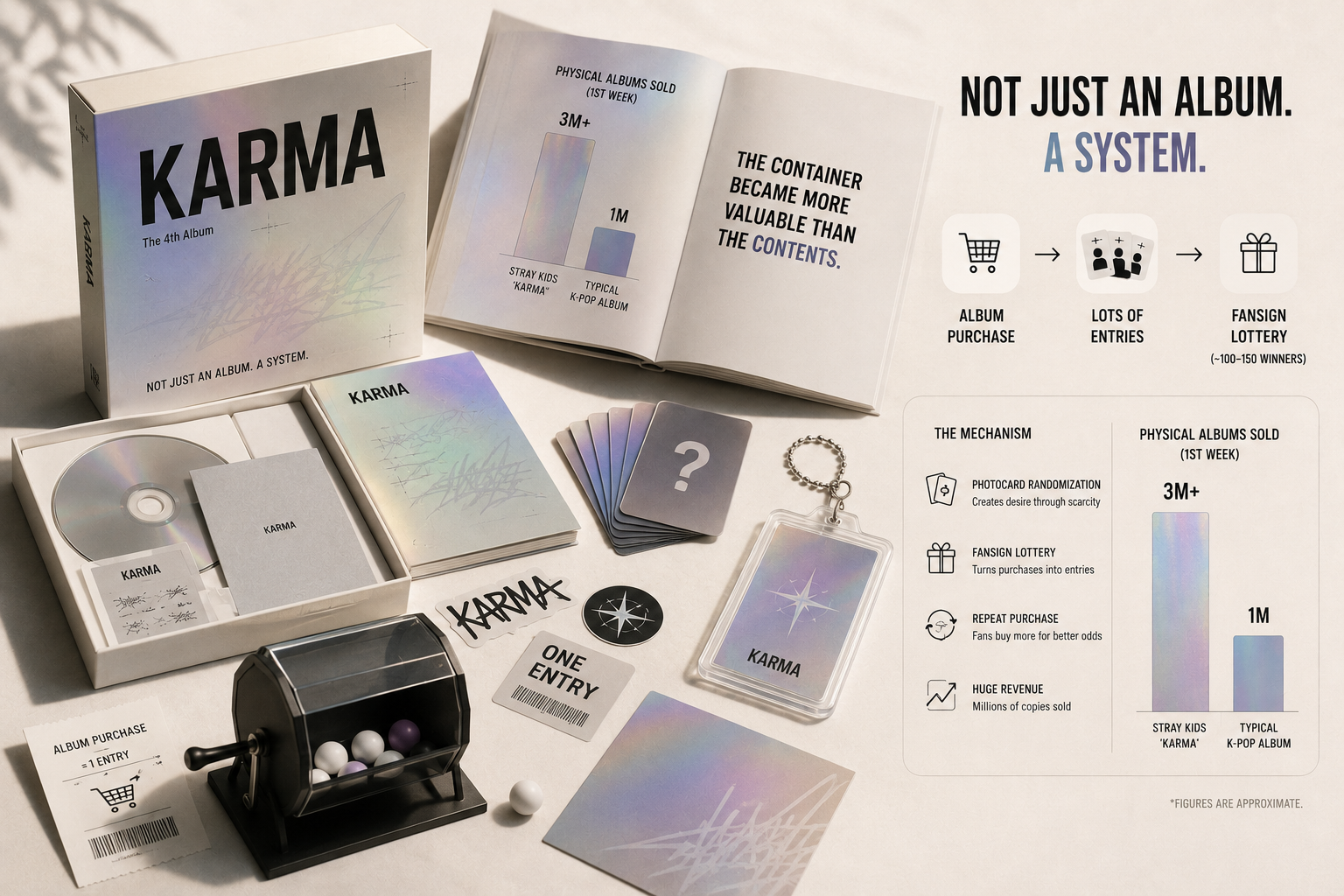
A CD nobody plays, a photocard everyone wants, and a fansign lottery that keeps the whole machine running.
Stray Kids’ fourth studio album, Karma, comes in five versions: Standard, Limited, Accordion, Compact, and an NFC keyring edition. The standard version — the one eligible for fansign event applications — ships in two sub-versions, each containing one of eight possible random photocards. Inside a single standard copy, you will find: one plastic wrapper, one box, one 112-page photobook, one postcard set, one mini poster, one paper CD sleeve, one set of coated stickers, and one photocard. That is seventeen components. The album sold three million copies in its first week.
CD player not included.
Only 8% of South Koreans use physical media to listen to music, according to the Korea Creative Content Agency’s 2024 industry white paper. The country that produces more physical albums per capita than anywhere else on earth has almost entirely stopped listening to them. This is not a contradiction. It is the business model.
Chapter One
How an Album Stopped Being an Album
The music industry spent most of the 2010s watching its core product become valueless. Streaming made the individual song effectively free — or nearly free, at fractions of a cent per play. The album as a format, which had been the industry’s primary revenue unit for decades, became architecturally obsolete. You could not charge $15 for something that was also available for $0.00 on a platform the listener already subscribed to for other reasons.
Every major Western label responded to this crisis the same way: by chasing streams, cutting budgets, and watching margins compress. K-pop responded differently. It did not try to make the album competitive as a music delivery format. It made the album into something else entirely.
The mechanism was the photocard. A small, business-card-sized collectible photo of an idol, randomized inside each physical copy — the modern format traces to Girls’ Generation’s 2010 album Oh!, the moment the random inclusion became standard practice. What the photocard did to the album is structurally identical to what the blind box did to the toy figurine: it converted a known product into a probability game. You are no longer buying an album. You are buying a chance at a specific card, inside an album that also happens to contain music.
The psychology of this is not unique to K-pop. It is the same mechanism that makes Pokémon card packs, baseball card wax packs, and gacha games work. Randomness creates desire. Scarcity — even artificial, manufacturer-controlled scarcity — creates value. The difference is that K-pop attached this mechanism to a format the music industry already knew how to distribute, chart, and report as “album sales.”
This article is not about what photocards are. It is about what they did to the product that contains them — and what happens to an industry when the container becomes more valuable than the contents.
Chapter Two
The Lottery Machine
The photocard made fans want to open multiple copies of the same album. The fansign lottery gave them a structural reason to buy them.
A fansign event — in which fans meet members in person or via video call for approximately one to two minutes each — is allocated through a lottery system. Each physical album purchased generates one entry. Approximately 100 to 150 fans are selected per event. There is no cap on how many entries a single person can submit.
The math is not complicated, but its implications are worth stating plainly.
The critical thing to understand about this system is that it does not make fans irrational. It makes them rational in a context with very specific incentives. If you want to meet your favorite artist badly enough, and your probability of selection scales linearly with your spend, and you can also afford to do it — buying 50 albums is a completely coherent decision. The system was designed to produce exactly this behavior.
KpopWave Editorial
In October 2024, representatives of SM Entertainment, YG Entertainment, and JYP Entertainment were called before South Korea’s National Assembly to address concerns about “album bulk-buying” and what a Democratic Party lawmaker described as unfair merchandise practices. JYP CEO Jung Wook responded that fansign events are “typically overseen by retailers.” SM CEO Jang Cheol Hyun said he would “return to the company to verify.” None of the executives disputed the underlying mechanism. The system was not denied. It was managed.
K-pop fans who buy albums specifically to enter fansign events — Korea Consumer Agency, 2024
Of fansign events in 2025 that required a physical CD album for entry — smart/NFC albums excluded
Individual components inside one standard copy of Stray Kids’ Karma — each generating waste when discarded
The combined result of the photocard mechanism and the fansign lottery was, for roughly a decade, an anomaly in the global music industry: a physical format experiencing growth while every other physical format declined. While CD sales in the United States, Europe, and Japan contracted steadily through the 2010s and early 2020s, South Korea’s physical album market expanded for nine consecutive years, peaking at over 115 million units sold in 2023 — the first time a single national market had crossed the 100 million album threshold in the streaming era.
The CD was not winning because people wanted to listen to CDs. The CD was winning because it had been converted into a vehicle for something people wanted much more: proximity to their favorite artists, and a collectible artifact of that proximity.
Chapter Three
The First Cracks
In 2024, for the first time since 2014, the growth stopped.
The factors behind the decline are multiple, and none of them individually is a death knell. BTS’s group enlistment removed the single largest volume driver from the market; their return in 2026 with the “ARIRANG” world tour is already recalibrating projections. International shipping cost increases since 2022 have made overseas purchases substantially more expensive, compressing the global collector market. Concert spending has increased — fans are choosing between buying 50 albums and buying a stadium ticket, and increasingly choosing the ticket.
But there is a more structural possibility underneath the cyclical factors: the fansign lottery system may have reached its extractable ceiling with the existing fanbase. New fan acquisition — the metric that Circle Chart’s senior researcher identified as the leading indicator — appears to be slowing. And new fans, who haven’t yet built the collection culture or the competitive fansign habit, do not replicate the bulk-buying behavior of entrenched fans. The machine needs constant recruitment to maintain its volume, and recruitment may be getting harder.
South Korea’s entertainment companies used 801.5 tons of plastic to produce physical albums in 2022 — a 14-fold increase from 55.8 tons in 2017, according to National Assembly data from the Ministry of Environment.
HYBE’s plastic output reached 1,405 tons in 2023, up from 729 tons the year it launched its Weverse Album, marketed as an eco-friendly alternative. SM’s plastic production grew from 400 tons (2022) to 647 tons (2024), the same period it released 25 smart albums.
The four major labels paid a combined ₩1.2 billion in waste charges to the Ministry of Environment between 2021 and 2024. Their combined operating profit in the same period was measured in hundreds of billions of won. The environmental cost of the system is real, visible, and almost entirely externalized.
Chapter Four
If the CD Disappeared Tomorrow
There is already an alternative. The “smart album” — an NFC card or QR code that unlocks digital music and content, without a physical disc — has been available since 2022. Weverse Albums, SMini, platform albums from indie producers: the technology exists, the format works, and it generates substantially less waste per unit.
The problem is that 78.4% of fansign events still require a physical CD album for entry eligibility. The smart album exists. The fansign system does not accept it. This is not an oversight. It is a revenue decision. The fansign lottery generates bulk purchasing behavior precisely because of the friction of the physical format — because the fan must buy a specific, physical object that comes with seventeen components and a random card. Remove the CD, and you remove the scarcity logic that makes the bulk purchasing feel necessary. You also remove a significant proportion of the unit volume the industry reports as “album sales.”
Billboard has attempted to navigate this terrain from the chart measurement side. In 2020, it eliminated merchandise and ticket bundles from chart eligibility. In 2023, it partially reinstated them as “Fan Packs” — with restrictions designed to ensure consumer intent. The underlying tension — between charts that measure music consumption and fans who are consuming something adjacent to music — has not been resolved by any of these rule changes. It has simply been managed.
Which brings the question to its sharpest form: what happens when the collectible becomes more valuable than the music?
In some respects, that has already happened. The Kpop4Planet campaigner quoted in Reuters put it without ambiguity: “Fans are now saying that the rest of the album other than the photocard does not hold any kind of value to keep it. Because nowadays, buying K-pop albums are just like buying photocards.” The music ships with the package. It is not why the package is purchased. This is not a moral failure of the fans. It is an accurate description of what the product has become.
I want to be direct about something before the conclusion: this is not a story about K-pop fans being manipulated. The fans who buy fifty copies of the same album are not victims. They understand what they are buying. They have decided that the access, the cards, and the participation in the collective ritual of a comeback are worth what they cost. That is a legitimate consumer choice, and the culture it has produced — the trading communities, the pol-kku decorating, the binder collections — is genuinely rich.
What this is a story about is an industry that found a solution to a problem that was destroying its Western competitors, and executed that solution with such efficiency that it created an entirely different set of problems. The problem it solved: how to make physical music worth buying in the streaming era. The problems it created: 6,667 tons of plastic waste, a bulk-purchasing economy that the National Assembly is now investigating, and a generation of fans who correctly understand that the CD inside the album is its least important component.
The K-pop album’s decline in 2024 and 2025 is not proof that the model is broken. It is proof that the model is maturing — and that maturing models require renegotiation. The fansign lottery will not disappear. The photocard will not disappear. But the specific physics of the current system — in which chart success is measured in units of an object that exists primarily to contain a collectible that has nothing to do with music — will eventually have to account for what it is actually selling.
The genius of the K-pop album was not convincing people to buy music. It was convincing them they weren’t buying music at all. The CD became the least important thing inside the album long before anyone admitted it. The question for the next decade is not whether that’s true. The question is whether the industry can survive building something new on top of the admission.