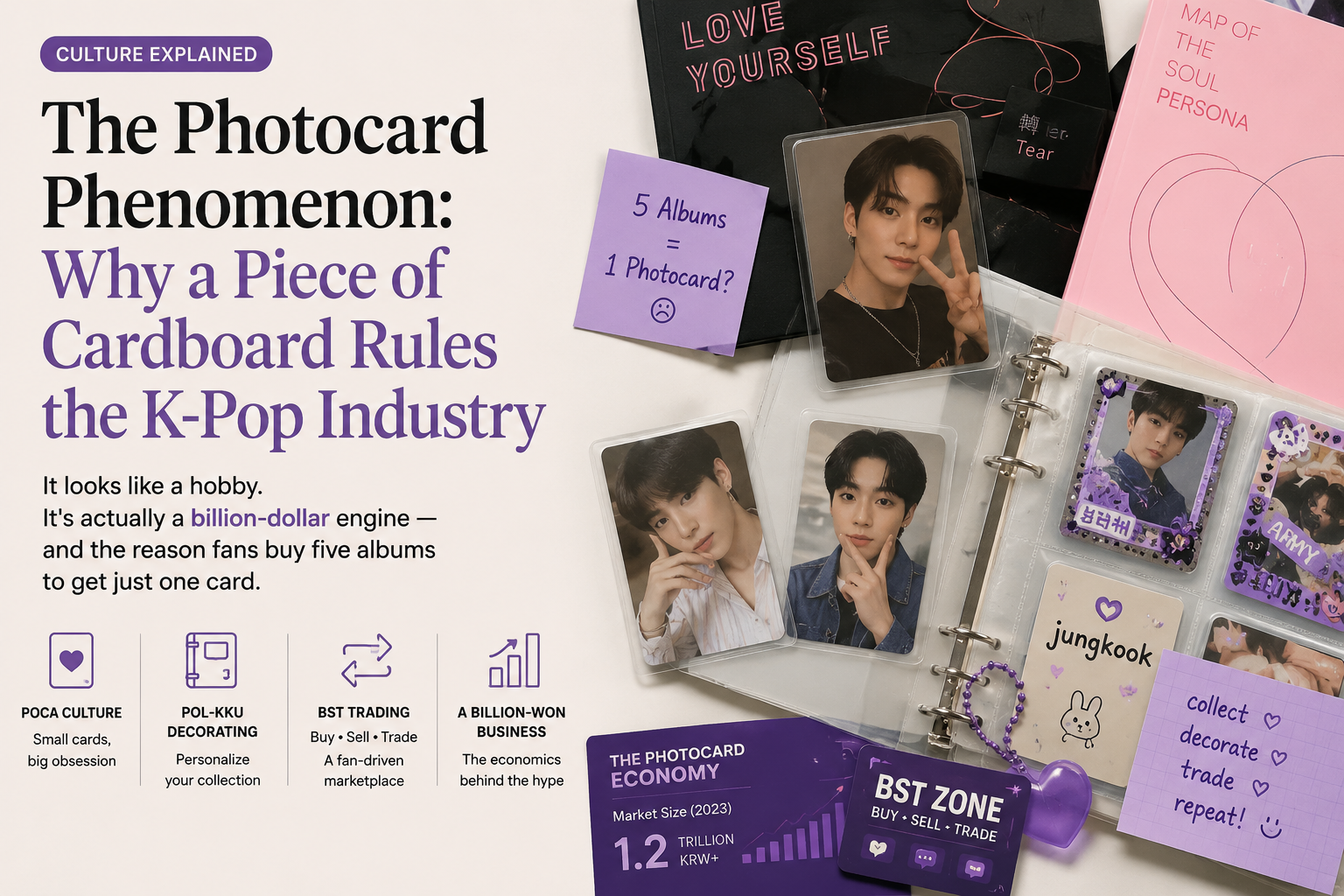
Why a Piece of Cardboard Rules the K-Pop Industry
If you’ve ever watched a K-pop fan carefully slide a small photo into a sticker-covered plastic sleeve like it’s a religious artifact, you’ve witnessed the photocard phenomenon. It looks like a hobby. It’s actually a billion-dollar engine. Let’s explain.
Here’s a scene that plays out thousands of times a day across the K-pop world. A fan buys an album. They don’t open it for the music — the music is already on Spotify. They open it for a small, business-card-sized photo tucked somewhere inside. They flip it over, see which member they got, and either celebrate or sigh in quiet despair.
Welcome to the strange, delightful, and surprisingly enormous world of K-pop photocards. If you’re new here, this guide will get you fluent fast.
A photocard — or “poca,” as fans call it — is a small collectible photo of an idol, usually included randomly inside a K-pop album. Think of it like a trading card for sports, except instead of a baseball player mid-swing, it’s your favorite singer giving a soft studio smile.
The format has surprisingly deep roots. The very first idol photocards trace back to 2007, when TVXQ! included member and group cards in their Japanese album. But the system we recognize today — the random photocard tucked into a Korean album — is widely credited to Girls’ Generation’s 2010 album “Oh!” That’s the moment the modern game began.
Fifteen years later, that little card has reshaped how an entire industry sells music.
— short for “photocard.” The card itself.
— your favorite member of a group. The one you’re collecting cards of.
— the card you actually get when you open an album. “I pulled my bias!” = a very good day.
Here’s the genius — or the diabolical part, depending on your bank account. The photocard inside each album is random. You don’t get to choose. And companies prepare multiple versions of the same album, each version containing a different random card from a larger set.
So if your bias is one member of an eight-person group, and there are four album versions, and each version has its own set of random cards… well. You can see where the money goes. A fan who simply wants one specific card of one specific person might open many albums and still not find them. This practice is so common it has a name: “album kkang” — buying multiple albums and opening them only for the photocards, often leaving the CDs untouched.
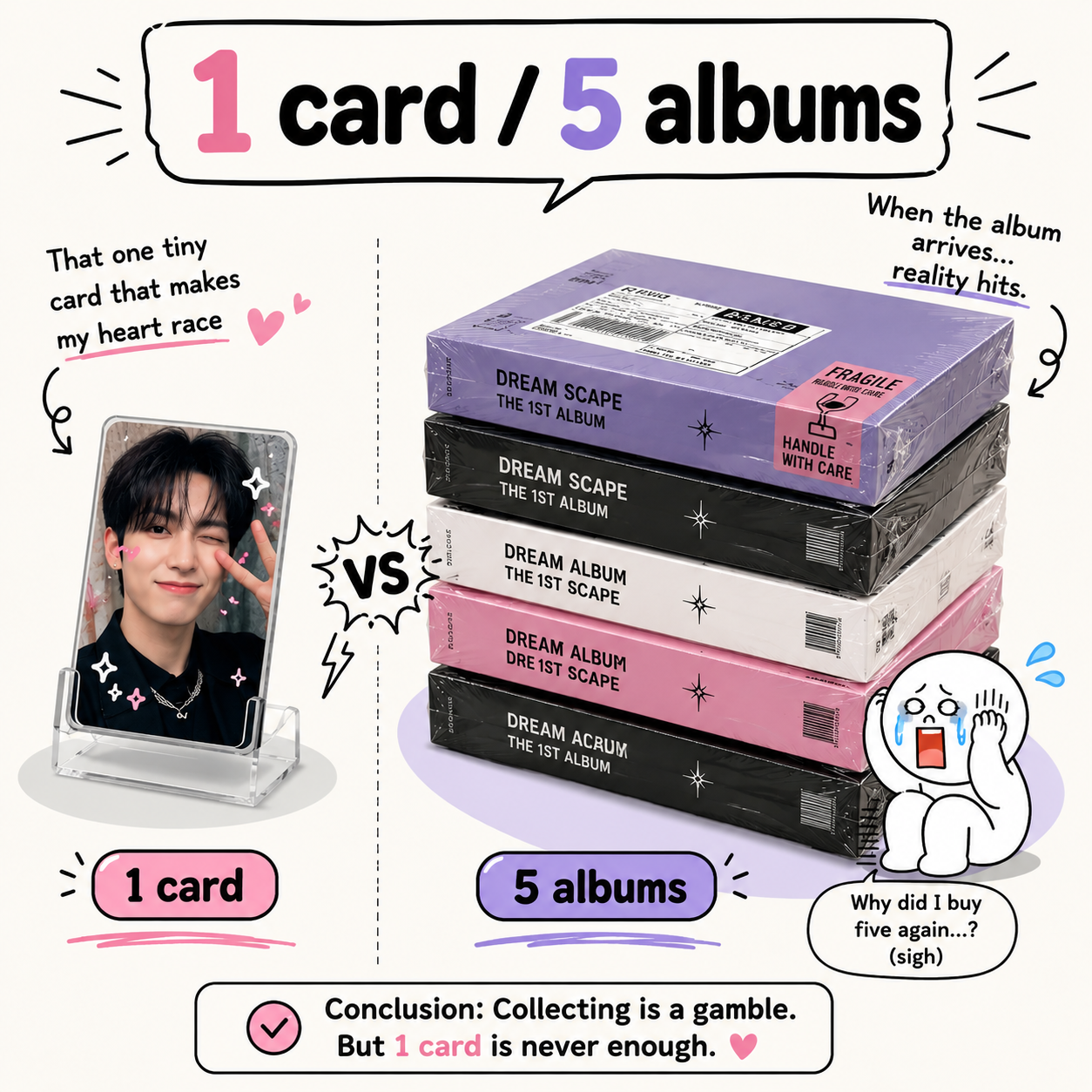
The music is free on streaming. The cardboard is what costs you.
Because the cards are random, an entire secondary universe has grown around getting the right one. This is where photocard culture becomes genuinely beautiful instead of just expensive.
Trading (BST). Fans buy, sell, and trade cards constantly — on Instagram, on X, on resale apps like Depop and Vinted. Got a duplicate of someone else’s bias? Trade it for yours. Many traders tuck in little freebies — stickers, fan-made cards — turning a simple swap into a tiny gift exchange. Fans meet up at concerts, cafés, and K-pop shops to trade in person. It’s a handshake economy built on cardboard.
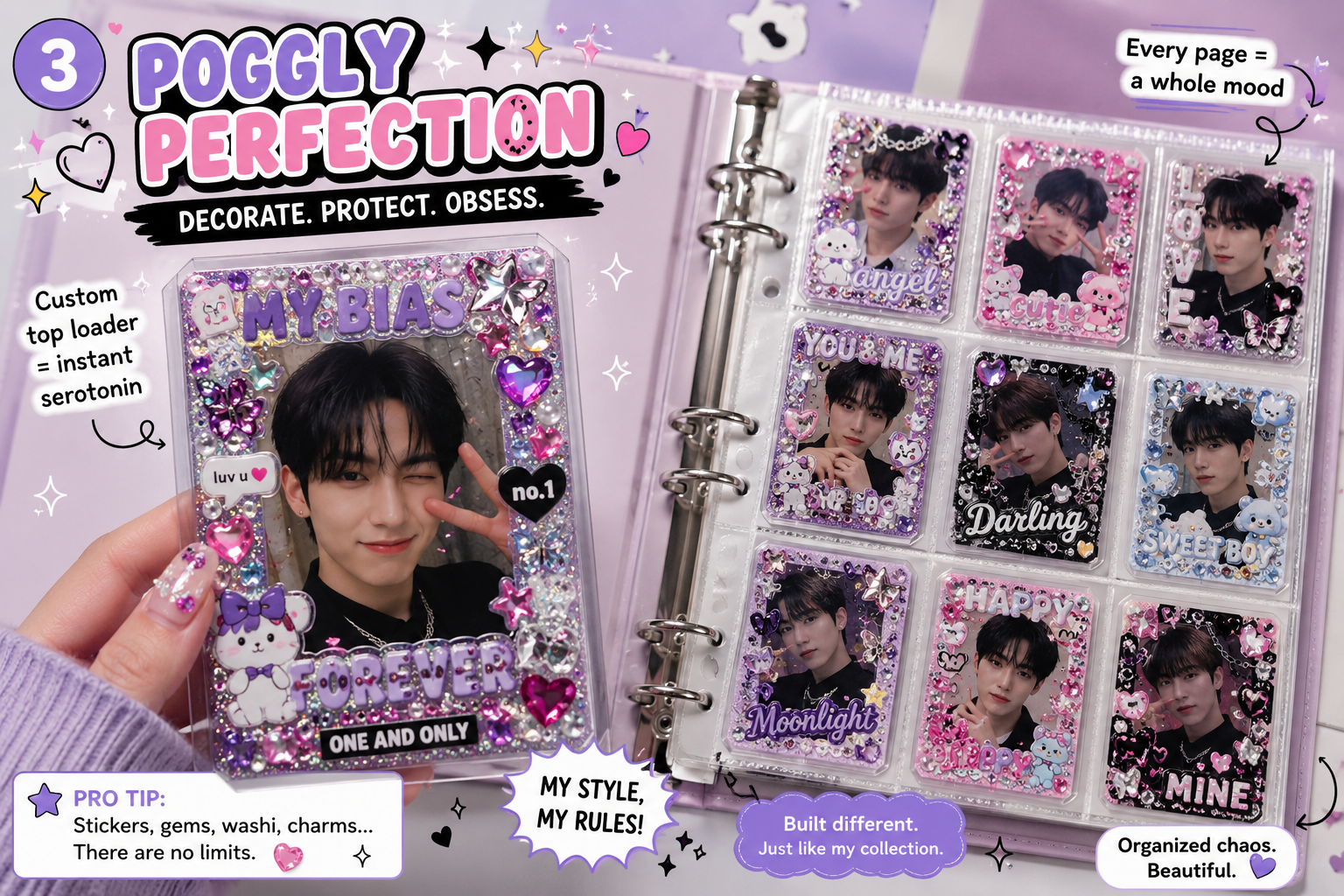
Decorating (“Pol-kku”). Korean fans coined the term “폴꾸” (pol-kku) — short for “Polaroid decorating.” Fans slide their cards into clear plastic “top loaders” and decorate them with stickers, washi tape, tiny gems, and glitter. The result is part scrapbook, part shrine.
Hoarding. And then there are the binders. Page after page of plastic sleeves, organized by group, by member, by era. Some collections grow large enough to qualify, affectionately, as a piece of furniture.
— “Buy / Sell / Trade.” The global resale economy where fans swap cards to complete collections.
— “Polaroid decorating.” Customizing a top loader with stickers and gems.
— the rigid clear plastic sleeve that protects (and frames) a card.
So far this sounds like a charming, slightly obsessive hobby. Here’s where it stops being small.
K-pop merchandise — with photocards as a central driver — is enormous business. Combined merchandise revenue from Korea’s four major entertainment companies hit roughly 791 billion won in 2024, and industry insiders projected it could reach 1 trillion won the following year. That’s a 26% jump. In 2024, the top physical albums in the U.S. averaged thirteen different CD variants — most of them K-pop — each one a fresh chance to sell the same music again with a different card inside.
The Modern Origin
Girls’ Generation “Oh!” — first random poca system
Merch Revenue (proj.)
Korea’s big 4 agencies combined (~$700M), 2025 forecast
Photocard Types
Reportedly issued for a single NCT release
CD Variants (avg.)
Top US physical albums in 2024 — mostly K-pop
Yes — the government actually stepped in because of these cards. In 2023, Korea’s Fair Trade Commission launched on-site investigations into SM, JYP, and YG over concerns that issuing dozens of photocard types per release was an unfair scheme to push fans into buying multiple albums. One group reportedly released nearly fifty different photocards for a single album. A piece of cardboard, it turns out, can summon a federal regulator.
Here’s the part that surprises newcomers. For all the talk of sales tactics and regulators, photocards endure because of something genuinely human: they make a digital relationship physical.
You can stream a song a thousand times and never hold anything. A photocard, by contrast, is something you can keep in your wallet, decorate, gift to a friend, or trade with a stranger who becomes a friend. In a fandom that mostly lives online, the poca is the thing you can actually touch — a small, tangible token of “I was here, I cared about this, this person mattered to me.”
That’s why a piece of cardboard rules the K-pop industry. Not because companies are clever (though they are). Because fans turned a random marketing insert into a language — a way to find each other, show devotion, and make something mass-produced feel personal.
Next time you see someone treating a small laminated photo like treasure, you’ll know: it’s not really about the cardboard. It never was.
Now you can walk into any fan conversation and nod knowingly when someone says they “pulled their bias.” You’re fluent. Welcome to the binder life.
Images in this article were generated using AI (ChatGPT / DALL·E).