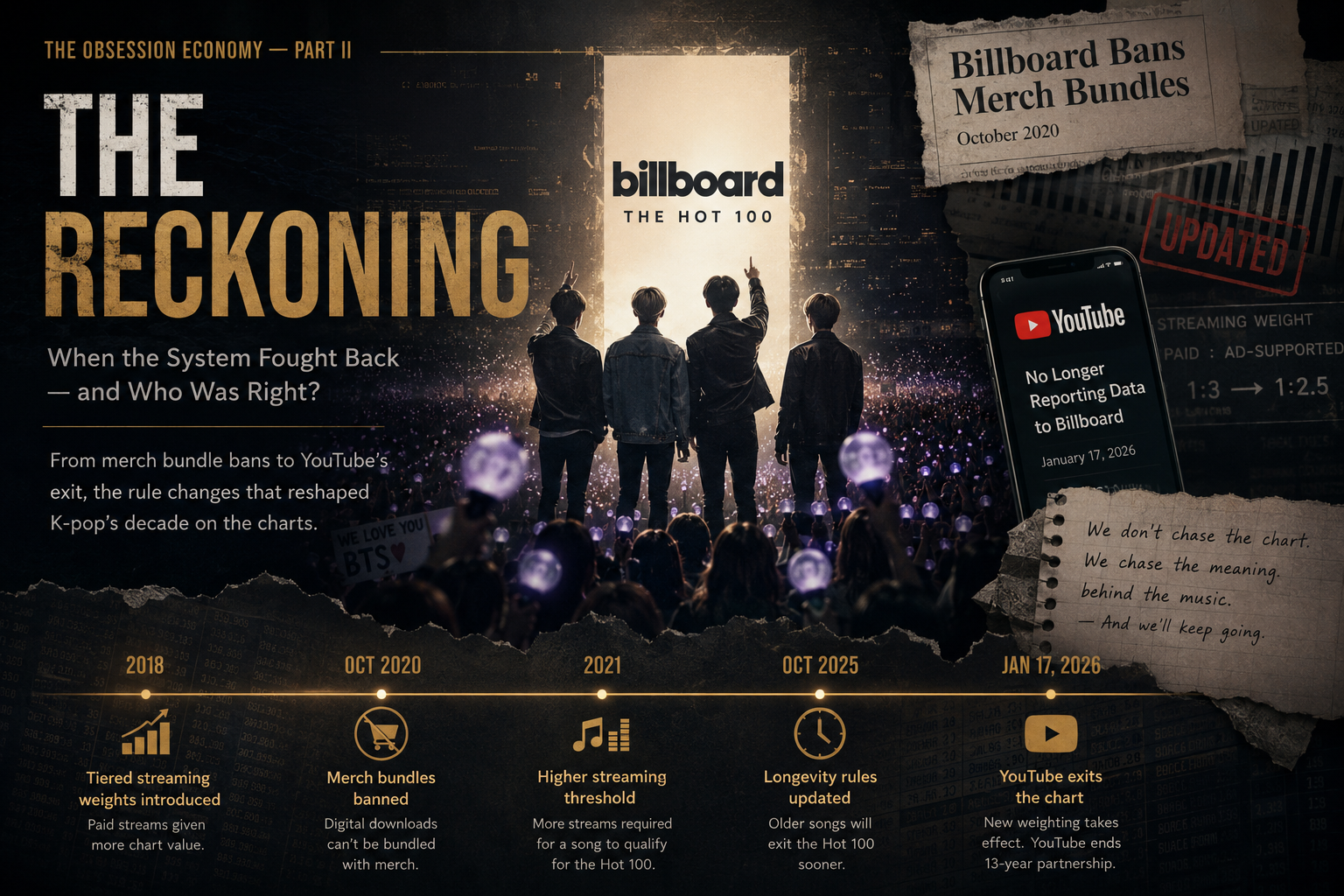
In the fall of 2020 — just weeks after BTS made Billboard history — the chart quietly changed its rules. Bundles, the practice of selling merchandise packaged with a digital music download to boost sales tallies, were prohibited. The announcement drew little mainstream coverage. Inside K-pop fan communities, it was read as exactly what it was: a direct response.
It would not be the last time.
Part I of this series explained how K-pop fans learned to work the chart system — studying Billboard’s methodology, engineering download campaigns, running 24/7 streaming relays across time zones. This part asks a harder question: what happened when the system started fighting back? And the harder question underneath that one: who was right?
Section I
When Billboard
Started Paying Attention
Billboard’s relationship with K-pop has followed an uncomfortable pattern: ignore, accommodate, restrict, repeat.
For most of the 2010s, the chart simply didn’t account for the reality of K-pop fandom. Its formulas were calibrated for domestic American consumption — radio airplay, retail sales, Spotify streams from US accounts. K-pop existed in a separate ecosystem, selling millions of physical albums in Asia and generating enormous YouTube viewership globally, and the Hot 100 barely noticed.
That began to change around 2017–2018, as BTS’s American profile grew large enough to register on multiple chart components simultaneously. Their 2018 album Love Yourself: Tear debuted at No. 1 on the Billboard 200 — the first Korean-language album ever to do so — driven almost entirely by album sales, not streaming. It was a chart result that, by every technical measure, was legitimate. And it made some people in the industry deeply uncomfortable.
The discomfort produced a series of rule changes — some targeted, some broader — that collectively shaped the decade’s chart landscape.
Section II
Why the Rules
Changed — and Who Paid
The January 2026 methodology overhaul is the most significant structural change to the Billboard Hot 100 in years, and it arrived wrapped in a dispute that reveals exactly how much the chart has become a contested arena.
Billboard’s stated rationale for narrowing the paid-to-free streaming ratio was straightforward: paid subscribers generate more revenue per stream, and chart position should reflect economic reality. YouTube’s counter-argument was equally straightforward: over 84% of US recorded music revenue now comes from streaming, most of it from ad-supported services where free-tier access dominates. Counting a premium Spotify stream as worth 2.5 times a YouTube view is, YouTube argued, a choice that disadvantages the platforms where most people actually listen.
YouTube’s Global Head of Music, Lyor Cohen, was unambiguous in his public statement: “Billboard uses an outdated formula that weights subscription-supported streams higher than ad-supported. This doesn’t reflect how fans engage with music today.” After what he described as extensive failed negotiations, YouTube pulled its data effective January 16, ending a partnership that had lasted since 2013.
Before (1:3 ratio): 1 paid stream = 3 ad-supported streams in chart value. Billboard: 1,250 paid streams = one album unit; 3,750 ad-supported streams = one album unit.
After (1:2.5 ratio): 1 paid stream = 2.5 ad-supported streams. 1,000 paid streams = one album unit; 2,500 ad-supported streams = one album unit.
Net effect: It takes 33% fewer ad-supported streams and 20% fewer paid streams to equal an album unit. Streaming counts more overall. But YouTube’s exit from data reporting means the world’s largest music video platform no longer contributes to chart calculations — a significant blow to fan campaigns that historically relied on YouTube view counts as a primary mobilization metric.
For K-pop specifically: The YouTube exit removes a major fan-accessible, free-tier streaming lever. Future campaigns will rely more heavily on Spotify and Apple Music — platforms that require paid accounts and therefore demand more from fans financially.
The irony of the YouTube exit is visible from any angle. K-pop fans built some of their most impressive chart campaigns on YouTube — it was free, global, accessible without a credit card, and its view counts were dramatic enough to generate headlines that drove further organic discovery. YouTube removing itself from Billboard is, structurally, a loss for fan-driven chart culture, even though YouTube’s stated reason was to increase the weight of ad-supported streams.
What’s left is a chart formula that costs more to game. That may be the point.
Section III · Centerpiece
Is It
Manipulation?
This is the question the industry has been circling for six years without quite being willing to answer directly. Let’s not circle it.
The case that K-pop fan streaming constitutes chart manipulation is coherent and worth stating clearly. The case against it is equally coherent. Both deserve more than a dismissive paragraph.
Manipulation — or the Most Honest Thing About the Chart?
The standard critique runs like this: when a song debuts at No. 1 on the Hot 100 with 254,000 downloads and 80% of its chart points sourced from a coordinated fan purchasing campaign, and then falls 44 places the following week when the campaign ends, it has not demonstrated genuine popularity. It has demonstrated organizational capacity. The chart position is not a measurement of how many people love the song. It is a measurement of how many people were willing to buy it four times on release day.
This critique is not wrong, exactly. But it carries an unstated assumption — that chart positions, absent K-pop fandoms, are accurate reflections of organic cultural popularity. They are not, and never have been. The Hot 100 has always been gameable. Payola — the practice of paying radio stations to play songs — was so endemic for so long that Congress passed legislation against it in 1960, and it continued anyway. Label-funded bulk purchases inflated physical sales charts for decades. Streaming farms — automated services that loop tracks to artificially inflate play counts — are an ongoing, documented problem that platforms and Billboard acknowledge they cannot fully detect.
The difference with K-pop fan campaigns is transparency. These operations are publicly documented. The streaming guides are posted on public fan accounts. The Shazam strategies are archived on fan wikis. Fans do not hide what they are doing — they announce it, coordinate it, and celebrate it. This is, depending on your framework, either the most honest form of chart manipulation in the industry’s history, or evidence that it isn’t manipulation at all.
- Artificial first-week spikes A No. 1 that drops 44 places in week two doesn’t reflect sustained popularity — it reflects a coordinated release-week operation.
- Multiple purchases of identical content Buying four versions of the same track to maximize download points exploits a chart mechanic, not genuine consumer demand.
- Chart as PR, not measurement When a chart position is the goal of a campaign, it loses value as an independent signal of cultural impact.
- Barrier to entry Acts without organized international fandoms cannot compete on equal terms, regardless of how good their music is.
- The system was already gamed Payola, streaming farms, and bundle manipulation predate K-pop by decades. Fan campaigns are the most transparent version of practices the industry has always tolerated.
- Real money, real fans Unlike stream farms or payola, every K-pop chart point reflects an actual human being making an actual purchase or streaming decision. The enthusiasm is genuine.
- Adaptation to gatekeeping When radio refused to play Korean-language music, fans found other levers. The intensity of chart culture is proportional to the resistance fans encountered.
- RM said it best “If there is a conversation about what No. 1 should represent, it’s up to Billboard to change the rules.” They did. Multiple times.
The most honest answer is probably this: K-pop fans did not manipulate the chart. They exposed how manipulable it always was. The response — a series of rule changes that specifically targeted the mechanisms fans had learned to use — is itself evidence that the chart’s authority depends on controlling who is allowed to influence it, and how.
That is not a neutral observation. It is an indictment of the chart as an institution. And it came not from critics, but from fans following the instructions that were publicly available to anyone.
Section IV
The Business
Behind the Obsession
There is one more layer to this story that rarely gets told in coverage of K-pop fan culture — and it is the most important one for understanding where this all goes next.
The streaming projects, the download campaigns, the Shazam relays: these were built by fans, for artists, with no direct financial stake. But the infrastructure that sustains, encourages, and monetizes that devotion is a multi-billion dollar corporate architecture — and it has been deliberately engineered to keep fans exactly where they are.
(record high)
active users, 2025
fans spent on Weverse
Weverse Shop in 2025
HYBE’s superfan platform, Weverse, turned its first annual profit in 2025 — a milestone the company described as a key indicator that its transition from a music label to a “fandom business platform” was complete. The distinction matters. A music label makes money when fans buy music. A fandom platform makes money when fans are continuously present, continuously engaged, and continuously spending — on digital memberships, merchandise, virtual goods, and exclusive content that exists nowhere else.
The platform is explicitly designed around what HYBE’s CEO described as a “scarcity model” for 2026: limited-access content, time-gated releases, exclusive fan experiences. This is not a coincidence of K-pop’s culture of closeness. It is an engineered system that converts the emotional bonds between fans and artists into a recurring revenue stream — and that keeps fans returning precisely because the content they value most is only accessible through the platform.
“To innovate future fandom businesses, we will design and test an integrated online and offline experience model based on scarcity.”
— HYBE CEO Lee Jae-sang · January 2026 address to staff
That quote should be read carefully. “Scarcity” in this context is not a description of what exists naturally — it is a design choice. Content that could be widely distributed is deliberately withheld and released to paying subscribers in controlled doses. The fan who streams a song 200 times is also the fan who pays for a Weverse membership, buys the photo card set, and attends the virtual fan meeting. The chart campaign and the subscription platform feed each other: the chart win generates cultural validation; the platform captures the financial value of the community that produced it.
This is the part of the story that doesn’t make it into most coverage of K-pop fandom. The fans are not just participants. They are, in a very specific economic sense, the product.
Section V
What Happens
Next
The question the music industry has been unable to answer cleanly is whether K-pop’s chart culture is a model, an anomaly, or a problem. Six years after “Dynamite,” all three answers remain defensible.
The case for “model”: Western artists and their labels have been studying K-pop fan engagement for years. Taylor Swift’s highly organized album bundles, Beyoncé’s coordinated streaming campaigns, the general industry shift toward superfan monetization platforms — all of these show the influence of K-pop’s playbook. The fans taught the industry what organized passion looks like, and the industry took notes.
The case for “anomaly”: The conditions that produced K-pop’s chart culture are not easily replicated. They emerged from a specific combination of structural exclusion (US radio refusing Korean-language music), extreme fan devotion cultivated by an industry that explicitly engineered parasocial intimacy, and a chart system whose rules happened to be exploitable in ways fans could access without a label’s infrastructure. Remove any one of those conditions and the phenomenon looks different.
The case for “problem”: Billboard’s steady stream of rule changes suggests it views coordinated fan activity as something to be managed rather than celebrated. The YouTube exit accelerates a trend toward a chart that reflects paid-subscription behavior — which, by definition, correlates with disposable income. A Hot 100 calibrated for Spotify Premium subscribers is a chart that systematically underweights listeners who can’t afford a subscription. That is not a neutral technical choice.
Billboard’s own reporting has documented what it calls the “K-pop paradox”: artists like ATEEZ and Stray Kids regularly chart at No. 1 on the Billboard 200 with album sales driven almost entirely by fan campaigns — while their most-streamed cities are Jakarta, Bangkok, and Tokyo, and their title tracks fail to chart in South Korea. Their chart positions reflect fan mobilization capacity, not the organic streaming footprint we typically associate with mainstream popularity.
This is a measurement problem, not a K-pop problem. If a chart position means something, it should mean the same thing for every act. At the moment, it means very different things depending on whether the artist has an organized international fanbase willing to purchase four versions of a digital single on release day.
Editorial
The chart didn’t just measure the music.
It became the battlefield.
I want to be direct about something that tends to get lost in coverage like this, including ours.
The fans who ran streaming projects, who studied Billboard’s methodology and reverse-engineered Shazam, who organized relay shifts across time zones — they were not doing something the music industry hasn’t always done. They were doing it visibly, at scale, without a corporate budget, and in response to an industry that had told them, repeatedly and explicitly, that their artists did not belong in the main categories.
Billboard’s rule changes were framed as technical corrections. What they actually did was move the goalposts every time fans learned where the goals were. The 2026 overhaul — narrowing the paid-to-free ratio, losing YouTube entirely — makes the chart progressively more expensive to influence at the grassroots level. That is a design choice. It is worth saying out loud.
At the same time: HYBE’s “scarcity model,” Bubble’s paid intimacy subscriptions, the engineering of fan devotion into a recurring revenue stream — these are not neutral either. The fans who organized those chart campaigns were genuinely passionate. The companies that monetized that passion were genuinely strategic. Both things are true, and pretending one cancels the other out would be dishonest journalism.
The chart is the trophy. But the question that stays with me, after two parts and several thousand words, is this: in a system where the trophy can be engineered from both sides — by fans below and labels above — what exactly does it prove?
Maybe that’s the most K-pop answer possible: it proves you cared enough to try. Whether the industry respects that is, and has always been, a separate question.