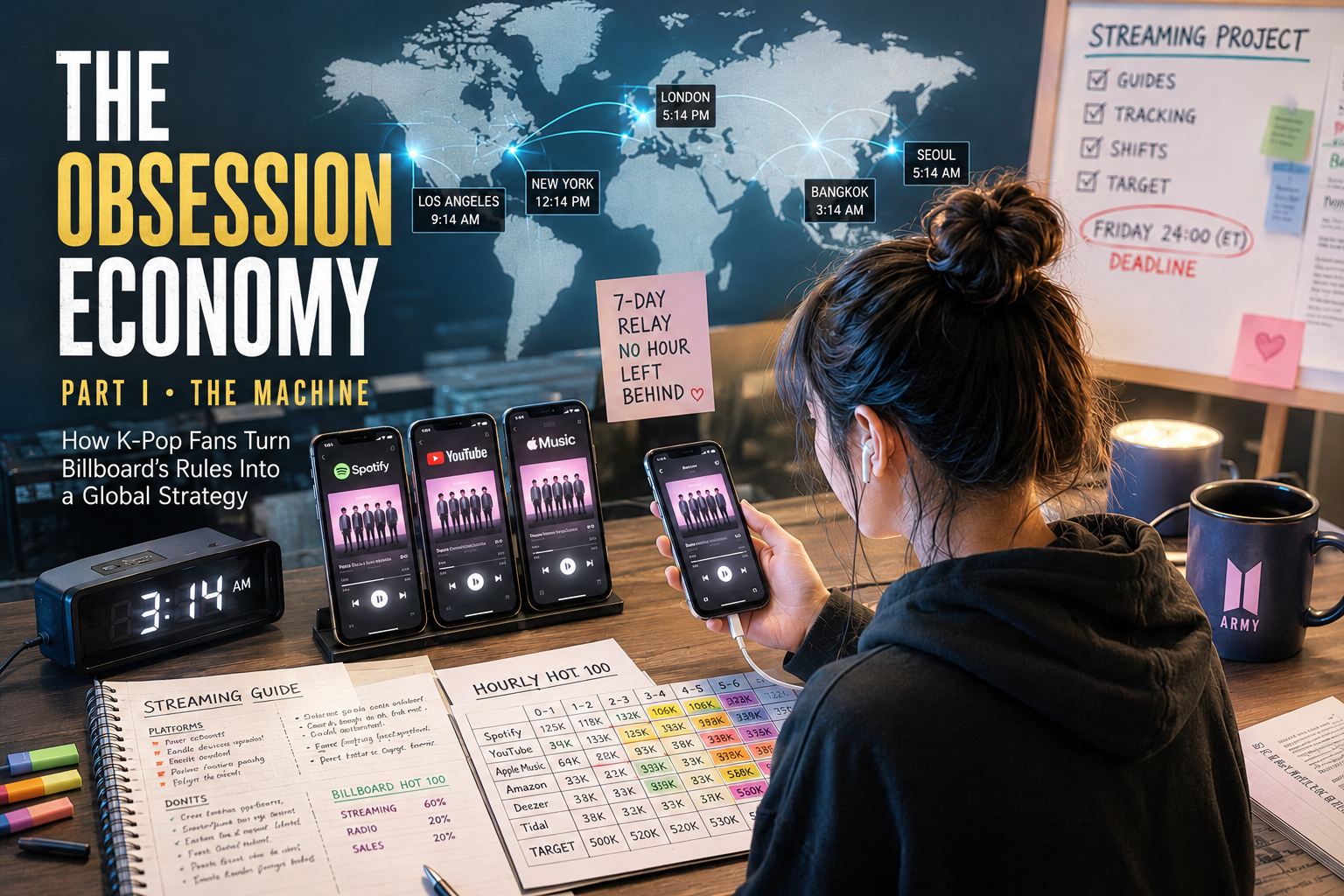
Inside the fandom strategy that turned chart rankings into a collective mission.
It is 3:14 in the morning in Bangkok. A 21-year-old nursing student has set three alarms through the night. Not for an early shift. She is streaming — and she is not alone.
Her phone runs four apps simultaneously. A shared Google Doc, color-coded and updated in real time by fans across six time zones, tracks hourly stream counts and flags which platforms need more volume. When she eventually sleeps, the playlist keeps running. When she wakes, she checks the overnight numbers the way other people check the news. By the time Billboard’s chart data closes — Friday at midnight Eastern — this relay will have run without interruption for seven days.
To most people outside of K-pop fandom, this looks like obsession. To the fans doing it, this looks like something else entirely: strategy.
Section I
What Is a
K-Pop Streaming Project?
In Korean fan communities, the term is 총공 — pronounced chong-gong, literally “total attack.” It refers to a coordinated, time-sensitive mobilization by a fanbase to maximize a single measurable outcome: streams, chart position, music show wins, award votes. It is organized, documented, and executed with a seriousness of purpose that has no real equivalent in Western fan culture.
But to call it “organized” barely captures what actually happens.
In the weeks before a major K-pop release, fan accounts — run entirely by volunteers, often anonymous — begin publishing what are known as streaming guides. These are not casual suggestions. They are operational documents, structured like internal memos at a PR firm. They specify which platforms to prioritize on which days. They distinguish between premium-tier and ad-supported streams and explain precisely why that distinction matters for Billboard’s formula. They advise on YouTube watch behavior — how long to watch before skipping, whether to let a video autoplay or manually replay — because the platform’s algorithm treats each behavior differently when tallying chart-eligible views.
Some guides include hourly timers. Some include shift rotation schedules. The US BTS ARMY official fansite published a guide instructing fans to “act like a human, not a robot” — meaning: vary your listening patterns, interact with the app naturally, do not loop a single track in a way that triggers a streaming platform’s fraud detection filter.
This was not paranoia. It was earned knowledge. Spotify confirmed that during the first 24 hours after BTS’s “Dynamite” dropped in August 2020, approximately 12.6 million plays were registered — but only 7.78 million were counted toward the official chart. Close to five million streams were filtered out. The fans had studied the rules well enough to know exactly where the system drew its lines.
Fan accounts publish platform-specific streaming guides weeks before a release — covering optimal stream behavior per platform, account management, and timing windows tied to Billboard’s chart tracking schedule.
Color-coded tracking documents shared across Discord, X (Twitter), and private group chats monitor hourly progress across all platforms. When numbers drop below target, alerts go out in real time.
Time zone relay systems divide the week into shifts. Fans in East Asia handle overnight hours for the US chart window. North American and European fans cover the rest. No hour goes unattended.
The target is always specific. There is no vague rallying cry. There is a number — a chart position, a stream milestone — and a countdown to the Friday midnight deadline.
Section II
How K-Pop Fans
Learn Billboard’s Rules
Here is the part that surprises most people: K-pop fans do not guess at how charts work. They research it — methodically, obsessively, and often more accurately than the journalists covering them.
The Billboard Hot 100 blends three data sources — streaming, radio airplay, and sales — each weighted differently, and each exploitable if you understand the formula. For years, K-pop fans faced a structural problem: American radio stations routinely refused to add Korean-language tracks. Some stations explicitly told fans they would play the songs only if fans could demonstrate demand — then didn’t follow through when demand was proven. Many fans interpreted the VMAs’ creation of a separate “Best K-Pop” category in 2019 as a way of recognizing K-pop while simultaneously isolating it from the main competitive categories. The walls were real, and documented. So the fans studied every available gap in them.
The result was something that looks, from the outside, like extreme dedication. From the inside, it functions more like a distributed research team.
Downloads were another weapon in the arsenal — one that most of the music industry had quietly abandoned. Prior to 2014, digital sales had been the dominant driver of Hot 100 chart performance. As streaming rose, downloads fell — and the chart formula shifted accordingly. But for a sufficiently organized fandom, that old mechanism could still be weaponized in the first week of release.
The strategy became formalized across dozens of fan operations: release multiple versions of the same track — original, instrumental, acoustic, remix — price each at 69 cents, and coordinate mass purchases across the tracking week. Each version counts separately toward the chart tally. It is, technically, entirely legal. Billboard eventually adjusted its rules in response to the practice. The fans adjusted in turn.
This is not hyperbole. Billboard’s own Pro data team published an analysis in 2023 noting that K-pop releases “routinely rely on downloads to account for more than 50% of chart points” — a figure unmatched by any other genre. For comparison, the average Hot 100 entry that year drew less than 4% of its chart points from downloads. K-pop fans were not playing the same game as everyone else. They were playing an older, harder, more meticulous version of it.
for typical K-pop Hot 100 entry
for non-K-pop Hot 100 entries (2023)
sourced from downloads (2023)
stream weighting ratio
Section III
The Night
Dynamite
Went to No. 1
August 21, 2020. The world is seven months into a pandemic. Live music has stopped entirely. US radio is programming cautiously. And a South Korean group has just released its first all-English-language single — not necessarily the music they most wanted to make, RM would later acknowledge, but a song designed in part to clear the last structural barrier: American airplay.
What happened in the seven days that followed is, depending on your perspective, either a triumph of fan dedication or the most sophisticated grassroots chart campaign in pop music history. Most likely, it was both at once.
How ARMY Took “Dynamite” to No. 1 — and What It Actually Took
Before the song dropped, fan accounts had been circulating a detailed operations document under the header “Dynamite Breakdown.” It covered pre-orders (four copies maximum per format, to avoid bulk-buy detection flags), iTunes purchase timing, YouTube watch-behavior guidelines, Spotify account management — and a methodical radio and Shazam campaign targeting specific US stations by market.
The Shazam targets were specific: 250,000 global Shazams within 24 hours; 450,000–500,000 by end of week one; top 10 on every major country chart. Fans were instructed to Shazam the track, clear their search history, and Shazam again — because Shazam’s algorithm weights unique searches, and because US radio programmers actively use Shazam data to evaluate add requests. The fans weren’t just asking stations to play the song. They were manufacturing the data that stations used to decide whether to play it.
BigHit, for its part, released not one version of “Dynamite” but several — acoustic, EDM, tropical, “poolside.” Each version drove additional purchases. At one point during launch week, multiple versions simultaneously held the top four spots on iTunes. The sales figure that resulted — 300,000 units in a single week — was the biggest digital sales week for any artist in nearly three years, surpassing records set by Taylor Swift and One Direction.
Final chart week numbers: 33.9 million US streams. 300,000 sales. 11.6 million radio airplay impressions. “Dynamite” debuted at No. 1 on the Billboard Hot 100. It was the 1,109th No. 1 in the chart’s 62-year history — and the first ever for a South Korean act.
“If there is a conversation inside Billboard about what being No. 1 should represent, then it’s up to them to change the rules and make streaming weigh more on the ranking.”
— RM, BTS · 2021
That quote, offered the following year, is worth sitting with. RM was not celebrating the system. He was critiquing it — calmly, from a position of authority earned by understanding it in full. And Billboard was, as it happened, already in the process of changing those rules. More on that in Part II.
The Dynamite campaign was not an isolated event. Three years later, Jimin’s “Like Crazy” debuted at No. 1 with 254,000 downloads in a single week — the highest in any week since Taylor Swift’s “Anti-Hero” — accounting for close to 80% of its total chart points. Then, in week two, with no new versions available to purchase, it dropped 44 spots to No. 45: the largest single-week fall for a non-holiday song in Hot 100 history. The machine had executed perfectly. And when the machine stopped, the chart told you exactly that.
It was, in its own way, the most honest data point in the entire story.
Section IV
Why K-Pop Fans
Stream Songs 24/7
The simplest answer — “because they love the music” — is true, but insufficient. Plenty of people love music deeply without turning it into an operational project. Something more specific is happening here, and it runs in several directions at once.
Participation as Ownership
K-pop’s production model is unusually transparent. Fans follow artists from trainee days, watch the process behind each release, and feel — not metaphorically — that they have a stake in the outcome. A chart result is evidence that the work was seen, that it crossed from one cultural context into another. Streaming projects are a way of making that stake concrete and legible.
Community Through Shared Mission
Luminate’s 2025 midyear music industry report found that K-pop fans significantly overindex in online community spaces — Discord, Reddit, WhatsApp, Twitch — compared to fans of other genres. Streaming projects create shared timelines, shared goals, shared moments of success and failure. The mission is almost secondary; the infrastructure of collective participation is the product itself.
Record-Making as Legacy
K-pop fans document obsessively. Every chart position, every milestone, every historical first is catalogued, archived, and cited years later. The goal is not simply for an artist to succeed in the present. The goal is for the success to be historically legible — stamped permanently into the official record of American popular music.
Response to Structural Exclusion
This element is the least discussed in mainstream coverage, and arguably the most important. When US radio refused to add Korean-language tracks, when award shows created separate categories to keep K-pop out of the main competition, fans developed workarounds and escalated. The intensity of K-pop’s chart culture is, in significant part, a response to documented gatekeeping. Streaming projects were not irrational escalation. They were adaptation — precise, effective, and ultimately successful enough to force the gatekeepers to change their gates.
Editorial
The fans didn’t just play the system.
They mastered it.
Music journalism has a habit of treating fandom as downstream of the industry — as something that happens after the decisions have been made. K-pop streaming culture is a sustained, empirical argument against that framing.
These fans learned Billboard’s methodology from primary sources. They reverse-engineered Shazam’s algorithm. They ran shift rotations across continents. They built, in their spare time and entirely without compensation, an operational infrastructure that most label marketing departments couldn’t replicate with a budget. And they did it not to game the system in any dark or covert sense — they did it because the system had made clear it wasn’t going to move for them otherwise.
September 1, 2020, was the 1,109th No. 1 in Billboard’s 62-year history. It was not an accident, and it was not passive. These fans studied the rules, found the pressure points, and pushed. And then Billboard changed the rules.
Whether that’s the end of the story, or the beginning of a more complicated one, is what Part II is for.