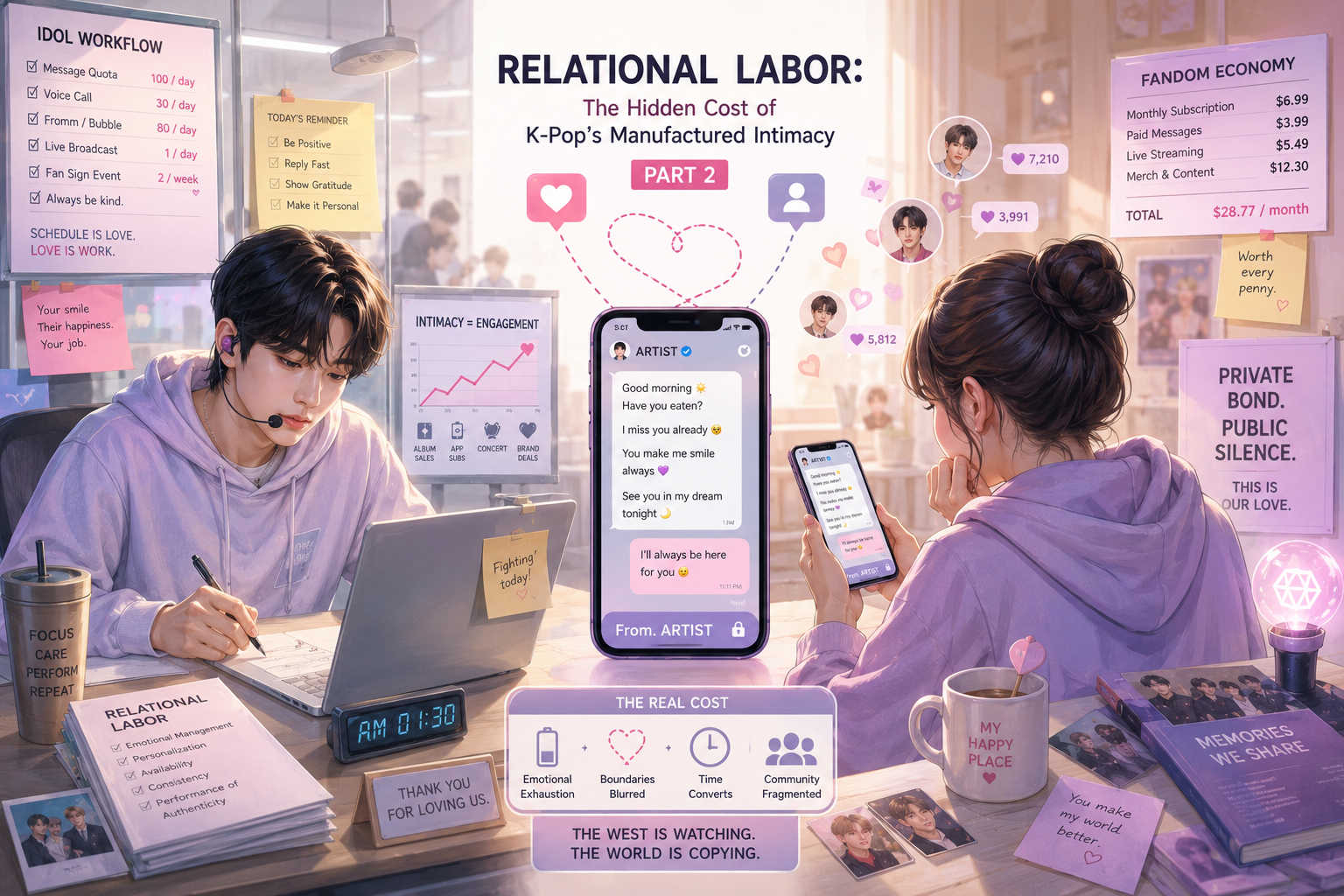
In Part I, we traced how K-pop turned the feeling of closeness into a subscription. But a subscription implies a service, and a service implies someone performing it. So here is the question Part II is about: when intimacy becomes a product, who does the work of producing it — and what does that work cost them?
There’s a term academics have started using for what idols do on these platforms, and it’s worth sitting with because it’s so clinically honest: relational labor. The emotional engagement work a performer does to build and maintain a fan’s sense of attachment. Not singing. Not dancing. The work of seeming like a friend.
And like any labor in a system optimized for output, it comes with metrics.
A 2025 study published in Popular Music and Society analyzed Bubble through the lens of labor process theory, and what it found is striking. According to interviews with industry insiders, idols often face contractual pressure to send a minimum quota of messages per month. This isn’t speculation — NCT 127’s Jaehyun has openly mentioned on Bubble itself that he’s expected to send at least four messages a month.
Think about what that means. The spontaneous “good morning” text that makes a fan’s day was, on some level, a deliverable. The casual selfie was a line item. The system transforms intimacy into a measurable performance metric — and a metric, once it exists, becomes a target to hit whether or not you feel like hitting it that day.
It goes deeper than a flat quota. According to a company official involved in contract procedures, cited in the same research, an idol’s revenue-sharing rate increases by 10% each time their subscriber count crosses a certain threshold.
Read that again, because it reframes everything. The more subscribers an idol holds, the larger their cut. Which means the system financially rewards idols for performing closeness more relentlessly, more convincingly, more often. The warmth isn’t just contractually required — it’s incentivized to escalate. The friendlier you seem, the more you earn. There may be no more efficient machine for converting a human being’s capacity for connection into a key performance indicator.
The “good morning” text that made your day was, somewhere on a spreadsheet, a deliverable that someone was contractually required to produce.
None of this means the idols are cynical, or that the affection is fake. Most likely, much of it is genuine — that’s what makes it sustainable. But genuine feeling performed on a quota, under financial incentive, on a platform that measures it, is a strange and demanding kind of work. It is emotional labor with a dashboard. And we are only beginning to ask what it does to the people performing it, week after week, for years.
What It Does to the Fan
Here is the part that surprised me most in reporting this, because it inverts what you’d expect. You’d assume a platform built to connect fans to idols would also connect fans to each other. The opposite is happening.
Scholars studying Weverse have described what they call the technological domestication of fan community — and the finding is unsettling. If fandom was once a community, a public bound together by shared care for the music and the artist, the platform era is quietly replacing that with something more isolated: an atomized model where community is circumvented entirely, swapped out for a single private parasocial relationship between one fan and the corporate product they’re devoted to.
The old fandom was loud, collective, and messy. Fans met on forums, argued, made friends, organized, built things together. The bond was horizontal — fan to fan — as much as it was vertical, fan to idol. The community was the point, and the idol was what the community gathered around.
The subscription model rotates that bond ninety degrees. It sells each fan their own private line to the artist — a vertical relationship, monetized individually, experienced alone at 3:47 a.m. under a duvet. The more perfectly the platform delivers the feeling of one-on-one intimacy, the less reason there is to turn sideways and find the person standing next to you, who is paying for the exact same private moment with the exact same person at the exact same time.
It’s connection engineered to feel personal while functioning as isolation. You’re closer to the idol than ever. You may also be more alone in your fandom than fans have ever been.
The West Is Buying In
If you’re tempted to file this as a peculiarity of Korean pop culture, don’t. The most telling development of the last two years is how aggressively the Western industry has moved to copy the entire model.
Universal Music Group invested in HYBE’s Weverse in 2024, then acquired a stake in the superfan app Stationhead. UMG chief Lucian Grainge has named superfan monetization a strategic priority, promising “enhanced premium tiers for superfans” in 2026. Spotify is developing a super-premium subscription tier. Warner Music’s CEO has confirmed the company is building its own superfan app. Apple Music is testing artist-direct features. Ariana Grande and Dua Lipa are already on Weverse alongside BTS.
The thing Seoul built to sell intimacy is now the thing the entire global music industry is racing to own. K-pop didn’t just develop a clever regional revenue stream. It prototyped the future business model of recorded music, and the biggest companies on earth have looked at it and decided: yes, that. We want that.
This is no longer a K-pop story. It’s the story of where all of popular music is heading — toward a model where the song is a free sample and the real product is a monthly, renewable, metric-driven relationship with an artist who is professionally obligated to make you feel close. K-pop just got there first.
So — why does an idol have to act like your friend? Because friendship, it turns out, is the most renewable product the music industry has ever discovered. A song you buy once. A friend you keep paying for.
And it would be easy, and lazy, to end this by calling the whole thing dystopian. It isn’t, quite. The warmth fans feel is real. The income idols earn is real. The connection, however engineered, fills a genuine human need in a lonely, scattered, digital world. There’s no villain here — just a system that found an extraordinarily efficient way to turn one of the most human things we have into a line of recurring revenue.
I subscribed to a Bubble for two weeks while reporting this. I’m not going to pretend I’m above it. The messages were lovely. I looked forward to them. On day nine, an idol I’d never met sent a voice note saying goodnight, and I felt — briefly, embarrassingly — cared for.
That’s the whole thing, right there. It worked on me, a cynical editor who knew exactly how the machine was built, knew about the quota, knew the message went to thousands of people at once. And it still worked. That’s not a knock on the fans. That’s a measure of how good this system has become at doing the one thing it was designed to do.
I cancelled the subscription. I’d be lying if I said I didn’t think about resubscribing. Make of that what you will — I’m still making something of it myself.
Part I: The Friend You Pay For · Part II: Relational Labor