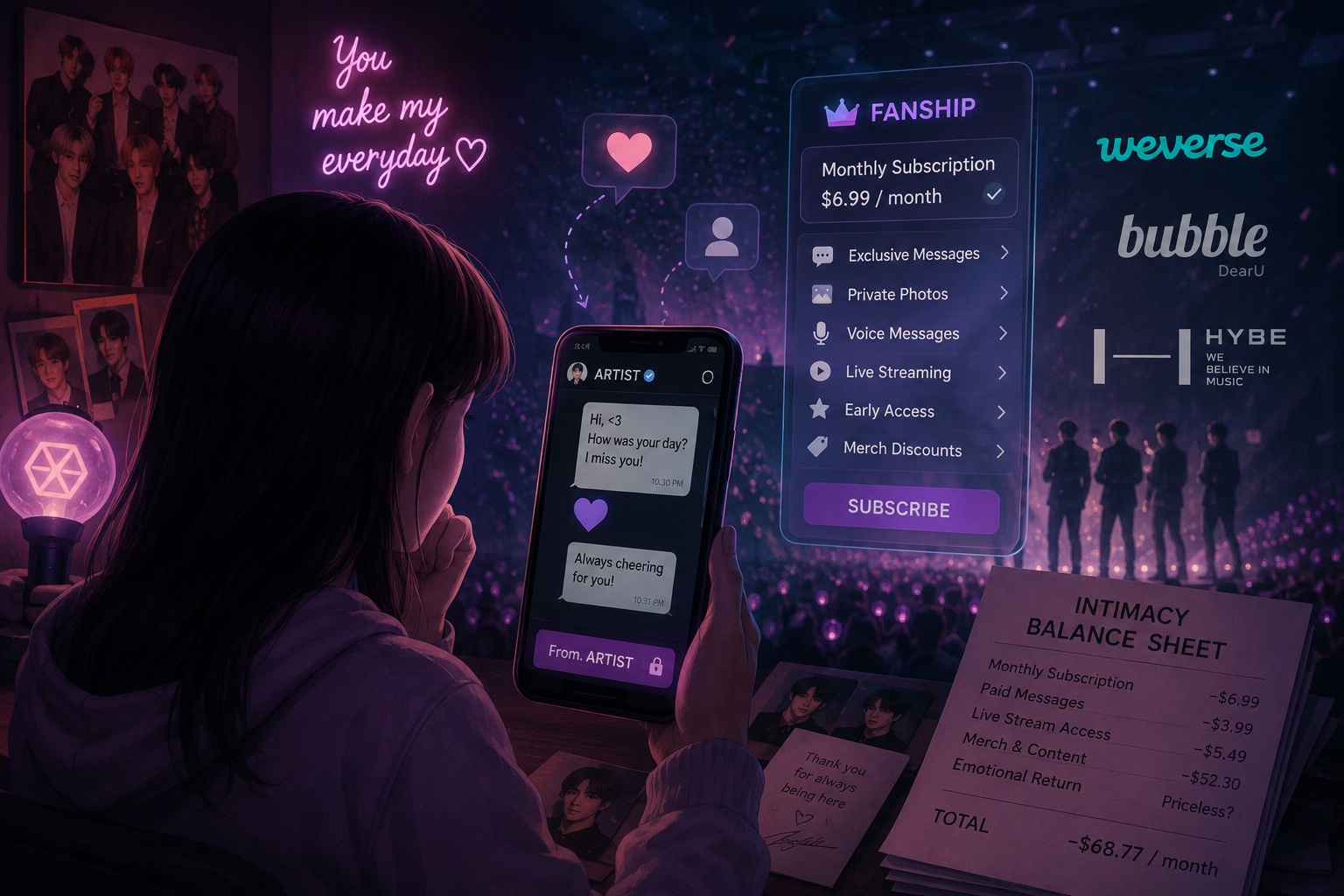
It’s 3:47 a.m. in Bangkok. A graduate student is awake under her duvet, phone glowing. A notification lights the screen: a message from her favorite idol, just for her. Except it isn’t just for her. It’s for several hundred thousand people, sent at once, and it cost her US $3.99 a month to receive. None of that makes the warmth she feels any less real — and that, precisely, is the business.
There is a question at the center of modern K-pop that almost nobody says out loud, because saying it out loud breaks the spell: why is an idol — a figure who is supposed to be aspirational, untouchable, larger than life — expected to talk to you like a friend texting from the next room over?
The answer is not sentimental. It’s structural. Somewhere in the last decade, the K-pop industry discovered that the most valuable thing it could sell was not a song, or a concert ticket, or even a photocard. It was the feeling of closeness — and it has spent the years since building an extraordinarily sophisticated machine to manufacture, package, and bill for that feeling on a recurring basis.
This is the story of how friendship became a product.
Intimacy as Interface
Open Bubble — the subscription messaging service that originated with SM Entertainment — and the first thing you notice is how familiar it looks. That’s not an accident. Its interface deliberately resembles KakaoTalk, Korea’s dominant personal messaging app, so that receiving a message from an idol feels structurally identical to receiving one from a close friend or a family member. The bubbles are the same shape. The notification lands the same way. The design’s entire purpose is to produce an illusion of one-to-one conversation — a pseudo-intimacy engineered down to the pixel.
For roughly $3.99 a month per artist, a fan can subscribe and send “direct” messages, and receive the idol’s photos, voice notes, and casual updates in return. HYBE’s Weverse introduced its own version, Weverse DM, in 2023, at around $4.59 a month. The idol’s reply may not be addressed to you specifically. It doesn’t matter. The interface has already done its work. Your brain processes the message the way it processes any text in that familiar chat window: as personal, as warm, as yours.
The genius wasn’t building a messaging app. It was making the messaging app feel exactly like the one you already use to talk to people you love.
This is the part worth slowing down on, because it’s the hinge of the entire model. K-pop didn’t invent the parasocial relationship — the one-sided emotional bond between a fan and a distant performer is as old as celebrity itself. What K-pop did was build the infrastructure to monetize it directly, turning a vague feeling of connection into a measurable, subscribable, renewable transaction. The parasocial bond used to be a byproduct of fame. Now it’s the product itself.
The Numbers Behind the Feeling
If this sounds like a soft, fuzzy, hard-to-quantify corner of the business, the financials will correct you quickly.
HYBE — the company behind BTS — posted record annual revenue of 2.65 trillion won in 2025, roughly $1.86 billion. Look at where that money came from, because the breakdown tells the whole story. Concert revenue grew 69% year over year. Merchandising and licensing climbed 35.8%. And the legacy product — recorded music, the actual songs — declined 10.2%. The thing the industry ostensibly exists to make is shrinking as a share of the take. Everything around the music is what’s growing.
Weverse MAU (Q1 2026)
Up 20% QoQ — a record, driven by the BTS reunion
HYBE Revenue (2025)
Record high — while recorded music fell 10.2%
Per Artist / Month
Bubble’s subscription price for “direct” messages
Minutes / Month on Weverse
Average time a user spent on the platform in 2025
Weverse alone reached 13.37 million monthly active users in the first quarter of 2026 — a record, up 20% from the previous quarter, propelled by BTS’s full-group reunion. The average user spent 263 minutes a month inside the app in 2025. That’s more than four hours, every month, living inside a space designed to feel like proximity to someone they’ll almost certainly never meet.
This is why analysts have stopped treating fan platforms as a curiosity. Goldman Sachs estimated the superfan-monetization opportunity at $4.3 billion in additional annual revenue for the recorded-music industry. That figure is not built on streams. It’s built on closeness.
Why the Song Stopped Being the Point
To understand how we got here, you have to go back to the wound that made it necessary.
When digital downloads gutted music revenue in the early 2000s and per-stream payouts arrived at fractions of a cent, the Korean industry made a decision Western labels were slower to make. It accepted that the recording itself would no longer reliably pay the bills — and it repositioned the recording as a marketing asset. The song became the funnel. The artist-fan relationship became the thing actually being sold.
The lineage is traceable. Girls’ Generation’s 2010 album “Oh!” was the first Korean release to tuck a photocard inside — a small physical token of connection that, within a few years, became near-mandatory across the industry.
The photocard was the analog prototype. It proved that fans would buy not just the music, but a tangible piece of closeness to the artist. The fan platform is simply that same insight, digitized, scaled, and put on a monthly billing cycle. The cardboard taught the industry the lesson. The software industrialized it.
And it works because it solves the industry’s oldest problem: unpredictability. A hit is a gamble. A tour is a logistical and financial risk. But a subscriber base is recurring, predictable revenue — the same reason every software company on earth wants you on a monthly plan instead of a one-time purchase. By moving fans from one-off purchases to subscriptions, K-pop built a financial floor beneath itself. Even when an artist pauses — for military service, for a hiatus, for anything — the monthly fees keep arriving.
Stop thinking of the song as the product. In 2026, the song is the advertisement. The product is the relationship — and the relationship renews automatically on the first of every month, whether or not new music ever arrives.
There is something undeniably brilliant about this. There is also something worth examining closely before we applaud it. Because a system this efficient at manufacturing closeness raises two questions it would rather you didn’t ask. What does it cost the person on the other end of the message — the idol, contractually obligated to be your friend? And what does it do to the fans, sold individual intimacy in place of the community they used to have?
That’s where we’re going next.
The message that lands at 3:47 a.m. didn’t write itself. Someone was contractually required to send it. In Part II: the labor behind the friendship, and the community it quietly replaced.