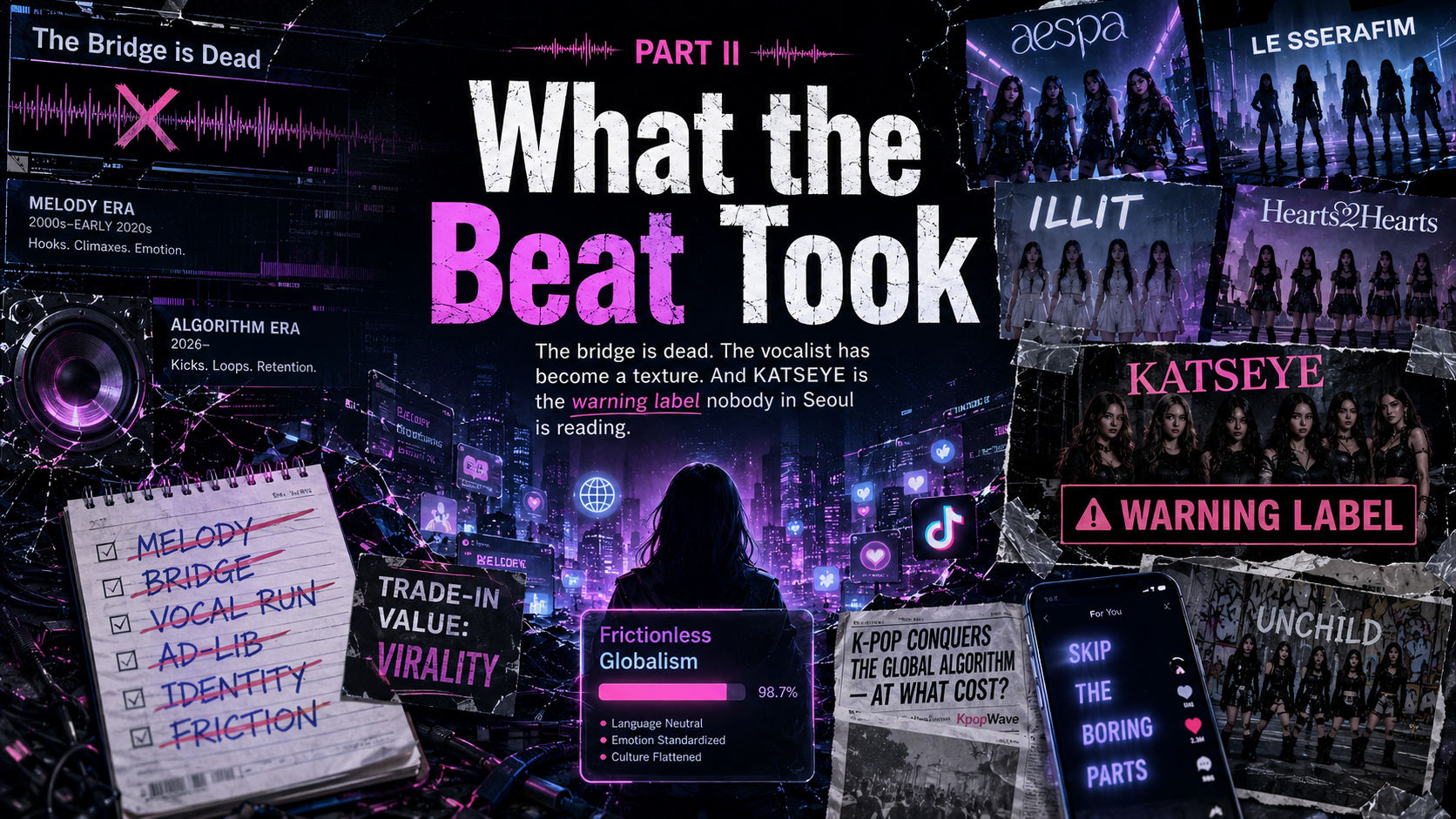
Let’s be precise about what happened. The techno femme wave of spring 2026 is not a genre. It is a convergence — multiple groups, multiple labels, multiple production teams arriving independently at the same industrial conclusion. Hard drops, repetitive hooks, and synchronized movement create emotionally intense clips that perform strongly across TikTok, YouTube Shorts, and Instagram Reels. Four-on-the-floor doesn’t require translation. A hardstyle drop registers identically in São Paulo, Stockholm, and Seoul. For strategists building global acts, that’s not a stylistic preference. It’s a supply chain decision. The music followed the logic. Now comes the reckoning.
The architectural achievement of classic K-pop — its most exportable and least replicable quality — was structural maximalism. Verse builds tension. Pre-chorus elevates it. Chorus delivers release. And then, in the back half, a bridge: a melodic and emotional left turn, often built around a high note from the main vocal, that recontextualized everything that came before it. The song rewarded full listens. The emotional payoff was buried at the three-minute mark, and finding it felt like a discovery.
Four-on-the-floor production flattens this architecture. When the kick drum is the protagonist, the song cannot afford to slow down, pivot, or surprise. The emotional peak has to arrive within the first thirty seconds — because that’s the clip window — and then sustain that temperature until the track ends. There is no climb because there is no summit to reach. There is only the plateau.
The bridge didn’t die quietly. It was optimized out of existence.
Techno and hard house are genres in which the vocalist is not the lead instrument. The beat is. In this production context, an idol’s voice functions less as a vehicle for emotional narrative and more as a synthesizer layer — another texture in the mix, processed with reverb and autotune until it blends into the mechanical fabric of the track.
Listen to how the vocals sit in “BOOMPALA” versus how they sit in LE SSERAFIM’s “ANTIFRAGILE” from 2022. In the latter, the voices carry distinct character — you can identify who is singing, and the emotional grain of each performance contributes to the song’s meaning. In the former, the vocals are chanting. They are rhythmically precise and sonically anonymous. The group’s individual vocal identities have been smoothed into a delivery mechanism for the hook.
This is happening across the board. When every group adopts the same production language, the individual textures that differentiated them begin to dissolve. The convergence is sonic. Its consequences are about identity.
The choreography shift is inseparable from the sonic one. Pre-techno K-pop choreography was built around formation changes, geometric precision, and full-body synchronization that required months of spatial rehearsal to execute. The body moved through space. The dance told a story.
High-BPM techno rewrites the physical brief entirely. IVE’s “BANG BANG” introduced a shoulder-swaying “Shoulder Dance,” a “Keyring Dance” mimicking headbanging, and an “Ayaya Dance” centered on dramatic back-bending — all upper-body isolations, all executable in a tight frame, all built for a vertical phone screen. The choreography has been cropped. Not by accident. By platform specification.
The TikTok dance challenge is not an organic byproduct of good choreography. It is the design brief. The thirty-second upper-body isolation moment is conceived first; the full stage performance is built around it. The idols are not dancing to the music. The music is being written for the dance. And the dance is being written for the clip.
Who Is Still Building Something
Not everyone collapsed into the consensus. The distinctions matter.
And UNCHILD. Six members, one month old, one debut single that sounds like a room full of people who haven’t yet been told what they’re not allowed to do. Chaotic. Overstuffed. Slightly unhinged. In a landscape of surgical optimization, that sloppiness is not a flaw. It is the only honest answer to a question the industry doesn’t know it’s asking.
The K-Pop Export Without the “K”
To understand where frictionless globalism terminates, you have to look outside Seoul entirely. KATSEYE released “PINKY UP” on April 9th, hours before their Coachella debut, pairing K-pop precision with a playful, high-fashion edge. It debuted at No. 14 on the UK Official Singles Chart and No. 28 on the Billboard Hot 100. By every commercial metric, it is among the most successful singles released in this entire wave. HYBE’s hypothesis, tested and confirmed.
But to call “PINKY UP” a K-pop success requires a meaningful distortion of the term. KATSEYE — formed in Los Angeles, singing in English, performing at Coachella — represents the logical endpoint of the globalization project that the Seoul-based groups are currently undertaking by degrees. HYBE took the K-pop methodology: the synchronized performance, the rigorous A&R precision, the visual world-building, the production infrastructure. And then removed the geography. The language. The cultural idiosyncrasy. The maximalist genre collisions. The things that made the original strange.
When “Celebration” was produced in part by Swedish contributors, LE SSERAFIM was moving toward KATSEYE’s coordinate. When “BOOMPALA” samples a 1993 Spanish dance hit to access a pre-loaded emotional response in a global audience, it is moving toward KATSEYE’s coordinate. When aespa strips the cyber-mythology from its production and leaves only the grinding synth bass, it is moving toward KATSEYE’s coordinate.
KATSEYE is not the future of K-pop. It is the warning label. When you remove the cultural friction, the supply chain works flawlessly. “PINKY UP” sounds great in a Coachella tent. It sounds like the global market, because it is the global market. It poses a devastating question for every label in Seoul currently optimizing their sound for maximum international portability: if you can build a perfectly frictionless K-pop product by removing the “K,” what strategic value remains in keeping it?
The genre has always cycled. But this cycle is different in kind, not just in content. Previous shifts — cute era to girl crush, girl crush to concept ambiguity — were changes in aesthetic register. This one is a change in underlying logic. The music is no longer being designed to be experienced. It is being designed to be deployed.
We traded the architectural bridge for a heavy kick drum. We traded vocal identity for mechanical chanting. We traded the maximalist, genre-colliding chaos that made this music genuinely strange — and therefore genuinely worth paying attention to — for a sound so perfectly calibrated to global distribution that it has begun to lose the thing that made it worth distributing.
The floor has dropped. The numbers are extraordinary. The clips are everywhere.
I have spent the better part of this spring listening to high-BPM Korean girl group releases, which is either rigorous journalism or a specific form of auditory punishment, depending on your perspective on the distinction.
Here is what I keep coming back to: the groups that genuinely unsettle me in this cycle are not the ones executing the consensus flawlessly. Those are impressive. They are also, increasingly, interchangeable. What unsettles me are the moments where something slips through the optimization — a melody that shouldn’t survive the production but does, a vocal choice that’s wrong for the brief but right for the song, a debut that’s too chaotic to be useful on TikTok and too alive to ignore.
UNCHILD is a mess. It is the most interesting mess I’ve heard this spring.
The techno wave will peak, as waves do. When it recedes, I want to know what’s left standing on the shore. My money is on the groups who never fully surrendered to the kick drum — who kept the melody alive somewhere in the track, even when the algorithm was asking them not to. They exist. You can hear them in the margins of May 2026, if you listen past the pile-up.
Part I: The Floor Drops Out · Part II: What the Beat Took