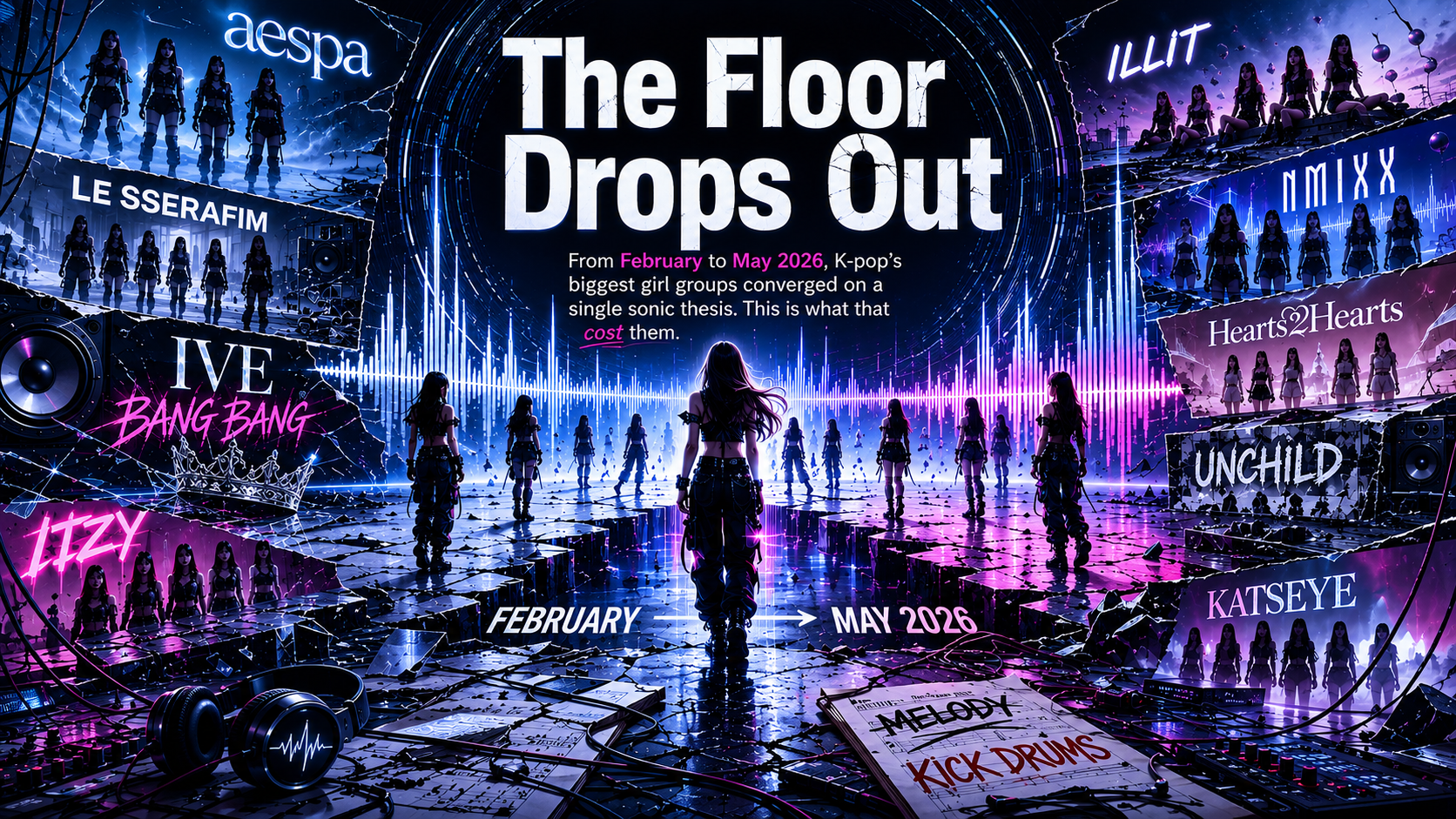
2026년 2월부터 5월까지. 서울의 스튜디오 시스템이 같은 주파수로 조율되었다. 그 주파수는 당신의 흉골을 진동시키고, 멜로디가 있던 자리를 공백으로 남긴다.
There is a moment in LE SSERAFIM’s “Celebration” where the drop arrives not as a reward for patience, but as a declaration. No build. No courtesy. Techno and hardstyle, two minutes and thirty-three seconds. By the time the kick lands, the argument is already over. You just need to feel it in your sternum.
This is not the K-pop of three years ago. Not the era of pastel aesthetics, melodic patient payoffs, or the deliberate approachability that once served as the genre’s universal passport. From February through May 2026, the industry’s biggest girl groups — plus a wave of rookies too new to know they were supposed to ease in — converged on a single sonic thesis. Harder. Faster. Louder. European club structures. Four-on-the-floor kicks. High BPM, heavy synth bass. Tracks engineered not to be listened to so much as detonated.
This is the story of four months that changed what K-pop sounds like. Whether that’s progress depends entirely on what you think K-pop was for.
Major Girl Group Releases
February – May 2026
BPM — BOOMPALA
LE SSERAFIM’s Latin house title track
Countries — iTunes Top 10
aespa “WDA” upon release
Runtime — Celebration
LE SSERAFIM. Techno / hardstyle.
February — The First Shot
IVE’s “BANG BANG,” released February 9th, opened on a striking Western swing-inspired intro before launching into a high-energy EDM and electronic foundation — punchy, straightforward, structurally unambiguous. The song’s verses exist to set up choreography. The chorus exists to set up TikTok. The pairing of fast-paced EDM with powerful choreography produced instantly recognizable moves — a shoulder-swaying “Shoulder Dance,” a hand-driven “Keyring Dance” mimicking headbanging, a dramatic back-bending “Ayaya Dance” — that sparked viral challenges across platforms within hours of release.
“BANG BANG” ranked No. 1 on Melon HOT100 shortly after its release. The comeback cycle around it — feeding into full album REVIVE+ — demonstrated with clinical precision how the industry now thinks about a music release. The thirty-second moment is designed first. The full three minutes is the extended cut.
Three weeks later, Hearts2Hearts — SM Entertainment’s eight-member rookies, fourteen months into their career — dropped “RUDE!” on February 20th. A house-based dance song with a rhythmic groove and bouncy synth sounds, praised for its “nostalgic yet fresh and propulsive” sound. The group had already swept multiple Rookie of the Year wins at MAMA and MMA. “RUDE!” consolidated a lane SM hadn’t owned since early f(x): electronic pop sleek enough to feel global, warm enough not to frost over.
“Sleek and fashionable — tasteful to the point of feeling generic within this era of subdued house sounds.”
— The Bias List, on Hearts2Hearts “RUDE!”
The backhanded compliment is itself evidence. There are now enough groups in this sonic territory that “generic” has become a coherent critique. Six months ago, that sentence couldn’t have been written.
April — The Escalation
ILLIT arrived April 30th with MAMIHLAPINATAPAI — a title that is either a stroke of playful genius or a publicist’s nightmare, depending on your tolerance for the unpronounceable. The title track “It’s Me” is a techno song describing the feeling of wondering what your relationship with someone is after a first date. The EP incorporates drum and bass, techno, electro-pop, pop rock, and alternative pop. What’s notable about “It’s Me” is that it threads genuine emotional warmth through a production style that in lesser hands registers only as aggression. The group described it as “a song like hot pot that you can’t stop eating once you start.” The metaphor is undignified and completely accurate.
Meanwhile, UNCHILD debuted April 21st under High Up Entertainment — the label that houses STAYC — with “We Are UNCHILD.” The music video showcased a vibrant, chaotic, self-empowering debut: colorful, quirky, slightly unhinged, packed with bright colors, graffiti, oversized props, and a cheerful disregard for compositional tidiness. In a spring defined by surgical precision, UNCHILD’s debut registered as something rarer: a group that sounds like it hasn’t yet been told what it’s supposed to be.
More on UNCHILD in Part II. In a landscape of surgical optimization, that sloppiness is not a flaw. It is the only honest answer to a question the industry doesn’t know it’s asking.
May — The Algorithmic Pile-Up
By May, it was no longer a trend. It was industrial overcapacity.
Stacked back-to-back, they blurred into a wall of sound. When every group is instructed to deliver a high-energy, TikTok-optimized club track on the same weekly cadence, the result isn’t a showdown. It’s a localized sonic recession. The market flooded. The kicks lost their impact because there was no silence left to contrast them against.
“BOOMPALA” was not designed for headphones. It was designed for the feed. It is the most cynical, and arguably most effective, viral mechanism of the spring: a track that achieves circulation through borrowed familiarity rather than original invention.
By the end of May, the transition was complete. Melody had been officially subbed out. The kick drum had taken its place. The question was what, exactly, we had won.
The bridge is dead. The vocalist has become a texture. And KATSEYE is the warning label nobody in Seoul is reading.