If you’ve ever watched a K-Pop concert — live or on video — you’ve probably noticed something that sets it apart from any other music event in the world. Tens of thousands of fans, holding glowing sticks that pulse and shift color in perfect sync with the music. Entire stadiums transformed into living seas of light. No two concerts look the same. No two fandoms glow the same color.
This is what K-Pop fans call “the ocean” (바다, bada) — and it didn’t happen overnight. The story of how K-Pop fandom cheering culture evolved from handmade colored balloons to sophisticated Bluetooth-connected lightsticks is, in many ways, the story of K-Pop itself: creative, passionate, deeply communal, and always pushing forward.
The Beginning: Seo Taiji and Boys (1992)
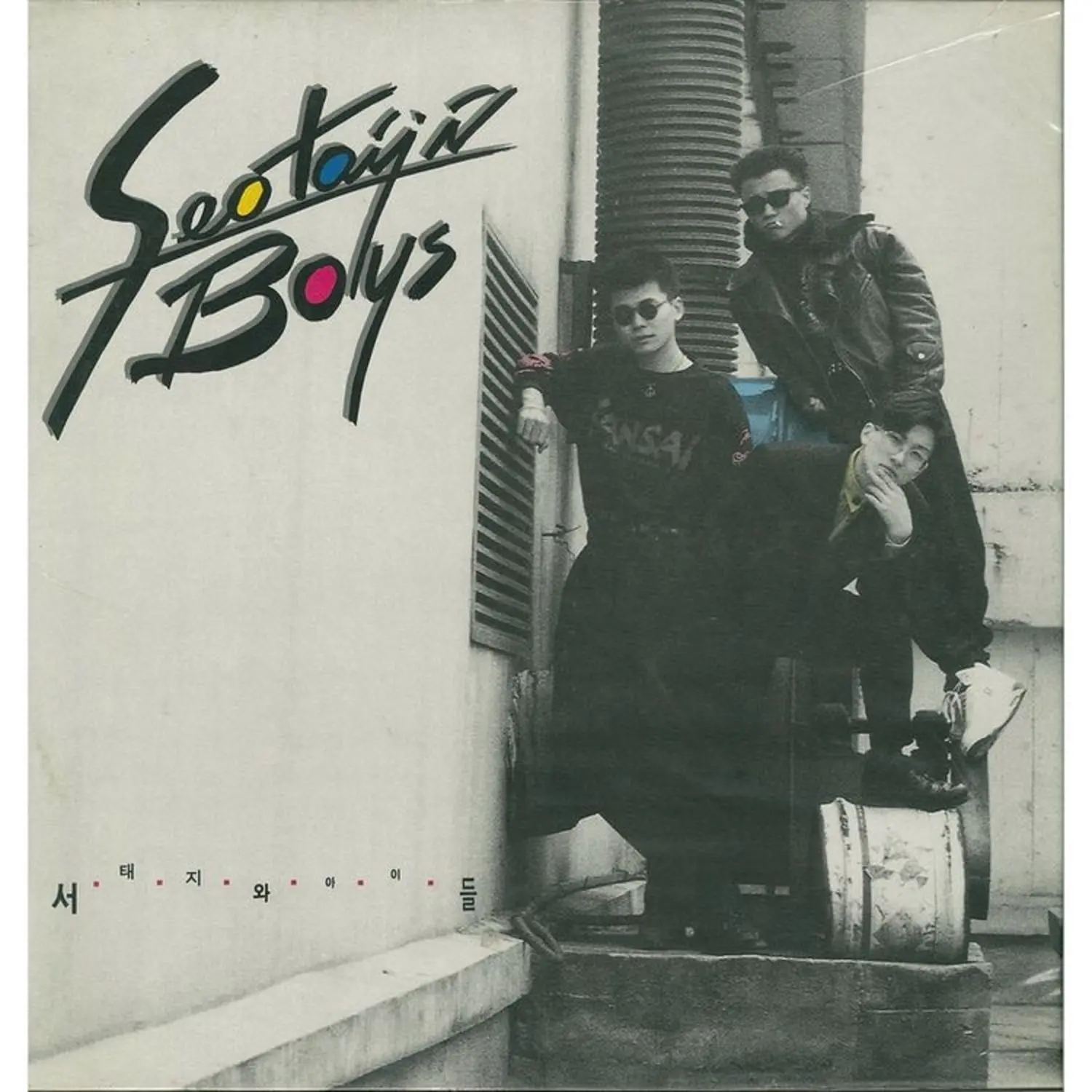
To understand K-Pop fandom culture, you have to go back to 1992 — the year most historians consider the true birth of modern K-Pop. That was when Seo Taiji and Boys debuted on a live Korean talent show and changed everything. Their fusion of hip-hop, rock, and pop shocked a generation raised on ballads, and their passionate young fanbase introduced something new to Korean concert culture: organized, visual fan support.
At this point, there were no lightsticks. No special merchandise. Fans showed their support the way people always had — with their voices, their presence, and eventually, simple objects they could hold up in a crowd. But something important was taking shape: the idea that a fandom should look like something. That a crowd of fans should be visually unified.
That idea would define everything that came next.
The Balloon Era: First Generation Idols (Mid-1990s)
By the mid-1990s, the first wave of Korean idol groups had arrived. Groups like H.O.T. (High-five of Teenagers), Sechskies, g.o.d, S.E.S., and Shinhwa were the superstars of their generation, and their fans were intensely loyal — and intensely competitive with each other.
With so many fandoms, a new question emerged: how do you show, at a glance, which group you support?
The answer was color.
Each major fandom claimed an official color, and fans showed up to concerts wearing it, carrying it, and waving it. The most popular method was colored balloons — simple, cheap, and visually striking when thousands of them filled an arena at once.
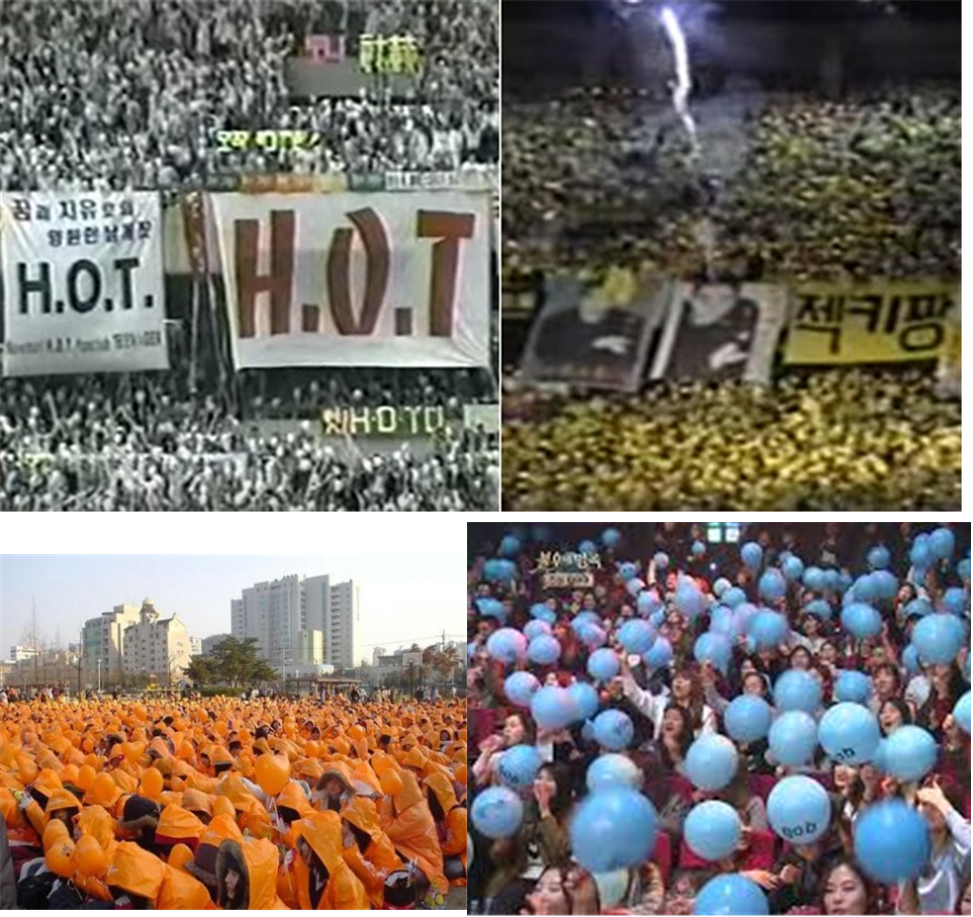
- H.O.T. fans brought white balloons
- Sechskies fans brought yellow balloons
- g.o.d fans brought sky blue balloons
- Shinhwa fans claimed orange
The effect, when it worked, was stunning. An entire concert venue bathed in a single color, pulsing with the energy of thousands of fans moving in unison. It was the original “ocean.”
But balloons had their limitations. They popped. They floated away. They were hard to see from a distance. And as more and more groups debuted, the palette of available colors started to run thin. Something better was needed.
The Transition: Toward Light (Late 1990s – Early 2000s)
As the late 1990s gave way to the 2000s, Korean idol culture was growing rapidly and crossing international borders — particularly into Japan, where a parallel but distinct idol culture had existed for decades.
Japanese idol concerts had long featured penlights — small, handheld glowing sticks that fans waved in choreographed patterns during performances. As Korean artists began touring Japan, their fans noticed these penlights and started bringing the concept back home.
The shift was gradual. Some fans began carrying glow sticks or small flashlights alongside their balloons. Others experimented with colored light sources. The fandom color tradition remained — but now, light was entering the picture.

The first Korean artist to have an officially branded lightstick is generally credited to solo singer Se7en, who introduced a “7”-shaped penlight during his Japanese concert tour in 2006. It was a small step, but an important one: for the first time, a K-Pop artist had a designed, group-specific light-based cheering item.
The age of the lightstick was about to begin.
The Game Changer: Big Bang’s Bang Bong (2006–2007)
If Se7en planted the seed, Big Bang grew the entire forest.
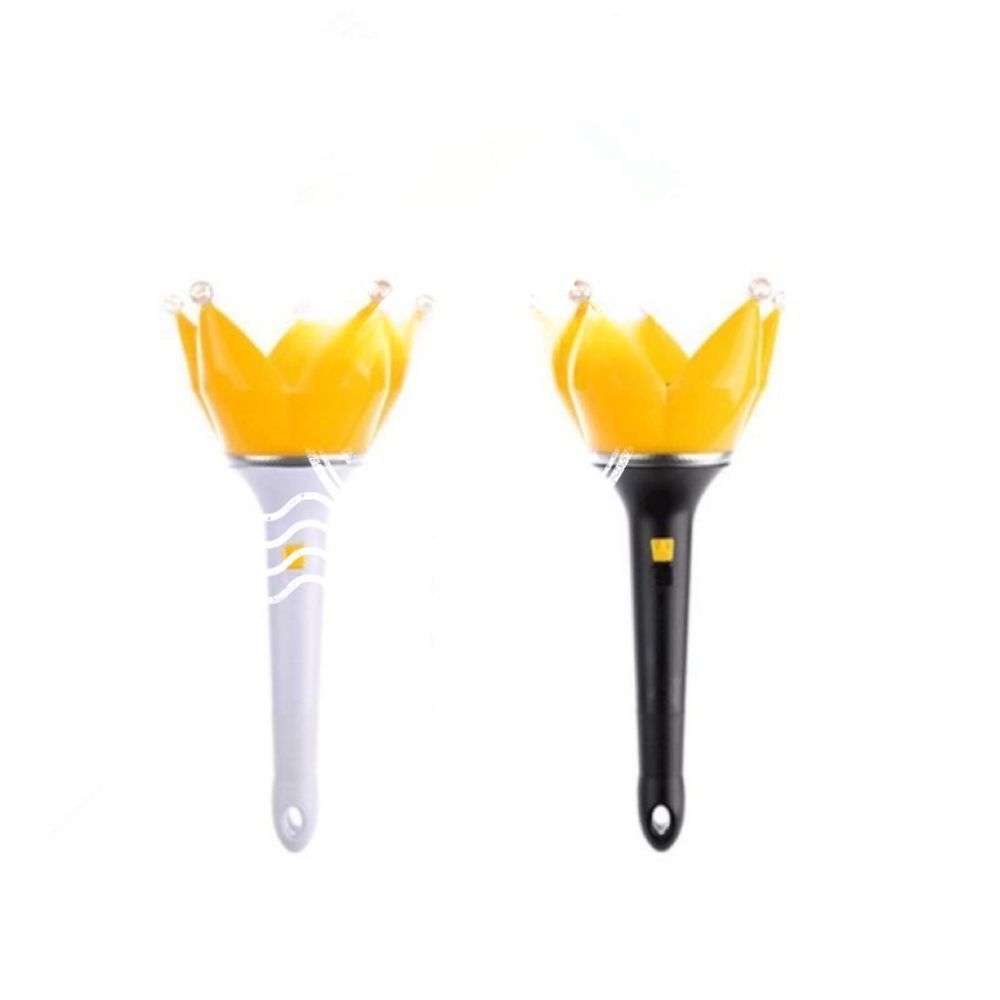
When Big Bang released their official lightstick — nicknamed the “Bang Bong” (뱅봉) — in 2006/2007, it changed the rules of K-Pop fandom culture permanently. The Bang Bong was shaped like a yellow crown, reflecting Big Bang’s self-declared status as royalty of K-Pop. It wasn’t just a color — it was a design. A statement.
The Bang Bong introduced a critical new idea: a lightstick should not just represent a color. It should represent the group’s identity, their concept, their relationship with their fans. The shape, the name, the design — all of it should mean something.
Other entertainment companies watched Big Bang’s fans fill venues with glowing yellow crowns and immediately understood: this was the future. Within a few years, almost every major K-Pop group had released their own official lightstick.
The balloon era was over.
The Name Matters: Lightstick Culture and Fandom Identity
As lightsticks became standard, a uniquely K-Pop tradition emerged around them: naming the lightstick.
Every official K-Pop lightstick has a name — usually a playful combination of the Korean word bong (봉, meaning “stick”) and something connected to the group’s identity or fandom name. These names became part of fandom language, used by fans worldwide.
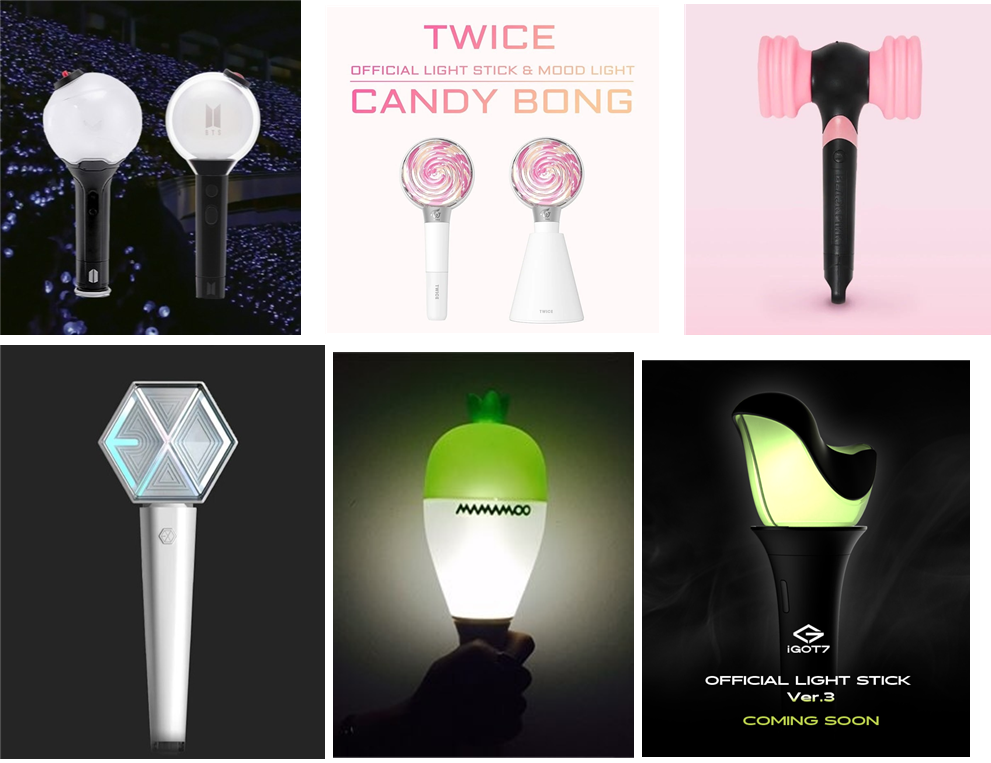
Some iconic examples:
- BTS — Army Bomb (아미밤): A sphere-shaped lightstick representing the connection between BTS and their fandom, ARMY
- TWICE — Candy Bong (캔디봉): Heart-shaped, reflecting TWICE’s sweet, cheerful image
- BLACKPINK — Bbyong Bong (삐용봉, later Bl-ping-bong): Hammer-shaped, designed by the members themselves, inspired by a toy hammer from a variety show
- EXO — EXO Lightstick: A translucent sphere with the EXO logo, later upgraded to Bluetooth connectivity
- Mamamoo — Moo Bong (무봉): Shaped like a radish, because the group’s fandom name “MooMoo” resembles the Korean word moo (무), meaning radish
- GOT7 — Ahgabong: Shaped like a small bird, reflecting the fandom nickname “Ahgase” (아가새, baby bird)
- Epik High — Park Gyu Bong: Notoriously shaped like a hand giving the middle finger, reflecting the group’s rebellious, philosophical image
The lightstick name became as important as the fandom name itself. When a new group announced their official lightstick design and name, it was a major event — fans dissected every design choice, every symbolic element.
The Ocean: What Lightsticks Created
With thousands of fans holding the same glowing object in the same color, K-Pop concerts developed something no other music genre has: the ocean (바다).
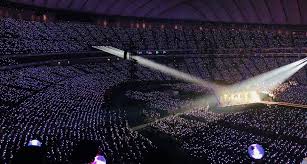
When the lights dim and the crowd raises their lightsticks, the result is breathtaking. A stadium full of a single glowing color, moving and swaying together — it genuinely looks like a luminous sea. Artists frequently speak about how emotional it is to look out from the stage and see their ocean.
The ocean became a point of pride and competition between fandoms. A fandom whose ocean was particularly vivid, particularly unified, particularly vast was seen as especially devoted. Fans would coordinate online before concerts, reminding each other to bring their official lightsticks, not unofficial knockoffs, so the color would be perfectly consistent.
The stakes became clear in 2008 with one of K-Pop history’s most infamous incidents: the Black Ocean directed at Girls’ Generation at the Dream Concert. Fans of competing groups agreed in advance to turn off their lightsticks during SNSD’s performance — leaving the group performing in darkness while every other act received a glowing ocean of support. The Black Ocean remains one of the most discussed moments in K-Pop fandom history, a stark illustration of just how much the ocean had come to mean.
The Technology Revolution: EXO and Bluetooth Synchronization (2016)
For years, lightstick oceans were beautiful but imprecise. Fans waved their lights at different speeds, in different directions. The color was unified, but the movement wasn’t.
SM Entertainment changed that in 2016 with a technological breakthrough for EXO’s concerts. They introduced remotely controlled lightsticks that could be synchronized via Bluetooth to the concert’s audio and lighting system.
For the first time, concert staff could control every lightstick in the arena simultaneously — changing colors, creating patterns, triggering wave effects that rippled across thousands of fans in the audience. The crowd didn’t just watch the light show; they were the light show.
The effect was overwhelming. Videos of EXO concerts with synchronized lightstick waves spread globally, introducing millions of international viewers to the concept. Every major entertainment company scrambled to develop similar technology.
Today, Bluetooth-synchronized lightsticks are standard for top-tier K-Pop acts. Modern lightsticks connect to smartphone apps, respond to the music in real time, and can display multiple colors. Concert experiences like BTS’s stadium tours feature some of the most sophisticated audience-integrated light shows in the history of live music.
The Design Arms Race: How Creative Can It Get?
As lightsticks became an established part of K-Pop culture, entertainment companies began pushing the boundaries of what a lightstick could look like. The design became as important as the function.
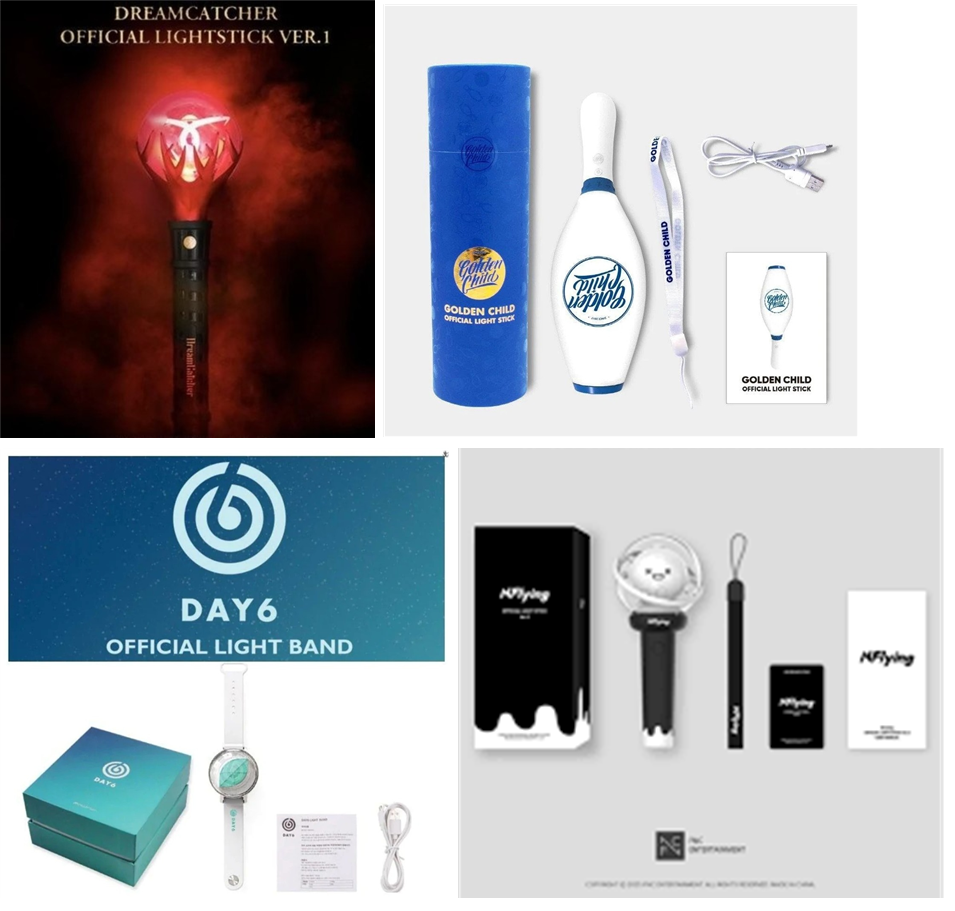
Some highlights from the ongoing K-Pop lightstick design arms race:
Dreamcatcher’s MongMongie currently holds the record for the largest K-Pop lightstick at 785mm in length — resembling a mage’s staff, perfectly matching the group’s dark fantasy concept.
Golden Child’s Runebong is shaped like a bowling pin, reflecting a playful sports theme.
DAY6’s Light Band broke the mold entirely — instead of a stick, it’s a wristband, reflecting the group’s band identity and making it easier to play air guitar without dropping anything.
N.Flying, in a legendary moment of fan service, once handed out actual potatoes as lightstick substitutes after releasing a song called “Hot Potato.” Not an official lightstick — but unforgettable.
The competition for the most creative, most meaningful, most uniquely-designed lightstick continues to this day, with each new group debut bringing a fresh design challenge.
Fandom Colors: Still Serious Business
Even in the era of shaped lightsticks and Bluetooth synchronization, fandom colors remain deeply important — and deeply contested.
With hundreds of K-Pop groups now active, choosing a fandom color has become a politically charged decision. Colors that seem distinct can look similar under concert lighting. Fandoms have engaged in genuine conflicts over perceived color theft.
Some famous color disputes:
- Cassiopeia (TVXQ’s fandom) famously went to war when rumors spread that iKON might choose red — which Cassiopeia considered their pearl red’s territory
- Shinhwa Changjos clashed with Block B fans over orange
- Colors now often have elaborate official descriptions — not just “blue” but “Pearl Cerulean Blue” or “Pastel Coral” — partly to establish distinctiveness
The seriousness with which K-Pop fans approach their fandom color reflects how meaningful the visual identity has become. Your lightstick color isn’t just an aesthetic preference — it’s an identity statement.
The Global Spread
What began as a uniquely Korean concert tradition has now become a global phenomenon.
International fans attending K-Pop concerts in Los Angeles, London, Paris, and São Paulo bring the same lightsticks and create the same oceans as fans in Seoul. The lightstick has become the single most recognizable symbol of K-Pop fandom identity worldwide.
The global market for official K-Pop lightsticks has grown into a significant industry. Premium lightsticks retail between $35–$60, with limited editions and collaboration models commanding much higher prices on the secondary market. Rare discontinued lightsticks from early-generation groups can sell for hundreds of dollars.
Non-K-Pop fans have taken notice, too. It’s now common for Western pop fans to imagine and design “concept” lightsticks for their own favorite artists — a direct influence of K-Pop fandom culture spreading globally.
What Comes Next?
The lightstick’s evolution shows no signs of stopping. Entertainment companies are currently exploring augmented reality integration, where lightsticks could interact with AR elements projected during concerts. Solar-powered and more sustainable designs are in development. Some groups have experimented with lightsticks that respond to individual fan profiles, creating personalized experiences within the unified ocean.
From handmade colored balloons in the stands of 1990s Seoul concert halls to Bluetooth-synchronized light shows filling 80,000-seat stadiums worldwide — the story of K-Pop cheering culture is ultimately a story about what happens when passionate fans are given the tools to become part of the performance itself.
The ocean glows on.
Interested in more K-Pop culture explainers? Check out our Features section for more deep dives into the world of K-Pop.