Beneath the Hook — Issue 003
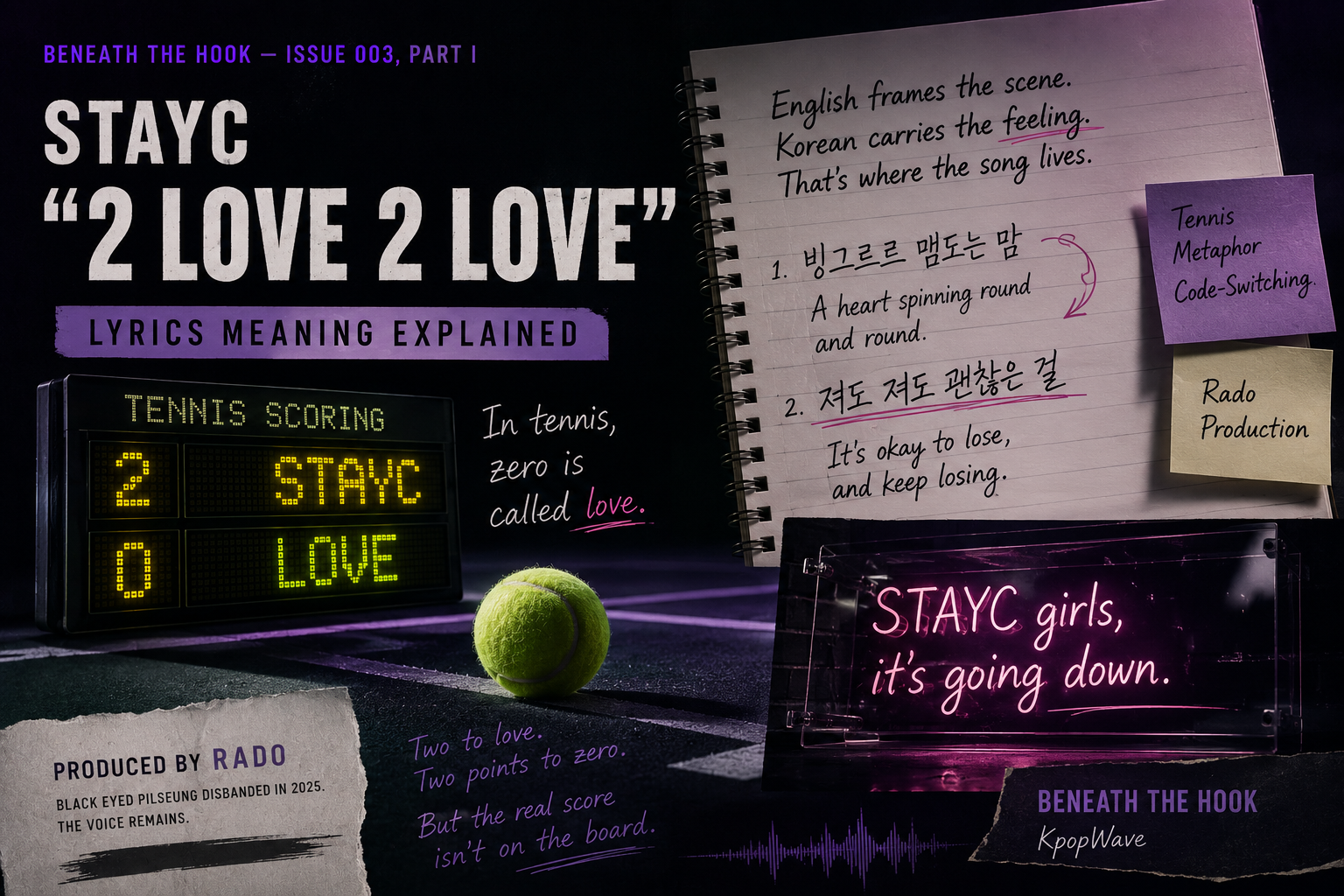
In tennis, zero is called love. STAYC built an entire album around that equation — and then wrote a title track that spends three minutes arguing with it.
STAYC’s “2 LOVE 2 LOVE” — the title track of their sixth single album 2:LOVE, released today, June 16, 2026 — is not just a love song. It is a study in how language behaves when feeling outpaces logic. Written by lyricist Joo Hyerin and produced by Rado, it deploys Korean and English not interchangeably but architecturally: English frames the exterior, Korean carries the weight. Part I reads the code-switching structure and unpacks the tennis metaphor that names the album. Part II, running next week, examines what happens when the song abandons its bilingual system entirely — and what that silence means.
Single Album
by STAYC
STAYC debut year
under High Up Ent.
Black Eyed Pilseung
officially disbanded
01The Equation
The album comes in three versions. One is called Court Zine. Another, Player Profile. The third, PLVE — the only one that doesn’t belong to the court, the only one that doesn’t need to explain itself.
The title of STAYC’s sixth single album is 2:LOVE. Written, as the group’s promotional materials confirm, as a tennis score — the O in LOVE replaced by the numeral 0, exactly as a scoreboard would read it. Two to love. Two to zero. The winning side has two. The other side has love.
In tennis, zero has been called love since at least the 19th century. The most widely cited etymology traces to the French l’œuf — the egg — because an egg resembles a zero in shape, and French aristocrats playing the original court game passed the word along until English players softened its pronunciation into something warmer, more romantic. A score of nothing became a word for everything. Whether or not that etymology is precisely accurate, the meaning is fixed: in tennis, to have love on the board is to have nothing. To be at love is to be at zero.
STAYC names their album after this equation. And then they write a title track that spends three minutes arguing with it.
“In tennis, to have love on the board is to have nothing. STAYC names their album after this equation — and then writes a title track that spends three minutes arguing with it.”
02Whose Voice Is That, Now
The song opens with a call that anyone who has followed STAYC since their November 2020 debut will recognize immediately.
2 LOVE 2 LOVE — Intro
| KO/EN | 2 LOVE 2 LOVE I’m falling 2 LOVE 2 LOVE (STAYC girls, it’s going down) |
This is the stamp. The rallying cry that appeared on “SO BAD,” on “ASAP,” on “STEREOTYPE,” on track after track across six years and six members and every evolution STAYC has undergone since Black Eyed Pilseung — the producing duo of Rado and Choi Kyu-sung — debuted them to a Korean music scene that hadn’t quite seen this combination of polish and personality before. The voice has always been there, a few bars in, marking the drop, announcing the arrival.
Except Black Eyed Pilseung no longer exists.
Rado (Song Joo-young) and Choi Kyu-sung had collaborated since 2009 and formally worked under the Black Eyed Pilseung name since 2014. Together they co-founded High Up Entertainment in 2017. Together they wrote TWICE’s “CHEER UP” and “TT,” SISTAR’s “Touch My Body,” Chungha’s “Gotta Go” — a decade’s worth of K-pop melody, the blueprint of a sound. In March 2025, citing what High Up Entertainment would later describe as “differences in musical direction,” Choi Kyu-sung departed the company. By September 2025, the split had been officially confirmed to the press. The name Black Eyed Pilseung, which had carried everything, was retired after 16 years.
2:LOVE is produced by Rado alone. “2 LOVE 2 LOVE” is credited to lyricist Joo Hyerin, with composition and arrangement by Rado, FLYT, Z4, and Maria. The Black Eyed Pilseung name does not appear on this album.
But the call is still there. STAYC girls, it’s going down.
Rado kept it. After the dissolution, after three albums navigating the new arithmetic of a partnership that no longer exists, he kept the signature phrase that both of them had built. That decision — to preserve the incantation even after the duo that invented it ceased to be — is the first thing this song asks you to sit with. And it connects, though perhaps obliquely, to everything that follows: a lyric written entirely about holding onto something you can no longer fully account for.
03The Architecture of Two Languages
The second thing the song asks you to sit with is its opening lyric.
2 LOVE 2 LOVE
| KO/EN | Now now now I know 헷갈리고 있는데 Now now now you move 아무 생각 못 하게 |
| ROM | Now now now I know hetgalligo inneunde Now now now you move amu saenggak mot hage |
| EN | Now now now I know — but I’m confused, and… Now now now you move — I can’t think at all |
English arrives first. Now now now I know — insistent, present tense, four syllables hammering the same moment with the confidence of someone who has figured something out. Then Korean lands, and it undoes everything: 헷갈리고 있는데. The dictionary definition is “I’m confused,” but the grammatical ending 있는데 does more than that. It trails off. It implies something unfinished, a sentence that didn’t quite close. The full emotional register: I know. But I’m confused. But. The English half insists. The Korean half admits.
This is not decorative bilingualism. It is structural. Once you identify the pattern in the first two lines, you cannot unhear it in the three minutes that follow.
English: What the Camera Sees
When English appears in “2 LOVE 2 LOVE,” it consistently describes what is visible — external, observable, frameable at a distance:
Korean: What the Body Knows
When Korean appears, the camera goes inside:
The line 잠도 못 자 지금 Everynight is worth pausing on. “Everynight” — compressed into a single English word — floats inside a Korean sentence about insomnia. But the Korean is doing the feeling. English is the label. This is not borrowing English for international appeal, which is the most common function of code-switching in K-pop and which scholars of Korean-English lyric mixing have documented as a tool for projecting a “global register.” Here the hierarchy is inverted. English in “2 LOVE 2 LOVE” names the category. Korean lives in it.
Korean has an unusually rich system of ideophonic words — terms that phonetically mimic sensory experience. 빙그르르 is one of them: a reduplication that sounds like spinning, used for everything from a coin rolling to a feeling of dizziness. It cannot be translated without losing its texture. No English equivalent captures both the motion and the lightness simultaneously. Its presence here — in the internal, Korean half of the song — is not accidental.
04The Grammar of Losing
The chorus brings the architecture into the open:
2 LOVE 2 LOVE
| KO/EN | 처음 느끼는 emotion 져도 져도 괜찮은 걸 (Hey) |
| ROM | cheo-eum neukkineun emotion jyeodo jyeodo gwaenchaneun geol (Hey) |
| EN | This feeling I’m feeling for the first time — emotion — losing and losing again, it’s okay |
“Emotion” is the English word — the abstraction, the clinical category placed at the pivot of the line. But what the song does with that emotion is entirely Korean. 져도 져도 괜찮은 걸. “It’s okay to lose, and keep losing.” Translating this phrase accurately is harder than it looks, because the ending 괜찮은 걸 is not a declaration. It is closer to self-persuasion. Not “it’s okay” but something like I’m telling myself it’s okay — and the wobble in the telling is audible in the grammar. You can hear the speaker arriving at this conclusion a half-second before they fully believe it.
And here is where the tennis score returns, and where the whole album title resolves.
In tennis, to have love — zero — is not a state of failure. It is the state before scoring begins. You start a match at love-all. You return to love after each game. Love is not the opposite of winning; it is what exists before the game has been decided. The album is called 2:LOVE. Two points to zero. But the song is not about the score. It’s about what it feels like to be the one at zero, insisting — through grammar, through the tilt of an ending — that it’s okay. That zero is not nothing. That love, even the kind that means you haven’t started yet, is still something worth being at.
“Love is not the opposite of winning; it is what exists before the game has been decided. The song is not about the score. It’s about what it feels like to be the one at zero.”
져도 져도 괜찮은 걸. Losing and losing again, it’s okay. Because in this particular game, losing is not the end of anything. It’s the whole point of being here.
05Key Vocabulary
| 헷갈리다 | to be confused / mixed up | Implies the confusion is involuntary — something happening to you, not a choice. The -있는데 ending leaves it grammatically unfinished, mimicking the experience. |
| 빙그르르 | spinning / round and round | An ideophone — a word that sounds like what it means. Soft, dizzy, light. Untranslatable without losing its texture. |
| 맴돌다 | to hover / circle / linger | Used for a feeling that keeps returning without resolution — orbiting rather than landing. |
| 괜찮은 걸 | it’s okay / it’ll be fine | The -걸 ending softens the statement into self-reassurance. Not a confident declaration but an argument the speaker is making to themselves, mid-fall. |
| 져도 져도 | even if I lose, even if I lose | The repetition is insistence. The Korean repetitive structure here amplifies the acceptance — the speaker has to say it twice to believe it. |
I’ll admit I didn’t immediately understand why this song needed a tennis metaphor. The first time I heard “2 LOVE 2 LOVE,” I thought the Court Zine aesthetic was a seasonal choice — something visual and athletic for a June comeback. Cute. Move on.
Then I spent an hour with the chorus.
져도 져도 괜찮은 걸. The more I read it, the more it resisted any single English interpretation. “It’s okay to lose” doesn’t capture the grammar. “I’m telling myself it’s fine” is closer but too self-conscious. What the Korean carries is something more delicate: the sound of a person arriving at acceptance a fraction of a second before they feel it.
That’s when the tennis score clicked. Because in tennis, to be at love isn’t shameful. It’s where everyone starts. You begin at zero and you work toward something — but the zero is necessary, not embarrassing. The song isn’t about falling behind. It’s about insisting that zero is a valid place to be.
Whether lyricist Joo Hyerin and Rado planned this convergence precisely, or whether the album concept and the lyric writing arrived at the same logic independently — I don’t know, and I’m not sure it matters. The best songs are bigger than their intentions. This one qualifies.
Part II, running next week, picks up where the song’s bilingual architecture breaks down — and asks what it means when a song in two languages goes completely silent in one of them.