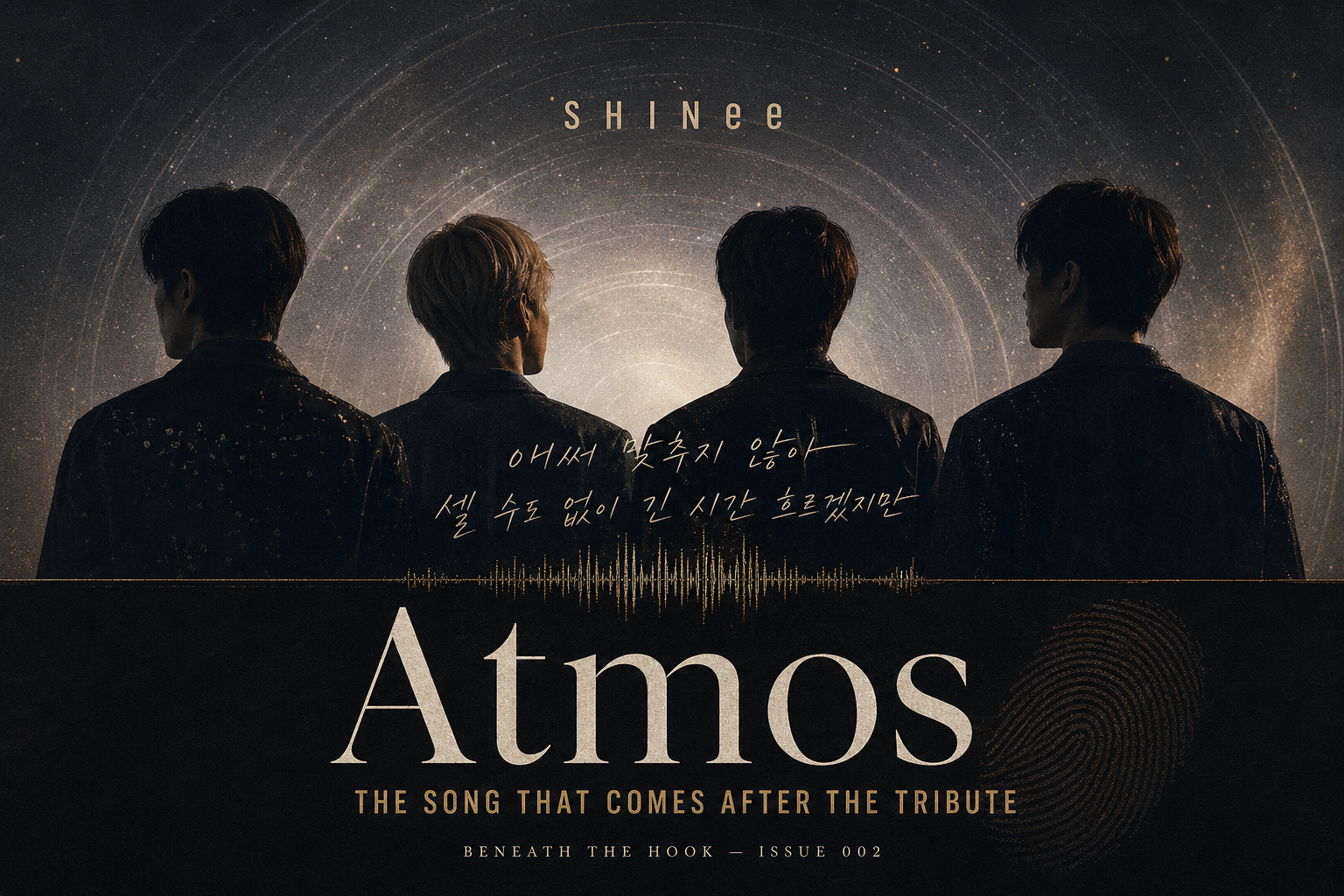
SHINee’s 18th anniversary track reads like a perfect summer romance. Read it again — and beneath the romance is another story about time, memory, and staying.
There is a version of “Atmos” that is exactly what it says it is.
A house-inflected electronic dance track. Glitchy synths, rhythmic bass, a constantly shifting arrangement. Two people so perfectly in sync that they stop trying to be. 애써 맞추지 않아 — “we don’t force ourselves to align anymore.” The feeling of love that has finally reached its completed form.
That version is a very good song.
Then there is the other version. The one you arrive at when you remember that SHINee released this on June 1, 2026 — exactly 18 years after their debut. One year after their previous release, a song built from lyrics that a fifth member wrote before he died. The version where 셀 수도 없이 긴 시간 흐르겠지만 — “though a time too long to count will pass” — is not something a lover says. It’s something a group says, at the 18-year mark, looking forward and backward at the same time.
In that version, the love song becomes something harder to name.
What the Lyrics Actually Do
Most of “Atmos” has no subject. Not in the grammatical sense — in the emotional sense.
“the color spreads”
열기 휘감아
“heat wraps around”
귀는 열려가
“the ears open up”
몸에 다가와
“it comes to the body”
SHINee — “Atmos” (2026) — final chorus
Four consecutive lines, and in not one of them does anyone do anything. Things happen. Sensation arrives. The world changes state.
This is not a stylistic accident. It is SHINee’s oldest compositional instinct — the refusal to locate love as an event between two people and instead render it as a climate. Something you are inside of before you noticed you entered it.
Fans have already named it: “Atmos” is a grown-up “View.”
They are right. “View” (2015) was perhaps the purest expression of this instinct — a song ostensibly about watching a city from above that contained almost no second-person address, no declaration, no narrative. Just perception, arriving and passing. “Atmos” is eleven years later and it has learned something: the perception has accumulated. 빈칸들이 분명해져 — “the blank spaces become clear.” You can only say that after enough time has passed to see where the blanks were.
The Word That Shouldn’t Be There
Go back to the second verse.
“It approaches, unmistakably, like a fingerprint.”
SHINee — “Atmos” (2026)
A fingerprint. Not a heartbeat, not a wave, not a breath — all the soft organic metaphors a love song reaches for. A fingerprint. The thing that is unique to one person and unchanged from birth. The thing that uniquely identifies a person, even when they are absent.
In a romantic reading, this is the specificity of a beloved person — the way you recognize them among everyone else, with biological certainty. It works. It’s beautiful, actually.
But a fingerprint is also the thing that remains after someone has left a room. The trace. The impression that outlasts the presence.
The lyric does not choose between these readings. It holds both, and the tension is the point.
The Year Before This One
To understand “Atmos,” you need to know what preceded it.
In May 2025, for their 17th anniversary, SHINee released Poet | Artist — a song built entirely from lyrics that Jonghyun wrote before his death in 2017, including his improvisational vocals recovered from the original demo. The album title references Jonghyun’s own posthumous solo record of the same name. In SHINee’s long tradition of affectionately “plagiarizing” each other across solo releases, this was the final, most serious iteration: completing something that had been left incomplete. Bringing him back into the room for one more song.
“Atmos” is the release that comes after that.
It is, in the most literal sense, the first thing SHINee made as the four people who remained — after the tribute, after nearly a decade of living with a presence defined by absence. SM described it as “the most SHINee-like” music they have made. What they mean is that it sounds like something that could only be made by people who have been doing this together for 18 years, through everything 18 years contains.
“Slow it down. I’m here.”
That line, in context, is not just reassurance to a lover. It is a statement of continuation. I am still here. After all of it, I am still here.
“애써 맞추지 않아” and What That Costs
The emotional center of the song is the chorus.
“Atmos — we don’t force ourselves to align”
Before the night’s gone, 둘은 하나
“Before the night is gone, the two become one”
SHINee — “Atmos” (2026) — chorus
This is written as a relief. And it is a relief. After 18 years, a group that has earned the right to stop trying so hard — to exist in a state of natural cohesion, the way people who have been through enough together eventually stop needing to perform their togetherness.
But 애써 맞추지 않아 only means something if you remember all the years of 애씀 — of effort, of forcing, of making it work across military service and solo careers and loss and the particular exhaustion of still being together when so much has changed. The relief is real because the struggle was real.
And 둘은 하나 — “the two become one” — is a number that requires examination. SHINee is four members now. Has been for eight years. “Two becomes one” is either a poetic compression of many into unity, or a quiet, unresolvable ache written into the math. The song does not explain which. It doesn’t need to.
I want to be precise about what I’m claiming and what I’m not.
I am not saying “Atmos” is secretly about Jonghyun. The group has not said this. SM has not said this. The official description positions it as a romantic track about completed love, and that reading is entirely valid and fully supported by the lyrics.
What I am saying is that a song released on the 18th anniversary of a group that has spent nearly a decade learning to carry grief — written in a language that systematically removes its own subjects, full of images that hold two meanings without resolving either — is not a song that fully belongs to only one reading.
셀 수도 없이 긴 시간 흐르겠지만 — though a time too long to count will pass.
You don’t write that in a summer love song unless you know exactly how long time gets.
“Atmos” is the most SHINee-like thing they’ve made in years. Not because it sounds like their earlier work — it doesn’t, particularly. But because it does what SHINee have always done best: write something that fits comfortably in one genre while quietly containing a second story. The kind of song where you think you know what you’re listening to, and then a line arrives and the bottom drops out.
That’s not a trick. That’s craft. And after 18 years, they still have it.