01The Title — A Contradiction That Is Actually a Philosophy
“Live Fast Die Slow” places two phrases in direct conflict — and that conflict is the song’s entire argument. The expression “live fast, die young” is one of the most recognizable phrases in rock and hip-hop culture: burn bright, burn short, don’t compromise. Taeyang keeps the first half and changes the second. Not “die young.” Die slow.
LIVE FAST,
DIE YOUNG
The original expression: burn at full intensity, don’t worry about the cost, brilliance over longevity. The philosophy of the reckless, the rebel, the artist who refuses to compromise even at the price of burning out.
LIVE FAST,
DIE SLOW
Keeps the intensity. Refuses the early exit. This is the philosophy of someone who has been in the industry for 20 years and is still here — still burning, still moving, but not burning out. The pace is full; the timeline is long.
The modification is the statement. “Live Fast Die Slow” is not a contradiction — it is a declaration of endurance. You can move fast and last. You can burn bright and remain. The song is Taeyang in 2026, twenty years into a career, saying: I am still going. Not despite the pace. Because of it.
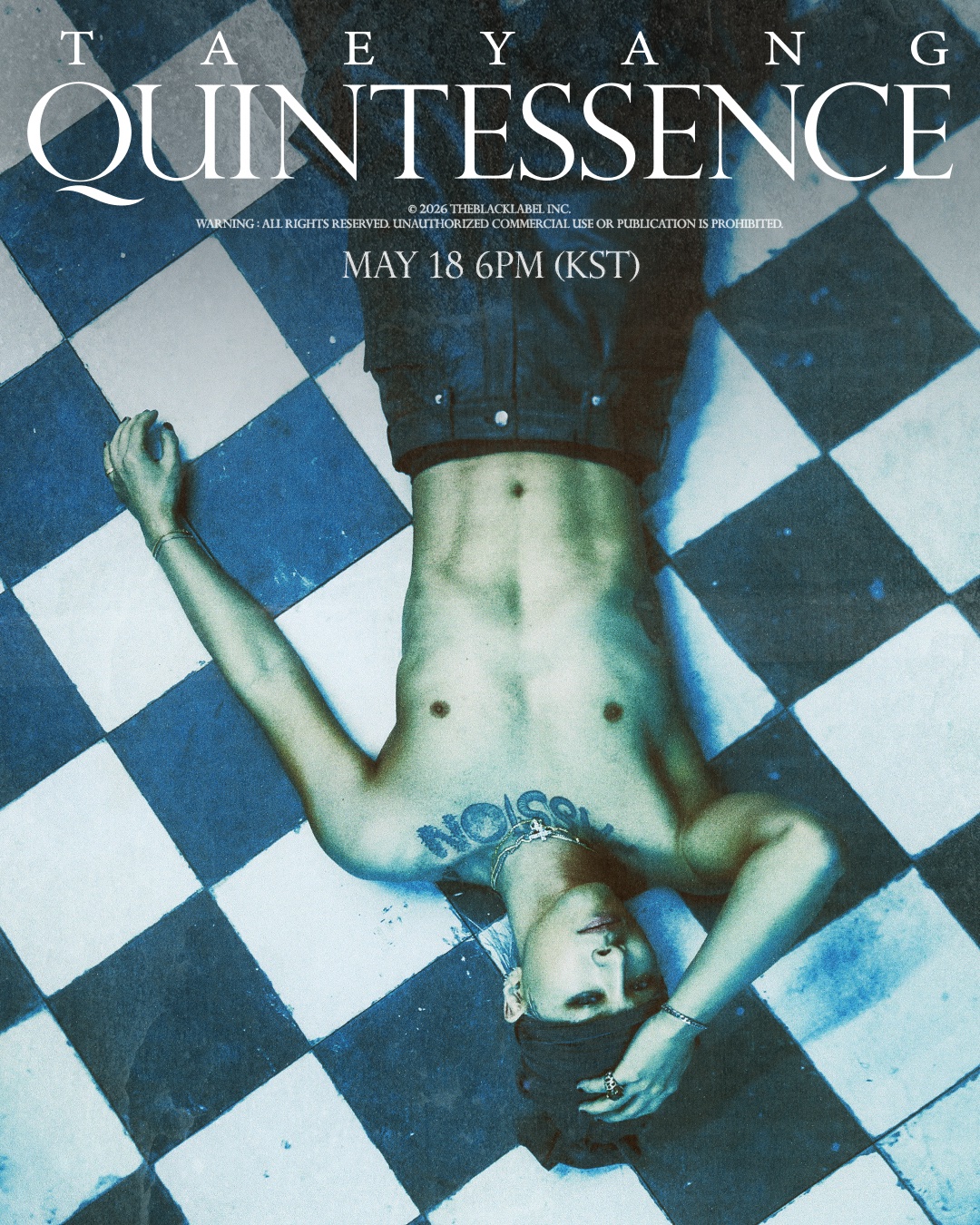
The album title “QUINTESSENCE” — which Taeyang personally conceived — refers to the purest, most essential form of something. In classical philosophy, the quintessence was the fifth element: not earth, water, fire, or air, but the substance of which celestial bodies were made — unchanging, perfect, eternal. Taeyang described the album as shaped by “long-running reflections on essence, identity, and the values that remain meaningful over time.” The title track enacts this: the quintessence of his artistic identity is someone who moves fast and endures. Both at once.
02Key Lyrics — Korean, Romanization & English Translation
The song moves fluidly between Korean and English — using Korean for the most personal and emotionally weighted moments, and English for the declarations that are meant to reach outward. Below are five passages that carry the most lyrical and biographical weight.
The Opening Call — A Comeback Stated Plainly
| Korean | 날 불러봐 눈을 뜬 순간 It’s a comeback 수십 번 아니 수백 번 Bet you miss that |
| Romanization | Nal bulleobwa Nuneul tteun sungan it’s a comeback Susip beon ani subaek beon Bet you miss that |
| English | Call for me / The moment I open my eyes — it’s a comeback / Dozens, no, hundreds of times / Bet you miss that |
날 불러봐 (nal bulleobwa) — “call for me” or “try calling my name” — opens the song as a direct address. Not a boast but an invitation: you know where I’ve been. The phrase 수십 번 아니 수백 번 — “dozens of times, no, hundreds of times” — is a self-correction that amplifies as it speaks. He starts to say “dozens” and upgrades it mid-sentence. The energy of the upgrade is the energy of the song.
“Bet you miss that” — in English, blunt and confident — closes the opening on a statement rather than a question. It does not ask whether you missed him. It tells you that you did. The confidence is not arrogance; it is the specific certainty of someone who knows what they built and knows it held in their absence.
The Trauma Line — Naming What’s Behind
| Korean | 파란 헤드 트라우마 향해 buck buck 떠난 기억들은 이제 duck duck |
| Romanization | Paran hedeu trauma hyanghae buck buck Tteonan gieokdeureun ije duck duck |
| English | Toward the blue-headed trauma — buck buck / The memories that have left — duck duck now |
파란 헤드 트라우마 (paran hedeu trauma) — “blue-headed trauma” — is the most oblique and most personal image in the song. 파란 means blue — but in Korean emotional vocabulary it also carries associations with youth, inexperience, and melancholy (청춘, 파란만장한 — a turbulent, eventful life). “Blue-headed” trauma suggests something that originated in that early, unsettled period. And the direction is 향해 (hyanghae — toward): he is moving toward the trauma, not away from it. Buck buck — charging directly at it.
The next line then dismisses the memories that have already passed: 떠난 기억들은 이제 duck duck — the memories that left are now duck duck: ducked under, avoided, no longer worth chasing. The contrast between the two lines is the song’s emotional logic: charge toward what is still ahead of you, duck under what is already behind you.
The World That Won’t Stop
| Korean | 세상은 날 위해 멈추지 않아 여전히 넌 여전히 꿈 같던 그때 그 모습 그대로 날 깨워줘 |
| Romanization | Sesang-eun nal wihae meomchuji anha yeojeonhi Neon yeojeonhi kkum gatdeon geuttae geu moseup geudaero nal Kkaewojwo |
| English | The world still doesn’t stop for me / You, still looking exactly as you did back then, like a dream / Wake me up |
This is the most emotionally layered passage in the song. 세상은 날 위해 멈추지 않아 — the world doesn’t stop for me — is the lyric’s central acknowledgment: no one waits. Time doesn’t pause for comebacks or absences or grief. The word 여전히 (yeojeonhi — still, as before, unchanged) appears twice in the same breath, creating an echo: the world is still moving, and you are still exactly as you were in that dream-like time.
The plea that closes it — 깨워줘 (kkaewojwo — wake me up) — is the song’s most vulnerable moment. The person being addressed appears to be both literal (someone from that dream-like past) and metaphorical (the version of himself from that era, which he wants restored). The world won’t stop. So: wake me up into it.
여전히 — “still” or “as before” — is one of Korean’s most emotionally weighted time adverbs. It does not just mean “still happening.” It means “happening exactly as it did before, unchanged despite everything that has intervened.” When the song says the world 여전히 doesn’t stop, it is saying: not just now, not just today — it never stopped, not once, through all of it. And when it says you are 여전히 exactly as you were — it is saying: everything else changed, and you didn’t. Both uses in the same line create a kind of vertigo: the world moves relentlessly and you stay exactly the same. The contrast is the feeling the song is made of.
The Korean Idiom at the Heart of the Chorus
| Korean | 갈 길이 멀어도 Live Fast Die Slow Life is 모 아님 도 |
| Romanization | Gal giri meoreodo Live Fast Die Slow Life is mo animdo |
| English | Even with a long way still to go — Live Fast Die Slow / Life is all or nothing |
모 아님 도 (mo animdo) is a Korean expression derived from the traditional board game Yutnori — a game played with sticks, where the results are called 도, 개, 걸, 윷, and 모, ranging from the lowest to the highest throw. 모 아님 도 means: either the highest result or the lowest. All or nothing. The maximum or the minimum, with nothing in between.
Dropping this idiom into “Life is 모 아님 도” is a culturally specific move that carries enormous weight in Korean: it is saying that life, at its core, doesn’t have comfortable middle grounds. You either commit fully — go for 모 — or you land on the lowest throw. The expression placed directly after “Live Fast Die Slow” becomes the song’s most compressed philosophical statement: there is no moderate version of this. You go all the way or you don’t go.
The Chorus Declaration — Call Me Big Bang
| Korean / English | 빨리 뛰는 놈 위에 나는 나 Call me Big Bang |
| Romanization | Ppalli ttwineun nom wie naneun na Call me Big Bang |
| English | Above the ones who run fast, I am me / Call me Big Bang |
빨리 뛰는 놈 위에 나는 나 — “above the ones who run fast, I am me” — is the song’s most confident line, and the most carefully structured. It does not say “I am the fastest” or “I am the best.” It says: above all comparisons, I am simply myself. The identity is not established by winning the race. It is established by existing outside the metric of the race entirely.
“Call me Big Bang” — in English, plain and unhesitating — is the most direct invocation of group identity in any of Taeyang’s solo work. BIGBANG is celebrating its 20th anniversary in 2026. The group announced a new album at Coachella in April. Taeyang is releasing this solo album on May 18 — his debut anniversary. He is not separating his solo identity from BIGBANG. He is declaring that they are inseparable. The solo album is the man; the man came from Big Bang; Big Bang is still him.
03Taeyang — 20 Years and What They Mean
The decision to release QUINTESSENCE on May 18 — his birthday — is not coincidental. Taeyang has spoken about the album as a deeply personal stocktaking: “I put myself into this process completely — my love, my joy, my passion — but sometimes I had to face my own madness along the way.” A birthday release on the 20th anniversary of the group that made him is the fullest possible statement of the album’s premise: this is the purest form of who I am, on the day I mark another year of being it.
BIGBANG’s Coachella performance in April 2026 — the group’s first major stage in years — announced that a new group album was in preparation. That announcement, weeks before Taeyang’s solo album, places “LIVE FAST DIE SLOW” inside a larger context: this is not a solo artist stepping away from his group. This is a member of BIGBANG in 2026, releasing the most personal music of his career while simultaneously being part of BIGBANG’s own return. “Call me Big Bang” is not a throwaway line. It is a statement of fact about how identity works when you’ve been part of something that long.
Taeyang’s solo album release history traces the arc of someone who has never released music casually. Solar (2010) established his solo identity. Rise (2014) produced “Eyes, Nose, Lips” — one of the most covered songs in Korean music history. White Night (2017) was his last studio album before military service, the pandemic, and the long pause. Down to Earth (EP, 2023) was his first release in six years. QUINTESSENCE (2026) is his first full studio album since 2017. Each release has been nine years or more in the making in emotional terms, even when the calendar gap was shorter. “Live Fast Die Slow” is the first song from any of these albums to name the pace explicitly.
04QUINTESSENCE — The Album That Took Nine Years to Make
Since last studio album WHITE NIGHT (2017)
BIGBANG debut anniversary — 2026
Tracks across 27 minutes
BAD
LIVE FAST DIE SLOW
Title Track
WOULD YOU
feat. TARZZAN & WOOCHAN of ALLDAY PROJECT
MOVIE
OPEN UP
feat. The Kid LAROI
LOVE LIKE THIS
YES
Samples BIGBANG & 2NE1 “Lollipop”
NOW
G.O.A.T
4U
The album’s sequence is deliberate. “BAD” opens — darkness first, before the title track’s declaration of direction. “LIVE FAST DIE SLOW” arrives as Track 2, immediately establishing the album’s governing philosophy. The middle of the album (“WOULD YOU,” “MOVIE”) leans reflective and cinematic. “OPEN UP” featuring The Kid LAROI brings the album’s brightest, most internationally accessible energy. “YES” — which samples BIGBANG and 2NE1’s “Lollipop” — is the album’s most explicit look backward at where all of this began. And “4U” closes the album in the direction of other people: the number that most obviously points outward, toward whoever is listening.
The “YES” sample is worth noting specifically. “Lollipop” (2009) was a BIGBANG and 2NE1 collaboration — a YG Entertainment cross-group project that became one of the most commercially successful K-pop songs of its era. Sampling it on a 2026 solo album is not nostalgia. It is continuity: Taeyang drawing a straight line from where he started to where he is now, on an album called QUINTESSENCE — the purest, most essential form of himself.
05The Songwriting — What “LIVE FAST DIE SLOW” Is Doing
Taeyang’s solo work has always been shaped by The Black Label’s production philosophy — a sound rooted in R&B, soul, and pop with careful attention to emotional honesty. “LIVE FAST DIE SLOW” marks a departure in one specific direction: the punk-leaning edge described by critics is new for Taeyang’s title track sound, and it serves the song’s argument perfectly. The song sounds like it means what it says.
The Modified Cliché
Beginning with a well-known phrase and changing one word is a high-risk lyrical strategy — it either lands with the precision of a key turning in a lock, or it falls flat as an obvious gimmick. “Live Fast Die Slow” lands because the modification is substantive rather than decorative. Changing “young” to “slow” doesn’t just invert the phrase — it replaces an attitude (reckless youth) with a philosophy (sustained intensity). The song earns the title by actually arguing for it across three minutes, rather than simply using it as a hook.
The Cultural Idiom Drop
Placing “모 아님 도” — a reference to the traditional Korean game Yutnori — inside a song that also references Coachella-ready punk energy and The Kid LAROI-adjacent production is a deliberate act of cultural grounding. Taeyang is not going fully international or staying fully local. He is himself: someone who grew up in Korean culture, whose references run through Korean game idioms and English slang with equal fluency, and who does not need to choose between them to be understood.
Chronological Self-Reference
“Call me Big Bang” — appearing in a solo album — is the most direct form of this technique. Rather than separating his solo identity from BIGBANG (as many group members do when releasing solo work), Taeyang names the group explicitly. This is a choice that only works after 20 years: the reference is not a reminder that he is famous. It is a statement that the source of everything he is remains what it always was.
| Technique | Example in the Song | Effect |
|---|---|---|
| Modified cultural phrase | Live Fast Die Slow (vs. “Die Young”) | Familiar frame, unexpected conclusion — forces the listener to reconsider what they thought they knew |
| Korean game idiom in bilingual track | 모 아님 도 (all or nothing) | Culturally specific grounding — maximum and minimum, no comfortable middle |
| Self-correction for emphasis | 수십 번 아니 수백 번 (dozens, no, hundreds) | The upgrade mid-sentence performs the energy it describes |
| Moving toward, not away from trauma | 파란 헤드 트라우마 향해 buck buck | Direction matters — charging toward difficulty is the song’s philosophy enacted in a single line |
| Group identity in solo context | Call me Big Bang | Refuses the separation of solo and group — twenty years later, the source is still the identity |
06Key Vocabulary — Words Worth Knowing
| Korean | Romanization | Meaning & Notes |
|---|---|---|
| 날 불러봐 | nal bulleobwa | Call for me / try calling my name — an invitation rather than a command; confident but open |
| 파란 | paran | Blue — but in Korean emotional usage also carries associations with youth, inexperience, and turbulence (파란만장한 인생: an eventful, turbulent life) |
| 향해 | hyanghae | Toward — the direction word that makes the trauma line active rather than passive; he is moving toward it, not from it |
| 여전히 | yeojeonhi | Still / as before / unchanged — implies continuity despite everything that has passed; the world is still not stopping, and you are still exactly as you were |
| 깨워줘 | kkaewojwo | Wake me up — the song’s most vulnerable request; both literal and metaphorical |
| 모 아님 도 | mo animdo | All or nothing — from the traditional Korean game Yutnori; the highest result or the lowest, nothing between |
| 갈 길이 멀어도 | gal giri meoreodo | Even though the road ahead is long — an acknowledgment of distance without resignation; the “even so” is the point |
| 타올라 | taolla | Burn / blaze up — the verb for fire catching and rising; used in the chorus to describe how to live inside “Live Fast Die Slow” |
Yutnori (윷놀이) is one of Korea’s oldest traditional board games, played during Lunar New Year and major holidays. Players throw four sticks called yut and move pieces on a board based on the result: 도 (one stick face-up, lowest), 개 (two), 걸 (three), 윷 (four), 모 (all four face-up, highest). The phrase 모 아님 도 — “either 모 or 도” — has entered general Korean usage as an idiom for all-or-nothing thinking: no middle results, no compromise positions. Placing this in a bilingual pop song where the surrounding lines are in English is a move that Korean listeners immediately understand at full emotional depth, while international listeners feel the weight of commitment in the “I want it, want it all” that follows directly. The English hook is the translation the song provides for itself.
— Why “LIVE FAST DIE SLOW” Is the Right Song for This Moment
“LIVE FAST DIE SLOW” works because it earns its claim. A title like this, on a lesser album or from a shorter career, would be posture. On QUINTESSENCE, released by someone who debuted in 2006, who has watched the world not stop for any of the things that happened in between, who is standing at 20 years and releasing music on his birthday — it is simply accurate.
The song does not celebrate recklessness. It claims something harder: that you can move at full speed and still be here. That the pace and the longevity are not opposites. That living fast does not require dying young. This is the philosophy of someone who has survived long enough to earn it.
갈 길이 멀어도 — even though the road ahead is long. Even so. The distance is acknowledged. And the answer to it is not to slow down. The answer is to burn — 타올라 — and keep going.
세상은 날 위해 멈추지 않아. The world doesn’t stop for him. It never did. He learned to run at its speed, and then faster. Twenty years in, he’s still running. Call him Big Bang. Call him TAEYANG. Call him whatever name fits the man who lived fast and is still here.