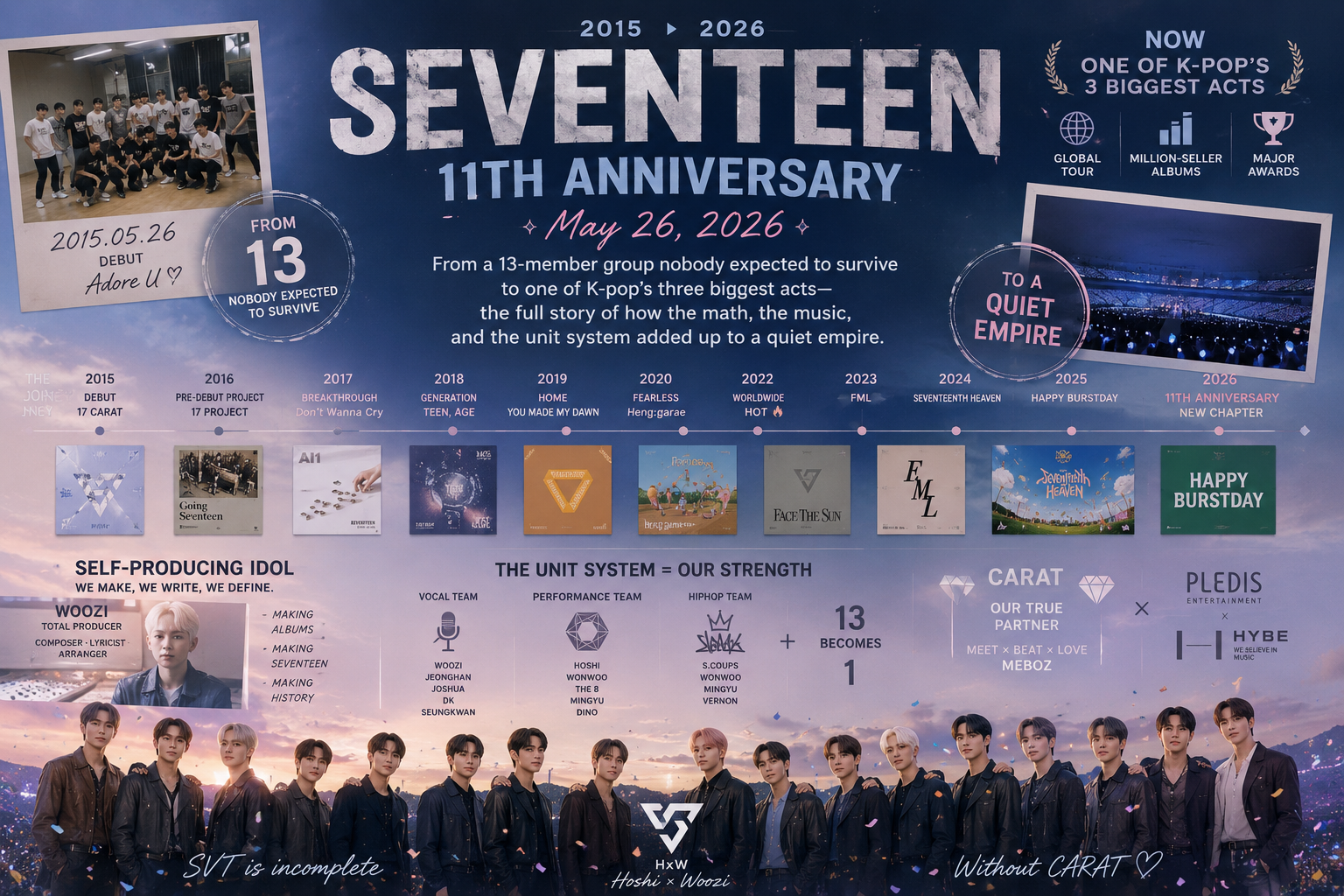
SEVENTEEN
The Korean music industry in 2015 had no real room for a 13-member group from a small agency that, by some accounts, couldn’t even afford in-ear monitors for its trainees. The conventional wisdom was clear: nobody could keep that many members visible, profitable, or relevant. The math didn’t work.
Eleven years later, that 13-member group is one of the three biggest K-pop acts in the world.
— A PROLOGUE
The Math That Wasn’t Supposed to Work
How thirteen became seventeen, and why the formula still defines them
The most-cited explanation for SEVENTEEN’s name goes like this: 13 members + 3 units + 1 team = 17. It’s the kind of formula that, on the surface, sounds like marketing — until you realize it was never the original plan. It was the answer to a question.
SEVENTEEN spent more than two years as a pre-debut variety project on UStream, where the trainee lineup shifted constantly. Members came and went. By the time Pledis Entertainment officially confirmed the final 13 in early 2015, the group needed a way to explain why the name didn’t match the number on stage. The 13+3+1 formula wasn’t a clever bit of branding invented at the top — it was a piece of philosophical reframing built underneath an awkward fact. They turned the misalignment into the identity.
And that identity stuck because, structurally, it actually does the work the name promises. The three units — Hip-Hop, Vocal, Performance — aren’t decorative. Each has its own leader (S.Coups, Woozi, and Hoshi), its own creative voice, and its own production language. A SEVENTEEN album isn’t 13 people taking turns on a track. It’s three teams writing in three idioms that have to fit inside one song. That’s why the group can release something as choreographically dense as “Aju Nice” in the same year as something as vocally restrained as “Don’t Wanna Cry” — and have both feel like SEVENTEEN.
The system did something else that became more important than anyone realized at the time: it built a structural redundancy into the group that almost no other K-pop act has. Eleven years later, with multiple members rotating through mandatory military service, that redundancy is the reason SEVENTEEN can still tour, release music, and stay culturally present. The architecture they laid down in 2015 was, in retrospect, the thing that made longevity possible.
Self-Producing, Before It Was a Marketing Line
When you can’t afford a producer, you become one
By the mid-2010s, “self-producing idol” had started to creep into K-pop’s vocabulary as a buzzword. SEVENTEEN did not invent the concept. But they may have been the first group for whom it was less an aesthetic choice than a survival mechanism.
Pledis Entertainment, at the time of SEVENTEEN’s debut, was a small label inside a system dominated by the Big 3. The story has been told many times — most credibly in interviews with the members themselves — that the agency couldn’t afford to outsource composition or choreography to industry professionals at the rate other groups did. Woozi, who joined as a trainee around the age of 14, became the group’s primary producer not because it was a positioning play but because the alternative was no album at all. He is now credited as co-writer or producer on roughly 80 percent of SEVENTEEN’s discography, holding over 100 song credits with the Korea Music Copyright Association — making him one of the most credited idol-producers in the country’s history.
Would we overcome these challenges together or not? We weren’t discouraged. We were too young to be discouraged. The passion of our dreams wasn’t deterred in the slightest.
— Woozi, UNESCO youth empowerment session, 2023
That quote has been parsed many ways. Read one way, it’s gracious. Read another, it’s the most honest thing anyone in K-pop has said about creative survival: when you don’t have the option to fail elegantly, you keep going. SEVENTEEN’s self-production identity was forged in that pressure — and the fact that, eleven years later, Pharrell Williams and Timbaland would line up to work with them is a quiet, retroactive vindication of the bet.
The Slow Climb
No viral moment. Just five years of work.
Most K-pop groups that survive past the five-year mark have a viral inflection point — a moment where the trajectory bends sharply upward. BTS had the Billboard awards. BLACKPINK had Coachella. EXO had the China explosion. SEVENTEEN doesn’t really have one. What they have instead is a graph that climbs almost linearly from 2015 onward — never spectacular, never collapsing, always one step higher than the year before.
From “Adore U” in 2015 through “Aju Nice” in 2016, “Don’t Wanna Cry” in 2017, the AL1-Teen, Age era of 2017–2018, and the cleaner, edgier shift around You Made My Dawn and An Ode in 2019, the discography reads like a band slowly figuring out what kind of band it is. The Western press began to notice. Time put them on its Next Generation Leaders list in 2020. Pitchfork started reviewing the albums. By the time the COVID pandemic forced live music indoors, SEVENTEEN had built a fan base that didn’t need a viral moment to keep growing.
Heng:garae and the Million-Seller Threshold
The first-week record that quietly changed the math
When SEVENTEEN’s seventh mini-album Heng:garae dropped in June 2020, it sold over a million physical copies in its first week — making SEVENTEEN one of only two K-pop groups in history at that point to have hit first-week million-seller territory. The other, of course, was BTS.
The distinction matters. K-pop has had cumulative million-seller groups before — EXO’s catalog had been doing it since 2013, with first albums going million across combined Korean and Chinese versions. SEVENTEEN’s Heng:garae was a different category: a single album, in a single week, crossing the line. That benchmark — first-week million sales — is the modern industry’s true gauge of cultural gravity, and SEVENTEEN, a group from a label that couldn’t afford studio time in 2015, joined a room of two.
They didn’t stop. Subsequent albums — Your Choice, Attacca, Face the Sun, FML, SEVENTEENTH HEAVEN — pushed cumulative numbers higher every cycle. FML, released in April 2023, sold more than 4.5 million copies in its first week, making it the best-selling K-pop album of all time at that point. It would later be named the best-selling album of 2023 globally by the IFPI — the first non-Western act to top the chart, and the first time a K-pop group did it without BTS in the conversation.
Happy Burstday, and the Pharrell Co-Sign
A 10th-anniversary album with three legendary American producers
In May 2025, SEVENTEEN marked their tenth anniversary with Happy Burstday — a 16-track full-length built around the concept of “explosive rebirth.” The album was their first full-length in three years, designed to function as a chapter break rather than a sequel. Every member contributed a solo song, including those serving in the military, who recorded their parts before enlistment.
The collaborators list is what made the international music press pay attention. Pharrell Williams. Timbaland. The kind of names that, fifteen years ago, would have been unimaginable on a K-pop tracklist. They weren’t ornamental features — they were producers, working on the structure of songs. For a group whose entire identity is built around self-production, bringing those two names in was both a flex and an acknowledgment: SEVENTEEN had reached the level where Pharrell and Timbaland answer the call.
The album opened a new phase. It’s the one that made it clear, for anyone still measuring K-pop by 2018 metrics, that SEVENTEEN had crossed into a different conversation.
Where They Are Right Now
The system pays off, eleven years later
In spring 2026, with several members rotating through mandatory military service, SEVENTEEN is in what would be a difficult moment for almost any other K-pop group. For SEVENTEEN, it has become a creative showcase. Their [NEW] World Tour is ongoing — including a third career stop at Philippine Sports Stadium in March. The SEVENTEEN 2026 JAPAN FANMEETING ‘YAKUSOKU’ just wrapped its main run in May, with live-screening events still rolling out across Asia.
But the most interesting thing happening right now is the unit explosion.
DK and Seungkwan are touring as MEBOZ. S.Coups and Mingyu launched the “Double Up” duo concept earlier this year. Hoshi and Woozi quietly released the HxW unit project in 2025. The unit S.Coups × Mingyu had their DOUBLE UP LIVE PARTY at Kaohsiung Arena in April. None of this is improvised content designed to fill the hiatus calendar. These are projects with full production credits, original music, and dedicated tour runs. They exist because the architecture has existed since day one. The 3-unit system that was built in 2015 to organize 13 different voices is, in 2026, the reason the group can split into duos without anything feeling like a placeholder. The infrastructure they laid down at debut turned out to be a long-term contingency plan they didn’t know they were building.
The Fandom That Earned the Name
Why Carats are different — and why the group is too
SEVENTEEN’s fandom is called Carat — a deliberate metaphor borrowed from one of their earliest songs, “Shining Diamond.” The premise: SEVENTEEN are the diamonds; Carats measure their value. The more Carats, the higher the value. It’s the kind of name that sounds saccharine on paper and becomes self-evident in person.
In 2026, with the group splintered across military service, solo activities, and unit projects, Carats have organized eleven-year-anniversary events on three continents — CARATCON in Annandale, Virginia. A11 My Love at Trinoma in Manila. BLAZE UP ANEW in Pasay City. Cupsleeve events in Mission, New York, and dozens of other cities. Most of these are run by fans, for fans, with no corporate backing. That kind of self-organization doesn’t happen by accident over eleven years. It happens when the group treats the fandom as a partner rather than a customer base. SEVENTEEN, for eleven years and counting, has done the latter at exactly the moments when it would have been easier not to.
- DebutMay 26, 2015 · 17 Carat mini-album · Pledis Entertainment
- Members13 — across Hip-Hop · Vocal · Performance units
- Best-SellingFML (2023) — 4.5M+ first-week sales · #1 IFPI Global 2023
- Last AlbumHappy Burstday (May 2025) · feat. Pharrell Williams, Timbaland
- Current Tour[NEW] World Tour · YAKUSOKU Japan fanmeetings (2026)
- Unit ActivityMEBOZ (DK × Seungkwan) · S.Coups × Mingyu · HxW (Hoshi × Woozi)
- FandomCarat · est. May 1, 2016 · lightstick “Bong-Bong-E”
- Industry FirstFirst K-pop act to headline Lollapalooza Chicago main stage (2024)
The KpopWave Take
K-pop is an industry built on the next thing. Comeback cycles measured in months. Group lifespans measured in seven-year contracts. The pressure is constant, and the casualty rate is high — among the groups that debuted alongside SEVENTEEN in 2015, the survival rate is approximately what you’d expect from a brutal natural-selection event. Most are gone. Some are footnotes. A few are still working but invisible.
SEVENTEEN spent eleven years doing the unglamorous version of K-pop success. They never had the viral moment. They never had the meme. They had a small label, thirteen members, three units, and a producer who learned his job under deadline pressure that would have broken most adults, let alone teenagers. What they built instead of a viral moment was infrastructure — the kind of structural redundancy and creative ownership that means, in 2026, with members in uniform and the calendar full of duo projects, the group is somehow more present than ever.
That’s what eleven years actually looks like. Not a montage. Not a victory lap. Just a group of people who decided, very early, that they were going to make this work — and then, every year for eleven years, made it work.
Carats already know. Everyone else might want to catch up.