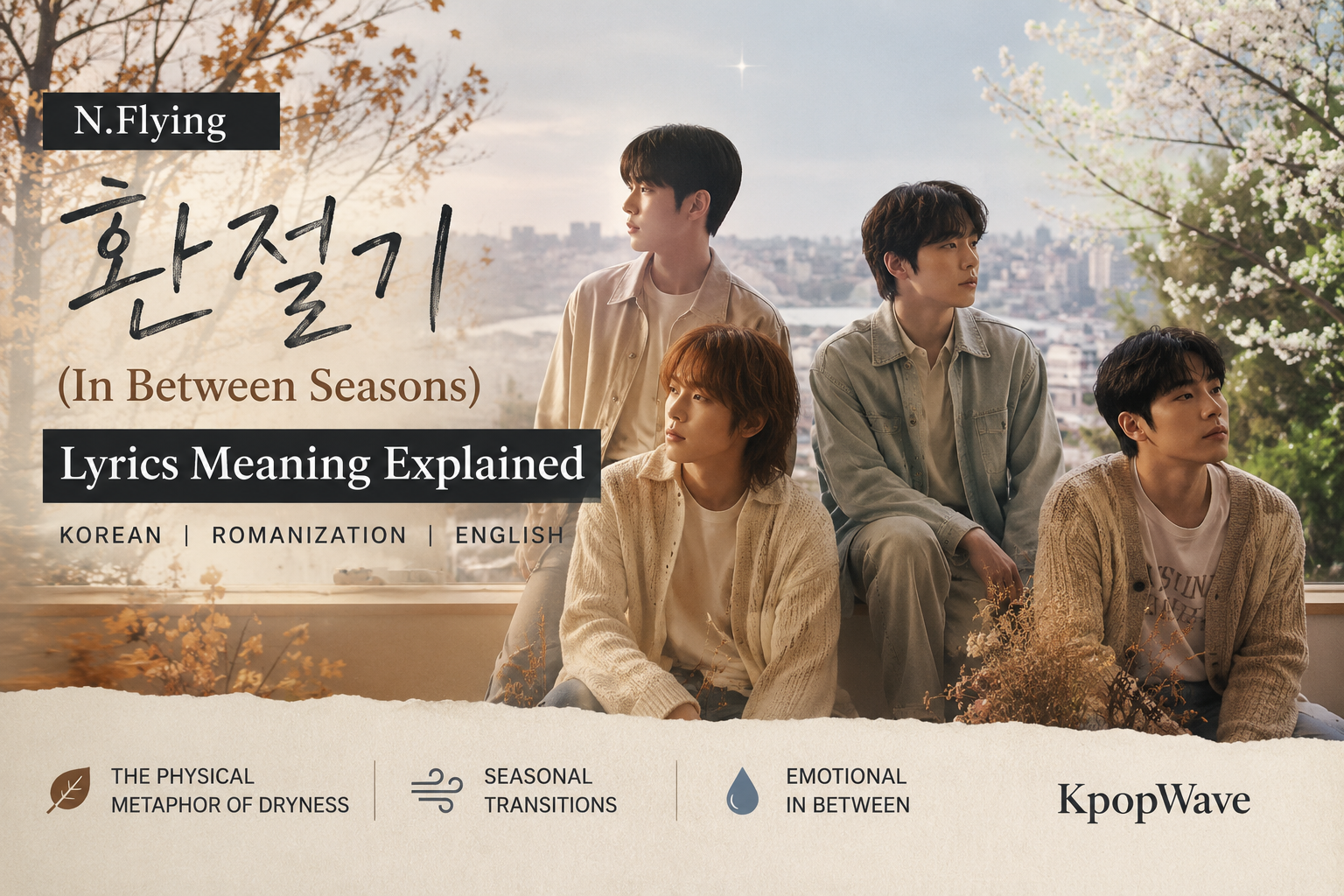
01The Title — What 환절기 (換節期) Actually Means
| Korean | 환절기 (換節期) |
| Hanja | 換 (hwan — to change, to exchange) + 節 (jeol — season, joint, section) + 期 (gi — period, time, phase) |
| Literal | “The period of seasonal change” — specifically the transitional weeks between one season and the next |
| Common usage | In Korean daily life, 환절기 is primarily associated with physical symptoms: dry skin, coughs, colds — the body’s difficulty adjusting to the change |
환절기 is a word Koreans use practically, not poetically. It appears in weather forecasts, pharmacy advice, and health warnings: 환절기에는 감기 조심하세요 (be careful of colds during the seasonal transition). It is the period when the body hasn’t caught up to the shift in temperature — when the immune system is down, the skin is parched, and the air has a quality that is neither one thing nor another.
The song takes this ordinary, medical-sounding word and uses it as the name for a specific emotional state: the period after a relationship ends, when the internal climate has shifted but the new season hasn’t arrived. You are no longer in what you were in. The next thing hasn’t come yet. You are in the transitional period — the 환절기 — of your emotional life.
The three characters of 환절기 each carry weight worth noting. 換 (hwan) means exchange or replacement — not gradual change but the substitution of one thing for another. 節 (jeol) means season but also joint, node, or section — a structural division of time. 期 (gi) means a defined period or phase. Together they describe not just “change” but a specific bounded interval: the period of replacement, between one defined phase and the next. The song lives in that interval — not the old season, not the new one, but the uncomfortable span between them.
02Key Lyrics — Korean, Romanization & English Translation
The song is entirely in Korean. Its most distinctive feature is a sustained physical texture metaphor — the dryness of the air and the body rendered as the dryness of the heart — that runs from verse to bridge without breaking. Below are four passages that carry the most lyrical weight.
The Opening — Body as Emotional Barometer
| Korean | 아침부터 기침이 나네 내 기분은 좀 나아지려나 다를 것 없는 오늘 하루야 딱 한 가지 내 옆에 네가 없단 말이야 |
| Romanization | Achimbuto gichimi nane Nae gibun-eun jom naajiryeona Dareul geot eomneun oneul haruya Ttak han gaji nae yeope nega eopdan mariya |
| English | I’ve been coughing since morning / I wonder if my mood will get a little better / It’s a day no different from any other / Except for one thing — you’re not beside me |
The song opens with a cough — the most ordinary symptom of 환절기, delivered without any emotional framing. The narrator is not announcing grief. They are describing a Tuesday morning: a cough, a question about whether today will be better, the recognition that it won’t be different. And then the one thing that is different: 딱 한 가지 (ttak han gaji — exactly one thing, just one thing). The precision of “exactly one” performs the song’s emotional logic: everything else is fine. The day is ordinary. Except for this one fact that makes the ordinary feel unbearable.
딱 is a Korean intensifier that means “exactly,” “precisely,” or “just” — it carries a sense of sharp specificity, of nothing more and nothing less. 딱 한 가지 — exactly one thing — is one of Korean’s most effective ways of making a single detail feel enormous by limiting it so precisely. The opener acknowledges everything that is normal about the day before naming the one variable that changes everything. The structure is the argument: the absence of one person is exactly as significant as everything else combined.
The Texture Sequence — Dryness as Emotional State
This five-stage sequence — parched, cracked, rustling, powdered, scattered — is the most sustained and precise piece of writing in the song. It describes the state of the heart after loss using only physical texture words, never once naming an emotion directly. The progression follows an exact physical logic: things dry out, then crack, then make the dry sound of their brittleness, then crumble, then disperse. Each stage is worse than the last, and the final stage — 흩날리다 — is the most complete form of dissolution available to solid matter.
What makes the sequence work is that it never explains the connection to emotion. It simply describes the texture, then lets the chorus ask to be taken somewhere. The listener makes the connection themselves. And having made it, they cannot unmake it: the next time their own skin feels parched in the seasonal transition, the song will have made that sensation mean something more.
The Chorus — The Request
| Korean | 날 데려가 줄래 계절이 가면 새 사랑을 내게 주세요 |
| Romanization | Nal deryeoga julae Gyejeori gamyeon Sae sarang-eul naege juseyo |
| English | Will you take me away / When the season passes / Please give me new love |
The chorus shifts register completely. After the clinical progression of dryness, the narrator makes two requests — one directed at a person (날 데려가 줄래 — will you take me away) and one directed at something larger, perhaps time or the universe itself (새 사랑을 내게 주세요 — please give me new love). The polite imperative form 주세요 (juseyo — please give me) is the form used when asking from a position of genuine need, not demand. It is the form of a request you make when you cannot provide the thing yourself.
The condition placed on the request — 계절이 가면 (gyejeori gamyeon — when the season passes) — is the song’s most patient line. Not now. When the season passes. The narrator is not asking for immediate rescue. They are acknowledging that 환절기 has its own timeline, that the transitional period must complete itself before what comes next can arrive. The request is for what comes after the transition — not for the transition to end early.
The Bridge — The Gap That Names Itself
| Korean | 벌어진 틈새 사이가 꼭 나의 처지 같았어 며칠 아프다 보면 괜찮겠지 |
| Romanization | Beoreojin teumsae saiga Kkok naui cheoji gatasseo Myeochil apeuda bomyeon Gwaenchangessjji |
| English | The widening gap between the cracks / Looked exactly like my situation / After hurting for a few days / I’ll be okay |
벌어진 틈새 (beoreojin teumsae — the widening gap, the crack that has opened up) returns to the dryness metaphor from outside. The narrator has been observing something cracked — perhaps a wall, a piece of wood, dried earth — and recognizes themselves in it. 꼭 나의 처지 같았어 (kkok naui cheoji gatasseo — it looked exactly like my situation) uses 처지 (cheoji), which means one’s circumstances or condition — not just feelings but the actual state of things.
And then the bridge delivers the song’s most understated line: 며칠 아프다 보면 괜찮겠지 — after hurting for a few days, I’ll probably be okay. Not a declaration of recovery. Not a vow to move on. Just the quiet, pragmatic acknowledgment that pain has a duration — that 환절기, whether of the body or the heart, eventually ends. The “probably” embedded in 겠지 (gessjji — I suppose, I imagine it will) keeps the line honest. It doesn’t promise anything. It just holds out the reasonable expectation that the transitional period won’t last forever.
03N.Flying — The Band That Writes Its Own Seasons
“New Flying” / “Next Flying” — “a new leap forward.” FNC Entertainment’s only active band act.
One of K-pop’s longest-running active band groups. Over a decade of continuous activity across Korea and Japan.
All three are members. Seo Yong-bae also composed alongside TAEY. Lee Seung-hyub (J.DON) is the group leader and primary creative engine — credited on all tracks of Everlasting.
Full lineup restored post-military service. Everlasting (2025) was the first album with all members present since pre-enlistment era.
Active across Korean and Japanese markets with separate discographies and fanbases in both regions.
“옥탑방 (Rooftop)” and “그래도 돼 (You’ll Be Okay)” are among their most recognized tracks for emotional honesty.
What distinguishes N.Flying within the K-pop landscape is structural: they are a band that plays instruments and writes their own material, in an industry where neither is the default. The self-writing credit on “환절기” — three members sharing the lyric credit, with two of them also composing — is not unusual for N.Flying. It is the norm. Lee Seung-hyub in particular has been the consistent creative center of the group’s Korean output, and the precision of the dryness sequence in this song reflects a writer who has spent a decade learning how to say specific things specifically.
N.Flying’s fanbase — called F.Light — has grown steadily across a decade through exactly this kind of writing. The group is not primarily a visual act or a performance spectacle act. They are a group that people return to because the songs describe things with accuracy. “환절기” is a song about the physical experience of heartbreak — not the dramatic variety but the quiet, persistent, waking-up-and-coughing variety — and the accuracy of that description is what N.Flying has built its decade on.
04The Song in Context — After Everlasting
First album with full lineup after military service completions. Marked the group’s full reunion and relaunch in the Korean market.
Approximately one year after Everlasting. A standalone single rather than part of an album project.
Releasing a standalone digital single allows the song to exist as a complete statement without album context obligations. The song needed no setup and no follow-through. It is a self-contained season.
A song about 환절기 released during actual 환절기. The timing is a detail, but it is the kind of detail that makes a song feel like it belongs to a specific moment rather than a general catalog.
The album title Everlasting and the single title 환절기 sit in interesting tension as consecutive releases. Everlasting claims permanence — the group, the bond, the music, continuing forever. 환절기 claims the opposite: the transience of a specific emotional period, the reality that seasons end. Together they suggest that what lasts and what changes are not opposites. The group is everlasting. Individual emotional seasons are not.
05The Songwriting — What Makes “환절기” Unusual
K-pop’s emotional vocabulary for heartbreak is extensive and well-established: tears, longing, dreams, the person who used to be there. “환절기” avoids almost all of it. It does not cry. It does not dream of the absent person. It does not promise to move on or to wait. What it does instead is describe a physical state with clinical precision and ask, quietly, for the season to change.
The Extended Physical Metaphor
The song’s decision to describe emotional states through physical texture — rather than naming the emotions directly — is its most distinctive compositional choice. 푸석이다, 갈라지다, 바스락거리다, 가루가 되다, 흩날리다: each word describes a texture or a sound or a physical process, never an emotion. The listener maps the physical to the emotional without being told to. This 일 is harder to write than direct emotional statement, and more durable: the physical descriptions stay in the body, where the emotion also lives.
The Pragmatic Bridge
“며칠 아프다 보면 괜찮겠지” — after hurting for a few days, I’ll probably be okay — is an unusual bridge for a K-pop song precisely because it refuses to be dramatic about recovery. It doesn’t promise transformation. It doesn’t declare resilience. It offers the modest, realistic expectation that a few days of pain will be followed by something more bearable. The 겠지 (probably, I suppose) keeps it honest: this is a hope, not a certainty. But a modest hope is more convincing than a vow.
The Seasonal Request
Asking a season to pass rather than asking a person to stay — or asking yourself to feel differently — is the song’s most philosophically patient choice. The narrator is not trying to change the emotional weather directly. They are waiting for the natural cycle to complete. 계절이 가면 (when the season passes) acknowledges that 환절기 cannot be rushed. You simply have to be in it until it ends.
| Technique | Example | Effect |
|---|---|---|
| Physical texture for emotion | 푸석이다 → 갈라지다 → 가루가 됐다 | Emotion rendered as sensation — the listener maps it themselves, which makes it stick |
| 딱 한 가지 (exactly one thing) | 딱 한 가지 내 옆에 네가 없단 말이야 | Precision amplifies weight — the one different thing carries everything |
| Mimetic sound word | 바스락거리는 마음 (rustling heart) | The word sounds like what it describes — the reader hears the dryness |
| Pragmatic bridge | 며칠 아프다 보면 괜찮겠지 | Modest hope is more convincing than vowed recovery — 겠지 keeps it honest |
| Conditional request to time | 계절이 가면 새 사랑을 내게 주세요 | Patience as emotional stance — the narrator waits for the season, doesn’t fight it |
06Key Vocabulary — Words Worth Knowing
| Korean | Romanization | Meaning & Notes |
|---|---|---|
| 환절기 | hwanjeolgi | The transitional period between seasons — practically associated with physical symptoms (dry skin, colds); used here as the name for an emotional state between relationships |
| 딱 한 가지 | ttak han gaji | Exactly one thing — 딱 adds sharp precision; makes the single absence feel as large as everything else combined |
| 푸석이다 | puseogida | To be dry and rough / parched — the texture of skin or earth that has lost moisture; the first stage of the dryness sequence |
| 갈라지다 | gallajida | To crack / to split open — used for skin, earth, wood under drought; the suffix 버렸다 makes it irreversible |
| 바스락거리다 | baseurakgeorida | To rustle / to crackle — a mimetic word; it phonetically evokes the dry sound of brittle things moving |
| 흩날리다 | heutnaallida | To scatter / to be dispersed — the final stage; powder blown and spread thin by the wind |
| 틈새 | teumsae | A gap / a crack / the space between things — used in the bridge to describe both a literal crack and the narrator’s circumstances |
| 처지 | cheoji | One’s situation / circumstances / condition — not just feelings but the actual state of things; more concrete than “situation” |
| 겠지 | gessjji | I suppose / probably will — a hedge on certainty; keeps the bridge’s hope realistic rather than declarative |
바스락 is a Korean mimetic expression — an onomatopoeic word that phonetically captures a sound. It describes the dry, papery rustling of things that have lost their moisture: dead leaves underfoot, a crumpled receipt, the sound of skin so dry it makes noise when you move. The suffix -거리다 turns it into a continuous verb: the rustling keeps happening, on and on. In the context of the pre-chorus — 바스락거리는 마음 (the rustling heart) — the word asks the listener to hear the heart, not just understand it. A heart so dried out it makes the sound of dead leaves. That is a different kind of loneliness from the kind that weeps or aches. It is the quieter kind — the kind that crinkles when you breathe.
— Why “환절기” Stays
“환절기” works because it describes an emotional experience that most songs avoid: not the acute grief of loss, not the dramatic moment of separation, but the weeks afterward — when the days are ordinary and the body is dry and the only different thing is exactly one thing.
The song does not reach for beauty in that experience. It does not reframe the dryness as something to be grateful for. It says: you are in the transitional period. The heart is cracked and crackling and crumbling to powder. After a few days of hurting, it will probably be okay. When the season passes, something new will come.
That “probably” — 겠지 — is what makes the song honest. N.Flying have spent a decade writing songs that say true things with precision, and the truth in “환절기” is that recovery is a likelihood, not a certainty, and that the wait is real and physical and has a sound. The sound of dry things in a dry season. The sound of 바스락거리는 마음 — a heart rustling like dead leaves, waiting for the weather to change.