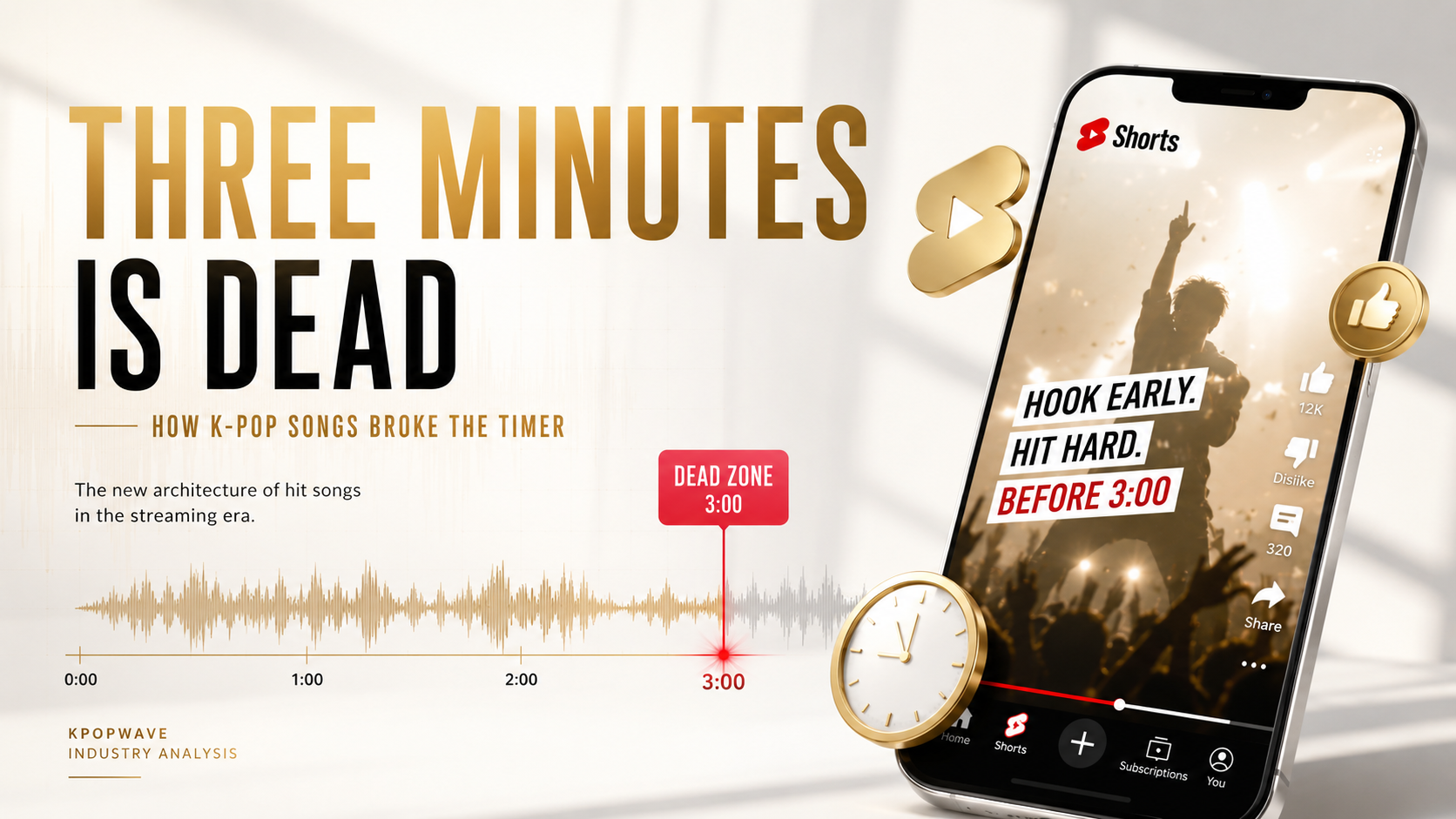
A generation of K-pop title tracks no longer has time for a slow build. KpopWave dissects how TikTok’s skip button, Spotify’s 30-second rule, and a vanishing bridge rewrote the architecture of the pop song itself.
Play ILLIT’s “Magnetic” and the hook arrives before you’ve finished reading the artist’s name on your screen. There is no slow build, no scene-setting verse, no four bars to get comfortable. By design, there’s no time for any of that — the hook has less than three seconds to survive a swipe.
The Vanishing Intro
For most of pop’s modern history, songs earned their chorus. An intro set a mood, a verse built a story, a pre-chorus raised the tension — and only then did the hook arrive, its impact sharpened by the wait. That architecture is now optional. Across a growing share of K-pop’s biggest global hits, the chorus doesn’t arrive after the buildup — it is the buildup. The scrambling happens hardest at the front of the track: signature hooks, vocal ad-libs, or a producer’s most recognizable sound now open songs that used to spend eight bars clearing their throat first.
The reason sits inside the algorithm, not the studio. On TikTok and YouTube Shorts, a song has roughly three to five seconds before a viewer’s thumb decides whether to keep scrolling — and every scroll-past teaches the platform to show the track to fewer people next time. A verse that takes its time to earn a chorus is, in that environment, a liability.
The shift isn’t universal, and it’s worth saying so plainly. ATEEZ and IVE both had strong years running a traditional intro-verse-chorus build, Hearts2Hearts leaned into SM’s legacy house-pop formula rather than chasing a hook-first structure, and YENA’s retro-leaning sound found an audience precisely because it didn’t rush. Chorus-first isn’t a rule K-pop has adopted uniformly — it’s a bet a growing number of producers are making, and for now it keeps paying off often enough that fewer of them are willing to skip it.
The Missing Bridge
The clearest casualty of this shift is the bridge — the section that once existed purely to change the emotional register before a final chorus. It’s expensive in a specific sense: a bridge takes fifteen to twenty seconds to do something a TikTok loop has no use for, since it doesn’t repeat cleanly and rarely maps onto a repeatable dance break. Cut it, and a song’s second half can loop straight from the second verse into the chorus without needing to resolve anywhere.
The runtime evidence is visible across four of the year’s most TikTok-native K-pop releases:
Debut single, March 2024. Reached the Billboard Hot 100 within four weeks of release — the fastest a K-pop girl group debut ever had.
May 2026. Samples “Macarena” — pop history’s most famous loop — and ships in three separate official lengths (see below).
April 2026. The shortest of the four — hook, both verses, and outro clear in the time of five looped TikTok clips.
January 2026. All-English lyrics by design — XG records exclusively in English across its catalogue.
None of the four run past three minutes, and the shortest, KATSEYE’s “Pinky Up,” clears its hook, both verses, and its outro in two minutes and eleven seconds. What’s missing from all four isn’t length so much as a specific shape: a formal bridge that pauses the loop to say something different. The chorus is the destination and the loop is the delivery mechanism — there’s no detour built in.
The Macarena Tell
No single 2026 release makes the case better than LE SSERAFIM’s “Boompala.” Its hook — the title itself, sung four times in a row before a single verse line arrives — samples Los del Río’s “Macarena,” a 1993 song whose entire cultural afterlife is built on being infinitely loopable and danced to in unison at every wedding reception on earth for three decades. Choosing to sample the most famous loop in modern pop history is either a knowing wink or an admission of exactly what the song is built to do. Probably both.
The stronger evidence is what happened after release. “Boompala” doesn’t exist as one official version; it exists as at least three, at three different lengths — a 2:56 standard cut, a 2:20 version built around member Kazuha, and a 3:40 version built around Hong Eunchae. That’s not a remix strategy in the old sense of a DJ edit or an acoustic version. It’s closer to a product team shipping the same feature in three package sizes and letting the data decide which one wins.
The Streaming Math
What the Algorithm Actually Pays For
Behind all of this sits an unglamorous fact about how streaming platforms count a stream. On Spotify, a play only counts once a listener has stayed past thirty seconds — full stop. A three-minute-thirty song streamed once in full pays exactly the same as a two-minute song streamed once and abandoned at the thirty-one-second mark. Play the two-minute song twice in the time it takes to play the longer one once, and the shorter song has generated double the counted streams for identical listening time. Nothing about that math rewards a song for having a bridge, an outro, or anywhere left to go after its best idea plays.
The industry didn’t need a memo to notice. Labels have been formalizing what fans were already doing for free since at least 2023, when FIFTY FIFTY’s label released an official sped-up edit of “Cupid” — credited to the artist name “sped up 8282” — that mirrored a fan-made TikTok remix already outperforming the original on the platform. What was a one-off in 2023 is closer to standard practice by 2026: major releases routinely arrive with an official sped-up or slowed edit alongside the standard version, giving short-form creators a legal, monetizable audio source instead of leaving that traffic to fan uploads.
A 3:30 song streamed once = 1 counted stream. A 2:00 song streamed twice in the same span = 2 counted streams — same listening time, same listener. Spotify counts any play past the 30-second mark as one full stream, with no bonus for staying longer.
— TikTok Global Music Programme Manager, on why labels now chase the remixes fans already made
None of this is a story about K-pop losing its nerve. Every one of the four songs above is a genuinely well-made piece of pop craft, and “Boompala” sampling “Macarena” is, structurally, a smart use of borrowed familiarity rather than a lazy one. What’s changed is which part of the job gets rewarded. A bridge used to be where a songwriter proved they could do something other than the hook. Increasingly, that’s not the assignment — the assignment is thirty seconds, repeatable, and available in at least two official lengths by the time it ships.
I don’t think that makes these songs worse, exactly. I think it makes them a different kind of object — built for a loop instead of a listen, and honest enough about it that a girl group can now put “boompala” on a track four times before the first real lyric shows up and have it read as a feature, not a flaw. Whether that’s a songwriting trend or a permanent rewiring of what a pop song is for is the question worth sitting with the next time a title track ends before the three-minute mark and you find yourself hitting replay instead of noticing it was short.
Song runtimes, genres, and release dates for “Magnetic,” “Boompala” (including its Kazuha and Hong Eunchae length variants), “Pinky Up,” and “Hypnotize” per official label/streaming metadata, cross-verified across Wikipedia and Apple Music listings.
General song-length trend data per Chartmetric’s 2024 Year in Music Report (average charting song length down roughly 15 seconds year-over-year, 30 seconds since 2019).
Counter-trend examples (ATEEZ, IVE, Hearts2Hearts, YENA) per independent 2026 K-pop production analysis (WooskiWrites).
FIFTY FIFTY’s official “Cupid” sped-up release per NME (April 2023); the practice’s normalization into a standard industry release format per subsequent trade coverage of sped-up/slowed official versions.
Spotify’s 30-second stream-counting threshold per Spotify’s own publicly documented streaming rules.