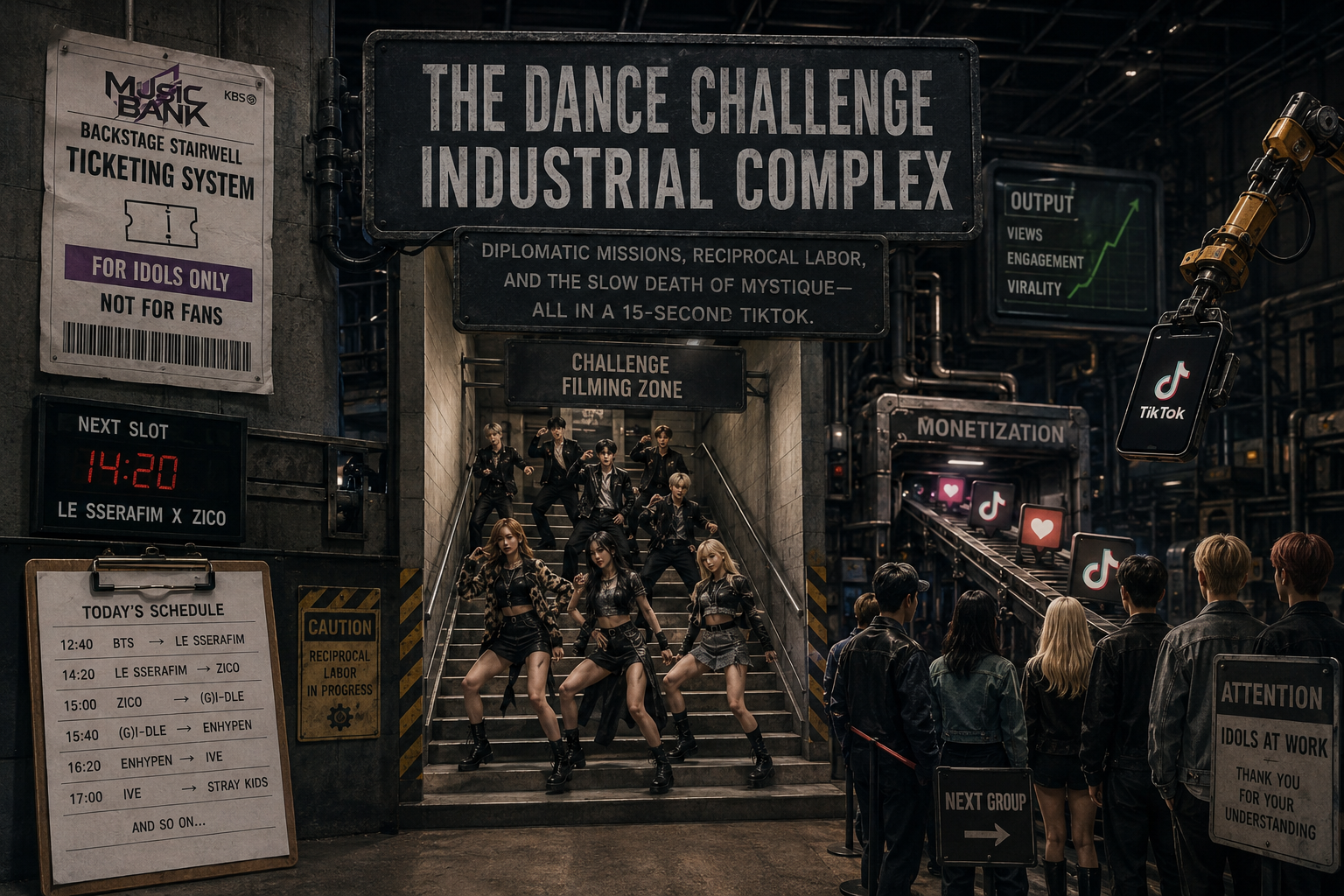
Diplomatic missions, reciprocal labor, and the slow death of mystique — all in a 15-second TikTok.
In March 2024, KBS Music Bank quietly introduced a ticketing system for its backstage stairwell. Not for fans. For idols. The staircase — a brutalist stretch of fluorescent-lit concrete between the dressing rooms and the stage entrance — had become so heavily booked for TikTok dance challenge filming that management had to implement a reservation queue to prevent traffic jams between groups waiting to perform thirty-second promotional videos for their labels’ social media accounts.
A ticketing system. For a staircase. For a 15-second video. This is where we are.
The K-pop dance challenge began as a spontaneous act of fan creativity. It is now a scheduled deliverable, a diplomatic currency, and — if you count the labor of every idol standing in a fluorescent-lit corridor awkwardly learning someone else’s choreography — a significant unpaid industry operation. What happened in between is a story about how quickly an organic cultural moment can be absorbed, systematized, and converted into infrastructure.
Chapter One
How It Started (And How Fast It Stopped Being Spontaneous)
The origin story is, at this point, canonical. On January 13, 2020, South Korean rapper Zico posted a casual video of himself dancing to his new song “Any Song” with MAMAMOO’s Hwasa. The video was unpolished. The location was unremarkable. The choreography was a simple hand gesture that anyone could replicate in their kitchen. Within weeks, the #AnySongChallenge had accumulated over 700 million views and 1.3 million uploads. “Any Song” reached number one on the domestic charts. Zico followed it with a second video with Chungha. The format was born.
What made it work was precisely its casualness. It looked like two musicians goofing off, not executing a promotional strategy. It was participatory — the whole point was that non-dancers could do it too. It spread because it was fun, not because it was polished.
The speed of industrialization is almost impressive. Four years from a rapper goofing off with Hwasa to a government-regulated staircase queue. The music industry has always been efficient at converting organic cultural moments into scheduled deliverables. It has rarely done it this fast.
Chapter Two
The TikTok Debt Ledger
When BTS’s Jin appeared in LE SSERAFIM’s “CRAZY” challenge in August 2024 — his first-ever TikTok collaboration, filmed on the day of his return from military service — fans on X observed something that deserved to be in a business school case study: “LE SSERAFIM collecting BTS members like Pokémon.”
The observation was funnier than it intended to be, because it was also accurate. By late 2024, LE SSERAFIM had filmed challenge videos with Jungkook (for “Perfect Night”), Jimin (for various collaborations), and now Jin. Each appearance was described in the press as a spontaneous show of support between label-mates and friends. Each appearance was also, functionally, a promotional asset delivered to LE SSERAFIM’s comeback campaign by one of the most recognized names in K-pop.
The question is not whether this is calculated. Of course it is. The question is whether it operates according to any legible logic — and, having spent more time than is reasonable watching idol TikTok challenge videos, I believe it does. There is an unwritten ledger. It works roughly like this:
→ LE SSERAFIM
Reciprocated
→ LE SSERAFIM
Pending
→ ILLIT Wonhee
Reciprocated
→ BTS Jungkook
Mutual
The ledger is not written down anywhere. No contract specifies that appearing in a labelmate’s challenge obligates a return appearance. But the pattern is consistent enough that fans track it obsessively — and when a debt goes unrepaid, the internet notices. The social currency is real even if the accounting is informal.
What makes this particularly interesting is the hierarchy embedded in the system. Same-label challenges operate on one set of rules (senior supports junior, junior promotes senior, the whole ecosystem benefits). Cross-label challenges operate on another (mutual fanbases, mutual visibility, no clear hierarchy but implicit awareness of who has more to gain). And then there are the asymmetric cases — a major act appearing in a smaller act’s challenge with no visible return — which function more like patronage than debt, and which carry their own social meaning.
KpopWave Editorial
The idol standing in the Music Bank corridor, slightly out of breath from their own performance, learning the hook of another group’s song from a phone screen while their manager watches — this person is doing promotional labor for a product that is not theirs. They are doing it because the system requires it, because their own comeback will require the same favor from someone else, and because the 15-second video they are about to film will appear on the other group’s official TikTok account and reach, conservatively, several million people.
This is a business meeting. It happens in a stairwell. It lasts ninety seconds. It requires a reservation.
Chapter Three
What We Lost in the Stairwell
There is something worth mourning here, and I want to be precise about what it is.
K-pop’s mystique — the careful management of idol image, the controlled distance between star and fan, the sense that everything you see has been curated and nothing is accidental — was one of the genre’s genuine innovations. It created a specific kind of desire: the feeling that access was rare, that proximity was earned, that the person on stage was a version of themselves that normal life could not contain.
Pre-challenge era: An idol’s non-stage appearance was event content. A brief airport sighting. A fan café post. A brief glimpse on a variety show. Scarcity created desire.
Post-challenge era: The same idol appears in your TikTok feed twice a week, in a different group’s video each time, learning choreography on camera with slightly visible effort, sometimes wearing the expression of a person who would rather be eating lunch. The content is charming. It is also relentless.
The tradeoff: Challenge content works. Streams go up. Fandoms grow. The promotional logic is sound. What it costs is the specific texture of wanting something you cannot easily see.
The challenge format is, at its core, anti-mystique. It requires idols to be casual, approachable, imperfect — to show the effort of learning the choreography, to laugh when they get it wrong, to appear human rather than exceptional. For fandoms that prize accessibility and parasocial closeness, this is ideal content. For the older conception of what K-pop stardom meant, it is a systematic dismantling of the architecture of desire.
I am not arguing that the old model was better. The accessibility of the current format has expanded K-pop’s global reach in ways that the mystique model never could. The challenge format is what put LE SSERAFIM’s choreography in front of people who had never watched a music show, in countries with no existing K-pop infrastructure. ROSÉ’s “APT.” challenge topped Billboard’s Global chart for two weeks. That does not happen with mystique. It happens with reach.
But reach and mystique are in tension, and the industry has clearly decided which one to prioritize. The stairwell is booked. The queue is full. The 15-second video posts in three hours. And somewhere between the music show set and the parking garage, an idol who has been awake since 5am is standing under fluorescent lights, phone in hand, performing someone else’s choreography for the algorithm, thinking — one assumes — about lunch.
I want to resist the obvious conclusion, which is that this is all fake and cynical and that dance challenges have ruined K-pop. That is not what I actually think. The best challenge videos are genuinely delightful. Jungkook doing “Perfect Night” with LE SSERAFIM on release day was a small perfect thing. The ZICO-Hwasa original is still charming six years later.
What I think is that the industrialization of the challenge format has created a new kind of idol labor that nobody has adequately described yet. These are not performances. They are not fan service in the traditional sense. They are cross-promotional content produced by artists for other artists’ campaigns, filmed in borrowed time, at borrowed locations, under the implicit social pressure of a reciprocity system that has no formal rulebook.
The idols doing this are professionals. They are good at it. Most of them appear to find it at least tolerable, and some of them appear to genuinely enjoy it. But the ticketing system at Music Bank’s stairwell is a funnier and more honest document of where K-pop is in 2026 than almost anything else I could point to.
The dance challenge began as play. It became content. It became strategy. And now it requires a ticket, a time slot, and a manager standing nearby checking the schedule. If Zico and Hwasa could see what their casual dance video hath wrought, I suspect they would find it impressive, slightly horrifying, and — in the way of all things that get systematized beyond recognition — oddly funny.
The staircase is booked through August. Check back in September.