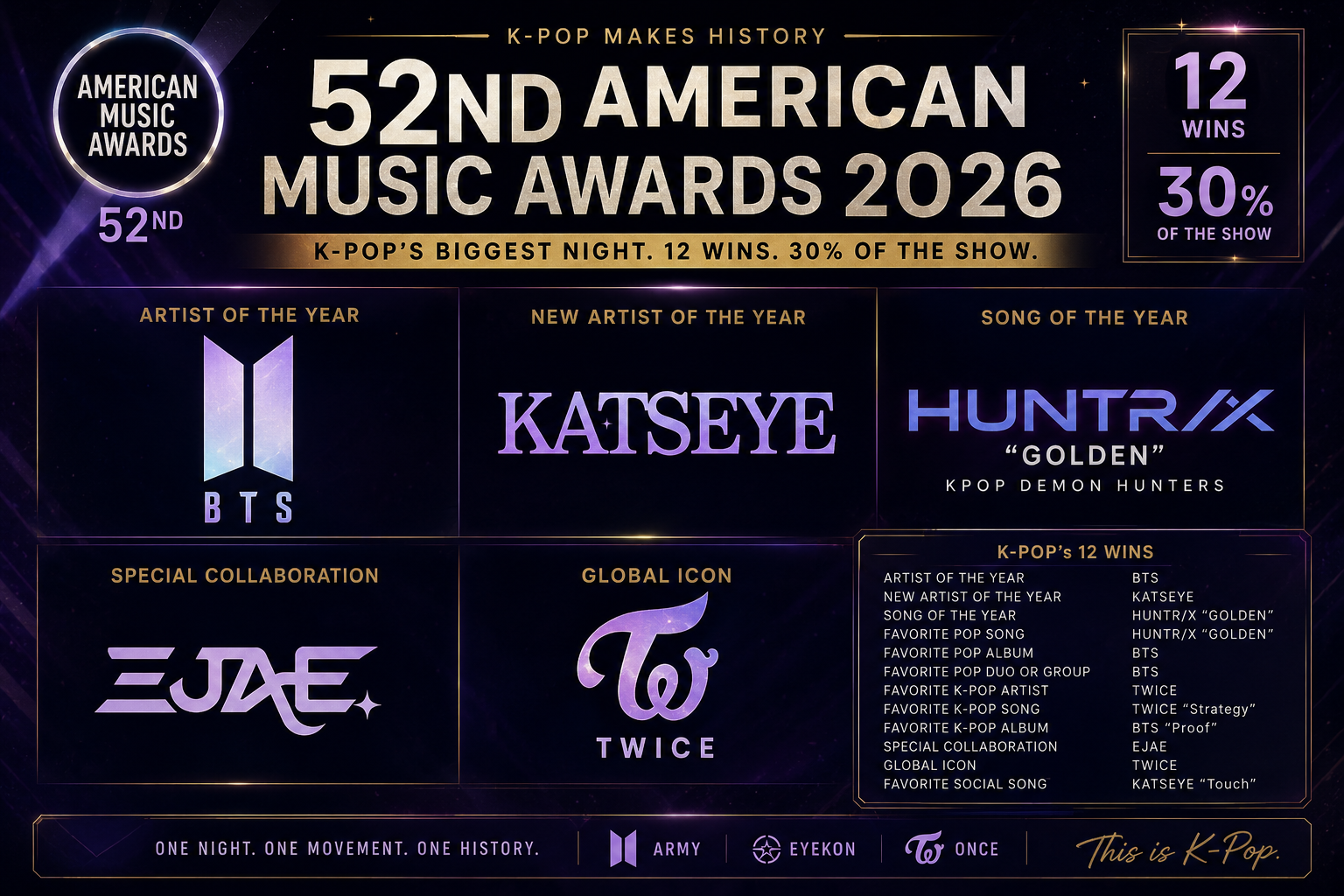
30 PERCENT OF THE ROOM.
The show opened with BTS performing “Hooligan” from a Las Vegas stage. It closed with K-pop holding twelve trophies. In between, the 52nd American Music Awards delivered the most concentrated demonstration of K-pop’s cultural weight in the history of American award shows — and it wasn’t close.
Forty trophies were handed out Monday night at the MGM Grand Garden Arena. K-pop-connected acts claimed twelve of them. That’s 30 percent of the room. Latin music, the genre that has been the most dominant non-English force at the AMAs for the better part of three decades, took home roughly six. On this particular night, in this particular city, Korean music outperformed every other genre on Earth except pop.
— MAY 25, 2026 · MEMORIAL DAY · MGM GRAND GARDEN ARENA · LAS VEGAS
The Full K-Pop Scorecard
Every trophy. Every category. No omissions.
Three Stories Inside the Numbers
What the trophies actually mean, one by one
They opened the show. They swept their three nominations. They are now 14-time AMA winners. The show that debuted them in 2017 with zero nominations spent Memorial Day night being headlined by them. From guest to owner in nine years.
Not in the K-pop category. In the general field. Against an entirely Western nominee list. New Artist of the Year went to a HYBE × Geffen group trained on K-pop methodology. The method won, not just the music.
The singing voices of a Netflix K-pop animated film won Song of the Year. EJAE, Audrey Nuna, and Rei Ami — three Asian-American artists, voicing K-pop idol characters — beat the entire pop field. K-pop as IP. This is what the next decade looks like.
BTS: What Fourteen Looks Like
The arithmetic of a career that nobody predicted would add up this high
Let’s be precise about what BTS’s 14-trophy total at the AMAs actually means. They are not the most decorated act in AMA history — that would be Michael Jackson, who accumulated 26 over his career. But they are the most decorated non-American act, and the only non-English-primary-language act in the top tier of the all-time list. They did it starting from zero nominations in 2017 and adding to the total every single year since. No other act in the show’s history has been as consistently productive at the AMAs across a nine-year span.
Monday night, they performed “Hooligan” to open the broadcast — the first time a K-pop act has ever opened the AMAs — and collected all three of their nominated categories. Artist of the Year for the second time. Song of the Summer for “SWIM,” the lead single from ARIRANG that debuted at No. 1 on the Hot 100 in March. Best Male K-Pop Artist, which at this point is less a competition than a formality. Then they went back to Allegiant Stadium the next two nights, where 65,000 people per night were waiting for them, to finish the Las Vegas stadium run they had paused for a single evening to attend this show. That detail — taking one night off from a sold-out stadium to collect a network television award — is the most precise summary of where BTS stands in 2026 that anyone could construct.
KATSEYE and the Methodology Win
When the training system beats the genre label
KATSEYE’s three trophies — New Artist of the Year, Best Music Video, Breakthrough Pop Artist — are arguably the most structurally significant K-pop wins of the night, and possibly of the decade. They did not win in the K-pop category. They won in the general pop field, against nominees who have no connection to Korean music whatsoever.
KATSEYE is the product of HYBE and Geffen Records’ deliberate experiment: take K-pop’s training methodology — the rigorous vocal and performance systems, the unit structure, the content architecture — and apply it to a group recruited globally, without the cultural K-pop framing. The result is a group that Western audiences can receive as a pop act while the infrastructure underneath it is entirely derived from Seoul. When KATSEYE won New Artist of the Year on Monday, the AMAs were not recognizing K-pop. They were recognizing what K-pop builds — and that distinction matters enormously for where the industry goes next.
K-pop spent nine years being recognized at the AMAs. On Monday, it stopped being recognized and started being dominant.
— KpopWave Editorial · May 26, 2026
Song of the Year: The Demon Hunters Moment
When an animated Netflix soundtrack beats the entire pop field
“Golden” — performed by the singing voices of HUNTR/X in the Netflix animated film KPop Demon Hunters — won Song of the Year at the 52nd AMAs. EJAE, Audrey Nuna, and Rei Ami: three Asian-American artists, voicing fictional K-pop idols in an animated series, accepted the biggest song award at American music’s largest fan-voted show.
Read that sentence again. Then consider that EJAE also won Best Soundtrack for the same project, giving her four trophies on the night — more than any single K-pop artist in AMA history in a single year. The KPop Demon Hunters project, between the main HUNTR/X wins and EJAE’s individual Soundtrack trophy, accounted for four of K-pop’s twelve Monday night trophies.
The industry implication is not subtle. K-pop IP — a fictional group, in an animated series, on a streaming platform — just won Song of the Year at the AMAs. The genre is no longer just producing music. It is producing universes that produce award-winning music. BTS arrived at the AMAs in 2017 as performers. KPop Demon Hunters arrived in 2026 as content that generates chart-topping original songs. These are not the same category of achievement. Both happened in the same building, on the same night, under the same genre umbrella.
The Latin Comparison
For context: the genre that has dominated non-English music at the AMAs for thirty years
Latin music — the dominant non-English genre at the AMAs since the late 1990s — had a strong night of its own. Bad Bunny won twice. Shakira took Best Female Latin Artist and Tour of the Year for her Las Mujeres Ya No Lloran World Tour. KAROL G received the International Artist Award of Excellence and Best Latin Album. Fuerza Regida and Kapo added two more. In total, Latin-connected acts took home approximately six trophies.
K-pop took home twelve.
That comparison is not a criticism of Latin music’s evening — it was a strong showing for a genre with deep roots in the show’s history. It is, rather, a measurement. Latin music had a 24-year head start at the AMAs, built a six-category infrastructure, and produced the show’s most-nominated artist this year in Taylor Swift’s neighborhood — Bad Bunny with two nominations. On Monday night, K-pop doubled Latin music’s trophy count. That is the kind of data point that makes industry people take meetings the following morning.
TWICE and the Longevity Factor
A ten-year-old group still taking home hardware in 2026
TWICE’s Best Female K-Pop Artist win is the quietest of K-pop’s twelve Monday night trophies, and perhaps the most underrated. TWICE debuted in 2015. They are a third-generation K-pop act. They completed a This Is For World Tour leg in North America earlier this year that drew 550,000 fans — the all-time record for a K-pop girl group in the region. On Monday, they added an AMA to the shelf. TWICE winning in 2026 is not a legacy acknowledgment. It is a current-market statement. They are here, they are drawing 550,000 people in arenas, and the AMAs continue to recognize it.
What Monday Night Actually Means
The morning-after reading
The 52nd AMAs were not the first awards show to give K-pop significant recognition. The Grammys have been slowly opening their doors. The MTV VMAs have had K-pop presence for years. But no single night at any American award show has produced twelve K-pop trophies out of forty total. No single night has seen a K-pop act open the broadcast, a K-pop-trained group win general-field New Artist of the Year, and a K-pop Netflix soundtrack claim Song of the Year — all in the same three-hour window. Monday in Las Vegas was not a milestone. It was a demonstration of saturation.
The show’s host, Queen Latifah, noted that this year’s AMAs received the most fan votes in the show’s history. That number is inseparable from K-pop. ARMY, EYEKON, ONCE — these fandoms do not watch awards shows. They mobilize for them. The AMAs’ voting infrastructure was built for exactly this kind of organized, global, multi-timezone fan behavior. K-pop fandoms have been the most reliable engine of that system for the better part of a decade. What Monday produced was the logical outcome of that alignment: a night that looked, in its final trophy count, like a K-pop show with country, pop, and hip-hop segments.
- DateMonday, May 25, 2026 — Memorial Day
- VenueMGM Grand Garden Arena, Las Vegas (largest venue in show history)
- HostQueen Latifah — most fan votes in AMA history this year
- K-Pop Total12 trophies out of 40 — 30% of the entire show
- BTSArtist of the Year · Song of the Summer · Best Male K-Pop Artist → 14 career AMA wins
- KATSEYENew Artist of the Year · Best Music Video · Breakthrough Pop Artist (all general field)
- HUNTR/XSong of the Year · Best Vocal Performance · Best Pop Song (KPop Demon Hunters)
- EJAEBest Soundtrack (KPop Demon Hunters) — 4 trophies on the night, a single-night K-pop record
- TWICEBest Female K-Pop Artist
- Show OpenerBTS — “Hooligan” — first K-pop act to open the AMAs broadcast
The KpopWave Take
There is a version of tonight’s story that frames it as a triumph. K-pop won thirty percent of the room. BTS opened and swept. A Netflix soundtrack beat the entire pop field. KATSEYE won New Artist of the Year in the general category. If you are looking for vindication, there is plenty of it in Monday night’s trophy count.
But the more interesting frame is not triumph — it’s normalization. K-pop at the AMAs in 2026 is not shocking anymore. It is not remarkable. It is not a conversation about whether the genre belongs. It is, simply, what happens now. BTS wins Artist of the Year. KATSEYE wins New Artist of the Year. A K-pop Netflix show wins Song of the Year. These are not surprises. They are outcomes that the industry’s own data — streams, sales, radio, tour grosses, and most relevantly, fan votes — was pointing toward for years.
The AMAs are a fan-voted show. K-pop fans vote better than anyone. The logical conclusion of that combination, played out over nine years, is Monday night in Las Vegas: twelve trophies, thirty percent of the room, and BTS opening the broadcast six miles from their own sold-out stadium.
The room finally caught up.