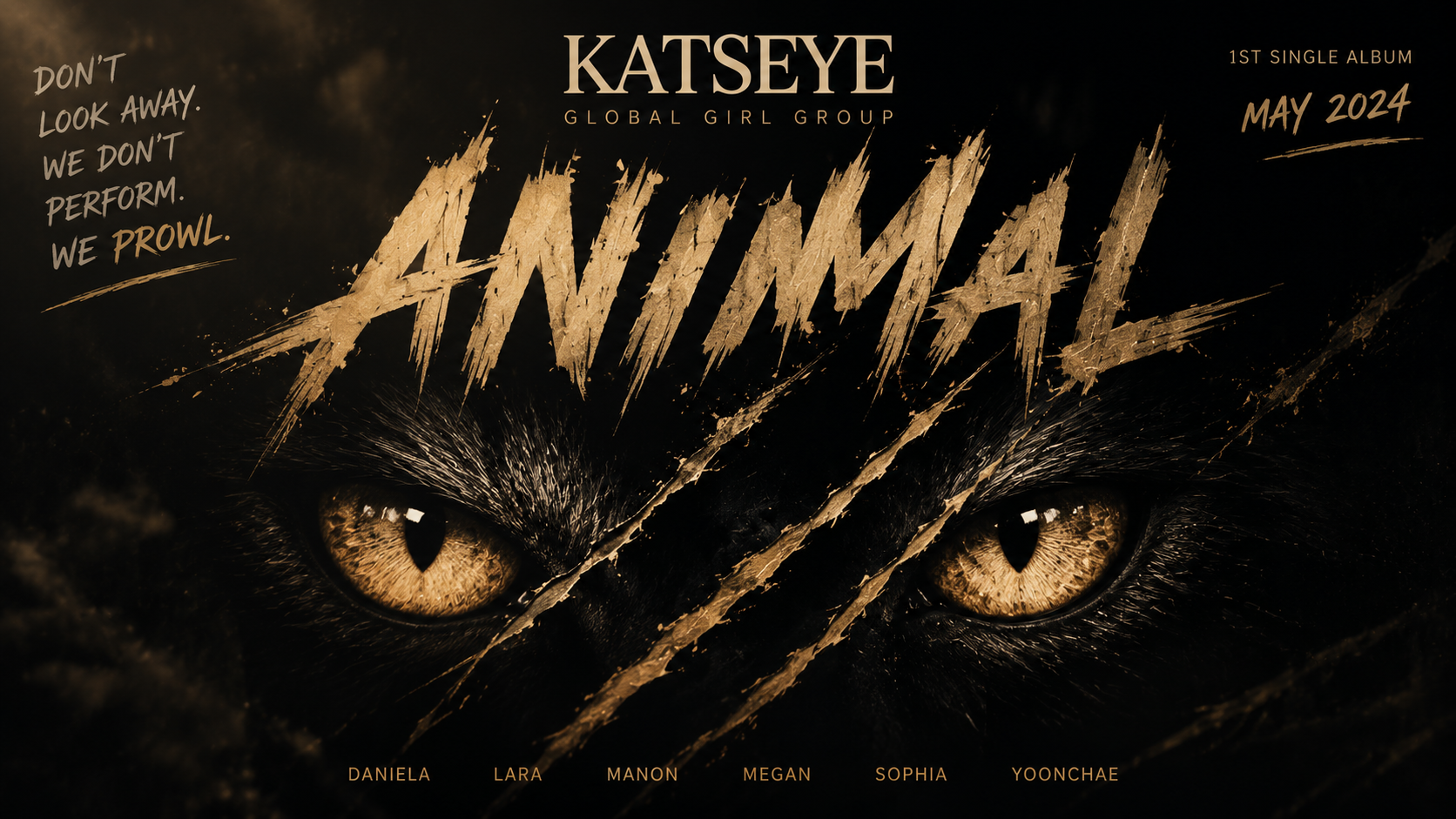
KATSEYE’s Ed Sheeran-co-written single is the most vocally confident thing the group has released. The conversation around it, days later, is still mostly about which member Billboard’s promo post forgot to include — again.
KATSEYE released “Animal” on July 24 — a genuinely strong pivot toward a more vocal-forward sound, co-written by Ed Sheeran, backed by a high-concept music video with a Demi Moore cameo. Five days later, most of the conversation in Korean entertainment coverage isn’t about the song at all. It’s about a Billboard promotional post that gave every member an individual photo except Yoonchae, the group’s only Korean member — and about Billboard quietly deleting all the individual photos once fans noticed, without a word of explanation.
Set the controversy aside for a moment, because “Animal” deserves it. It’s a clear stylistic turn from the chaos of “Gnarly” and “Pinky Up” — more melodic, more restrained in its production, and built to let the members’ voices carry the track rather than hide behind stacked hooks and TikTok-ready two-word choruses. The lyric plays with the gap between a composed public self and a wilder private one, letting that tension build across the verses before releasing into a chorus that keeps circling back to the same idea: nobody sees the version of you that only comes out behind closed doors.
Reception has split along a familiar line. Outlets like PinkNews and mxdwn framed it as a vocal showcase fans had been asking for — a return to the more melodic register of “Gabriela,” the group’s most-streamed song, after a run of brasher, more percussive singles. A more critical strain of reviews, RateYourMusic’s user base chief among them, pushed back hard, arguing the vocal performances blur together into an anonymous, over-processed sameness, and that the songwriting talent involved (Sheeran, Slatkin, Fedi) produced something safer than it needed to be.
Fans have been begging KATSEYE to actually sing rather than lean on repeated hooks — and on this track, they finally do.
A user review argued the vocal performances are nearly indistinguishable from member to member, calling the result too safe to leave much impression.
Described as an easier, more radio-friendly listen than the group’s more chaotic recent singles — a deliberate change of pace.
One listener called the song “not bad” — catchy in the chorus, but flat enough overall that little beyond the hook stuck after one listen.
The “Animal” video, directed by Cody Critcheloe, leans into a similarly high-concept register: the group performs for a fictional review panel called “Boyseye,” gets torn apart critically, and rebuilds with the help of a scene-stealing Demi Moore playing a “Devil Wears Prada”-adjacent fashion tyrant. There are gender-swapped looks, a nod to the 1996 film “Bound” in a scene between Daniela and Lara, and enough visual ideas packed in that several reviewers noted the video does more narrative work than the song’s three minutes technically need. It’s ambitious in the way KATSEYE’s visuals reliably are — the concept is doing a lot of the storytelling the lyric leaves understated.
The Post That Overshadowed the Comeback
Shortly after “Animal” dropped, Billboard’s official social accounts posted a comeback promo: a group photo followed by an individual slide for each member. Fans noticed quickly that five members got their own slide — and Yoonchae didn’t. Screenshots spread fast across X and Korean forums, with users describing the omission as impossible to read as a simple accident, given it targeted the group’s only Korean member specifically.
Billboard’s response, once the backlash escalated, wasn’t to add the missing photo. It quietly deleted all six individual slides, leaving only the group photo standing, without any public comment, correction, or apology. Korean entertainment outlets covering the story explicitly framed it as part of a pattern rather than a one-off — coverage noted fans describing Yoonchae as recurrently the member left out of individual features, and several outlets used the word “again” in their headlines. The story also revived Billboard’s own older reputation problem: in 2021, the outlet drew criticism for an illustration accompanying its BTS Grammy coverage that critics said caricatured the members in a way widely read as racially insensitive: the illustrator apologized at the time, though Billboard itself never issued a formal statement.
Commenters asked plainly why the Korean member had been the one left out, and called the removal-without-explanation response worse than the original mistake.
Coverage noted Billboard had “not publicly addressed the criticism” even after the photos came down, leaving fans with no acknowledgment at all.
It’s worth being precise about what actually happened here, separate from the question of intent. Deleting all the individual photos rather than adding the missing one doesn’t correct the imbalance the post created — it just erases the evidence of it. No apology, no acknowledgment, no explanation of what went wrong in the editing process. For an outlet whose entire business is credibility in music coverage, that’s a strange way to handle even an honest mistake.
- This isn’t happening in a vacuum for KATSEYE specifically. The group has spent much of 2026 fielding race-related scrutiny on multiple fronts — questions around Manon’s still-unexplained hiatus, a member’s father’s since-deleted social posts drawing criticism in March, and now this. None of these incidents are the same event, and KpopWave isn’t asserting they share a cause. But the accumulation is doing real reputational work on the group’s “multinational family” branding, whether or not any single incident holds up to scrutiny on its own.
- The “just delete it” response is its own small case study. It mirrors a pattern we’ve flagged in other coverage this year: institutions responding to visibility problems by reducing visibility further, rather than fixing the actual gap. Removing everyone’s photo technically achieves “equal treatment” — nobody gets an individual feature — while doing nothing to answer why the original omission happened in the first place.
None of this erases what’s genuinely good about “Animal.” But it’s a useful reminder that a strong comeback can be completely overshadowed by five minutes of careless content moderation, and that “we made everyone equally invisible” is not the same thing as accountability.
“Animal” is a good song getting a genuinely unfair hearing right now, and that’s a shame — it’s the most vocally confident thing this group has put out. But I don’t think it’s KpopWave’s job to pretend the two stories are separate when the audience clearly isn’t treating them that way.
What bothers me most isn’t the original omission — content teams make mistakes, and one missing photo, on its own, could plausibly be an accident. It’s the response. Silently deleting the evidence instead of adding the missing photo and saying “our mistake” reads less like an outlet correcting an error and more like one hoping the story disappears along with the images. For a group whose entire premise is that six different backgrounds can share one stage without anyone getting flattened into the background, watching the press covering them do exactly that — quietly, with no comment — is the part of this story that deserves to outlast the news cycle.
— KpopWave Editorial
Reporting cross-verified across Billboard, Billboard Canada, Koreaboo, Shining Awards, IBTimes Singapore, Segye Ilbo, Xports News, Nate News, Rolling Stone, mxdwn, PinkNews, Just Jared, and RateYourMusic (July 2026). Claims regarding Billboard’s intent are not asserted by KpopWave; all characterizations of motive are attributed to fan and press commentary as reported. Song lyrics are described in original paraphrase and not reproduced. Quoted material is limited and independently confirmed across multiple outlets.