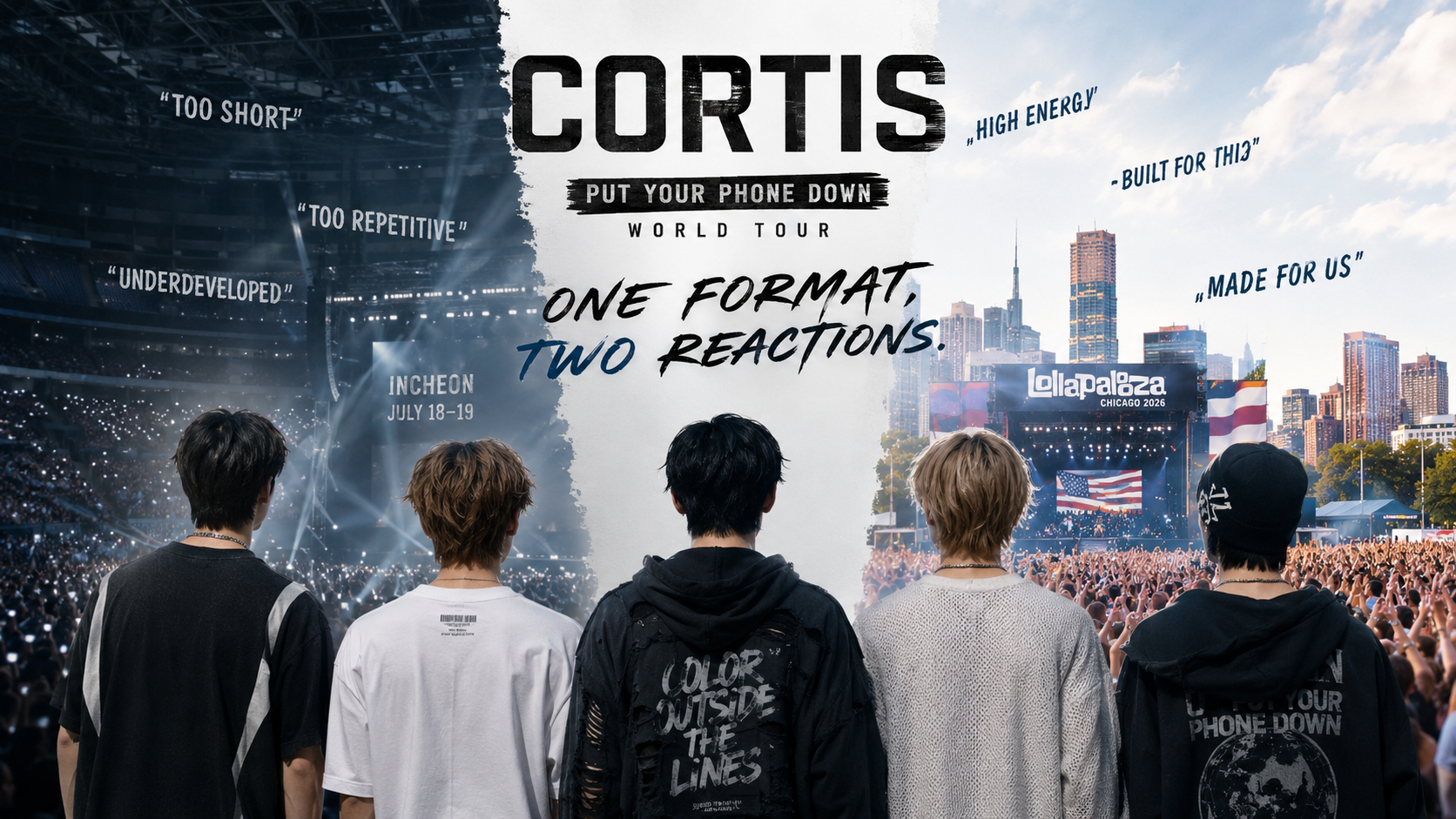
CORTIS’s debut concert got called too short, too repetitive, and underdeveloped. Three weeks later, the group played Lollapalooza and opened a sold-out North American tour — the exact audience one critic argued the format was built for all along.
CORTIS opened its debut world tour, “Put Your Phone Down,” at Incheon’s Inspire Arena on July 18 to a genuinely rough reception — not for the performances themselves, but for the show around them. Less than three weeks later, the BigHit Music group played a solo stage at Lollapalooza Chicago as the festival’s only K-pop boy group, and on August 4 opened the North American leg of the same tour in Toronto. The question hanging over this leg of the tour isn’t whether CORTIS can perform. It’s whether a format that read as a shortfall in Korea reads as something else entirely once it’s playing to the crowd it may have been designed for.
CORTIS is barely a year into its career — the group debuted in August 2025 with a 12-song catalog spread across two EPs, “COLOR OUTSIDE THE LINES” and “GREENGREEN.” That’s a thin songbook to build a full headline show around, and it showed. Attendees at the July 18–19 Incheon shows reported a roughly 100-minute set that leaned hard on repetition: “YOUNGCREATORCREW” reportedly played five times, “REDRED” four times, with no costume changes, no video interludes, and largely no stage banter between songs. Online reaction was swift and largely unflattering, with complaints centered less on the group’s live ability — several reviews specifically praised their vocals and stage presence — and more on whether the show represented fair value against its roughly $96 ticket price.
BigHit responded quickly. Fans noted visible adjustments between the two Incheon nights, and member James posted a warm, specific thank-you message on Weverse after the final show, addressed to fans who’d danced, moshed, and stuck it out through a rough debut outing. The adjustments didn’t fully settle the debate, though — some fans welcomed the changes, others asked pointedly why they hadn’t been there from night one.
Not every review treated the format as a failure. Culture critic Kim Sung-soo, quoted in the Korea Herald’s coverage of the Incheon shows, offered a different read: that CORTIS’s concert resembled Western hip-hop shows or music festivals more than a conventional K-pop idol concert — repeated songs used deliberately to build crowd energy, rather than a rotating setlist designed to showcase range. Some attendees echoed that read themselves, arguing the stripped-down, high-repetition, high-participation format matched the tour’s own title and the group’s “color outside the lines” branding better than a traditional two-hour idol show would have.
That theory had an obvious hole in it at the time: if the format was intentional, why did BigHit visibly adjust it after one night of backlash? A deliberate artistic choice doesn’t usually get revised mid-run. But the theory gets a genuine second test now that the tour has moved to the market where festival-style, repetition-driven live shows are already the dominant convention — North America, where Lollapalooza-goers spend entire weekends watching sets built exactly the way critics described CORTIS’s Incheon show.
The Credentials That Travel
Whatever happened in Incheon, CORTIS arrived in North America with a mainstream foothold most K-pop acts don’t reach in their first year. The group was the first K-pop act to headline the opening night of the NBA Crossover Concert Series during 2026’s NBA All-Star Weekend. “GREENGREEN,” its second EP, debuted at No. 3 on the Billboard 200 — a 12-spot jump from its first release. And the Lollapalooza Chicago booking put CORTIS on a festival bill built entirely around the kind of high-energy, repetition-friendly set structure Kim Sung-soo described, alongside acts whose entire live business model depends on crowds that don’t expect a costume change every third song.
What’s notable is that the North American leg hasn’t reproduced Korea’s specific complaint — at least not yet, and not in the same form. Toronto’s show, at a roughly 5,000-to-6,000-seat venue, reportedly drew a virtual queue estimated by fans at 340,000 to 400,000 people. Resale tickets bottomed out above $560. The loudest North American fan complaints so far aren’t about setlist repetition or runtime; they’re about scarcity — too few cities, venues too small for the demand, prices pushed up by a queue nobody expected to be that long for a group barely a year into its career.
That’s a meaningfully different problem than Incheon’s. Korean fans paid roughly $96 and argued about whether they got enough show for it. North American fans are being asked to pay several times that, if they can get a ticket at all, for a show whose actual content hasn’t drawn nearly the same scrutiny yet.
It’s too early to say definitively whether the “festival format” theory holds up — CORTIS’s North American shows are only just beginning, and no substantial review coverage from the Toronto opener had emerged as of this writing. But the shape of the two markets’ complaints so far tells its own story.
- In Korea, the audience was measuring CORTIS against the standard two-to-three-hour idol concert with costume changes and VCR segments — a well-established genre convention the show didn’t meet, at a price point where that mismatch stung.
- In North America, that convention doesn’t exist in the same form. A stripped-down, high-repetition, audience-participation-driven set is much closer to what festival and hip-hop concertgoers already expect. The complaint that’s surfaced instead — not enough shows, not enough seats, prices driven up by scarcity — is a demand problem, not a content problem.
If that pattern holds through the rest of the tour, it would suggest Kim Sung-soo’s read was closer to accidentally correct than deliberately planned: a format built without a clear audience in mind that happens to fit North America’s live-music conventions better than Korea’s, whether or not that was the actual intent from BigHit’s side.
I don’t think anyone at BigHit sat down a year ago and designed a 100-minute, repetition-heavy show specifically for American festival crowds — the mid-run adjustments in Incheon make that a hard case to argue with a straight face. But intent and outcome aren’t the same thing, and it’s genuinely interesting that a format criticized as underdeveloped in one market is landing in a market built to reward exactly that kind of show.
If CORTIS’s North American reviews come back warmer than Incheon’s did, the honest lesson isn’t that BigHit was secretly right all along. It’s that a young group’s first tour can be simultaneously under-built for the audience that raised it and reasonably well-suited to the audience it’s now trying to win — and that those two things being true at once says less about the format itself than about how differently “enough show” gets defined depending on which side of the Pacific you’re standing on.
— KpopWave Editorial
Reporting cross-verified across the Korea Herald, Korea Times, WION, The Express Tribune, Allkpop, ZAPZEE, The Morning Calm Post, and ticket marketplace listings (Ticketmaster, StubHub, SeatGeek) as of August 6, 2026. North American tour reception is still developing; this piece reflects reporting available at time of publication and should be treated as a snapshot, not a final verdict. Quoted material is limited and independently confirmed across multiple outlets.