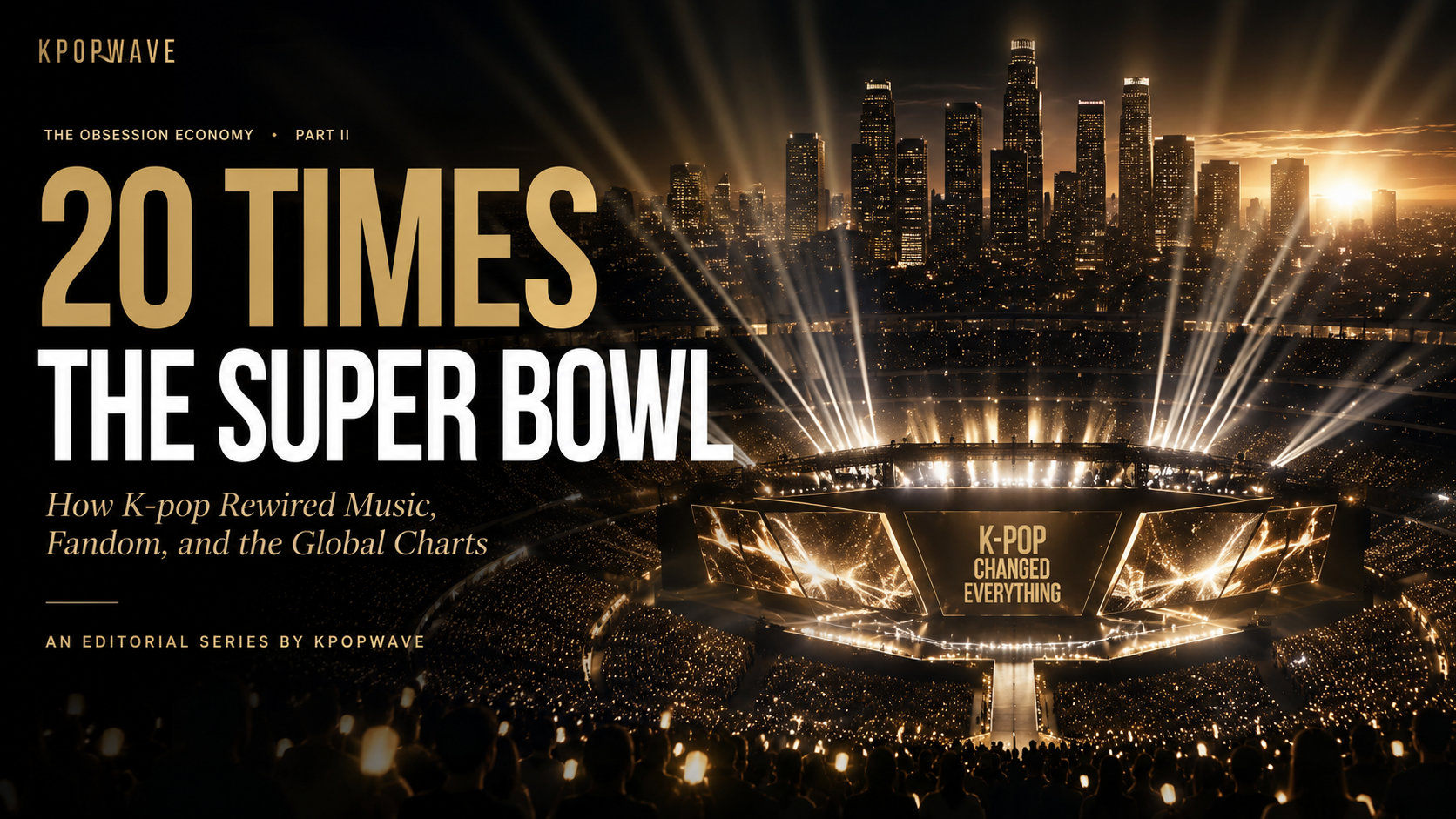
Forget the Super Bowl. On July 19, BTS, Madonna, Shakira, and Justin Bieber will attempt to compress the biggest live spectacle in human history into exactly 660 seconds.
The first-ever World Cup Final halftime show is 11 minutes long. That’s not a limitation. That’s the design.
FIFA president Gianni Infantino has never been accused of underselling anything.
So when he said the first-ever World Cup Final halftime show would reach “a couple of billion viewers — twenty times the Super Bowl,” the number landed somewhere between prophecy and provocation.
Twenty times. Let that sit for a moment. Then consider what it means for BTS, Madonna, Shakira, and Justin Bieber — who will walk onto the MetLife Stadium pitch on July 19 and have exactly eleven minutes to make it true.
Minutes of
Performance
Co-
Headliners
Projected
Viewers
Halftime Show
in WC History
Chapter One — Why Football Never Had a Halftime Show
The answer is simple and structural: fifteen minutes.
The Super Bowl halftime runs 28 to 30 minutes — stage construction included. FIFA’s Laws of the Game mandate a 15-minute break, maximum. The math never worked. For 95 years of World Cup history, no one could fit a proper production into a soccer break. Until someone decided to stop trying to fit a Super Bowl into football — and instead engineer something entirely new.
FIFA trialled the concept at last year’s Club World Cup Final, also at MetLife. Same stadium, smaller audience, lower stakes. The proof of concept held. And in 2026, the blueprint scales up to the biggest match on earth.
“This is the single largest gathering of artists united for a cause since Live Aid, and it could well be the most-watched 11 minutes of broadcast music performance in history.”
Hugh Evans, CEO — Global Citizen
The show clocks in at 11 minutes. The entire spectacle — four co-headliners, Burna Boy, Gustavo Dudamel, Coldplay with PS22 Chorus, Sesame Street and Muppets characters, 82,500 in the stadium — compressed into the length of two commercial breaks. That constraint is not a limitation. It’s the design. Every second will be engineered. Nothing can meander, nothing can be filler. The 11-minute World Cup halftime show will be, by necessity, the most precisely produced live performance in history.
Chapter Two — The Numbers, Honestly
Before we accept Infantino’s “couple of billion” figure, it deserves scrutiny.
| Metric | 2026 Super Bowl | 2022 World Cup Final | 2026 WC Final (Projected) |
|---|---|---|---|
| Peak Simultaneous Viewers | 128M (U.S. only) | 571M (global) | 1B – 2B (global) |
| Total Match Audience | ~180M (U.S.) | 1.4B+ (global) | Uncharted |
| Halftime Performance | Bad Bunny (~13 min) | None | BTS · Madonna · Shakira · Bieber (11 min) |
| Broadcast Markets | Primarily U.S. | 200+ countries | 200+ countries |
| Multiplier vs. Super Bowl | 1× | ~4.5× (match only) | ~8× – 20× (FIFA projection) |
The “couple of billion” is a projection, not a verified figure. Possible? Yes. Guaranteed? No. But even at half that number — one billion simultaneous viewers — the World Cup Final halftime show would be the most-watched live musical performance since records began. The Super Bowl isn’t the ceiling anymore. It’s the floor.
Chapter Three — What This Lineup Actually Says
The four co-headliners were not assembled randomly. Read together, they tell a very specific story about how pop’s center of gravity has moved — and keeps moving.
Madonna
Super Bowl XLVI headliner (2012). The artist who rewrote what a woman could own in pop — and kept rewriting it for four decades. Now 67. Still the establishment’s most dangerous member.
Shakira
Super Bowl LIV co-headliner (2020). “Waka Waka” remains the best-selling World Cup song in history. Performed at the opening ceremony in Mexico City — the only artist spanning the full arc of 2026, from first kick to last whistle.
BTS
ARIRANG (March 2026) debuted #1 globally. “Swim” hit Billboard Hot 100 #1. 82-date world tour, every date sold out. First full comeback after mandatory military service separated all seven members for four years.
Justin Bieber
Four years off the road after health issues ended the Justice World Tour. Returned at Coachella, April 2026 — 90-minute set, first live show since 2022. Now: the World Cup Final. The comeback that nobody saw coming, on the biggest stage that has ever existed.
Madonna. Shakira. BTS. Justin Bieber. Three continents, four different moments when something that wasn’t supposed to conquer Western pop did exactly that.
Madonna in the 1980s rewrote what a woman could own in the industry. Shakira crossed the language barrier not by abandoning Spanish, but by making the world want to learn it. BTS built the largest fandom on earth without changing a single thing about where they came from. And Bieber — the Canadian kid from YouTube who outsold everyone at 16, then spent four years in the dark fighting his own body — is the wild card who makes this lineup feel human rather than institutional.
FIFA may have intended spectacle. What they actually booked was a living history of how pop’s center of gravity keeps moving. And a reminder that the artists who move it are never the ones the industry expected.
There is one thread that deserves particular attention. Shakira performed at the opening ceremony in Mexico City on June 11 — alongside Burna Boy, who is also on tonight’s halftime bill. Now she closes the tournament at the Final on July 19. No other artist in this show spans the full arc of 2026 — from the first kick to the last whistle. That isn’t coincidence. It is the clearest confirmation that Shakira, right now, is the living bridge between football and music in a way no one else currently is.
Chapter Four — Chris Martin Doesn’t Perform. He Architects.
The show is curated by Coldplay’s Chris Martin — announced in May via a video starring Elmo, Cookie Monster, Kermit, and Miss Piggy, with a FaceTime cameo from BTS. Elmo suggested Madonna. Cookie Monster pitched BTS. Animal pushed for Shakira. Absurd, deliberate, and completely on-brand for what Global Citizen does: make the serious feel accessible without making it feel small.
Martin brings a specific track record. Coldplay’s 2016 Super Bowl show — with Beyoncé and Bruno Mars as guests — is the template for how a halftime show can balance spectacle with emotional weight. What made it work wasn’t Coldplay. It was Martin’s willingness to step aside and let the bigger story tell itself. Here, Coldplay performs alongside the PS22 Chorus — elementary school students from Staten Island, New York — a pairing that is simultaneously the most wholesome and the most structurally interesting creative decision in the entire show.
1:30 PM ET — Closing Ceremony (90 min before kickoff)
Post Malone · Robbie Williams · Nicole Scherzinger · Laura Pausini · IShowSpeed · Tom Cruise (special appearance) · Jennifer Hudson (U.S. national anthem)
3:00 PM ET — Kickoff: Spain vs Argentina
Halftime (~3:45 PM ET) — Halftime Show · 11 minutes
Co-Headliners: BTS · Madonna · Shakira · Justin Bieber
Featured: Burna Boy · Gustavo Dudamel · PS22 Chorus with Coldplay · Sesame Street & Muppets
FIFA Global Citizen Education Fund: $100M target · $50M+ already raised
That $50 million figure — raised from ticket sales before a single note is performed on July 19 — is the number that puts everything in context. This isn’t a charity show dressed as entertainment. The financial architecture was built first. The spectacle is the delivery mechanism.
Chapter Five — ARIRANG, and What BTS Standing There Actually Means
The album is named after a centuries-old Korean folk song — widely considered Korea’s unofficial national anthem, a melody that survived occupation, war, and diaspora. “Arirang” is a song about leaving, about the weight of distance, and the longing of return. BTS chose that name for their comeback record deliberately — an album about identity and absence, written in the shadow of four years of mandatory military service that separated the group entirely.
They went away. They wrote an album about leaving. Now they perform it in New Jersey, in front of two billion people.
“The most important thing is just that we are here back together again. We’re going to see the fans all over the world.”
RM, BTS — GQ, 2026
The symbolism is almost too precise to be accidental. But here is what matters beyond the symbolism. BTS are not performing on July 19 as K-pop ambassadors, or as representatives of Korea, or as proof of any wave. They are performing because ARIRANG is one of the best-selling albums of 2026, because “Swim” is one of the biggest songs on earth right now, because their world tour sold out 82 dates before most people finished their morning coffee on announcement day.
The Korean pop industry didn’t create this moment. Thirteen years of work did. And four years of waiting.
I have been thinking about what “twenty times the Super Bowl” actually means — not as a marketing line, but as a statement about where music and sports have arrived together in 2026.
The Super Bowl halftime show became culturally dominant because American television made it so. Massive domestic audience, one time zone bloc, a media ecosystem primed to turn 13 minutes of performance into a week of discourse. That formula worked because it was contained. The show happened in America, for America, and the rest of the world watched if it felt like it.
What July 19 represents is something structurally different. A global simultaneous audience with no single dominant media market, no single language, no single fandom making it happen. BTS’s ARMY, Madonna’s decades of devotees, Shakira’s Latin American base, Bieber’s generation who grew up with him, the football audience that has never cared about any of them — all watching the same 11 minutes, at the same moment. That has never happened before. Not at Live Aid. Not at the Olympics. Not anywhere.
And the honest question I keep returning to: after July 19, what is the Super Bowl halftime show? It remains enormously important within American culture. But it will no longer be able to claim the crown it has held since Michael Jackson in 1993 turned the intermission into the main event. That crown transfers. And it transfers to a stage built by an American, a Colombian, seven Koreans, and a Canadian — none of whom represent a single country’s culture, and all of whom got here by refusing to stay inside one.
That isn’t the story of K-pop going global. That isn’t even the story of BTS. It’s the story of what happens when the world finally gets big enough for the music to match it.
We’ll be watching. All two billion of us.
FIFA president Gianni Infantino has never been accused of underselling anything.
So when he said the first-ever World Cup Final halftime show would reach “a couple of billion viewers — twenty times the Super Bowl,” the number landed somewhere between prophecy and provocation.
Twenty times. Let that sit for a moment. Then consider what it means for BTS, Madonna, Shakira, and Justin Bieber — who will walk onto the MetLife Stadium pitch on July 19 and have exactly eleven minutes to make it true.
Minutes of
Performance
Co-
Headliners
Projected
Viewers
Halftime Show
in WC History
Chapter One — Why Football Never Had a Halftime Show
The answer is simple and structural: fifteen minutes.
The Super Bowl halftime runs 28 to 30 minutes — stage construction included. FIFA’s Laws of the Game mandate a 15-minute break, maximum. The math never worked. For 95 years of World Cup history, no one could fit a proper production into a soccer break. Until someone decided to stop trying to fit a Super Bowl into football — and instead engineer something entirely new.
FIFA trialled the concept at last year’s Club World Cup Final, also at MetLife. Same stadium, smaller audience, lower stakes. The proof of concept held. And in 2026, the blueprint scales up to the biggest match on earth.
“This is the single largest gathering of artists united for a cause since Live Aid, and it could well be the most-watched 11 minutes of broadcast music performance in history.”
Hugh Evans, CEO — Global Citizen
The show clocks in at 11 minutes. The entire spectacle — four co-headliners, Burna Boy, Gustavo Dudamel, Coldplay with PS22 Chorus, Sesame Street and Muppets characters, 82,500 in the stadium — compressed into the length of two commercial breaks. That constraint is not a limitation. It’s the design. Every second will be engineered. Nothing can meander, nothing can be filler. The 11-minute World Cup halftime show will be, by necessity, the most precisely produced live performance in history.
Chapter Two — The Numbers, Honestly
Before we accept Infantino’s “couple of billion” figure, it deserves scrutiny.
| Metric | 2026 Super Bowl | 2022 World Cup Final | 2026 WC Final (Projected) |
|---|---|---|---|
| Peak Simultaneous Viewers | 128M (U.S. only) | 571M (global) | 1B – 2B (global) |
| Total Match Audience | ~180M (U.S.) | 1.4B+ (global) | Uncharted |
| Halftime Performance | Bad Bunny (~13 min) | None | BTS · Madonna · Shakira · Bieber (11 min) |
| Broadcast Markets | Primarily U.S. | 200+ countries | 200+ countries |
| Multiplier vs. Super Bowl | 1× | ~4.5× (match only) | ~8× – 20× (FIFA projection) |
The “couple of billion” is a projection, not a verified figure. Possible? Yes. Guaranteed? No. But even at half that number — one billion simultaneous viewers — the World Cup Final halftime show would be the most-watched live musical performance since records began. The Super Bowl isn’t the ceiling anymore. It’s the floor.
Chapter Three — What This Lineup Actually Says
The four co-headliners were not assembled randomly. Read together, they tell a very specific story about how pop’s center of gravity has moved — and keeps moving.
Madonna
Super Bowl XLVI headliner (2012). The artist who rewrote what a woman could own in pop — and kept rewriting it for four decades. Now 67. Still the establishment’s most dangerous member.
Shakira
Super Bowl LIV co-headliner (2020). “Waka Waka” remains the best-selling World Cup song in history. Performed at the opening ceremony in Mexico City — the only artist spanning the full arc of 2026, from first kick to last whistle.
BTS
ARIRANG (March 2026) debuted #1 globally. “Swim” hit Billboard Hot 100 #1. 82-date world tour, every date sold out. First full comeback after mandatory military service separated all seven members for four years.
Justin Bieber
Four years off the road after health issues ended the Justice World Tour. Returned at Coachella, April 2026 — 90-minute set, first live show since 2022. Now: the World Cup Final. The comeback that nobody saw coming, on the biggest stage that has ever existed.
Madonna. Shakira. BTS. Justin Bieber. Three continents, four different moments when something that wasn’t supposed to conquer Western pop did exactly that.
Madonna in the 1980s rewrote what a woman could own in the industry. Shakira crossed the language barrier not by abandoning Spanish, but by making the world want to learn it. BTS built the largest fandom on earth without changing a single thing about where they came from. And Bieber — the Canadian kid from YouTube who outsold everyone at 16, then spent four years in the dark fighting his own body — is the wild card who makes this lineup feel human rather than institutional.
FIFA may have intended spectacle. What they actually booked was a living history of how pop’s center of gravity keeps moving. And a reminder that the artists who move it are never the ones the industry expected.
There is one thread that deserves particular attention. Shakira performed at the opening ceremony in Mexico City on June 11 — alongside Burna Boy, who is also on tonight’s halftime bill. Now she closes the tournament at the Final on July 19. No other artist in this show spans the full arc of 2026 — from the first kick to the last whistle. That isn’t coincidence. It is the clearest confirmation that Shakira, right now, is the living bridge between football and music in a way no one else currently is.
Chapter Four — Chris Martin Doesn’t Perform. He Architects.
The show is curated by Coldplay’s Chris Martin — announced in May via a video starring Elmo, Cookie Monster, Kermit, and Miss Piggy, with a FaceTime cameo from BTS. Elmo suggested Madonna. Cookie Monster pitched BTS. Animal pushed for Shakira. Absurd, deliberate, and completely on-brand for what Global Citizen does: make the serious feel accessible without making it feel small.
Martin brings a specific track record. Coldplay’s 2016 Super Bowl show — with Beyoncé and Bruno Mars as guests — is the template for how a halftime show can balance spectacle with emotional weight. What made it work wasn’t Coldplay. It was Martin’s willingness to step aside and let the bigger story tell itself. Here, Coldplay performs alongside the PS22 Chorus — elementary school students from Staten Island, New York — a pairing that is simultaneously the most wholesome and the most structurally interesting creative decision in the entire show.
1:30 PM ET — Closing Ceremony (90 min before kickoff)
Post Malone · Robbie Williams · Nicole Scherzinger · Laura Pausini · IShowSpeed · Tom Cruise (special appearance) · Jennifer Hudson (U.S. national anthem)
3:00 PM ET — Kickoff: Spain vs Argentina
Halftime (~3:45 PM ET) — Halftime Show · 11 minutes
Co-Headliners: BTS · Madonna · Shakira · Justin Bieber
Featured: Burna Boy · Gustavo Dudamel · PS22 Chorus with Coldplay · Sesame Street & Muppets
FIFA Global Citizen Education Fund: $100M target · $50M+ already raised
That $50 million figure — raised from ticket sales before a single note is performed on July 19 — is the number that puts everything in context. This isn’t a charity show dressed as entertainment. The financial architecture was built first. The spectacle is the delivery mechanism.
Chapter Five — ARIRANG, and What BTS Standing There Actually Means
The album is named after a centuries-old Korean folk song — widely considered Korea’s unofficial national anthem, a melody that survived occupation, war, and diaspora. “Arirang” is a song about leaving, about the weight of distance, and the longing of return. BTS chose that name for their comeback record deliberately — an album about identity and absence, written in the shadow of four years of mandatory military service that separated the group entirely.
They went away. They wrote an album about leaving. Now they perform it in New Jersey, in front of two billion people.
“The most important thing is just that we are here back together again. We’re going to see the fans all over the world.”
RM, BTS — GQ, 2026
The symbolism is almost too precise to be accidental. But here is what matters beyond the symbolism. BTS are not performing on July 19 as K-pop ambassadors, or as representatives of Korea, or as proof of any wave. They are performing because ARIRANG is one of the best-selling albums of 2026, because “Swim” is one of the biggest songs on earth right now, because their world tour sold out 82 dates before most people finished their morning coffee on announcement day.
The Korean pop industry didn’t create this moment. Thirteen years of work did. And four years of waiting.
I have been thinking about what “twenty times the Super Bowl” actually means — not as a marketing line, but as a statement about where music and sports have arrived together in 2026.
The Super Bowl halftime show became culturally dominant because American television made it so. Massive domestic audience, one time zone bloc, a media ecosystem primed to turn 13 minutes of performance into a week of discourse. That formula worked because it was contained. The show happened in America, for America, and the rest of the world watched if it felt like it.
What July 19 represents is something structurally different. A global simultaneous audience with no single dominant media market, no single language, no single fandom making it happen. BTS’s ARMY, Madonna’s decades of devotees, Shakira’s Latin American base, Bieber’s generation who grew up with him, the football audience that has never cared about any of them — all watching the same 11 minutes, at the same moment. That has never happened before. Not at Live Aid. Not at the Olympics. Not anywhere.
And the honest question I keep returning to: after July 19, what is the Super Bowl halftime show? It remains enormously important within American culture. But it will no longer be able to claim the crown it has held since Michael Jackson in 1993 turned the intermission into the main event. That crown transfers. And it transfers to a stage built by an American, a Colombian, seven Koreans, and a Canadian — none of whom represent a single country’s culture, and all of whom got here by refusing to stay inside one.
That isn’t the story of K-pop going global. That isn’t even the story of BTS. It’s the story of what happens when the world finally gets big enough for the music to match it.
We’ll be watching. All two billion of us.