All seven members posted the same statement, at the same time, on July 29. Behind the quiet wording is the latest chapter in a Recording Academy grievance history that includes Kendrick Lamar, Beyoncé, Drake, and The Weeknd — and a category most of them would recognize immediately.
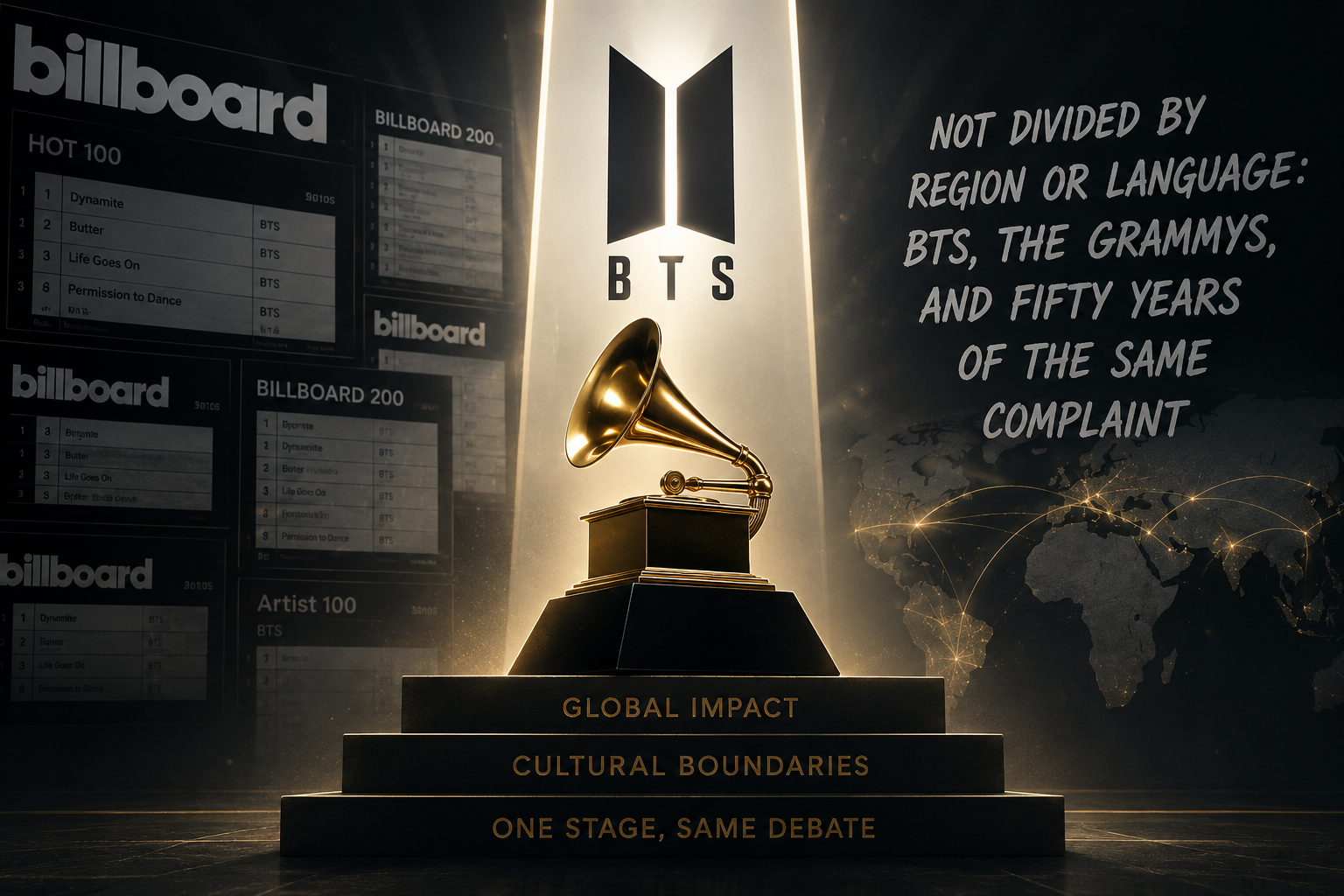
On July 29, every member of BTS posted an identical statement to their personal social media accounts within minutes of each other: they would not be submitting music for consideration at the 69th Grammy Awards, set for February 2027. The stated reason was almost gentle — a hope that music could be heard and loved for itself, rather than divided by region or language. It arrived exactly one month after the Recording Academy quietly announced a new category: Best Asian Pop Music Performance. Read those two facts side by side and the boycott stops looking gentle at all.
The Recording Academy revealed the new Asian Pop category last month, positioned as a way to evaluate K-pop, J-pop, C-pop, and other Asian-language pop music on its own terms. On July 29, BTS responded — not with a statement calling the category racist, and not with individual complaints, but with a single, identical line posted by all seven members at once: they wouldn’t be submitting to this year’s Grammys, because they hoped music could be heard and loved for what it is, not divided by region or language.
The Recording Academy responded the next day. CEO Harvey Mason Jr. posted that he was saddened to hear of BTS’s decision, that he understood and respected it as artists making their own creative choice, and that the Asian Pop category was created to spotlight the depth, diversity, and remarkable growth of Asian pop music — an expansion of recognition, in his framing, not a way to sideline anyone from the categories that already existed. Major outlets including the New York Times, BBC, and The Guardian all picked up the story within hours, several describing it as a quiet but unmistakably pointed rebuke of the Grammys’ handling of Asian artists.
This isn’t a group with a chip on its shoulder about one bad year. BTS has been nominated multiple times in the years since “Dynamite” made them the first K-pop act nominated for Best Pop Duo/Group Performance in 2021 — and lost. “Butter” earned the same nomination the following year — and lost again. Rosé’s “APT.,” a genre crossover collaboration with Bruno Mars that became one of the biggest global hits of 2025, picked up a nomination in 2025 and came away empty-handed as well.
The one asterisk: earlier this year, “Golden,” from the Netflix animated film “KPop Demon Hunters,” won a Grammy in an original soundtrack category — the first Grammy win connected to K-pop as a genre. It’s a real milestone, but a narrow one. The win belonged to a fictional girl group inside an animated film, not to any actual K-pop artist submitting music as themselves. As of this year, no living, breathing K-pop act has ever won a competitive Grammy.
A Category With a History
It’s worth taking the Recording Academy’s stated intent seriously, because on its face, a category built to recognize Asian pop music isn’t an unreasonable idea — the Grammys already carve out dedicated categories for Latin, African, and global music traditions, and none of those are inherently controversial. The argument for the Asian Pop category is that it creates a guaranteed place at the ceremony for artists who, historically, have been shut out of the main pop and record categories entirely.
The argument against it is exactly the one BTS’s statement gestures toward without spelling out directly: a dedicated category can function less as an additional door and more as the only door — a tidy space to route Asian-language acts into, so voters in the “real” categories don’t have to reckon with them. Korean commentary on the boycott has drawn a specific, pointed historical parallel: the Grammys’ 1989-created Best Urban Contemporary Album category, which critics have long argued was built to contain Black artists whose music was crossing into the pop mainstream, keeping them out of Album of the Year contention rather than welcoming them into it. That category was renamed Best Progressive R&B Album in 2020, after years of criticism that “urban” had become a racially coded euphemism.
BTS’s boycott lands inside a much longer institutional pattern — one where the Recording Academy’s credibility with non-white artists has been challenged, publicly, roughly once every few years, usually followed by a promise to do better.
“Good Kid, m.A.A.d City” lost Best Rap Album and Best New Artist to Macklemore & Ryan Lewis, who swept every rap category they were nominated in. Macklemore himself later texted Lamar a public apology, calling the result “robbery” — a moment that became its own symbol of the Academy misjudging hip-hop.
“Lemonade,” widely considered the year’s most culturally significant album, lost the top award to Adele’s “25.” Adele used part of her acceptance speech to say the award should have gone to Beyoncé — an unusual, direct on-stage concession from the winner herself.
Despite “After Hours” and “Blinding Lights” dominating the year commercially and critically, The Weeknd received no nominations at all. He called the Academy “corrupt” on social media and later announced a permanent boycott over its anonymous nomination review committees, which he and others argued quietly overruled voter consensus.
In solidarity with The Weeknd’s snub, Drake argued publicly that artists should stop being surprised every year by the gap between impactful music and Grammy recognition, and floated the idea of building something to eventually replace the ceremony altogether.
Facing sustained backlash, the Recording Academy eliminated most of its secretive nomination review committees, the same mechanism The Weeknd had specifically named. The reform came only after multiple A-list artists went public, not before.
No single snub, no zero-nomination year to point to — instead, a rejection of the structure itself, announced the same way the group does almost everything: as a unified group statement, not an individual complaint.
It would be too neat to say BTS is simply repeating the Weeknd or Kendrick Lamar’s grievance with the serial numbers filed off. The specific histories are different, and they deserve to stay different: the Recording Academy’s decades-long undercounting of Black artists in its top categories is its own documented pattern, rooted in a specific American racial history that Asian pop’s current situation doesn’t simply map onto.
What does transfer, structurally, is the mechanism being contested — not a single bad vote, but an institutional sorting system that decides, in advance, which categories certain artists are expected to compete in. Whether that sorting is framed as “Urban Contemporary” in 1989 or “Asian Pop” in 2026, the practical effect critics describe is the same: a separate lane that looks like recognition and functions, at least partly, as containment. BTS’s statement is notable precisely because it doesn’t make that accusation explicitly — it just declines to participate, and lets the timing do the talking.
- The case for the Academy: a dedicated category could genuinely grow the number of Asian artists recognized at all, especially ones without BTS’s crossover commercial power, and abolishing it wouldn’t guarantee those artists get folded into the main pop categories instead.
- The case against it: categories built this way have a track record of becoming permanent holding pens rather than stepping stones — the Urban Contemporary category existed for over three decades before being renamed, and Black artists’ underrepresentation in Album of the Year persisted the entire time it existed alongside it.
I don’t think the Recording Academy set out to insult anyone — Harvey Mason Jr.’s explanation reads like a genuine, if tone-deaf, attempt at inclusion, and dedicated categories for regional and linguistic traditions aren’t inherently a bad idea. But intent has never been the part of this pattern that mattered. The Weeknd wasn’t shut out because anyone at the Academy disliked him personally, and Kendrick Lamar wasn’t denied Best New Artist out of malice. Institutions don’t need bad intentions to keep producing the same lopsided results, year after year, category after category.
What makes BTS’s move different from the artists before them isn’t the complaint — it’s the register. No tweet calling anyone corrupt. No individual grievance. Just seven people saying, together, that they’d rather not compete for a trophy shaped like the exact problem they’re describing. Whether the Recording Academy hears that as a request for change or just waits for the news cycle to move on is the only part of this story still genuinely undecided.
— KpopWave Editorial
Reporting cross-verified across Seoul Shinmun, Munhwa Ilbo, Sports Khan, Kyunghyang Shinmun, Money Today, Star News, Billboard, Rolling Stone, the BBC, and CBS News coverage of the Recording Academy’s historical nomination controversies (2014–2026). BTS’s statement is quoted in translation from its original Korean; all characterizations of the Recording Academy’s intent are attributed to Harvey Mason Jr.’s own public statement or to press/commentary as cited. Quoted material is limited and independently confirmed across multiple outlets.