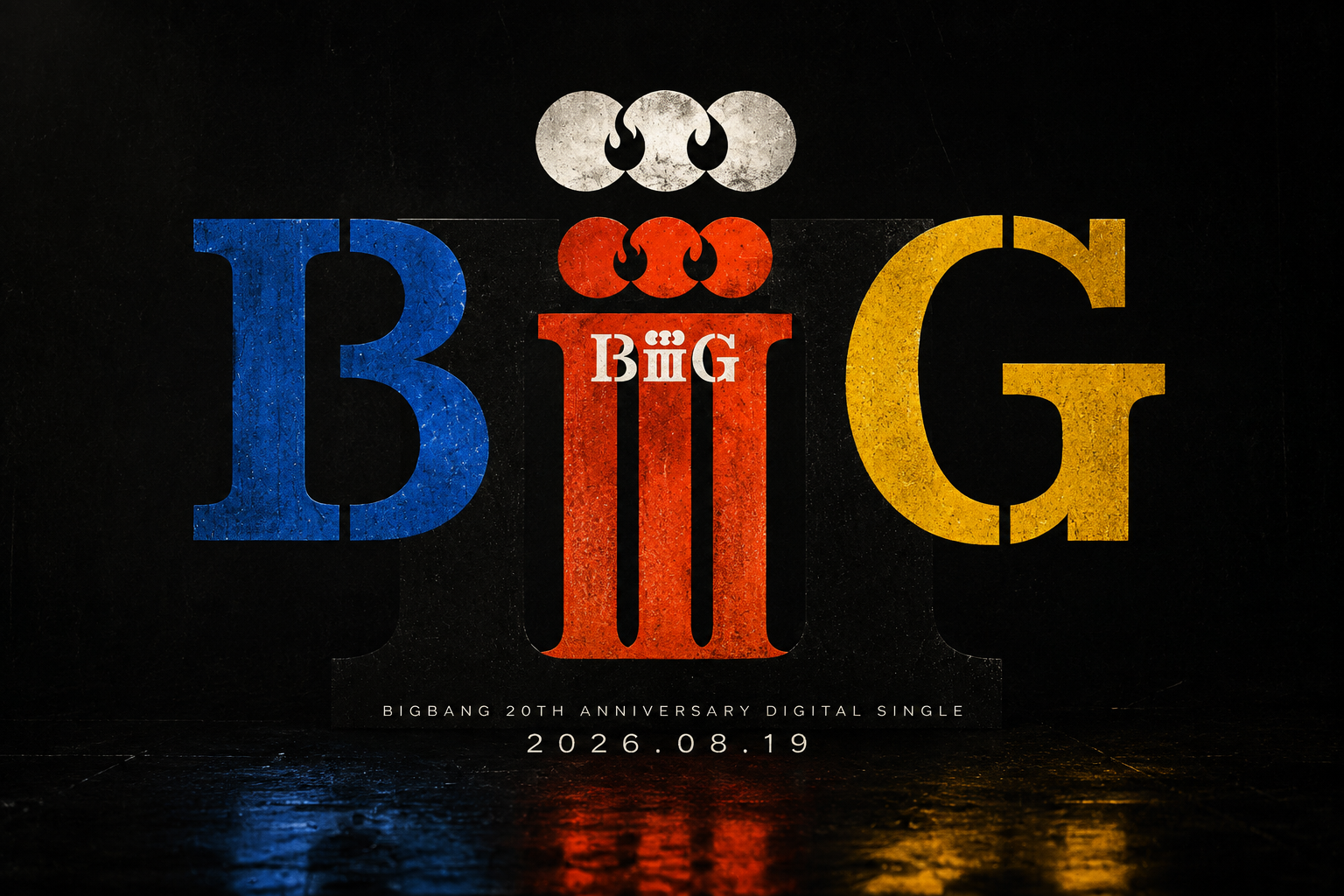
01The Title — BiiiG as a Typographic Statement
The title is not a word. It is an event. BIGBANG stretching “Big” into “BiiiG” — three extra letters, three extra dimensions of the same claim — is the entire song in miniature. You don’t need to add letters to “Big” to convey magnitude. Adding them anyway is the point: excess as proof of capacity, the willingness to take up more space than the word requires because you have that much space to take.
This is also a statement about how BIGBANG has always operated within K-pop. For twenty years, the group has not competed within genre conventions — they have bent conventions around themselves. The title BiiiG isn’t asking you to acknowledge BIGBANG’s size. It’s demonstrating it by taking up extra characters in its own name and seeing if anyone objects. Nobody does. That’s the point.
August 19, 2026 is not an approximate anniversary release. It is the exact date — August 19, 2006 to August 19, 2026, twenty years to the day. K-pop groups mark anniversaries frequently, but releasing new music on the precise twentieth anniversary date, rather than sometime during the anniversary year, is a different commitment. The precision is the message: BIGBANG has been tracking this date for twenty years, and they arrived at it on time, with a song that knows exactly what day it is.
02Key Lyrics — Every Line Is a Twenty-Year Statement
BiiiG is not a simple song. It is dense with Korean idioms, wordplay, cultural references, historical self-citation, and in-group language that rewards unpacking. Below are the passages where the density is highest — and where understanding what’s being said reveals how deliberately every word was chosen.
The Chorus — The Most Information in the Fewest Words
유행이라지 마
Been there done it
Be somethin’ ?!
빛날 희(熙)
Verse 1 — Twenty Years Stated Seven Different Ways
입이 떡 하니 벌써
스무고개 Twerk
우주 앰버서더
알아서 기어와
Verse 2 — The Historical Density
쌍팔년 South-Korean
젊음의 도심 한가운데
The Bridge — Two Reference Points, Twenty Years Apart
| Verse 1 | 우린 같이 따로 놀지 의식 공간도 초월하니 Big Shots 살바도르 달리 |
| Translation | We play together separately / We transcend even the space of consciousness / Big Shots — Salvador Dalí |
| Verse 2 | 우린 같이 따로 놀지 날아다녀 링 나비같이 Big Shots 무하마드 알리 |
| Translation | We play together separately / Flying around the ring like a butterfly / Big Shots — Muhammad Ali |
같이 따로 놀지 (gati ttaro nolji) — “we play together separately” — describes BIGBANG’s group dynamic with unusual precision. Three members who have maintained vastly different solo careers — G-DRAGON as fashion-forward artistic provocateur, TAEYANG as R&B vocalist and choreography authority, DAESUNG as Japan-touring concert powerhouse — and yet remain BIGBANG when they’re together. The togetherness and the separateness are not in tension. They are the source of the group’s resilience.
The two bridges each close with a “Big Shot” reference: Salvador Dalí in the first, Muhammad Ali in the second. Dalí — the surrealist who made the impossible visible, who transcended the rules of what art was supposed to look like. Ali — who moved through the ring like a butterfly and stung like a bee, who combined beauty and power in a way that had never been seen before. The two figures are not random. They are chosen as the specific historical archetypes of people whose greatness redefined what greatness looked like in their field. BIGBANG is claiming that lineage explicitly.
This Korean proverb — literally “the old official is the renowned official” — is one of the language’s most direct ways of asserting that experience produces excellence that cannot be replicated by enthusiasm alone. In Korean cultural contexts, it’s frequently invoked when someone younger or newer attempts to challenge or dismiss someone with a longer track record. BIGBANG invoking it in their twentieth anniversary song is a precise and culturally loaded move: it names what they are claiming (veteran superiority) in the exact idiom that Korean culture already has for that claim, and delivers it so casually — one line, no explanation — that the confidence of the delivery is itself the argument.
03BIGBANG in 2026 — Three Members, Twenty Years, No Asterisk
Debut to BiiiG — August 19, 2006 to August 19, 2026
Cities on the XX: COSMOS World Tour 2026–2027
First album as a 3-member group — G-DRAGON, TAEYANG, DAESUNG
BiiiG의 핵심 작사·작곡 주도. 코첼라 2026 퍼포먼스, 솔로 앨범 ‘Übermensch’ 연이어 성공. 2026년 현재 K팝 역사상 가장 영향력 있는 솔로이스트 중 한 명으로 평가받음.
2026년 5월 솔로 정규 4집 ‘QUINTESSENCE’ 발매 — 타이틀 “Live Fast Die Slow”로 20주년 분위기 선점. BIGBANG 복귀를 가장 먼저 공식화한 멤버.
일본에서 10년 이상 독보적인 콘서트 투어 커리어를 쌓은 멤버. 대규모 돔 투어 경험이 가장 많아 그룹의 라이브 퍼포먼스 기반을 가장 단단하게 유지해온 인물.
T.O.P 전역 후 개인 활동, 승리 탈퇴 이후 공식 3인조로 재편. BiiiG는 이 체제로 발매하는 첫 음반으로, 재편된 라인업의 정체성을 처음으로 음악으로 선언한 작품.
The 3-member lineup context matters for how “BiiiG” is heard. BIGBANG debuted as five members. For most of their peak commercial years, they operated as four or five. “BiiiG” is the first major release that is definitively three — G-DRAGON, TAEYANG, and DAESUNG, named in the chorus — without any implicit asterisk for absent members. The song does not address the lineup change. It doesn’t need to. The chorus names who is here. The music makes the case that this is enough. The arguing point for BiiiG is not “we’re back” — it’s “we never stopped being BIGBANG.”
04The Song as Campaign Launch — BiiiG Was Always a Stadium Song
Understanding “BiiiG” requires understanding that it was not conceived as a standalone single. It was conceived as the opening document of BIGBANG’s 2026–2027 World Tour — the song that would be heard first in the room before the tour began, and then performed inside that room two days later. Every structural decision in the song reflects this: it was written for a stadium.
The 뱅봉 Line as Live-Performance Architecture
Naming the 뱅봉 (the official BIGBANG light stick) directly in the chorus is not fan service — it is stage engineering. When “Fan zone 뱅봉” plays in Goyang Stadium, Jamsil, or any of the nineteen cities on the world tour, the audience raises the light stick simultaneously. The lyric has been designed so that the object in every fan’s hand becomes a prop in the song’s performance. The line and the action are one thing. There is no separation between what the song says and what the audience does when it says it.
The Camcorder MV Aesthetic as Anti-Nostalgia
The music video’s vintage camcorder visual treatment is not a nostalgic gesture. It is an anti-nostalgic one. Twenty-year-old groups face a specific danger when they reference their history: doing so too directly casts them as “past tense” — a legacy act revisiting its greatest hits rather than an active group making new work. The camcorder aesthetic solves this by using the visual texture of the past while the content remains entirely present. The footage looks archival. The performers are doing something new. The past is invoked as atmosphere, not as subject.
코첼라 밸리 뮤직 앤드 아츠 페스티벌
G-DRAGON 헤드라이너 / 빅뱅 무대 포함
TAEYANG 솔로 정규 4집 QUINTESSENCE
“Live Fast Die Slow” — 20주년 분위기 선점
BiiiG — 디지털 싱글 발매
데뷔 20주년 당일 오후 6시 / 3인조 체제 첫 음반
BIGBANG 2026-2027 WORLD TOUR ‘XX: COSMOS’ 개막
고양종합운동장 — BiiiG 발매 이틀 후
19개 도시 글로벌 투어
오클랜드, 파리, 런던, 타이베이, 싱가포르, 시드니 등
20주년 정규 앨범
《MADE》 이후 약 10년 만의 정규 — 발매 시기 미확정
05The Songwriting — Density as Its Own Statement
“BiiiG” contains more distinct cultural references, Korean idioms, and self-citations per minute than almost any K-pop song in recent memory. This is deliberate. The density itself is the argument: a group with this much accumulated reference material has earned the right to use it all at once, without explaining any of it, trusting that the audience is equipped to receive it.
Korean Idioms as Proof of Cultural Depth
구관이 명관, 스무고개, 입이 떡 하니 — these are not words a group uses to seem Korean. They are words a group uses when they have been Korean for twenty years and have earned the cultural shorthand they carry. International audiences who don’t know the idioms still feel their weight; Korean audiences who do know them feel the precision of each choice. The song works on both levels simultaneously, which is exactly what BIGBANG has done for twenty years.
The Historical Reference Ladder
The song climbs a ladder of historical reference with each verse: the proverb, quantum mechanics, the 1988 Seoul Olympics, Italian musical terms embedded in Korean pop culture, Salvador Dalí, Muhammad Ali, the Big Bang theory. Each reference is from a different field and a different era. Together they describe a group that has been paying attention to everything, absorbing everything, and has enough context now to place themselves in conversation with all of it at once.
| Korean | Romanization | Meaning & Notes |
|---|---|---|
| 유행이라지 마 | yuehaengirajji ma | “Don’t call it a trend” — rejection of generational dismissal; BIGBANG built the trends, they didn’t follow them |
| 구관이 명관 | gugwan-i myeonggwan | Korean proverb: “The veteran is the master” — the old official is the renowned official; experience produces excellence newcomers can’t replicate |
| 스무고개 | seumugogae | Twenty Questions — traditional Korean guessing game; metaphor for twenty years of progressive revelation |
| 뱅봉 | baengbong | BIGBANG’s official light stick — named in the lyric so that it becomes a live-performance prop simultaneously |
| 양자역학 | yangjayeokhak | Quantum mechanics — a system where two contradictory states can coexist; self-description of BIGBANG’s contradictory multitudes |
| 쌍팔년 | ssangpallyeon | 1988 — Korean slang for the year of the Seoul Olympics, shorthand for Korea’s global emergence |
| 같이 따로 놀지 | gati ttaro nolji | “We play together separately” — describes three members who are individually distinct and collectively inseparable |
| 아버지 | abeoji | Father — “BANG of 아버지” claims foundational status, the origin point from which subsequent K-pop descends |
06What BiiiG Is For — and Why It Works
“BiiiG” is not a comeback song. It is a declaration that there was no absence to come back from. The song does not acknowledge the gap, does not reference the difficulty, does not make the case for relevance — it simply operates at full capacity and lets that operation be the argument.
This is the only approach available to a group at BIGBANG’s level. A humble comeback would be inappropriate — BIGBANG has not been humble for twenty years, and false modesty at the start of their third decade would ring as inauthentic as anything they could do. A nostalgic comeback would be the category error the camcorder aesthetic was designed to avoid. An aggressive-return-energy comeback would imply there was something to prove, which there isn’t. What remains is exactly what “BiiiG” does: show up, name who you are, reference twenty years of cultural capital in three minutes, and trust that the audience can receive all of it.
유행이라지 마. Don’t call it a trend. Everything big big big big. That everything big’z me. Twenty years later, the name still means exactly what it always meant — the Big Bang, the event that started everything, the origin point of what followed. G, Tae, 대성이. Three members. Twenty years. The mouth still drops open. The 뱅봉 still goes up. The claim is still accurate.
All the way up. Nuthin’ can stop it. BiiiG.