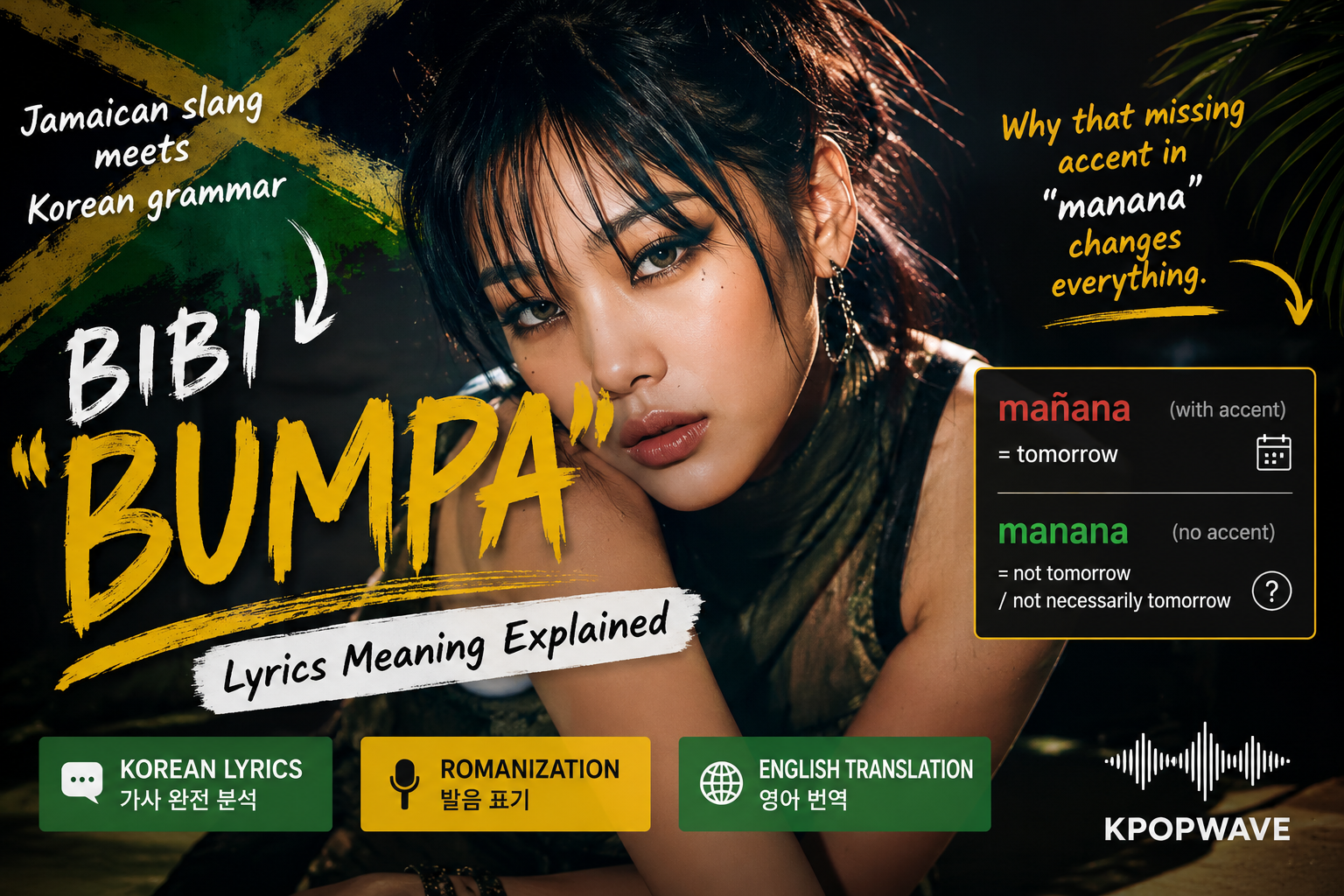
BUMPA
01What the Title Holds
“BUMPA” arrives in the ear before it arrives in the mind. That’s the point. The word is borrowed from Jamaican patois, where it refers to the buttocks — but BIBI weaponizes its double life in Korean. “부딪혀 나의 bumpa” translates literally as “collide, my bumpa” or “bump against me.” The title is both the body part and the verb. The thing and the action.
The choice to title the song in transliterated English rather than Korean is itself a statement. BIBI doesn’t translate the word — she transplants it. The foreign slang lands in a Korean pop song and refuses to explain itself. That refusal is the song’s attitude in microcosm.
02Key Lyrics
I. The Opening Hook — Three Languages, One Command
The Korean lines do the heavy lifting of the image — ocean air, wave motion, involuntary dancing — and then hand off to English and Spanish for the personal statement. The structure mirrors the song’s logic: Korean establishes the world, the other languages act inside it.
II. “manana” — The Accent That Isn’t There
The correct Spanish spelling is mañana (tomorrow). BIBI writes it as “manana” — stripping the ñ, stripping the accent, stripping the future tense. Whether intentional or a phonetic choice, the effect is that “tomorrow” becomes an approximate, a suggestion, something too distant to properly spell. You can’t spell a concept you refuse to live in.
III. The Party Line — Register Shift
기집애 (gijibae) is a vernacular, slightly rough term for “girl” — more street-level than formal Korean. BIBI uses it casually, without irony. Combined with “face down” — a posture that prioritizes body over face, presence over performance — the verse reclaims the casual gaze as something mutual, something everyone at the party shares equally.
IV. The Urgency Verse
“오늘이 끝인 듯하지” is the philosophical heart of the song dressed as a party lyric. “It feels like today might be the end” — not tragic, not apocalyptic, just the way a perfect hot day feels when you don’t want it to end. The urgency is tender. The Korean verb ending -지 adds a shared, rhetorical quality: it’s not a statement, it’s a check-in. You know what I mean, right?
03Who Is BIBI
Kim Hyeong-seo (김형서), born September 27, 1998 in Ulsan, debuted under the stage name BIBI on May 15, 2019 with the single “Binu.” She was discovered by Yoon Mi-rae and Tiger JK after they came across her self-produced songs on SoundCloud — a detail that matters, because BIBI has always been a complete artist in the fullest sense: writer, composer, producer, visual director.
Her breakthrough came with “밤양갱” (Bam Yang Gang) in February 2024 — a Chang Ki-ha production that achieved a perfect all-kill and sparked a viral singing challenge involving chestnut jelly. The song reportedly caused a 40% increase in bamyanggaeng sales across South Korea. It went on to win Best Pop Song at the 2025 Korean Music Awards and ranked #1 on multiple year-end charts.
“BUMPA” represents a sharp pivot in register. Where “밤양갱” was soft and melancholic, “BUMPA” is loud, multilingual, and deliberately carnal. Both are authentically BIBI — the range is the point.
04Release Context
“BUMPA” was released on May 20, 2026 as a standalone single — not part of an album. It marks BIBI’s first release under Feel Ghood Music’s new global distribution partnership with Warner Music Korea, meaning this is the first track designed from the outset for expanded international reach.
The single also has a notable pre-history: it had already been performed live before the studio version dropped, with fans circulating clips and anticipating an official release. The song arrived already beloved.
Discography Timeline
05Code-Switching Architecture
What makes “BUMPA” structurally interesting is how deliberately each language is assigned a role. This is not accidental multilingualism — it’s a system.
| Lyric | Language | Function in the Song |
|---|---|---|
| baila para mi / give it to me papi | ES | Command and desire. Spanish carries the erotic imperative — direct, hot, international. It opens and closes the song like a frame. |
| 저기 불어오는 바닷바람이 / 파도를 만들어 춤추게 하듯 | KO | Imagery and interiority. Korean builds the sensory world — the breeze, the waves, the felt logic of dancing. BIBI’s most poetic register. |
| you got me dancing / face down | EN | Physical state and posture. English names what is happening to the body without explaining why. Blunt and immediate. |
| dancing like no manana / summer time | MIX | Hybrid / refusal zone. Spanish vocabulary, English syntax, accent stripped. The grammar of urgency — no future tense, no diacritics, no tomorrow. |
| 오늘이 끝인 듯하지 / 사랑을 나누지 | KO | The emotional core. Only in Korean does BIBI say “it feels like today might be the end.” Vulnerability arrives in the mother tongue. |
| 부딪혀 나의 bumpa | MIX | The hook. Korean verb + Jamaican noun. The collision of languages performs the collision it describes. Untranslatable on purpose. |
The pattern follows a consistent logic: Spanish frames desire → Korean builds the world and holds the emotion → English and hybrid lines name the body’s response. The languages don’t compete — they each own a layer of experience.
06Key Vocabulary
| Word / Phrase | Romanization | Meaning | Why It Matters |
|---|---|---|---|
| 부딪혀 | budittchyeo | Collide / bump into (imperative) | A command toward physical contact. Combined with “bumpa,” it creates an untranslatable hook that is simultaneously Korean grammar and Jamaican slang. |
| 바닷바람 | badatbaram | Sea breeze / ocean wind | A compound: 바다 (sea) + 바람 (wind). The specific sensory trigger that sets the whole song in motion — the involuntary feeling of being moved. |
| 춤추게 하듯 | chumchuge hadeus | As if making [it] dance | The grammar of being acted upon. The waves don’t decide to dance — the wind makes them. The song positions the singer similarly: dancing because something else wills it. |
| 오늘이 끝인 듯하지 | oneuri kkeunin deuthaji | It feels like today might be the end | The philosophical center of the song in seven syllables. The -듯하다 construction expresses approximation — not certainty, but felt urgency. The -지 ending invites agreement: you know? |
| 기집애 | gijibae | Girl (casual / street-level register) | More vernacular than the standard 여자 (yeoja) or 여자애 (yeojaae). Its informality signals that “BUMPA” exists in the register of real, unguarded summer nights — not polished pop performance. |
| baila para mi | — | Dance for me (Spanish imperative) | Grammatically a command directed at someone else. But BIBI also says “you got me dancing” — so who is commanding whom? The song keeps the power mutual. |
| manana (cf. mañana) | — | Tomorrow (Spanish) — accent removed | Arguably one of the most deliberate choices in the song. Stripping the tilde from mañana doesn’t just simplify spelling — it strips the future from the word. Dancing like there’s no tomorrow, spelled like tomorrow doesn’t exist. |
“BUMPA” doesn’t ask to be understood. It asks to be felt — in the ribs, in the hips, in the specific warmth of an evening that refuses to end. The three languages don’t translate each other; they take turns owning different parts of the night. Spanish holds the heat, Korean holds the feeling, English holds the body, and the hook holds all three at once in a word that isn’t quite any language at all.
That’s the song’s real argument: some things can only be communicated by collision.