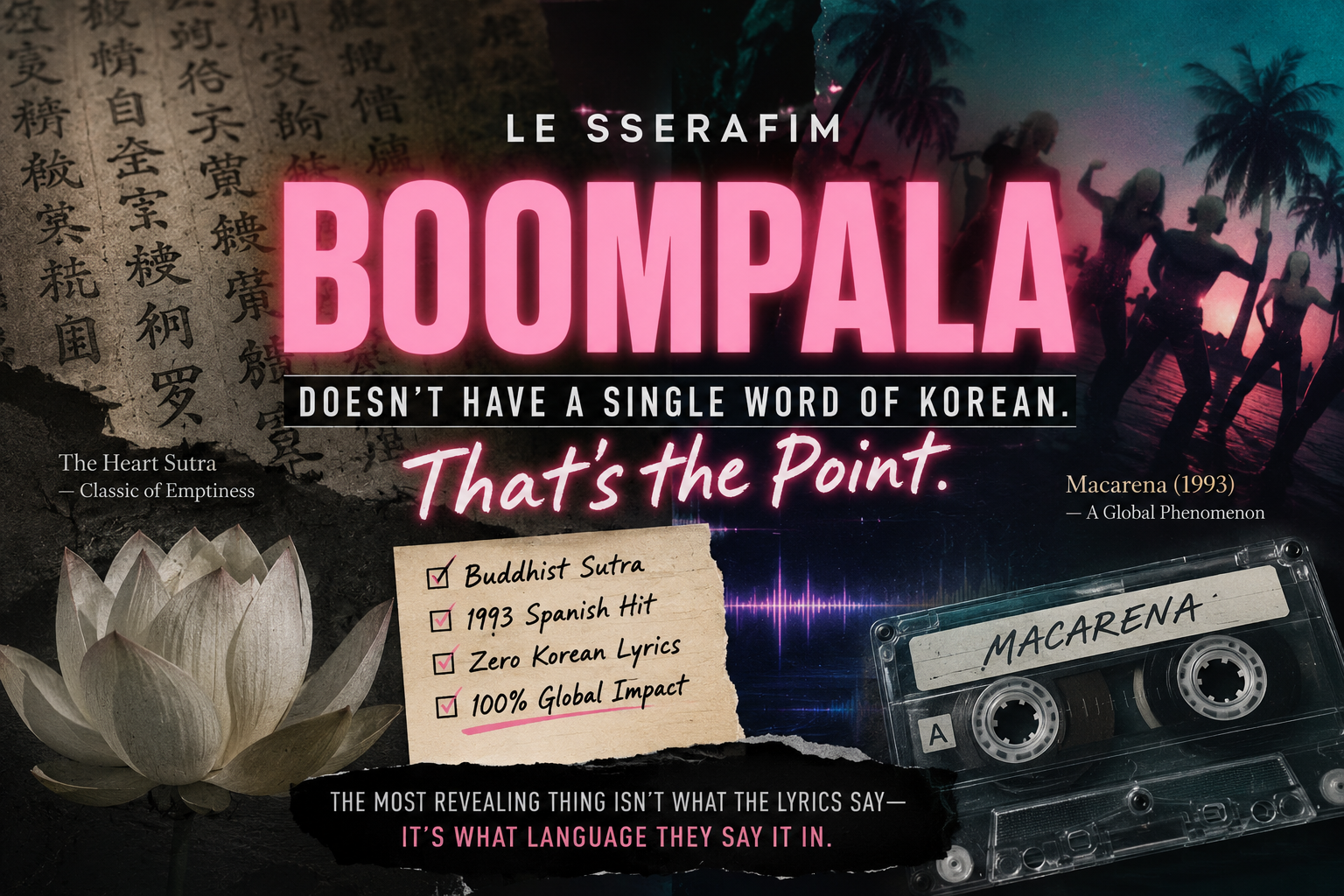
LE SSERAFIM’s biggest song of 2026 is built on a Buddhist sutra and a 1993 Spanish hit about infidelity. The most revealing thing isn’t what the lyrics say — it’s what language they say it in.
Eight million people streamed “BOOMPALA” in its first week. Most of them probably couldn’t tell you what it means — and that’s not an insult. It’s the architecture of the song.
The title is a made-up word. The hook is a 1993 Spanish dance track about infidelity. The verses borrow vocabulary from Sanskrit spirituality. And somewhere underneath all of it, according to Huh Yunjin herself, is one of the oldest philosophical texts in East Asian history: the Buddhist Heart Sutra.
There is not a single syllable of Korean.
For a group whose name is an anagram of “I’m Fearless” — whose debut single was recorded in Korean and Japanese, whose breakthrough hit ANTIFRAGILE still opens with the unmistakable cadence of Korean pop diction — this is not an accident. It is a document. A record of how far, and in which direction, LE SSERAFIM has traveled in four years.
first 7 days
Hot Shot Songs
Spotify Weekly Top
200 Top 10 albums
The Surface: A Very Good Summer Song
Let’s be fair to the song on its own terms first.
“BOOMPALA” is, at the level of pure sonic construction, extremely well-made. The Latin house production leans on the “Macarena” sample with enough lightness that it never tips into pastiche — the brass hit lands, the rhythm section pushes forward, and the chant of boompala boompala boompala yeah functions exactly as a great hook should: it gets into your head before you’ve decided to let it.
The choreography, a loose-limbed update of the original Macarena arm sequence, became a TikTok format within 48 hours of the MV drop. In a chart week unusually crowded by a mass release from Drake, it stopped just short of the Hot 100 — a fact that sent Korean online communities into prolonged debate about what “should” have happened. Theqoo consensus: under normal competitive conditions, it was in.
All of this is the song working. The song works.
The Layer Below: What Huh Yunjin Actually Said
Here is where it gets interesting.
In promotion interviews for PUREFLOW pt. 1, Huh Yunjin described the conceptual core of “BOOMPALA” as an idea drawn from the Buddhist Heart Sutra — specifically, the sutra’s teaching that fear is not a fixed condition but an illusion, one that dissolves when you see through the nature of perception itself.
The Heart Sutra is among the most recited texts in Mahayana Buddhism. Its most famous line — form is emptiness, emptiness is form — is not a comfort slogan. It is a radical ontological claim: that the things we perceive as solid, permanent, threatening, are not inherently so. That the weight of fear is something the mind constructs, and can therefore unmake.
It has been chanted in Korean temples, Japanese Zen practice, and Tibetan ritual for over a thousand years. In 35 lines, it covers what it takes most philosophical traditions volumes to approach.
So far, this is the part every other outlet covers. What they don’t ask is: what happened to that idea on the way to the final lyrics?
Only loving on myself, I’m coming
My celestial chakra is stunning
Namaste namaste I’ma stay up
LE SSERAFIM — “BOOMPALA” (2026)
The Heart Sutra is a Mahayana Buddhist text — East Asian in origin, philosophical in nature. Chakras are a concept from Hindu philosophy, rooted in the Sanskrit Vedic tradition. Namaste is a Sanskrit greeting from the same Vedic lineage — distinct from Buddhist thought.
The song places concepts commonly associated with different South Asian and East Asian religious traditions side by side, without apparent distinction between them — smoothed together under the ambient category of spiritual wellness.
This is a description, not a verdict. But it’s the description that makes the song worth reading carefully.
Is this syncretism — the long tradition of spiritual ideas migrating and blending across Asia? Or is it the flatter kind of borrowing: Eastern = spiritual = interchangeable, as legible on a wellness app as in a song? The answer almost certainly depends on whether you were raised in these traditions or arrived at them through aesthetics. Which is itself a question worth sitting with.
The Irony Baked Into the Sample
The “Macarena” sample is the most widely discussed element of the song, and also the most underanalyzed.
The framing — both in the song and in almost all coverage — is generational nostalgia. The Macarena as collective memory. Party energy crossing thirty years. Joyful and uncomplicated.
The original “Macarena” is not uncomplicated.
Los del Río’s 1993 single — the one that spent 14 weeks at No. 1 on the Billboard Hot 100 in 1996 — is, at a lyrical level, about a woman who sleeps with her boyfriend’s two best friends while he’s away at military training, and feels zero remorse about it. Dale a tu cuerpo alegría, Macarena translates roughly as “give your body some joy, Macarena.” The joy is not ambiguous.
Que tu cuerpo es pa’ darle alegría y cosa buena
Dale a tu cuerpo alegría, Macarena
Eh, Macarena — ¡Ayy!
Los del Río — “Macarena” (1993) — layered directly into BOOMPALA
“BOOMPALA” samples these lyrics — they appear directly in the track, layered under the English verses — and repurposes them as backdrop for a message about Buddhist non-attachment and fearless self-love.
This is either a brilliantly layered piece of musical irony, in which liberation from fear is literally scored over a song about sexual autonomy and the refusal of guilt — or it is a case of sampling the vibe while ignoring the text. Given that Yunjin and the production team demonstrably engaged with the philosophical content of the Heart Sutra, the former reading seems more defensible.
But it is worth naming that the song’s broadest audience is almost certainly not parsing the Spanish. They are hearing the rhythm. Which is, perhaps, the song’s own point: the body knows something the anxious mind doesn’t.
The Identity Thread: From Fearless to Featureless
Here is the arc, laid out plainly.
The name “LE SSERAFIM” is an anagram of “I’m Fearless.” Korean identity front and center.
Borrows Nassim Taleb’s concept from English-language finance writing. English enters.
English title. References Western outlaw mythology. Korean becomes seasoning.
Shorter. Blunter. More universal. The titles are monosyllables that land in any language.
One word. No translation required.
English + Spanish + Sanskrit. The group that debuted in Korean letters releases a title track in which Korean does not appear at all.
Each English-forward release has coincided with the group’s expanding global footprint — five consecutive Billboard 200 Top 10 albums, the highest monthly Spotify listeners among fourth-generation K-pop girl groups. Whether that is cause or correlation is a question the data alone cannot answer. BTS, NewJeans, and aespa have all found global reach while keeping Korean at the center. The language shift is a choice, not a requirement.
That distinction matters.
I want to be careful here, because the easy version of this argument is also the lazy one: K-pop sold out, English bad, authenticity lost. That is not what I’m saying.
What I am saying is that “BOOMPALA” is a genuinely fascinating object — not despite its contradictions but because of them. A song that cites the Heart Sutra and samples Macarena. That speaks about fearlessness in three languages, none of them the one the group grew up speaking. That hit No. 1 in Japan — the country most invested in second-generation K-pop’s Korean-language legacy — while containing zero Korean.
And I’ll say what the rest of this piece has only implied: there is a version of this story where the group founded on Korean identity becomes a delivery mechanism for globally legible wellness aesthetics — and the Heart Sutra is what’s left of the original content. That might be uncharitable. But it’s the question I can’t stop thinking about.
The Heart Sutra teaches that nothing is permanent. Not even, it turns out, the language a group writes its songs in. Whether that is wisdom or irony probably depends on how you feel about the industry that produced it.