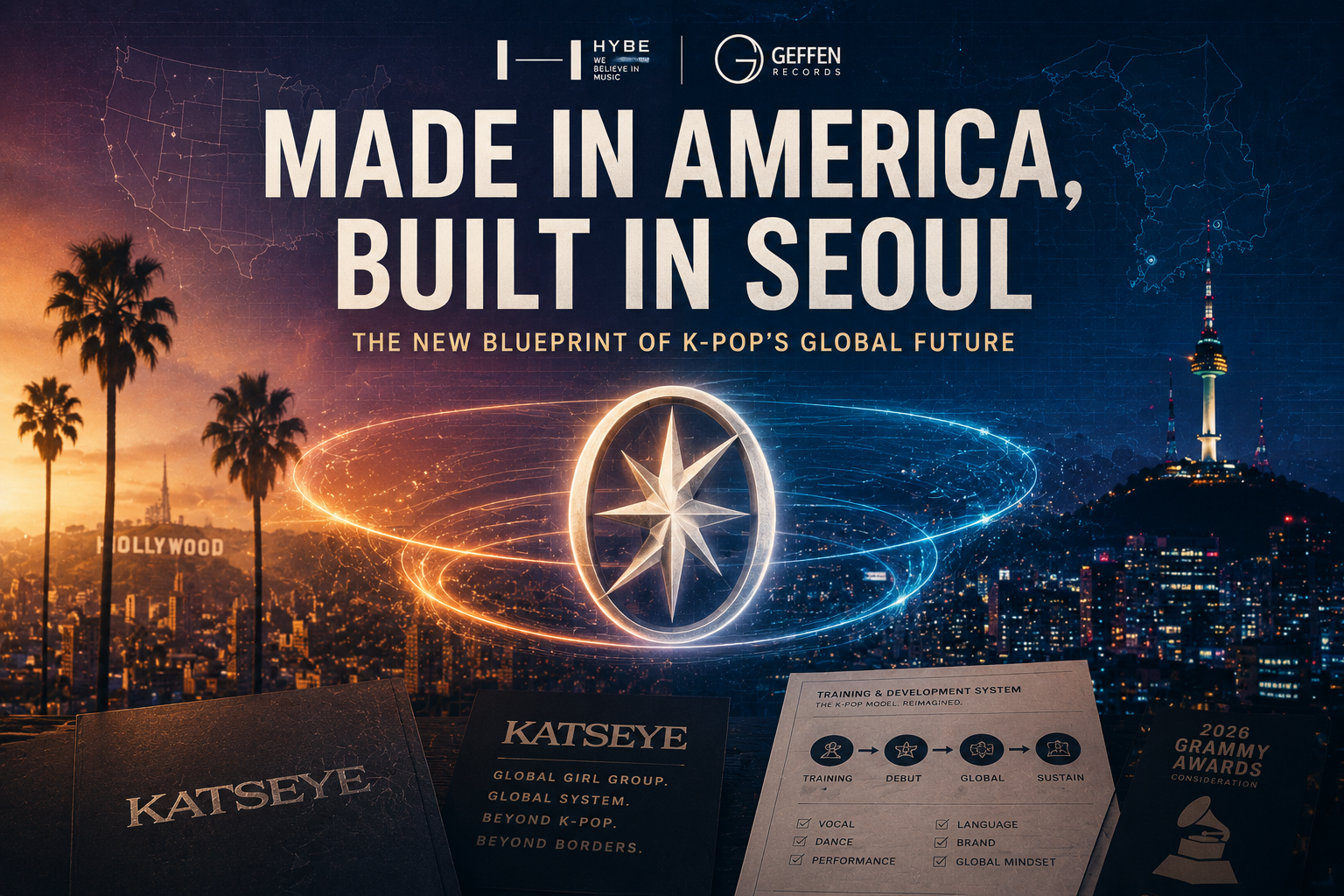
KATSEYE was designed to erase the line between K-pop and pop. Two years in, it’s working — and that might be the most unsettling thing about it.
The Gap ad ran for roughly sixty seconds. Six young women in white tees and denim, laughing in an LA parking lot, sunlight catching their hair at angles that looked accidental but weren’t. It felt completely, unmistakably American.
Watch it a second time and something shifts. The formations are too clean. The transitions between positions happen in fractions of a second, every body moving with a synchronicity that casual choreography doesn’t produce. The smiles are real — you can tell — but the infrastructure holding the whole thing together is something else entirely. This was not shot in a parking lot. This was engineered in a training room, then dressed in denim and walked outside.
That gap — between what KATSEYE looks like and how KATSEYE was made — is exactly what this story is about.
Section I
The Experiment:
Exporting the System
In 2023, HYBE and Geffen Records announced a partnership with a specific and unprecedented goal: not to release a K-pop group in America, but to build one there. The distinction matters more than it might first appear.
K-pop acts had been breaking into the American market for years — through sheer fan organization, billboard campaigns, Grammy nominations that went unawarded. What HYBE and Geffen proposed was different. They were not going to export a finished product. They were going to export the factory.
The technical term inside the Korean entertainment industry is T&D — Training and Development. It is the system that produces K-pop idols: years of vocal training, dance conditioning, language coaching, performance direction, image management, and fanbase cultivation, all applied before a single song is released. It is, depending on your perspective, either the most rigorous artist development program in the entertainment world or one of its most ethically complex. Probably both. What it unquestionably is, is effective.
HYBE and Geffen compressed that system into roughly one year. They received over 120,000 applications from around the world, selected 20 finalists, and ran them through an accelerated T&D program in Los Angeles — not Seoul. English-speaking coaches. American stages. But Korean methods: the drilling, the precision, the standard that treats a performance as something to be perfected rather than approximated.
The final six were chosen through a live elimination broadcast — another K-pop staple, the survival show format that had launched dozens of groups back home — streamed simultaneously on YouTube and Weverse. The entire process was then repackaged as an eight-episode Netflix docuseries, Pop Star Academy: KATSEYE, directed by Nadia Hallgren, the filmmaker behind Michelle Obama’s Becoming. By the time KATSEYE debuted in August 2024, millions of people had already watched them be made.
That is not incidental. It is the model.
The System Behind Every K-Pop Group You’ve Ever Watched
Training and Development is the proprietary infrastructure of the Korean entertainment industry. Unlike Western artist development — which typically begins after a label signs an artist who already exists — T&D begins before the artist is fully formed. Trainees as young as 13 sign with agencies, move into company-provided housing, and begin years of daily training in vocals, dance, languages, and performance. They are not yet artists. They are candidates.
The system produces a specific kind of performer: technically rigorous, visually precise, trained to execute complex group choreography with consistency across hundreds of performances. It also produces the parasocial intimacy infrastructure that drives K-pop’s commercial model — the fan-facing content, the curated personal brand, the documented vulnerability that creates emotional investment before a debut even happens.
KATSEYE is the first group to undergo this system entirely outside of Korea. Not a Korean group marketed internationally. Not an international member added to a Korean group. A group built from the ground up using Korean methodology, in America, for a global market. If it works — and early data suggests it is working — the implications extend far beyond KATSEYE itself. HYBE has already announced a second group under the same model, with a fourth member to be determined through a competition called World Scout: The Final Piece.
The T&D system is no longer a Korean export. It is becoming a global template.
Section II
K-Pop
Without the K
The debate started almost immediately after KATSEYE debuted, and it hasn’t stopped. On TikTok, fan forums, and music criticism sites, the same question keeps surfacing: is KATSEYE a K-pop group?
The question sounds definitional — almost petty. It isn’t. What it’s actually asking is whether “K-pop” describes a place of origin, a production methodology, a visual aesthetic, a commercial system, or some combination of all four. And how you answer that determines whether KATSEYE represents K-pop’s expansion or its dilution.
The case against is simple: KATSEYE sings almost entirely in English, promotes primarily in the United States, and does not appear on Korean music shows. By the most literal definition — Korean popular music — they don’t qualify. One widely-shared TikTok put it bluntly: “Name one Korean song of theirs.” (There is one, a track called “Flame.” One.)
The case for is more nuanced and, to this editor’s eye, more interesting. KATSEYE uses K-pop’s training infrastructure, its visual grammar, its fan engagement architecture, its performance philosophy — the elements that actually define what K-pop sounds and looks like as an experience, regardless of what language it’s delivered in. The choreography, the precision, the synchronized emotional delivery, the parasocial content strategy, the Weverse presence, the photocard merch. These are not incidental stylistic choices. They are the system.
“All the nominees represent a sort of post-idol K-pop. Rosé, HUNTR/X, and KATSEYE represent the globalized version, where the ‘K’ is very much there, but some people might argue it’s silent. The songs are not necessarily for Korea, by Korea, from Korea — just kind of beyond Korea.”
Bernie Cho — President, DFSB Kollective · Music Industry Analyst
“It tells you that K-pop is not considered as something niche anymore. Now, when we think about pop music in general, we also think of K-pop as part of it.”
Mathieu Berbiguier — Visiting Assistant Professor in Korean Studies, Carnegie Mellon University
The academic framing — “post-idol K-pop,” “the globalized version,” the ‘K’ going silent — maps almost exactly onto arguments KpopWave has been making in our own editorial work. It is not a coincidence that this language is emerging simultaneously across critics, academics, and fan communities. KATSEYE did not create this question. They made it impossible to avoid.
What’s most revealing is how HYBE and Geffen themselves navigate the label. In marketing materials, they use the term “global girl group” — a deliberate sidestep. In industry conversations, HYBE describes its methodology as “K-pop-based.” Neither claim is dishonest. Neither is fully transparent. They are selling K-pop’s system while keeping K-pop’s brand at arm’s length, because the system travels better without the geography attached.
Uses K-pop methodology: T&D training system · synchronized group choreography · survival show debut format · Weverse fan platform · photocard merchandise · parasocial content strategy · precise visual direction · multi-language member lineup
Does not use K-pop convention: Korean-language lyrics (with one exception) · Korean music show promotions (M Countdown, Music Bank, etc.) · Korean domestic chart targeting · Korean-language fan community infrastructure
The verdict depends entirely on your definition. If K-pop is a genre defined by language and geography, KATSEYE is not K-pop. If K-pop is a production philosophy and performance culture, KATSEYE may be its most advanced export.
Section III
What the
Numbers Say
Whatever KATSEYE is, the market has an opinion. And the market is saying yes — loudly, across multiple platforms simultaneously, in a way that looks less like a fan campaign and more like organic traction.
That distinction is worth dwelling on. In Part I of our Obsession Economy series, we documented how K-pop fan campaigns engineer first-week chart results through coordinated downloads and streaming relays. KATSEYE’s chart performance looks different. “Gabriela” spent 25 weeks on the Hot 100, peaking at No. 21 — not from a coordinated campaign but from genuine repeat listening and TikTok discovery. It is the kind of longevity that streaming projects can’t manufacture.
KATSEYE music · 2025
global artist of 2025
largest daytime audience in festival history
Billboard 200 peak
The Grammy nominations underline the point. KATSEYE earned two nods at the 68th Grammy Awards — Best New Artist and Best Pop Duo/Group Performance for “Gabriela.” They did not win Best New Artist; that went to Olivia Dean. But the nomination itself is its own data point. Grammy voters, historically skeptical of K-pop precisely because they associate it with fan-driven chart mechanics rather than organic industry consensus, gave KATSEYE two nods. The argument that the Academy was responding to music rather than fandom is supported by the numbers: KATSEYE’s chart longevity and streaming footprint look nothing like a coordinated campaign. They look like a group people genuinely wanted to keep listening to.
And then there is the monetization layer — which is where the K-pop system becomes most visible beneath the pop surface.
Weverse in America
KATSEYE’s fan engagement runs through Weverse — HYBE’s superfan platform — which had 12 million monthly active users at its 2025 peak. In the US and Canada alone, Weverse user growth hit 26% year-over-year in 2024. KATSEYE’s presence on the platform means their American fans are being funnelled into the same subscription and merchandise ecosystem that Korean fandoms use. The toolset is identical. Only the language on the screen has changed.
Photocards in the US Market
Photocards — the small collectible cards included in physical album packages, each featuring individual member photos — were a K-pop fandom staple that Western markets barely knew existed two years ago. KATSEYE’s merchandise drops consistently sell out. Fan resale markets for rare KATSEYE photocards operate on exactly the same secondary-market logic as BTS or TWICE cards. The collectible monetization model, once considered a distinctly Korean phenomenon, is now functioning in the US without translation.
The Scarcity Engine
HYBE’s CEO described their 2026 strategy as a “scarcity model” — time-gated releases, exclusive fan experiences, limited digital content. KATSEYE is the first group to be built and launched under this framework from day one. Their sold-out North American tour, their Coachella 2026 slot, their Grammy performance appearance — all of this is being managed not just as a music rollout but as a fandom economy event. The fans spending money on KATSEYE are being given an experience architecture that was designed, from the beginning, to keep them spending.
“KATSEYE is the evolution of K-pop. The training, the performance-heavy promotions, the TikTok challenges, the company — all of it makes them K-pop. The language they sing in will not change this.”
— allkpop forum thread · “Is KATSEYE K-pop or Not?” · June 2025
Editorial
K-pop is not going global.
It’s going invisible — and that’s the point.
I want to be careful here, because there are two very different ways to read KATSEYE’s success, and both are defensible.
The optimistic reading: K-pop’s methodology has proven so effective that it can now be decoupled from its geography and applied anywhere. That’s a vindication of what the Korean entertainment industry built. The training system works. The performance philosophy works. The fan engagement architecture works. KATSEYE is proof that these tools belong to the world now, not just to Seoul.
The unsettling reading: what HYBE and Geffen have done is extract K-pop’s most commercially valuable components — the precision, the parasocial intimacy, the collectible monetization, the scarcity-driven fandom economy — and repackage them without the Korean language, the Korean artists, or the Korean cultural context that created them. The result is a product that carries all of K-pop’s power and none of its origin. The methodology travels. The culture it came from gets left behind.
Neither reading is complete on its own. KATSEYE’s members are genuinely talented. Their music is genuinely good. The diversity of their lineup — Filipino, Indian-American, Ghanaian-Italian, Cuban/Venezuelan-American, Chinese-American, Korean — represents something real about the world K-pop has always claimed to speak to. You cannot watch Lara’s background in Bharatanatyam inform her stage presence and call that culturally hollow.
But I keep coming back to this: HYBE built the second group. They are already running the same process again. The T&D export is not a one-time experiment. It is becoming a product line. And the question that stays with me is whether, ten years from now, K-pop’s greatest legacy will turn out to be the music it made — or the system it invented, which the rest of the world quietly learned to use without it.
KATSEYE didn’t erase the line between K-pop and pop. They revealed that the line was always about business, not music. That’s a more interesting discovery than anyone seems to know what to do with.