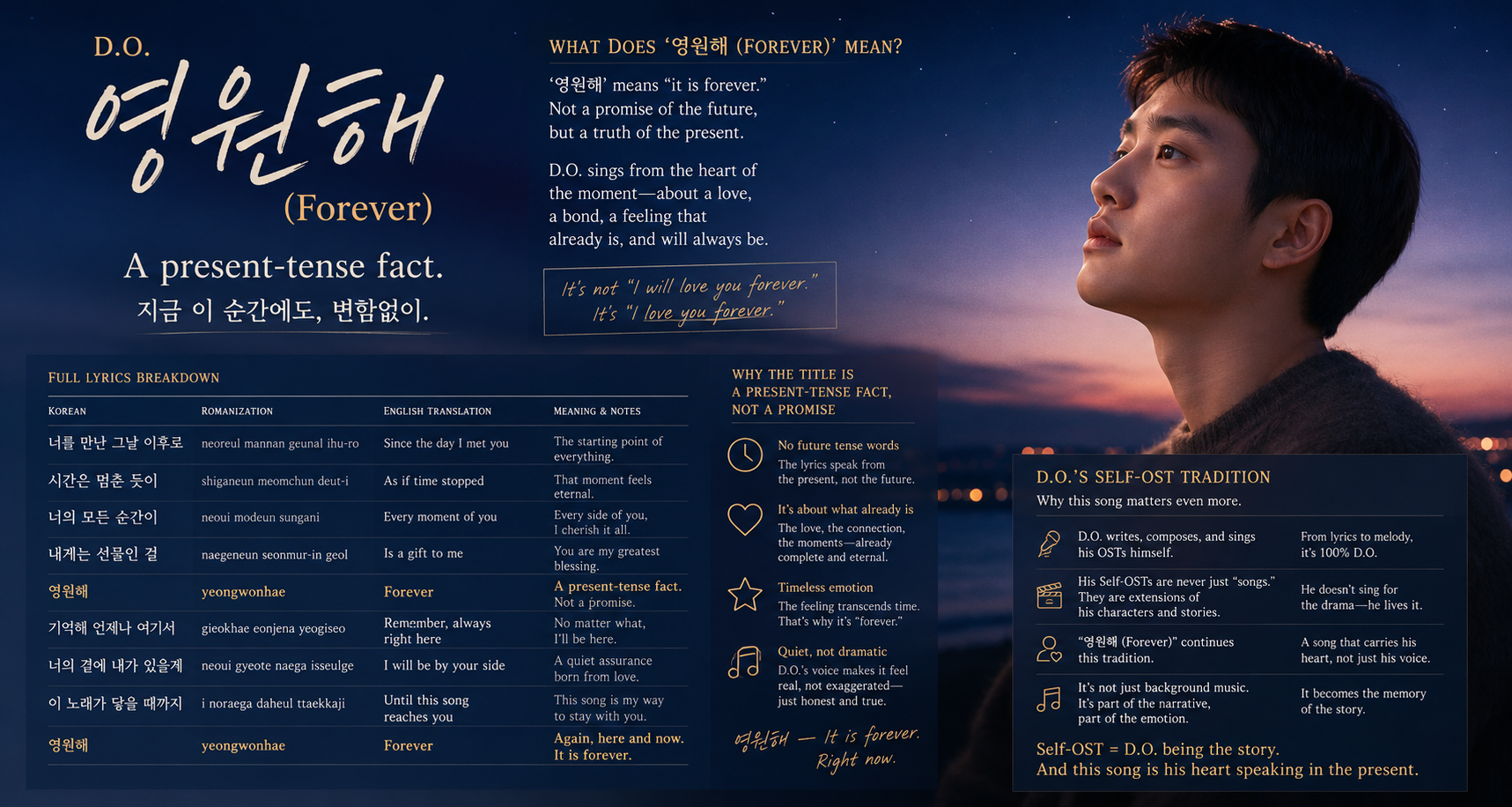
01The Title — What “영원해” Is Actually Claiming
| Korean | 영원해 |
| Romanization | Yeongwonhae |
| Literal | “It is eternal” / “We are forever” — present tense declaration, not a wish |
| Structure | 영원 (yeongwon — eternity, forever) + 해 (hae — the casual present tense of “to be / to do”). Not “I hope we are forever.” Not “we will be forever.” Simply: we are. |
The grammatical choice here carries everything. Korean has several ways to express eternal love — 영원히 사랑해 (I will love you forever), 영원하길 바라 (I hope this lasts forever), 영원할 거야 (it will be forever). Each of these places the eternity in the future or in hope. 영원해 does neither. It places eternity in the present tense. Not a promise. Not a wish. A declaration of current fact.
And yet the song immediately follows this declaration with 그럴 거라 믿어 의심치 않아 — “I believe this without a doubt.” The presence of “I believe” right after the declarative statement creates a subtle tension: if it were simply true, you wouldn’t need to say you believe it. The song opens with the most confident possible claim, then immediately reveals the work of maintaining that confidence. That tension — between the declaration and the faith required to hold it — is what the entire song is about.
02Key Lyrics — Korean, Romanization & English Translation
The song is entirely in Korean — no English lines. Every emotional weight is carried in the language, and several of its most important moments depend on grammatical structures that English flattens into something simpler. Below are five passages that reward close reading.
The Unpredictability of Life — Not Celebrated, Just Named
| Korean | 삶은 왜 언제나 예측할 수 없지 그게 특별하다는 뜻은 아니지만 내일을 기대해 |
| Romanization | Salmeun wae eonjena yecheukhal su eobjji Geuge teukbyeolhadaneun tteuseun anijiman Naeil-eul gidae hae |
| English | Why is life always unpredictable / That doesn’t mean it’s special / But I look forward to tomorrow |
This is the song’s most intellectually honest moment — and the most unusual for a K-drama OST. The typical emotional move at this point would be to reframe unpredictability as a gift: life is uncertain, and that’s beautiful. The song explicitly refuses that reframe. 그게 특별하다는 뜻은 아니지만 — “that doesn’t mean it’s special” — is a concession. Life being unpredictable isn’t romantic. It just is.
And from that honest admission — not from false consolation — comes 내일을 기대해: I look forward to tomorrow. The hope is not built on a lie about unpredictability being wonderful. It is built on the willingness to look forward anyway, in full knowledge of the difficulty. That “but” — 지만 — is doing the emotional work of the entire song in a single syllable.
지만 is the Korean adversative conjunction — “but,” “however,” “and yet.” It appears at the exact pivot point of the song’s argument: life is unpredictable, that’s not special, but I look forward to tomorrow. In Korean, the -지만 form can carry a weight that English “but” sometimes loses — it acknowledges the preceding clause in full before turning. The song doesn’t erase the difficulty. It holds it, then turns anyway. That -지만 is the song’s moral architecture in one syllable.
The Hard Days — Named Without Softening
| Korean | 아닌 하루도 분명 있겠지 불안한 하늘에 고갤 못 들며 힘이 부쳐 서로를 놓칠 때 |
| Romanization | Anin harugo bunmyeong itgessji Buranhan haneule gogael mot deulmyeo Himi buchyeo seororeul nochil ttae |
| English | There will surely be days that aren’t okay / Unable to lift my head under an anxious sky / When we’re too exhausted to hold on to each other |
아닌 하루 (anin haru) — “a day that isn’t [okay]” — uses the negative modifier 아닌 without naming what the day falls short of. The absence of the standard is the point: everyone knows what a good day feels like. 아닌 하루 is the day that doesn’t feel like that. The vagueness is intentional and inclusive — every listener fills in their own version.
불안한 하늘에 고갤 못 들며 — “unable to lift my head under an anxious sky” — is one of the most visually precise images in the song. The sky itself is 불안한 (buranhan — anxious, uneasy, unsettled). The person below it cannot look up. The weight of anxiety is rendered as a physical posture: head down, unable to meet even the sky’s gaze.
힘이 부쳐 (himi buchyeo) — “running out of strength” — uses the verb 부치다, which means to be insufficient, to fall short of what is needed. It is not a dramatic collapse but a quiet running-out: the energy required to hold on to someone simply exceeds what is available. This is the most honest description of relationship difficulty in the song — not betrayal, not conflict, just exhaustion that makes holding on too hard.
The Promise — No Hierarchy, Just Speed
| Korean | 누가 먼저가 될 것 없이 달려가서 네 이름을 가장 크게 외칠게 눈이 마주칠 때까지 |
| Romanization | Nuga meojeoga doel geot eopsi dallyeogaseo Ne ireumeul gajang keuge oechilge Nuni majuchil ttaekaji |
| English | Without worrying about who goes first — I’ll run to you / And call your name as loudly as I can / Until our eyes meet |
누가 먼저가 될 것 없이 (nuga meojeoga doel geot eopsi) — “without it mattering who goes first” — is the chorus’s most generous phrase. In Korean emotional culture, 먼저 (first) carries social weight: who reaches out first after a fight, who apologizes first, who gives in first. These are charged questions. The song dismisses the entire framework: it doesn’t matter. Whoever needs to run, runs. No score kept.
눈이 마주칠 때까지 (nuni majuchil ttaekaji) — “until our eyes meet” — closes the chorus as the only destination that counts. Not until things are resolved, not until the hard conversation happens, not until everything is explained. Just: until we are looking at each other again. Eye contact as the measure of reunion — the moment when two people are back in the same world together.
The Closing Verse — Anxiety Acknowledged, Joy Promised
| Korean | 어떤 날에는 또 어느새 불안이 하루를 흐리게 만들어도 어떤 날에는 또 행복함이 가득해져 있을 거란 걸 알아 어느새 넌 웃고 있어 |
| Romanization | Eotteon nalenon tto eoneusse buran-i Harurul heurige mandeureodo Eotteon nalenon tto haengbokhami gadeukhaejyeo isseul georaheun geol ara Eoneusse neon utgo isseo |
| English | On some days, anxiety will have clouded everything before I know it / But on other days, I know happiness will have filled you up / And before I know it, you’re smiling |
The repeated 어느새 (eoneusse — “before I know it,” “without noticing”) is the word that ties the final verse together. Both the bad and the good arrive without announcement: anxiety clouds a day before you notice, and happiness fills someone before you notice. The word makes both states feel equally involuntary — neither sought nor avoided, they simply arrive. What remains constant is the person watching: 넌 웃고 있어 — you’re smiling. The smile, too, arrives without being forced. And the narrator sees it.
03D.O. — The Actor Who Always Brings a Song
What distinguishes D.O.’s relationship with the OST from most actor-singers is consistency. He does not occasionally contribute a track when scheduling allows. He has sung the OST for every major project he has starred in since his acting debut — a pattern sustained across a decade and multiple genres, from films to television dramas to military service projects.
외침 (Outcry) — Cart OST
Film debut / acting + OST simultaneously
세상 끝에서 (At the End of the World) — It’s Okay, That’s Love OST
First major drama OST
I’m Gonna Love You — 100 Days My Prince OST
Pre-military service / peak solo-drama crossover
자꾸만 (Constantly) — Bad Prosecutor OST
Post-military return to both acting and OST
영원해 (Forever) — Resident Playbook OST Part 6
Spin-off of Hospital Playlist / composed by Jin Dong-wook
The Self-OST, for D.O., functions as a bridge: music listeners discover the actor, drama viewers discover the vocalist. But the deeper function is tonal coherence. D.O.’s voice — described consistently by Korean music critics as 청량하면서도 묵직한 (clear yet weighted, cool yet substantial) — does something specific that suits the kind of material he tends to act in. His dramas are not high-concept thrillers or explosive melodramas. They are quiet, character-driven stories about people trying to do their jobs and stay connected to each other. His voice carries the same register.
04Resident Playbook — The Drama That Needed This Song
(Resident Playbook)
Resident Playbook is the direct spin-off of Hospital Playlist — one of the most beloved Korean dramas of the 2020s, known for its warm ensemble storytelling and a soundtrack so carefully curated it became a cultural artifact in its own right. Following that legacy, Resident Playbook‘s OST lineup was treated as a major event: the announcement in April 2025 revealed contributions from Stray Kids’ Lee Know, Seungmin, and I.N., aespa’s Winter, IVE’s An Yujin, TXT, SEVENTEEN’s DK, and (G)I-DLE’s Minnie — a constellation of 4th-generation K-pop’s most prominent voices, all serving a single drama’s emotional needs.
D.O.’s Part 6 arrived at the mid-point of the drama’s run — after the ensemble had been established and before the final emotional stakes were fully revealed. Composer Jin Dong-wook, whose OST credits include My Liberation Notes, built a track designed for exactly that position: warm enough to feel like belonging, reflective enough to acknowledge difficulty, forward-looking enough to carry the drama into its second half. “영원해” is not a love song in the conventional sense. It is a song about the act of maintaining love — the daily choice to return to it when the difficulty of life makes maintaining it feel like too much.
언젠가 눈부시게 빛날 테니
Mido and Falasol
비밀의 문
Winter (aespa)
Someday
Lee Know, Seungmin, I.N (Stray Kids)
영원해 (Forever)
D.O. / This Song
TBA
TXT
TBA
DK (SEVENTEEN)
05The Songwriting — What Makes “영원해” Work as an OST
An OST has one job that a standalone single does not: it must carry meaning in two directions simultaneously. Listened to inside the drama, it scores a moment — it adds emotional dimension to what the viewer is watching. Listened to outside the drama, it must work as a complete song in its own right, accessible to people who have never seen a single episode. Most OSTs succeed at one and fail at the other. “영원해” manages both, and the reason is structural.
Universal Specificity
The song’s central situation — two people trying to stay connected while life makes staying connected difficult — is specific enough to feel real and universal enough to belong to any relationship. It does not reference hospitals, medical residency, or any plot detail from the drama. What it references is exhaustion, anxiety, the difficulty of maintaining eye contact when the sky feels wrong. These are not drama-specific experiences. They are human ones. The song can be heard by someone who has never watched a single episode of Resident Playbook and understood completely.
The Architecture of Honest Hope
The song’s emotional logic is: acknowledge the difficulty fully, then choose forward anyway. It does not offer false comfort — it says explicitly that unpredictability is not special, that there will be days that aren’t okay, that exhaustion can make people lose each other. And from that honest foundation, it offers: I will run to you regardless of who goes first. I look forward to tomorrow. Before I know it, you’re smiling. The hope in the song is earned because the difficulty has not been minimized.
D.O.’s Vocal Register as Instrument
Jin Dong-wook’s composition is built around D.O.’s specific vocal qualities rather than a generic OST arrangement. D.O.’s voice sits in a mid-range that carries emotional weight without requiring dramatic runs or high-note climaxes — the song’s most emotionally resonant moments are delivered in a controlled, almost conversational register. This is the register of someone talking to a person they know well, not performing for a crowd. It matches the song’s content exactly: these are not grand declarations but ordinary promises, made with full knowledge of what they cost.
| Technique | Example | Effect |
|---|---|---|
| Present-tense declaration | 영원해 (not “영원할 거야”) | Eternity is now, not a future promise — changes the emotional weight entirely |
| Honest refusal of false consolation | 그게 특별하다는 뜻은 아니지만 | Unpredictability is not romanticized — the hope that follows is earned, not assumed |
| Physical rendering of anxiety | 불안한 하늘에 고갤 못 들며 | Anxiety is visible as posture — head down, unable to look up |
| Hierarchy dissolved | 누가 먼저가 될 것 없이 | No score kept — whoever needs to run, runs first |
| Eye contact as destination | 눈이 마주칠 때까지 | Not resolution, not explanation — just: until we’re looking at each other again |
06Key Vocabulary — Words Worth Knowing
| Korean | Romanization | Meaning & Notes |
|---|---|---|
| 영원해 | yeongwonhae | We are forever / it is eternal — present tense; not a wish or a promise but a statement of current fact |
| 믿어 의심치 않아 | mideum uisimacha ana | I believe without a doubt — the double negation (의심치 않아: not doubting) intensifies the conviction while revealing it requires active maintenance |
| 아닌 하루 | anin haru | A day that isn’t [okay] — the missing standard is intentional; everyone fills in their own version of what the day falls short of |
| 불안하다 | buranhada | Anxious, uneasy, unsettled — used here to describe the sky itself; the anxiety is ambient and pervasive, not a specific fear |
| 힘이 부치다 | himi buchida | To run out of strength / to be insufficient — a quiet running-out, not a dramatic collapse; the energy to hold on simply falls short |
| 누가 먼저 | nuga meojeo | Who goes first — loaded in Korean emotional culture; the song explicitly dismisses the question as irrelevant |
| 눈이 마주치다 | nuni majuchida | Eyes meeting / making eye contact — the verb 마주치다 implies encounter; two things meeting each other, not one looking at the other |
| 어느새 | eoneusse | Before I know it / without noticing — used for both anxiety clouding the day and happiness filling someone; both arrive unannounced |
| 흐리게 | heurige | To make hazy / to cloud — from 흐리다 (overcast, blurry, unclear); anxiety doesn’t destroy the day, it blurs it |
The phrase 눈이 마주치다 — eyes meeting — uses the verb 마주치다, which describes two things encountering each other mutually rather than one directed at the other. It is the verb used when you unexpectedly meet someone’s gaze, when two cars almost collide, when paths cross without planning. In the context of the chorus — “I’ll run to you and call your name, until our eyes 마주치다” — the word choice matters: the destination is not one person looking at the other, but the moment of mutual encounter, when both people are simultaneously present to each other. That is the specific thing being run toward. Not forgiveness, not resolution, not explanation. The moment when two people are in the same world again, looking at each other, at the same time.
— Why “영원해” Is More Than an OST
“영원해” succeeds as an OST because it does not ask to be understood as one. It does not require knowledge of the drama, the character, or the plot. It requires only familiarity with the experience it describes: two people trying to stay close while life makes staying close hard. Anxiety that clouds a day before you notice. Exhaustion that makes you lose each other. The decision to run anyway, without keeping score of who ran first.
For D.O., the song is the latest entry in a pattern that has defined his career since 2014: he does not separate the actor from the singer. Every major project he takes as an actor arrives with a song attached — not as a promotional exercise but as an extension of his presence in the story. The voice you hear on the OST is the voice of the character’s world. When D.O. sings 누가 먼저가 될 것 없이 달려가서 네 이름을 가장 크게 외칠게, you hear it in the voice of someone who has spent weeks inhabiting the world where that promise needs to be made.
That is what the Self-OST does at its best. It collapses the distance between the performer and the performance until there is no distance left. 영원해. We are forever. Not a wish. Not a future promise. A fact declared in the present tense, maintained one hard day at a time, until the eyes meet again.