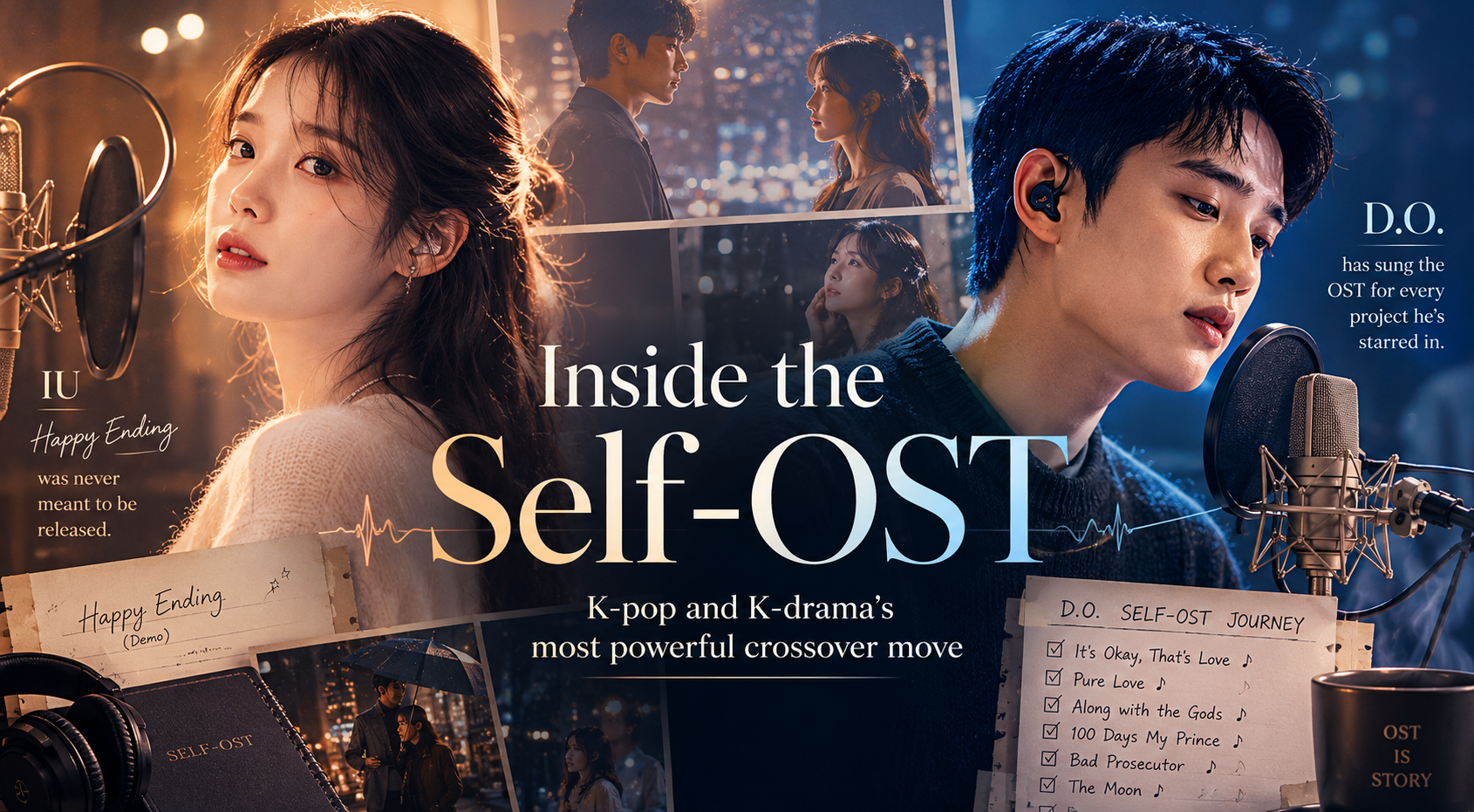
How Idols Like IU and D.O. Bridge K-Pop and K-Dramas
When an actor on screen is also the voice on the soundtrack, something rare happens — the line between performance and music dissolves entirely. Two artists, EXO’s D.O. and IU, have turned this into an art form.
When the Character Sings Its Own Story
There is a particular kind of goosebump that only K-content can deliver. You are deep inside a drama — a character is breaking, confessing, letting go — and a song rises under the scene. Then you realize the voice singing those words belongs to the very actor on screen. The character’s emotion and the singer’s voice are the same thing. The story doesn’t just play out visually; it pours directly into the music charts.
This is the Self-OST — when an idol performs (and sometimes writes) the original soundtrack for a drama or film they themselves star in. It is one of the purest points where K-pop and K-drama fold into each other, and no two artists embody it more completely than EXO’s D.O. (Doh Kyung-soo) and IU (Lee Ji-eun).
They approach it differently. One treats the Self-OST as a bridge between two careers; the other treats it as a tool for writing a character from the inside. Together, they reveal a model of artistry that the English-speaking world still doesn’t quite have a word for.
D.O.: The Actor-Singer, Built In From Day One
D.O.’s screen career began the way it would continue — with a song attached.
In 2014, he made his film debut in Cart, playing the role of Tae-young. He didn’t just appear on screen; he sang the soundtrack’s title track, “Outcry” (외침), which closed the film over its ending credits. For an idol’s very first acting role, recording the OST as well was a statement of intent: the acting and the singing were never going to be separate things.
Eleven years later, he ran the exact same play: on April 27, 2025, D.O. released “Forever” (영원해), Part 6 of the OST for the tvN drama Resident Playbook (언제가는 습기로원 전공의생활). A warm mid-tempo ballad built to showcase his clean, understated tone, the track extends the show’s gentle emotional register into music. The songwriting came from Jin Dong-wook — a composer with OST credits on My Liberation Notes and other dramas — pairing a proven soundtrack writer with a singer who knew the material from the inside.
The thread running through both is consistency. D.O. is EXO’s main vocalist, and he carries that musical identity into the projects he acts in. The Self-OST, for him, is where his two careers meet on the same piece of work.
IU: She Doesn’t Just Sing the Character — She Writes It
IU takes the idea one step further. She doesn’t only lend her voice; she picks up the pen.
Her acting career began alongside one of her biggest early chart triumphs. In the 2011 KBS drama Dream High, the ballad “Someday” — written and composed by J.Y. Park — became a phenomenon, spending three consecutive weeks at #1 on the Melon weekly chart and eclipsing even the show’s title track in popularity. It announced that IU’s presence in a drama could move the charts on its own.
But the true songwriter’s chapter of her story began just a few months later. For the 2011 MBC drama The Greatest Love, IU wrote both the lyrics and the music for “Hold My Hand” (내 손을 짬아) — her first self-composed song to ever get an official release. It climbed to #2 on the Gaon weekly comprehensive chart and marked the true beginning of her identity as a singer-songwriter.
Then she went quiet on the Self-OST front for eight years — until Hotel del Luna.
In 2019, IU starred as the imperious Jang Man-wol in tvN’s Hotel del Luna, and for the show’s twelfth episode she delivered “Happy Ending.” What makes this track remarkable isn’t just that she sang it. According to her team, IU read the episode 12 script, decided on her own initiative to write the song, and produced it purely to serve the drama’s emotional climax — with no plans to release it as a commercial single. It existed only to carry the scene where Jang Man-wol and Gu Chan-seong reaffirm their feelings. The character’s interior life, written into lyrics by the actor playing her.
For IU, the Self-OST is a tool of characterization. Singing is only the surface; the real act is writing — collapsing the roles of actor, lyricist, and vocalist into a single song.
Two Strategies, One Phenomenon
Here the contrast gets genuinely interesting. Both artists make Self-OSTs, but their underlying strategies pull in opposite directions:
The D.O. Model
The OST functions as a connector between his music career (EXO and solo) and his acting career. A released, charting single lets fans cross over in both directions: music listeners discover the actor, drama viewers discover the vocalist.
The IU Model
With “Happy Ending,” she did something almost counterintuitive: she made a song and declined to sell it. And this is where the power of her approach shows. Hotel del Luna was already an “OST powerhouse” — a soundtrack so stacked it is often celebrated alongside mega-hits like Goblin as one of the rare dramas to completely dominate the music charts outright. Its lineup read like a who’s-who of Korea’s OST royalty: Taeyeon, Heize, Gummy, Ben, Paul Kim, Punch. Chart-topping professionals, every one.
And yet it was IU’s unreleased “Happy Ending” — a track you couldn’t even stream on its own — that sent global fans searching. In a field engineered for commercial performance, the song built purely for narrative immersion became one of the most hunted. That is the paradox that proves the IU model: sometimes prioritizing the story over the sale is the more powerful brand move.
The Fandom Conversion Engine
The Self-OST is also, quietly, one of K-content’s most efficient fandom-conversion tools.
Picture the path: an English-speaking viewer streams Hotel del Luna on Netflix, gets wrecked by the episode 12 ending, and immediately searches “IU Happy Ending Hotel del Luna.” That search doesn’t end at one song — it opens the door to IU’s wider catalogue, her concerts, her decade of self-written music. A drama viewer becomes a music listener.
D.O.’s case runs the same circuit in reverse just as easily: an acting fan who came for Resident Playbook follows “Forever” back to EXO. The Self-OST is the hinge that lets a fan swing from screen to sound, or sound to screen, without ever feeling pushed.
For global audiences in particular — who often enter Korean culture through a single drama on a streaming platform — that hinge is enormously valuable. It turns a one-time viewer into a multi-format fan.
The Boundary Is Disappearing
What D.O. and IU ultimately demonstrate isn’t “a singer who also acts.” It’s something newer: a model in which music and acting operate inside the same narrative, each deepening the other. The song is not a marketing add-on to the drama; it is part of how the story is told.
That is exactly why a music-first publication has every reason to follow the soundtrack across the screen. The OST was never a detour away from music — it was always music doing what it does best: carrying the story.