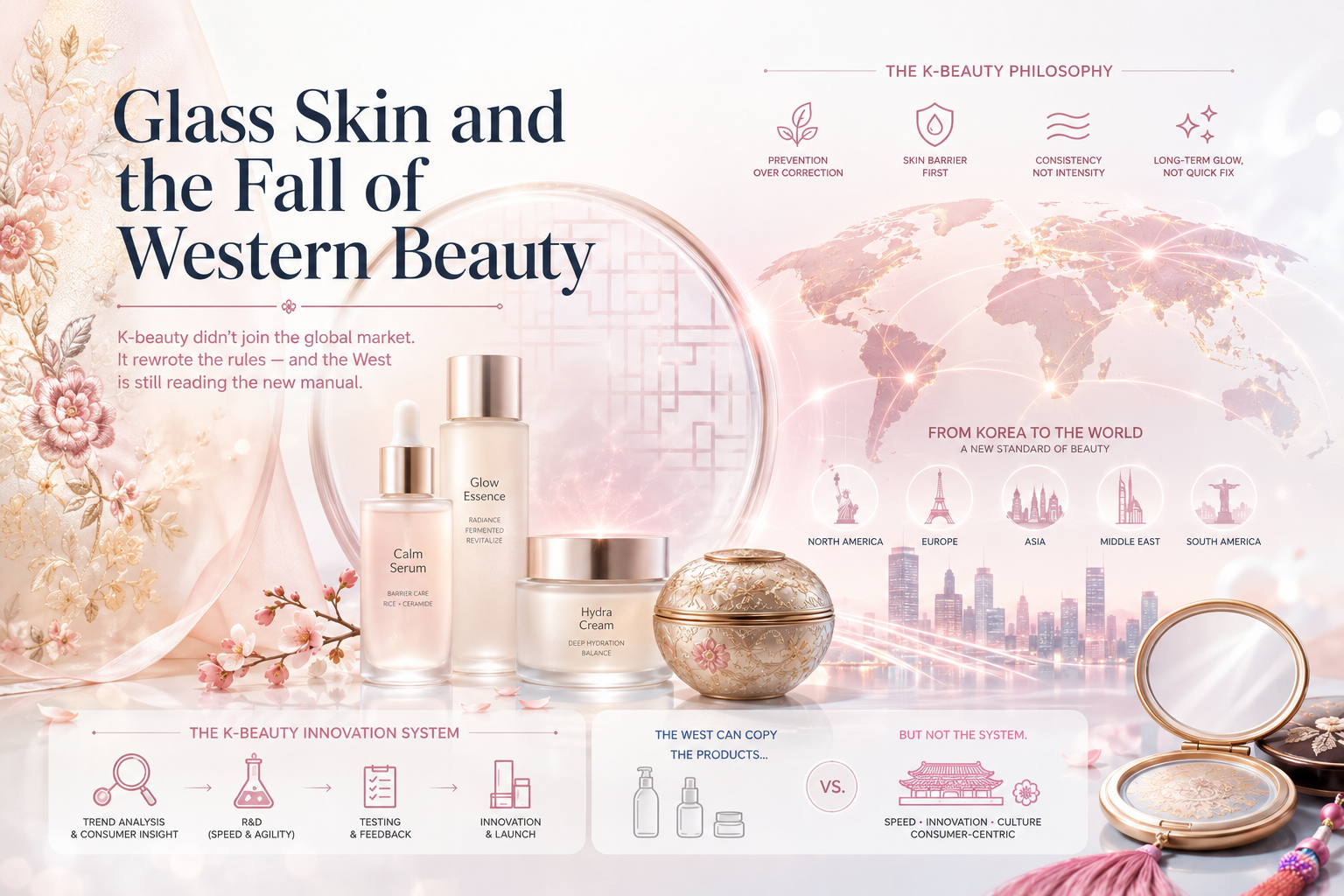
K-Beauty Didn’t Win With Better Creams. It Won With a Faster Way of Imagining Beauty.
A confession before we begin: this is an editorial, not a market report. The numbers are real and they are staggering — but the story underneath them is about something the spreadsheets can’t quite capture. It’s about who gets to decide what “beautiful” means, and how Seoul quietly took the pen.
Western beauty spent decades perfecting camouflage. Seoul became obsessed with prevention.
That single sentence contains most of what you need to understand about the last ten years in the global cosmetics industry. One tradition asked: how do we hide what’s wrong? The other asked: how do we make sure nothing goes wrong in the first place? Those are not two strategies competing in the same game. They are two different games — and one of them turned out to be the one the world actually wanted to play.
The Old Rulebook
For most of modern beauty history, the Western model was remarkably stable, and — let’s be honest — a little complacent. The premise was coverage. Foundation to even out tone. Concealer to hide what foundation missed. Powder to set the whole thing in place. The product promised to make imperfection disappear for the length of an evening, and that promise sold extraordinarily well for a very long time.
It was a profitable, comfortable arrangement. Estée Lauder, L’Oréal, and a handful of legacy houses had spent the better part of a century perfecting the art of the makeover. The pitch never really had to change because nothing forced it to. Why innovate the philosophy when the quarterly numbers kept arriving on schedule?
The trouble with a comfortable arrangement is that it makes you slow. And slow is exactly the wrong thing to be when someone on the other side of the world decides to change the question entirely.
Seoul Rewrites the Brief
K-beauty’s core idea sounds almost too simple to be revolutionary: if you fix the skin, you don’t need to hide it. Stop treating the symptom on the surface and start working on the thing underneath. The goal was never a flawless face for one night — it was healthy skin that looked good with nothing on it at all.
That philosophy spawned an entire vocabulary the West didn’t have words for. Skin flooding — layering hydration until the barrier is saturated. Toner pads that turned a tedious step into a thirty-second ritual. Barrier repair as a daily priority rather than a dermatologist’s emergency. An SPF culture so thorough it treats sunscreen as the single most important anti-aging product you own — a position Western beauty took an embarrassingly long time to adopt. “Glass skin” became the famous headline, but the real story was the system beneath it: prevention, hydration, consistency, patience.
And the world bought it. Literally. South Korea’s cosmetics exports broke through the US $10 billion barrier in 2024, rising 20.6% year on year, cementing the country as the third-largest cosmetics exporter on earth — behind only France and the United States. Not bad for a beauty tradition that, twenty years ago, most Western consumers couldn’t have located on a map.
The Numbers Did Something Strange
Markets usually follow demand. K-beauty did something stranger. It changed what demand looked like.
It didn’t just sell more product into an existing appetite — it rewired the appetite itself, convincing millions of people they wanted things they’d never thought to ask for: fermented essences, f-step routines, snail mucin, cushion compacts. Then it sold them the products to match. And then the numbers came.
Global Market (2025)
Projected to hit $38B by 2033 — CAGR of 11.3%
US Share of K-beauty Online Sales
Up from just 18% in 2022 — now bigger than China
Europe’s Share
Up from 3% in 2022 — UK and Germany leading
Korean Cosmetics Exports YoY
Crossed $10B in 2024 — world’s #3 exporter
Look at the American figure again, because it’s the one that should make a Western beauty executive put down their coffee. In 2022, the US accounted for 18% of global K-beauty online sales. By late 2025, that number was 51% — Korea had overtaken China to become its single largest market. That is not a trend line. That is a takeover, conducted in plain sight, one TikTok skincare routine at a time.
The Idol Effect
Here is the part the market reports tend to undersell, and it’s the most important part of the whole story.
L’Oréal built its empire the old-fashioned way: it bought advertising. Billboards, magazine spreads, celebrity contracts negotiated in conference rooms. K-beauty did something that money can’t directly buy. It had K-pop.
Korea didn’t buy its way into the global beauty conversation. It sang its way in — and the skincare came along for the ride.
Think about what actually happened. BTS, BLACKPINK, SEVENTEEN, TWICE, IVE — these groups performed for hundreds of millions of people across every screen on the planet, in punishing high-definition, sweat-free under stage lights, skin luminous in close-up after close-up. And somewhere in the audience, a question planted itself in millions of minds at once: why does their skin look like that?
That question is worth more than any ad campaign ever conceived. Because the viewer wasn’t being sold to — they were being made curious. And curiosity, unlike advertising, feels like your own idea. The pipeline from “why does their skin look like that” to “let me try that green tea serum” was the most efficient distribution network the beauty industry had ever seen, and no Western conglomerate owned a single inch of it.
The brands understood the assignment. Jennie of BLACKPINK fronted Hera for six years. IVE’s Wonyoung became the face of Innisfree. SEVENTEEN’s Mingyu turned the same brand into a global men’s-skincare gateway. And the receipts are unambiguous: after Laneige named BTS’s Jin as a brand ambassador, the brand’s sales jumped more than 30% in a single quarter. One idol. One quarter. Thirty percent. That is not endorsement. That is infrastructure.
The fastest-growing segment in K-beauty is men — projected to grow at a CAGR north of 14%. Why? Because K-pop idols normalized male skincare in front of a global audience, openly using serums, BB creams, and sheet masks. A teenage boy in Texas who would never have walked into a beauty aisle will absolutely order what his favorite idol uses. K-pop didn’t just sell skincare. It rewrote who’s allowed to want it.
What the West Can — and Can’t — Copy
The Western industry has, to its credit, noticed. The response has been swift, visible, and slightly desperate. Walk into a Sephora today and the shelves have quietly rearranged themselves to look more like a Seoul beauty hall. Western brands now sell skin tints, cushion foundations, toner pads, fermented essences, SPF sticks, hydrating sunscreens — innovations that were Korean first and are now simply “the market.”
So they can copy the products. They’ve proven that. The harder question is the one that actually matters.
They can launch a cushion foundation. They can put “glass skin” on a billboard. They can reformulate a serum with snail mucin and call it innovation. What they cannot easily copy is the speed.
A trend spotted on a Seoul street in January can be a finished product on a shelf by spring. Korea’s manufacturing and product-development ecosystem moves in weeks. The legacy Western R&D cycle still moves in years. Even France’s famously cautious houses are now reportedly compressing their development timelines, trying to mirror the rapid turnaround that defines Korean beauty — and even that is an imitation of a rhythm they didn’t invent.
The product was never the innovation. The speed was. The willingness to fail fast, iterate faster, and treat beauty as a living conversation with the consumer rather than a sermon delivered from a marketing department.
And there’s one more thing the West will struggle to replicate, because it can’t be reformulated or rushed to market: the philosophy. The belief — genuine, cultural, decades-deep — that skincare is self-care, that prevention beats correction, that healthy skin is the goal and makeup is merely optional decoration on top of it. You can put that sentence in an ad. You cannot put it in a culture overnight.
I keep coming back to the same realization, and it reframes the entire story for me.
K-beauty didn’t win because it made better creams. Plenty of brilliant chemists work in Paris and New York. It won because it built a faster, more curious, more democratic way of imagining beauty itself — and then handed the microphone to the most powerful cultural export of the century to broadcast it.
The West can reverse-engineer a toner pad. It’s already done it. But the thing worth copying was never on the shelf. It was the question Seoul taught the world to ask: what if the goal was never to hide your skin, but to make it so healthy you’d never want to? Western brands can sell you the answer now. They just can’t pretend they thought of the question.