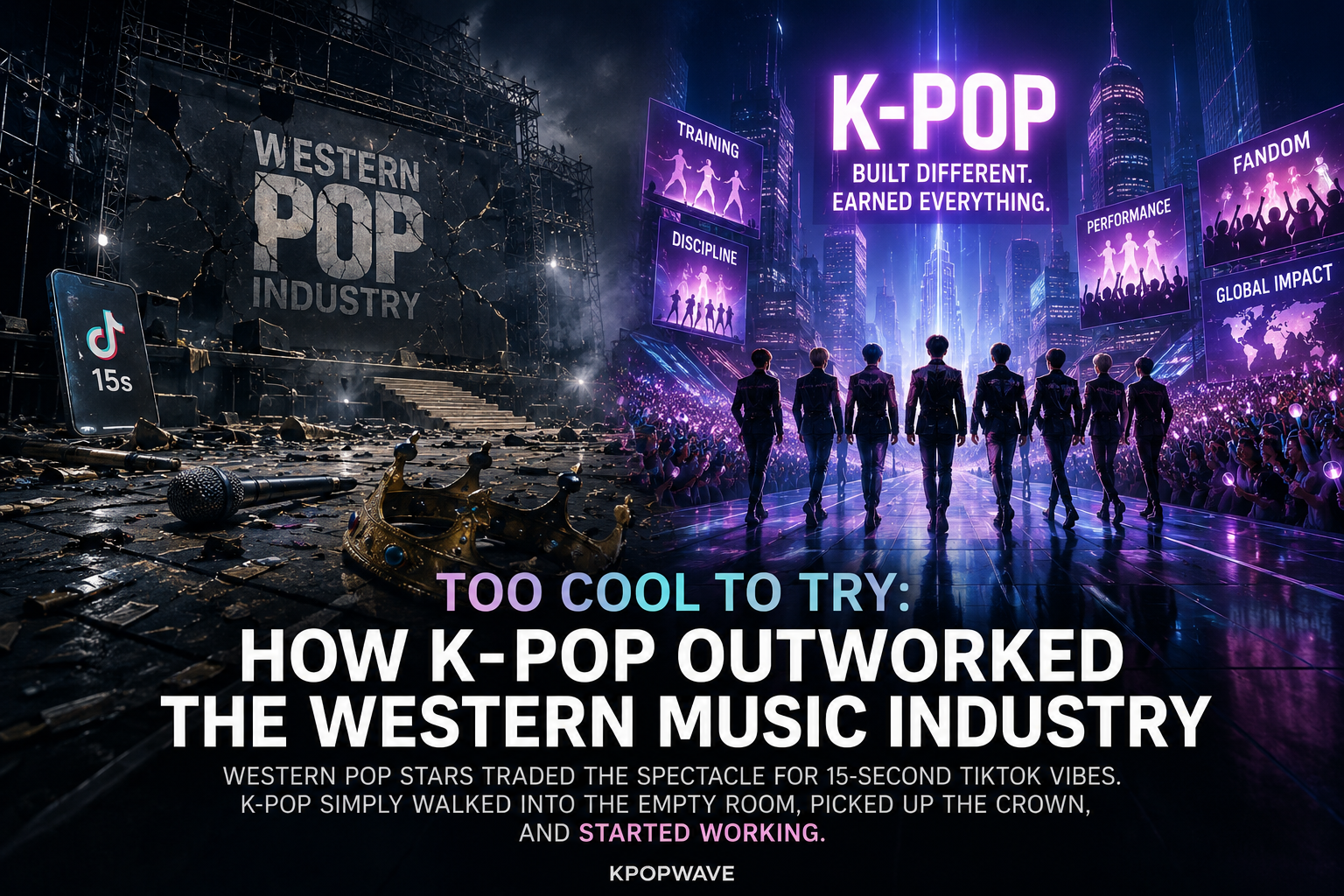
A confession before we begin: this is not an objective analysis. This is an editorial. The opinions below are those of a writer who has spent too many hours watching K-pop practice videos at 2 a.m. and has become, frankly, a little evangelical about it.
Let’s acknowledge the obvious counterargument first, because ignoring it would be dishonest.
Taylor Swift performed 149 shows across 51 cities and five continents, running over three and a half hours each night, and wrapped the highest-grossing tour in history after nearly two years on the road. Beyoncé turned stadiums into chrome-drenched dance temples. These women work. Nobody who has watched either of them perform would seriously argue otherwise.
So when I say Western pop has a work ethic problem, I’m not talking about its best. I’m talking about its average. And the average, right now, is a Maybach, a ring light, and a fifteen-second snippet of a song that may or may not actually come out.
The Vibe Economy
Somewhere in the last decade, a significant portion of Western pop stars decided that effort was aesthetically embarrassing. Rehearsed choreography became “try-hard.” Elaborate stage production became “cringe.” The correct pose was effortless — bored, untouchable, allergic to the appearance of having practiced anything.
Apathy became the luxury product. Sweat was for the lower classes.
The audience was not fine with it. They were just quiet about it — right up until they found something better.
The logic made sense, briefly. If you could generate the same streaming numbers by posting a mood board and a cryptic caption as you could by executing a full live performance, why perform? The metrics confirmed it. The industry followed the metrics.
The audience was not fine with it. They were just quiet about it — right up until they found something better.
What K-pop Actually Sells
Here is what happens when a K-pop group prepares a comeback.
Trainee period (pre-debut): 8–12+ hours a day, 6–7 days a week during intensive periods. Vocal lessons, dance practice, language coaching, conditioning, image training. Simultaneously.
Active promotion: 10–16+ hour workdays standard — recording, choreography run-throughs, music show rehearsals, broadcasts, fan events, travel, and interviews. Sleep and breaks minimal on back-to-back schedules.
2025 CNN documentary, MZMC trainees, Seoul: Girls began their day with two hours of gym workouts before heading into a full schedule of vocal and dance training — stretching into the night, often until midnight.
This is not exceptional. This is Tuesday.
This is not a secret. K-pop agencies post the practice videos. They show you the hours. They make the effort visible on purpose — because the effort is the product.
That’s the part Western critics keep missing when they reach for words like “manufactured” or “calculated.” Yes, it’s calculated. The calculation is: show people how hard you work, and they will respect you for it. It is, if anything, the least cynical premise in the music industry.
Hours per day
Typical workday during active promotion period
Days a week
Trainee schedule during intensive pre-debut periods
Eras Tour shows
Taylor Swift — yes, Western pop has its titans too
Hours per show
Average Eras Tour set length — the bar exists in the West, too
The Thing That Doesn’t Translate on a Screen
There is a specific experience that K-pop delivers and that most Western pop currently does not, and it has nothing to do with the music itself.
It is the experience of watching someone give everything.
Not the performance of effort — not staged candid moments of fake exhaustion for the camera — but the genuine, documented, quantifiable reality of a group of people who have trained for years to stand on a stage and not waste a single second of it. Perfect formations. Synchronized breathing. Choreography executed at full intensity for the fifteenth music show that week.
The teenager in Ohio stanning a K-pop group isn’t doing it because it’s exotic. They’re doing it because the group shows up. Every single time.
With the choreo sharp and the harmonies locked and the outfits pressed, at 7 a.m. on a Thursday music show that half the industry considers beneath them.
Western audiences didn’t outgrow spectacle. The industry stopped providing it, decided it was too expensive and too risky, and replaced it with vibes. K-pop kept providing it. The audience noticed. They noticed the way you notice when someone is genuinely trying in a room full of people who have decided trying is embarrassing.
The Receipts
The Western music industry has started to notice. The AMAs expanding dedicated K-pop categories wasn’t a sudden awakening to artistic merit — it was a booking decision made by people who needed bodies in seats and fandoms that would actually show up and make noise.
K-pop fandoms show up. They stream. They vote. They organize. They buy. Not because they were told to — because the people they’re supporting have visibly, demonstrably, on camera and in practice footage and in fourteen-hour promotional schedules, earned it.
You can’t manufacture that kind of loyalty with a ring light and a vibe.
Seoul is not selling music. It is selling real estate — a permanent ecosystem that fans can inhabit between comebacks. Reality shows, vlogs, behind-the-scenes footage, late-night Weverse live streams. If Western pop is a series of isolated dots, K-pop is an unbroken line.
In the attention economy of 2026, music is no longer just something you listen to. It is a space you inhabit. Western artists are selling a quick visit. K-pop is selling a home.
The crown didn’t move because K-pop was smarter or more “internet-savvy” or better at exploiting algorithms. It moved because K-pop kept working when everyone else decided work was optional.
The era of the untouchable, apathetic pop star is not a phase. It is a terminal decline. You cannot sustain a global pop empire on fifteen-second aesthetic clips and a refusal to sweat. The audience hasn’t moved on from pop music. They simply outsourced their devotion to an industry that still respects the transaction.
If Western pop wants the throne back, it’s going to have to get off the couch and start rehearsing. Until then, the capital of pop music is no longer Los Angeles or London. It’s Seoul. And it got there the old-fashioned way — it earned it.