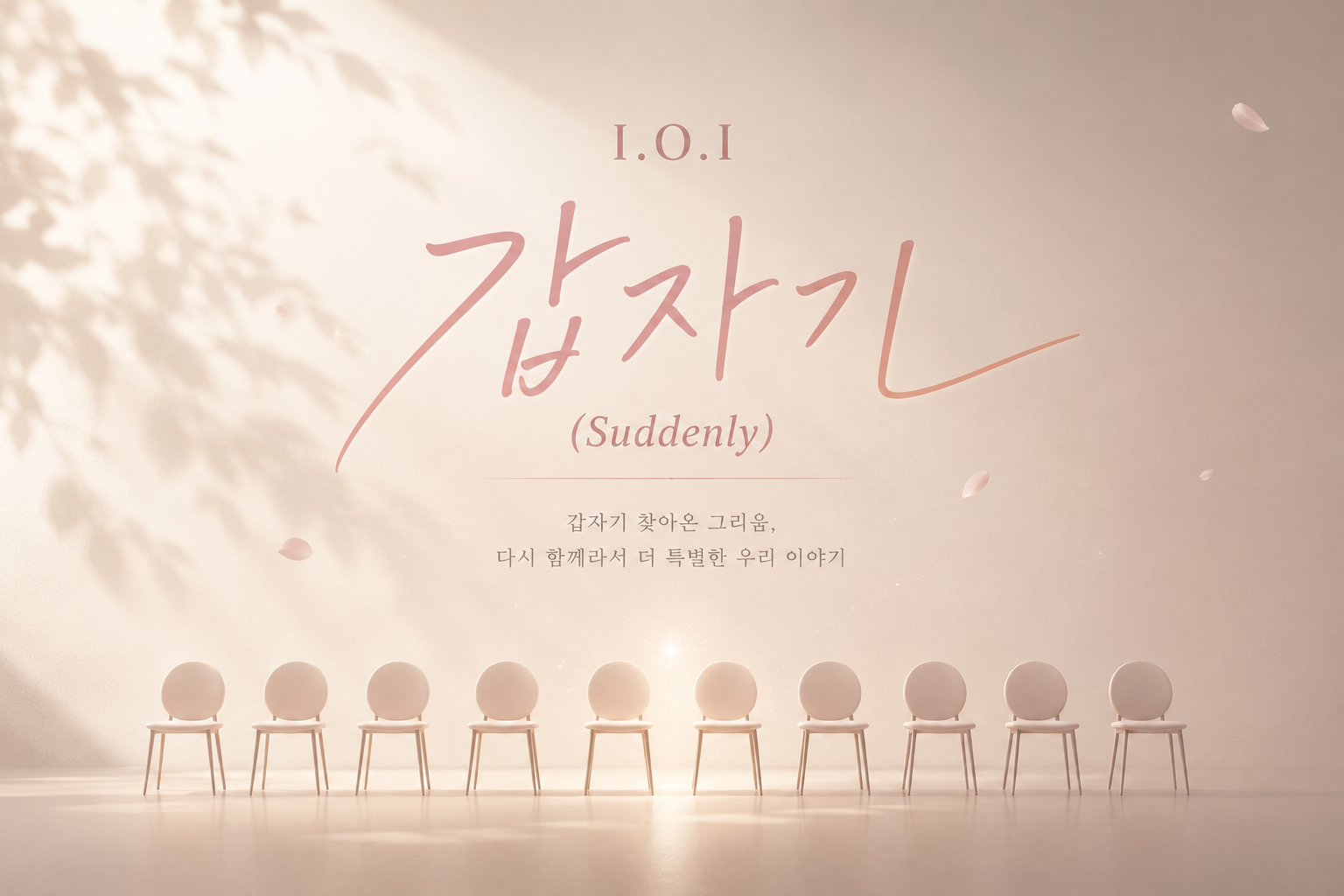
01The Title — One Word That Changes Everything
갑자기 (gapjagi) means “suddenly” or “all of a sudden” — but what makes it work as a song title is not the translation. It is the grammatical implication. 갑자기 is an adverb. It modifies what happens. And what it modifies here is the entire emotional experience of the song: the longing didn’t arrive because you summoned it. It arrived suddenly. Without your permission. Despite everything you did to prevent it.
The album title LOOP is the most self-aware word I.O.I could have chosen for a reunion release. A loop is a structure that returns to where it started — a circle, a repeat, a cycle that closes back on itself. For a group that disbanded in 2017, reconsidered reunions in 2019, canceled again, and finally returned in 2026, the word is both a musical term and a biographical description. The song “갑자기” enacts the loop concept exactly: the narrator has been in a loop with this memory — it keeps returning, keeps breaking through, keeps pulling her back to where she started. LOOP as an album title is the frame. “갑자기” is what it feels like from the inside.
02Key Lyrics — Korean, Romanization & English Translation
The song is entirely in Korean with two English phrases embedded at structurally important moments. The Korean carries the full weight of the emotional experience; the English — “In the midnight” and “Till the morning” — functions as a temporal frame, marking the hours during which the loop plays out. Below are five passages that reward closest reading.
The Opening Reframe — Loss as Something That May Have Been Right
| Korean | 어쩌면 잘된 일이야 빨간 노을빛처럼 예쁜 널 보내야 했던 그때가 머나먼 희미한 기억 |
| Romanization | Eojjeomyeon jaldoen iriya Ppalgan noeulbitcheoreom Yeppeun neol bonaeyahaetdeon geuttaega Meonameon huimihan gieok |
| English | Maybe it was for the best / Like the red glow of a sunset / That time when I had to let you go, beautiful as you were / Is now a distant, hazy memory |
어쩌면 잘된 일이야 (eojjeomyeon jaldoen iriya) — “maybe it was for the best” — is a phrase Korean speakers will immediately recognize as the thing you say when you have not fully convinced yourself. 어쩌면 (eojjeomyeon — maybe, perhaps) is the word that reveals the uncertainty. If it had truly been for the best, the word would not be “maybe.” The opening line is an argument the narrator is making to herself, not a settled conclusion.
The sunset image — 빨간 노을빛처럼 (like the red glow of a sunset) — is the song’s most carefully chosen visual. A sunset is beautiful and inevitable and unrepeatable. It is something you watch leave. The color red carries emotional weight in Korean aesthetics: not danger here, but warmth, saturation, the particular beauty of something ending. The person being remembered is described as beautiful in the act of being let go — beautiful like a sunset, which means beautiful precisely because it is leaving.
The Midnight Overflow
| Korean | 자려고 누웠는데 갑자기 너에 대한 생각에 잠겨 In the midnight 별처럼 감정들이 쏟아져 Ooh 갑자기 너에 대한 그리움에 사무쳐 Till the morning |
| Romanization | Jaryeogo nuweonneunde gapjagi Noe daehan saenggak-e jamgyeo In the midnight byeolcheoreom gamjeongdeuri ssodajyeo Ooh gapjagi noe daehan geuriume samugyeo Till the morning |
| English | I lay down to sleep and suddenly / I became lost in thoughts of you / In the midnight, emotions pour down like stars / Ooh, suddenly I am pierced to the bone with longing for you / Till the morning |
잠겨 (jamgyeo) — “became submerged” or “became immersed” — uses the verb 잠기다, which means to be locked in, to be submerged, to sink into. It is not active thinking but passive immersion: the thoughts didn’t arrive as guests, they surrounded her and she sank into them.
감정들이 쏟아져 (gamjeongdeuri ssodajyeo) — “emotions pour down” — uses the verb 쏟아지다, which describes the kind of pouring that happens when a container is overturned: sudden, uncontrolled, everything at once. The star simile before it makes the image complete: in the midnight, when it’s dark enough to see them, stars appear all at once — you can’t see a few and gradually more, they are all suddenly there.
The most emotionally precise word in the chorus is 사무쳐 (samugyeo) — from 사무치다, which means to pierce to the bone, to be cut through to the core. It is not a gentle longing. It is the kind that physically reaches inside. The word is used in Korean for extreme cold, extreme grief, extreme longing — sensations that don’t stay at the surface but penetrate all the way through.
사무치다 is one of the most specifically Korean emotional verbs — and one of the hardest to render in English. It describes a feeling that penetrates completely: a cold that gets into your bones, a sorrow that reaches the deepest part of you, a longing so sharp it feels physical. The English “pierced to the bone” approaches it but sounds more violent than the Korean. 사무치다 is not violent — it is deep. It describes a quality of thoroughness: this feeling has reached every part of me, there is no layer of me it hasn’t touched. When the chorus uses 그리움에 사무쳐 — pierced to the bone with longing — it is placing the emotion in the register of something that cannot be managed, redirected, or avoided. It has already gone all the way through.
The Traffic — Ordinary Life Holding an Extraordinary Absence
| Korean | 막혀 있는 도로 위 수많은 차 중 하나 내 마음 알아주던 너는 어디 있을까 |
| Romanization | Makhyeo inneun doro wi Sumanheun cha jung hana Nae maeum arajudeon neon eodi isseulkka |
| English | On a congested road / One among countless cars / Where might you be now — you who understood my heart |
This verse is the song’s most visually precise moment, and its most quietly devastating. The setting shifts from the bedroom at midnight to a daytime traffic jam — ordinary, anonymous, everyone stuck in the same place going nowhere fast. The narrator is one car among countless cars. And in the middle of that anonymous mass, she asks: where are you?
The phrase 내 마음 알아주던 너 (nae maeum arajudeon neo) — “you who understood my heart” — uses the past-tense modifier form (-던) to place the understanding definitively in the past. Not “you who understands my heart.” You who used to. The verb 알아주다 (arajuda) carries extra weight: it is not simply “to know” (알다) but “to know and acknowledge” — to understand someone and let them feel understood. The person being remembered was not just someone who knew her. They were someone who made her feel known.
The Bridge — The Memory That Refuses to Fade
| Korean | 아무리 애써도 괜찮은 척해 봐도 잊을 만하면 또 드리워지는 기억 우리 추억들 자꾸만 아른아른거리잖아 |
| Romanization | Amuri aesseo-do gwaenchanheun cheok haebwado Ijeul manhhamyeon tto deuriweojineun gieok Uri chueokdeul jakuman areunareugeorijanh-a |
| English | No matter how hard I try, no matter how much I pretend to be okay / The memory casts its shadow again just when I’m about to forget / Our memories keep shimmering, flickering before me |
잊을 만하면 (ijeul manhhamyeon) — “just when I’m about to forget” — is one of Korean’s most emotionally precise constructions. The phrase describes the exact moment of near-forgetting: not having forgotten, not struggling to forget, but the moment right before forgetting becomes real. And it is precisely at that moment — 또 (tto — again, once more) — that the memory returns. The timing is not random. The return happens at the worst possible moment: when release was almost within reach.
아른아른거리잖아 (areunareugeorijanh-a) — “shimmer and flicker before me” — is arguably one of the more difficult words in the song to render in English. 아른아른 is a Korean mimetic expression describing the visual effect of something seen through heat haze, or the shimmer of something at the edge of perception — not clearly visible, not clearly gone, flickering in and out. The suffix -거리다 makes it an active verb: the memories are actively shimmering, continuously, they won’t stop. The word captures exactly the quality of an intrusive memory: not the memory itself, but its shimmer — the way it keeps appearing at the edge of your vision even when you’re not looking for it.
03I.O.I in 2026 — Nine Women Who Became the Blueprint
Debut anniversary — May 2026
Members reuniting (Zhou Jieqiong & Kang Mina absent)
Seoul concert nights — Jamsil Indoor Stadium
Widely described by fellow members as the driving force behind the reunion. Members have noted that Chung Ha took the initiative in gathering everyone together — her standing as one of K-pop’s most respected solo artists made her the natural anchor for the project’s credibility.
Co-wrote “갑자기” with VVN. In promotional interviews, Somi described the reunion’s emotional intent as a wish for fans to travel back to that era and reconnect with the feeling of following I.O.I in 2016. Her writing credit adds biographical weight to the song’s most precise emotional moments.
Whose acting career has placed her in major prestige television productions since 2017. Her vocal performance anchors the chorus — the 사무쳐 line in particular requires control at emotional peak.
Took home Best New Actress at the 2025 Blue Dragon Film Awards, walked the red carpet at Cannes 2026. Her presence at the reunion underlines the broader point: these are not idols returning to idol work. They are cultural figures choosing to return to where they began.
Each at a different point in their respective careers — acting, solo music, modeling. According to members, the group made a mutual commitment to prioritize I.O.I schedules over individual activities throughout the reunion period — a collective agreement that made the project possible after two previous attempts had fallen through.
Both unable to participate in 2026 activities due to acting commitments. Both appear on the closing track “웃으며 안녕,” recorded in 2016 — meaning their voices are present on the album even if they could not be present in person.
The reunion’s cultural weight is difficult to overstate. In 2016, these members were teenagers competing on a survival show. By 2026, the nine participating members collectively represent some of the most accomplished careers in the generation of artists that Produce 101 produced: chart-topping soloists, acclaimed film and television actors, and artists whose influence extends well beyond K-pop. “갑자기” lands differently from any other reunion song precisely because of that gap — these are not people who have been together this whole time. They are people who spent a decade becoming who they are, and then chose to return.
The song about the involuntary return of something you tried to leave behind is being performed by people who are themselves an involuntary return. The loop is not just the album title. It is the group’s relationship with each other, and with the moment in 2016 that shaped all of them.
04I.O.I: LOOP — The Album That Closes the Circle
PINKY GIRL — 1st Mini Album
Debut / “Dream Girls”
MISS ME? — 2nd Mini Album
“Very Very Very” / “Whatta Man”
Disbandment
Contract ended January 2017
Reunion canceled
Mnet vote manipulation investigation
I.O.I: LOOP — 3rd Mini Album
10th anniversary reunion / 9 members
IOI (Where My Girls At)
갑자기 (Suddenly)
Title Track
SPF 100+ (Summer Pop Fantasy)
IF I
그때 우리 지금 (Then, Now and Forever)
웃으며 안녕 (Goodbye with a Smile)
Recorded in 2016 / Prod. 진영 (Jung Jinyoung) / incl. Mina & Jieqiong
The album’s structure maps an emotional arc from arrival to farewell. Track 01 (“IOI (Where My Girls At)”) opens the album as a declaration — the group announcing themselves before anything else. Track 02 (“갑자기”) is the emotional present: the sudden return of something that was supposed to be over. Tracks 03–05 move through what the reunion actually sounds and feels like — summer lightness (“SPF 100+”), conditional longing (“IF I”), and the bittersweet acknowledgment of time (“그때 우리 지금,” literally: then, us, now). Track 06 is the most extraordinary gesture on the album: “웃으며 안녕,” recorded in 2016 and produced by Jung Jinyoung, featuring Mina and Jieqiong — the two members who could not join the 2026 activities — using their actual voices from that year.
The closing track means the album ends with the voices of all eleven members as they were when they were teenagers — including the two who could not be present in 2026. The loop closes not by erasing the people who are missing, but by bringing them back in the only form possible: the recordings they left behind. The circle is complete, and it includes everyone.
05The Songwriting — Why Somi’s Credit Matters
“갑자기” was co-written by Jeon Somi and VVN. The production team — VVN, KUSH, and IDO — built a synth-pop framework that sits at the intersection of contemporary K-pop and the warmer, more atmospheric production that characterized 2nd-generation idol music. The deliberate choice to bridge those eras sonically is mirrored in the lyrical content: the song is about the past arriving in the present without announcement.
Somi’s Co-Writing Credit as Biographical Context
Somi was 15 years old when Produce 101 aired. She was one of the most visible members of I.O.I throughout their run, and one of the members whose departure — to JYP Entertainment, then to The Black Label — was most discussed. She has since built one of the strongest solo careers of any former I.O.I member. Her writing credit on “갑자기” means the song’s most emotionally precise lines — the maybe-it-was-for-the-best that isn’t fully convinced, the memory that returns just as forgetting was becoming possible — were shaped by someone who has had a decade to think about exactly this experience.
The Mimetic Vocabulary of Involuntary Memory
The song makes concentrated use of Korean mimetic expressions — words that describe physical and perceptual qualities directly. 아른아른거리다 (shimmer and flicker), 사무치다 (pierce to the core), 쏟아지다 (pour out suddenly) — these are not abstract emotional labels but sensory descriptions. The choice to render memory as something that shimmers, pours, and pierces rather than something that is simply “there” gives the song its specific texture. Remembering is not a cognitive act in this song. It is a physical event.
| Technique | Example | Effect |
|---|---|---|
| The uncertain opening | 어쩌면 잘된 일이야 | The “maybe” reveals the narrator has not fully convinced herself — the argument is ongoing |
| Sensory rendering of memory | 아른아른거리잖아 (shimmer and flicker) | Memory is not recalled — it appears at the edge of perception, uninvited, continuously |
| Penetration verb for longing | 사무쳐 (pierced to the bone) | Longing is not surface-level — it has gone all the way through every layer |
| Timing of return | 잊을 만하면 또 (just when about to forget, again) | The memory doesn’t return randomly — it returns at the worst possible moment |
| Understanding in the past tense | 내 마음 알아주던 너 (you who understood me) | -던 makes the understanding definitively past; what is lost is not just the person but the feeling of being known |
06Key Vocabulary — Words Worth Knowing
| Korean | Romanization | Meaning & Notes |
|---|---|---|
| 갑자기 | gapjagi | Suddenly / all of a sudden — an adverb that makes the emotion involuntary; it happened to the narrator, she did not cause it |
| 어쩌면 | eojjeomyeon | Maybe / perhaps — the qualifier that reveals the opening line is self-persuasion, not settled belief |
| 노을 | noeul | Sunset glow / twilight — the specific warm redness of the sky as the sun sets; beautiful and temporary |
| 잠기다 | jamgida | To be submerged / to sink into — passive immersion; the thoughts surrounded her and she sank, not the other way around |
| 쏟아지다 | ssodajida | To pour out suddenly — the kind of pouring when a container overturns; uncontrolled, all at once |
| 사무치다 | samuchida | To pierce to the bone / to penetrate completely — used for extreme cold, grief, longing; the feeling has reached every layer |
| 알아주다 | arajuda | To know and acknowledge — not just to know, but to understand someone and make them feel understood; what the narrator lost |
| 드리워지다 | deuriweojida | To cast a shadow / to be draped over — the memory doesn’t arrive, it descends; it comes from above and covers |
| 아른아른거리다 | areunareugeorida | To shimmer and flicker — a mimetic expression for something seen through heat haze or at the edge of perception; the memory that won’t fully appear or fully disappear |
아른아른 is a Korean mimetic expression — a word that phonetically evokes what it describes. It captures the visual quality of something seen through heat haze, or a shimmer at the very edge of perception: not clearly present, not clearly absent, flickering between appearing and disappearing. The suffix -거리다 turns it into an active verb: the memories are actively, continuously shimmering. They don’t stop. The word is almost impossible to translate in a way that preserves both the visual quality and the involuntary continuity. English words like “shimmer,” “flicker,” or “haunt” each capture part of it — but none carry the specific quality of something that is both there and not there, constantly, at the edge of your vision whether you look for it or not. The song’s final image — 우리 추억들 자꾸만 아른아른거리잖아, our memories just keep shimmering before me — lands as the song’s most honest description of what memory actually does: it doesn’t leave, it doesn’t fully arrive, it just keeps appearing, again and again, suddenly and without permission.
— Why “갑자기” Is the Only Song That Could Open This Album
“갑자기” works as the title track of I.O.I’s reunion album because it is the most honest possible description of what reunion is. Not a triumphant return. Not a planned comeback. Something that kept appearing at the edge of memory — shimmering, flickering, impossible to fully forget — until finally it broke through.
In promotional interviews, Somi described the reunion’s emotional intent as a wish to bring fans back to that era — to the feeling of being young and watching I.O.I for the first time. The song is not asking listeners to remember I.O.I. It is describing a structure of memory that everyone who has ever loved someone and then lost them — to time, to distance, to the ordinary forces that separate people — will immediately recognize. The memory comes 갑자기. It pours like stars. It pierces to the bone. And just when you think you’re about to forget, it casts its shadow again.
The album is called LOOP. The loop is running. 아른아른거리잖아 — our memories just keep shimmering. They always did. The women who made this song spent a decade finding that out.