NINE YEARS
On November 19, 2017, a Korean group nobody in the room had heard a year earlier walked onto the American Music Awards stage and performed a song that wasn’t in English. The audience didn’t quite know what to do. There was no nomination. No trophy. No Western co-sign on paper.
Nine years later, K-pop has its own category at the AMAs. Two of them, actually. The category has a winner every year. The genre’s biggest acts have headlined Artist of the Year. A Netflix animated film about K-pop demon hunters is up for Best Soundtrack. And the show is being held — like an accidental coronation — in the same Las Vegas city where BTS happens to be playing four sold-out stadium nights the same week.
— A PROLOGUE
The Beginning: One Stage, One Bet
November 2017 — the first time anyone said “K-pop” at the AMAs and meant it
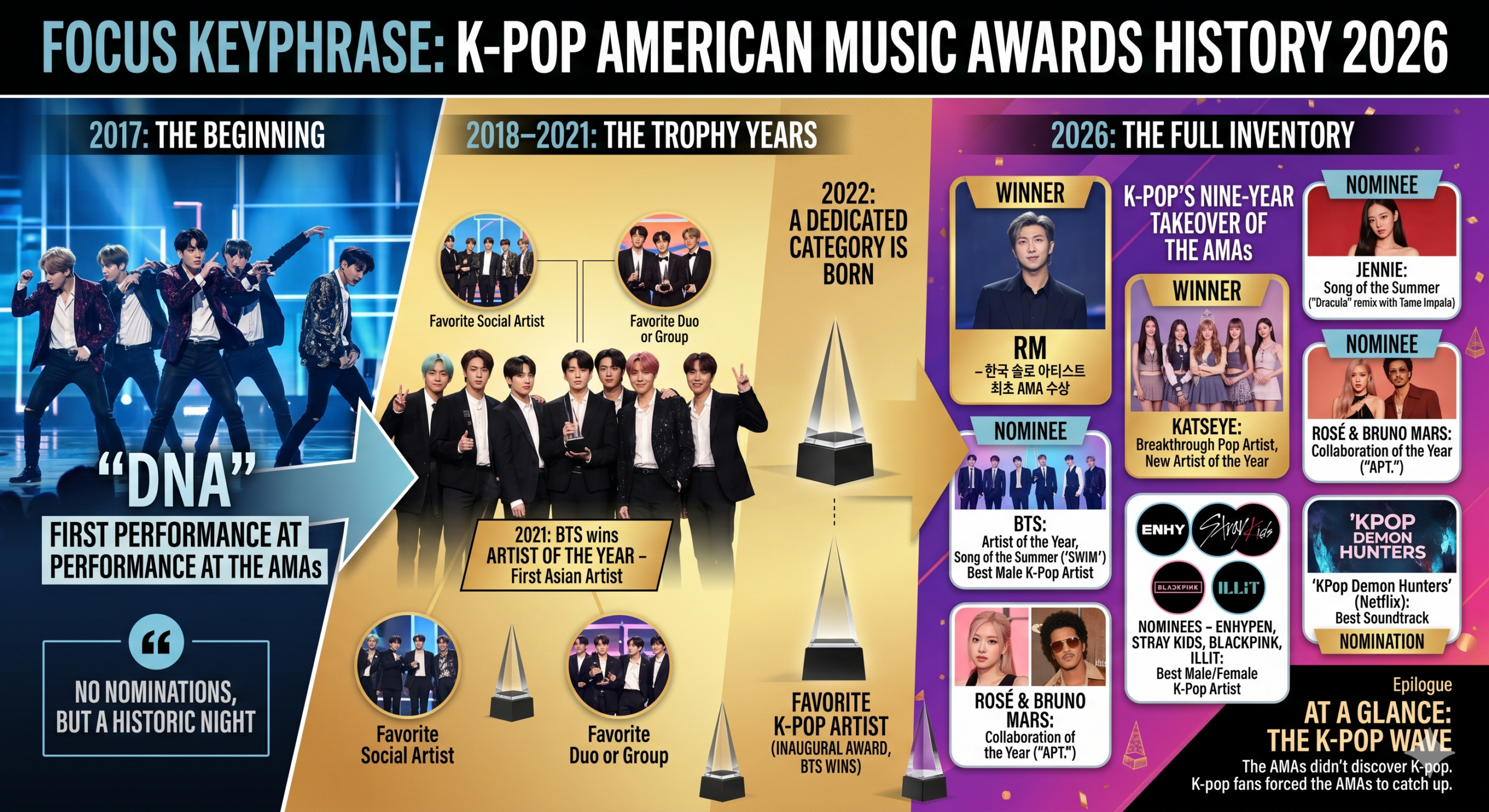
The 2017 American Music Awards were not designed with K-pop in mind. There was no category. No nominee. No precedent. But the show invited BTS to perform “DNA” — making them the first Korean group to take a major U.S. awards-show stage. They performed in Korean. The crowd reaction was a mix of curiosity, surprise, and, in some sections, the kind of room-shaking screaming that doesn’t usually happen at music awards.
The thing nobody at the AMAs realized at the time: that five minutes wasn’t a one-off booking. It was the opening move. Within a week, K-pop iTunes downloads in the U.S. spiked. Industry analysts noticed. By the time BTS came back in 2018, the AMAs had something they didn’t have the year before — a reason to actually count.
The Trophy Years: 2018–2022
How one group’s win streak rewrote what the AMAs thought was possible
What followed was, in retrospect, one of the most remarkable five-year runs by any single act at the AMAs. BTS won at least one trophy every single year from 2018 through 2022. They went from “the K-pop group everyone is curious about” to “the K-pop group that wins things” to, eventually, “the K-pop group that wins the biggest thing.”
BTS
Favorite Social Artist (first AMA trophy)
BTS ×3
Favorite Social Artist · Favorite Duo or Group Pop/Rock · Tour of the Year
BTS ×2
Favorite Social Artist · Favorite Duo or Group Pop/Rock
BTS ×3
Artist of the Year · Favorite Pop Song (“Butter”) · Favorite Pop Duo or Group
BTS ×2
Favorite Pop Duo or Group (4-peat) · Inaugural Favorite K-Pop Artist
RM
Favorite K-Pop Artist (first Korean solo winner in AMA history)
The 2021 win is the one that broke the ceiling. Artist of the Year is the AMAs’ biggest single trophy — the night’s headline. BTS won it against Taylor Swift, The Weeknd, Drake, Ariana Grande, and Olivia Rodrigo. They were the first Asian act in the show’s history to do so. South Korea’s president tweeted them congratulations. The next morning, every K-pop label in Seoul made an internal decision: this was no longer a moonshot.
The Category Appears
2022, and the question of what it means when an award show makes a separate room for you
In 2022, the AMAs created a category called Favorite K-Pop Artist. BTS won it. They were the first. The category existed because the genre’s commercial weight had crossed a line — there were now enough K-pop acts charting, touring, and selling that the show needed a way to recognize more than one of them per year.
But “your own category” is a more complicated honor than it sounds. K-pop joined a small list of genres that the AMAs has added in this way over the decades. Latin music got its first dedicated category in 1998, and now has six. Afrobeats was added in the same year as K-pop — 2022 — and remains at one. Country, R&B, and hip-hop have been there since the show began. The pattern is consistent: when a genre develops the kind of consumption volume that the AMAs’ nomination data (provided by Billboard and Luminate) can no longer ignore, it gets a room of its own.
There’s a critical lens on this — the question of whether a separate category is an embrace or a quiet form of segregation. Latin music spent the better part of two decades in its “own” categories before its biggest stars routinely competed in the show’s general fields. Bad Bunny is now the most-nominated artist some years. The same arc may be playing out for K-pop right now. In 2026, BTS is back in the general Artist of the Year category — not the K-pop one. The hard work of building a dedicated category eventually becomes the work of outgrowing it.
The Solo Era Begins: 2025
First Korean solo nominations, first Korean solo winner
For the first seven years of K-pop’s AMA presence, every nomination came from groups. That changed in 2025. BTS’s Jimin, RM, and BLACKPINK’s Rosé all earned individual nominations in Favorite K-Pop Artist — the first time Korean solo artists had ever been nominated at the AMAs. Rosé also received a nomination for Collaboration of the Year for “APT.” with Bruno Mars, becoming the first K-pop soloist nominated outside the K-pop category in AMA history.
RM won. He became the first Korean solo artist to take home an AMA. He did it while still serving in the South Korean military — the trophy was accepted on his behalf. His winning album, Right Place, Wrong Person, had been a critical and commercial high point: a Top 5 Billboard 200 debut, near-universal critical acclaim, and a body of work that read less like an idol release than like an album by a writer who happened to also be an idol. The AMAs had spent eight years recognizing the group. In 2025, they recognized the individual.
2026: The Full Inventory
A K-pop nominee in almost every major category, and a Netflix soundtrack in the running
The 2026 AMA nominations, announced April 14, are the most K-pop-saturated list the awards have ever produced. The genre isn’t a story this year. It’s a baseline.
Artist of the Year · Song of the Summer (“SWIM”) · Best Male K-Pop Artist
New Artist of the Year · Breakthrough Pop Artist · Best Music Video (“Gnarly”)
Best Soundtrack · “Golden” (HUNTR/X): Song of the Year · Best Pop Song · Best Vocal Performances
Song of the Summer — “Dracula” (with Tame Impala)
BTS · ENHYPEN · Stray Kids · plus other male K-pop nominees
BLACKPINK · ILLIT · plus other female K-pop nominees
The KATSEYE entry is, in its own way, as historically significant as the BTS one. KATSEYE is a HYBE × Geffen Records group built with K-pop methodology for an American market. They were trained the K-pop way, debuted through a K-pop-style survival show, and now exist mostly inside Western music infrastructure. Their three nominations — including New Artist of the Year against an entirely Western field — are the AMAs recognizing not just K-pop artists, but the K-pop system, applied to a globally-built group.
And then there’s KPop Demon Hunters. The Netflix animated film picked up four nominations across categories including Best Soundtrack, with “Golden” — performed by HUNTR/X (the singing voices of EJAE, Audrey Nuna, and Rei Ami) — competing in Song of the Year, Best Pop Song, and Best Vocal Performances. A K-pop-themed animated film is one of the most-nominated K-pop works at this year’s ceremony. That’s not a small detail. That’s the shape of the next decade.
What the AMAs Are Actually Measuring
Streams. Tour grosses. Radio. And the one number that changed everything: votes.
The AMAs make a point of explaining how their nominations work. Unlike the Grammys, which use a voting body of industry members, the AMAs rely on Billboard and Luminate data — streaming, sales, radio airplay, tour grosses — to determine nominees. Winners are then decided by fan voting. That structure is precisely the structure that K-pop fandoms were built to exploit.
ARMY, BLINK, Carat, MOA, ATINY — these aren’t passive fanbases. They are coordinated voting infrastructures with global timezones, dedicated voting accounts, and intra-fandom strategy meetings. The AMAs ask for the kind of behavior K-pop fans were already doing. That’s why the genre’s growth at this particular show has been so steep, so consistent, and so impossible to ignore. The voting system rewards what K-pop fans do best: show up, in numbers, on schedule, for the artist they care about.
The AMAs didn’t discover K-pop. K-pop fans forced the AMAs to catch up.
— KpopWave Editorial
That sentence sounds combative. It isn’t meant to be. It’s just what the data shows. The AMAs are a fan-voted show, and K-pop fans have been the most reliable voters in popular music for the better part of a decade. When the show added a K-pop category in 2022, it wasn’t a gift. It was an acknowledgment that the show’s own voting numbers had been telling them, for years, that the genre had arrived. The category was the AMAs catching up to its own data.
What Comes Next
Where the K-pop x AMA relationship goes from here
If the Latin music arc is the template, K-pop is still in its middle phase. Latin music spent roughly fifteen years in its “own” categories before its biggest stars routinely contended in the show’s general fields. K-pop has done it faster — BTS made the jump to Artist of the Year by 2021, only six years after the genre had any AMA presence at all. That timeline is unusually compressed. The question now is whether the next generation of K-pop artists — KATSEYE, ILLIT, Stray Kids, ENHYPEN, the solo wave from BLACKPINK and BTS — can follow into the general categories the way BTS did, or whether the K-pop category becomes a comfortable holding pattern.
The 2026 lineup suggests they will follow. KATSEYE is in New Artist of the Year. Jennie’s “Dracula” is in Song of the Summer. The Netflix soundtrack is in Best Soundtrack against entirely non-K-pop competition. These are not the K-pop category. These are the general fields — the ones that matter when you’re trying to argue that the genre isn’t a niche anymore. K-pop is doing what Latin did, but in half the time.
- First PerformanceBTS · 2017 · “DNA” — first Korean group on a major U.S. awards stage
- First WinBTS · 2018 · Favorite Social Artist
- Biggest WinBTS · 2021 · Artist of the Year (first Asian act in AMA history)
- Dedicated Category2022 · Favorite K-Pop Artist · BTS (inaugural winner)
- First Solo WinRM · 2025 · Favorite K-Pop Artist — first Korean solo AMA winner
- 2026 K-Pop ActsBTS · KATSEYE · BLACKPINK · Jennie · ENHYPEN · Stray Kids · ILLIT · HUNTR/X (KPop Demon Hunters)
- Total Trophies12 — 11 BTS group + 1 RM solo
- Categories Now2 dedicated K-pop categories (Male / Female) — up from 0 in 2021
The KpopWave Take
In 2017, K-pop went to the AMAs as a guest. In 2026, K-pop is part of the AMAs’ actual infrastructure — its categories, its general fields, its voting math, its primetime broadcast pitch. That transition happened in nine years. Nine years is a short timeline for cultural integration of a non-English genre into the biggest American fan-voted award show. By comparison, Latin music took roughly two decades to make the same journey, and Afrobeats is still very much in its first phase.
What separates K-pop’s arc, ultimately, isn’t the music. It’s the fans. The AMAs are a show structurally designed to reward whoever can mobilize the most votes — and K-pop fandoms are, by a substantial margin, the best-organized voting machines in modern popular music. The relationship between the genre and the show is not one of discovery. It’s one of consequence. The AMAs reward what gets voted for. K-pop fans vote.
On Monday, May 25, the 52nd American Music Awards will hand out trophies in Las Vegas — six miles from where BTS happens to be playing four sold-out stadium nights. Whatever the results, the bigger picture is already settled. The genre that walked onto the AMA stage in 2017 with zero nominations now has more nominees than most countries. The arrow only points one direction. Carats, ARMYs, BLINKs, EYEKONs — they already know that. Everyone else is finally catching up.