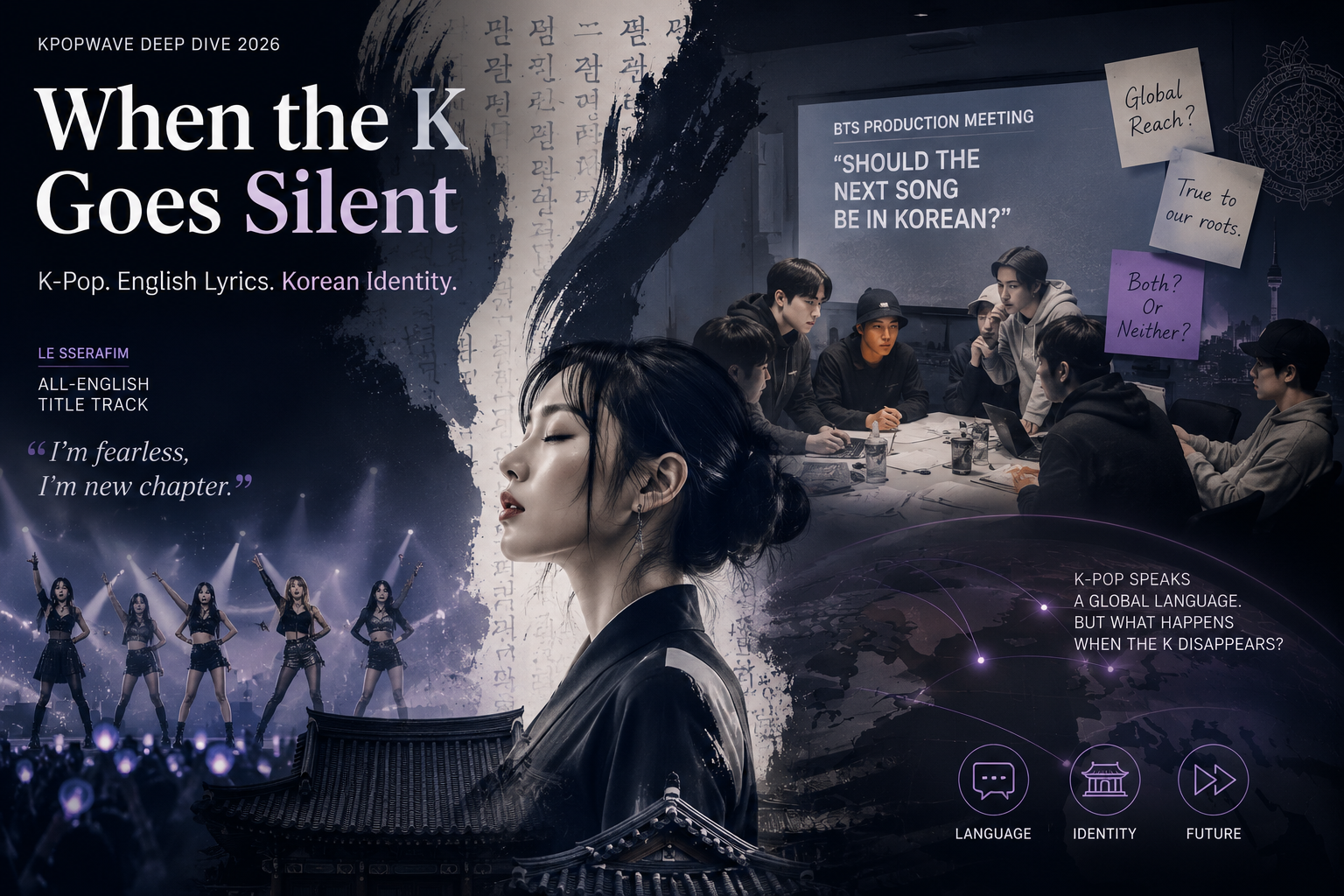
LE SSERAFIM dropped ‘BOOMPALA’ today. The beat is a Macarena sample. There’s a lyric in Spanish — mañana. There is no Korean. Not a single syllable. It is an excellent piece of global pop. And if you played it to someone who had never heard of K-Pop, they would have absolutely no reason to ask where it came from.
That, in a sentence, is what this column is about.
I. The Numbers
The shift has been underway for years, but 2026 has made it impossible to ignore. A study published in English Today, a Cambridge University Press journal, confirmed that English words now account for 41.3% of all K-Pop lyrics — and the trajectory only goes in one direction. This isn’t a stylistic choice by individual artists anymore. It’s a structural condition of the industry.
The irony buried in those numbers is almost too neat. K-Pop is a $10 billion global industry expanding at 8% annually — and yet its home market is cooling. Industry experts have been direct about why: labels prioritizing English-heavy songs for international appeal are quietly alienating the local audience that built this genre in the first place. K-Pop’s globalization is estranging K-Pop’s homeland.
II. Arirang, in English
There is no more instructive case study right now than BTS’s comeback album, ARIRANG, released in March. The album is named after a 600-year-old Korean folk song — perhaps the single most loaded cultural object in the Korean national imagination. A melody about longing, separation, and resilience that became a symbol of collective identity across generations of Koreans. BTS chose it as the title of their most anticipated album in nearly four years.
Then look at the production credits: Mike WiLL Made-It. Diplo. Flume. Ryan Tedder. El Guincho. The album was written over months of LA-based songwriting sessions. Its language listing puts English before Korean.
“I think there are too many English lyrics. The rap verses, in particular, could use more Korean.”
— Suga, BTS, from the documentary The Return (2026)
That quote isn’t from a critic. That’s Suga — speaking in a production meeting about his own group’s album, trying to talk the project back toward the language he grew up rapping in. RM agreed with him in the same room: “There’s a level of authenticity we need to have here.”
Read that again slowly. Two members of the most successful Korean musical act in history had to make the case — inside a meeting room — for using Korean in their own music. They were not overruled. But they had to argue for it. That is how far the tectonic plates have shifted.
In “Aliens,” a track on ARIRANG, RM raps: “I’m the only one who speaks English, but that is how we kill.” The same song weaves in references to the traditional jungmori rhythm, the Korean custom of taking shoes off indoors, and independence fighter Kim Gu.
The tension isn’t hidden. It’s the song. BTS knows exactly what they’re doing — and what they’re giving up to do it. That self-awareness is both what makes the album compelling and what makes it a little heartbreaking.
III. The KpopWave Problem
We should be honest about something here at KpopWave. One of our core editorial functions has always been translating Korean lyrics for English-speaking fans — not just word for word, but concept by concept. The cultural scaffolding underneath the language. The things that don’t survive a dictionary.
Han — that particular Korean weight of grief that refuses easy resolution. Nunchi — the constant atmospheric awareness of what others need and feel, a social sense with no true English equivalent. Heuk-su-jeo — the dirt spoon, the vocabulary of class resentment that BTS weaponized in “Baepsae” in 2015. These aren’t just words. They are entire philosophies compressed into syllables, and they can only exist in the language that made them.
If BOOMPALA’s “Saving the shame for mañana” is what we’re asked to explain now, our job changes in a fundamental way. We are no longer translators of a culture. We are copy editors of a press release.
And that matters not just for us — it matters for the fans. The global ARMY that fell in love with BTS didn’t fall for English-language pop. They fell for something that felt genuinely, specifically, stubbornly Korean. The foreignness was the point. The translation was the adventure.
IV. In Fairness
The honest version of this argument has to account for what K-Pop actually is — and has always been. This genre was never ethnically pure music. It was born from the deliberate synthesis of American R&B and hip-hop structures, Japanese idol management systems, and Korean emotional sensibility. Hybridization isn’t a corruption of K-Pop. It’s the founding condition.
BTS proved the model could work in reverse. “IDOL” in 2018 took EDM and buried traditional Korean percussion inside it, reclaiming their identity through the very genre they’d been accused of imitating. “Paldogangsan” had members rapping in regional Korean dialects about their hometowns. “Baepsae” built its fury around a Korean idiom about class immobility. K-Pop can absorb English and still remain distinctly itself — the history proves that.
English lyrics perform better on Spotify’s algorithmic recommendation system. They clear the hurdle for pop radio playlisting in the US and UK. They simplify synchronization licensing for film and TV. Billboard Hot 100 entries, historically resistant to non-English tracks, become more accessible. For a $10 billion industry, these are not small considerations — they are existential strategy.
The pressures that produced BOOMPALA and shaped ARIRANG’s LA sessions are not the result of artistic cowardice. They are the logical output of what happens when a national cultural export scales into a multinational commercial product. The blame, if there is any, belongs to a system — not to the artists navigating it.
V. The Editor’s View
And yet.
The decision to make BOOMPALA entirely in English — with Spanish in the middle — while releasing it under the K-Pop banner doesn’t feel like evolution. It feels like erasure. “Mañana” had space in that song. Korean didn’t. That’s a choice, and choices mean something.
BTS titled their album after the most sacred folk melody in Korean cultural memory, opened it with that song rising from an electronic beat like something waking up — and then filled the rest of the tracklist with what LA’s finest producers make when they’re given a brief. The framing is Korean. The execution is Los Angeles. There is something genuinely moving in that tension, and something genuinely uncomfortable.
“Gangnam Style” shook the world in Korean. “DNA” cracked the Billboard charts in Korean. “Spring Day” made people cry in Korean — and most of them didn’t understand a word. The foreignness wasn’t a barrier. The foreignness was the thing that made people lean in, reach for the translation, start to learn. The language was not a problem that needed solving. It was the entire invitation.
When that invitation disappears, what remains? Technically accomplished pop music built by excellent professionals for a global audience. Which is fine. There’s plenty of that. But it’s no longer a genre that needs — or rewards — the kind of deep engagement that made K-Pop fans the most devoted fanbases in the world. You don’t build an ARMY around a song that sounds like it could have come from anywhere.
KpopWave will keep doing what we do — finding the Korean left in the music, excavating it, and bringing it to you. But let’s be clear about what that means now: our work is becoming an act of preservation more than translation. We’re not archivists yet. But we’re watching the window narrow. The K in K-Pop is not a brand prefix. It’s a promise. We’d like it to be kept.
LE SSERAFIM ‘BOOMPALA’ released May 22, 2026 (HYBE / Source Music). English-only lyrics confirmed via official release. BTS ARIRANG released March 20, 2026 (Big Hit Music); Suga’s quote sourced from Billboard’s coverage of documentary BTS: The Return (March 2026). English accounts for 41.3% of K-Pop lyrics per English Today, Cambridge University Press (2024). Domestic consumption figures from Circle Chart 2025 Mid-Year Report, as reported by Korea Herald and Malay Mail (July 2025). K-Pop production market valuation ($10B, 8% CAGR) from Go2Market Research Global K-Pop Production Market Report 2025.