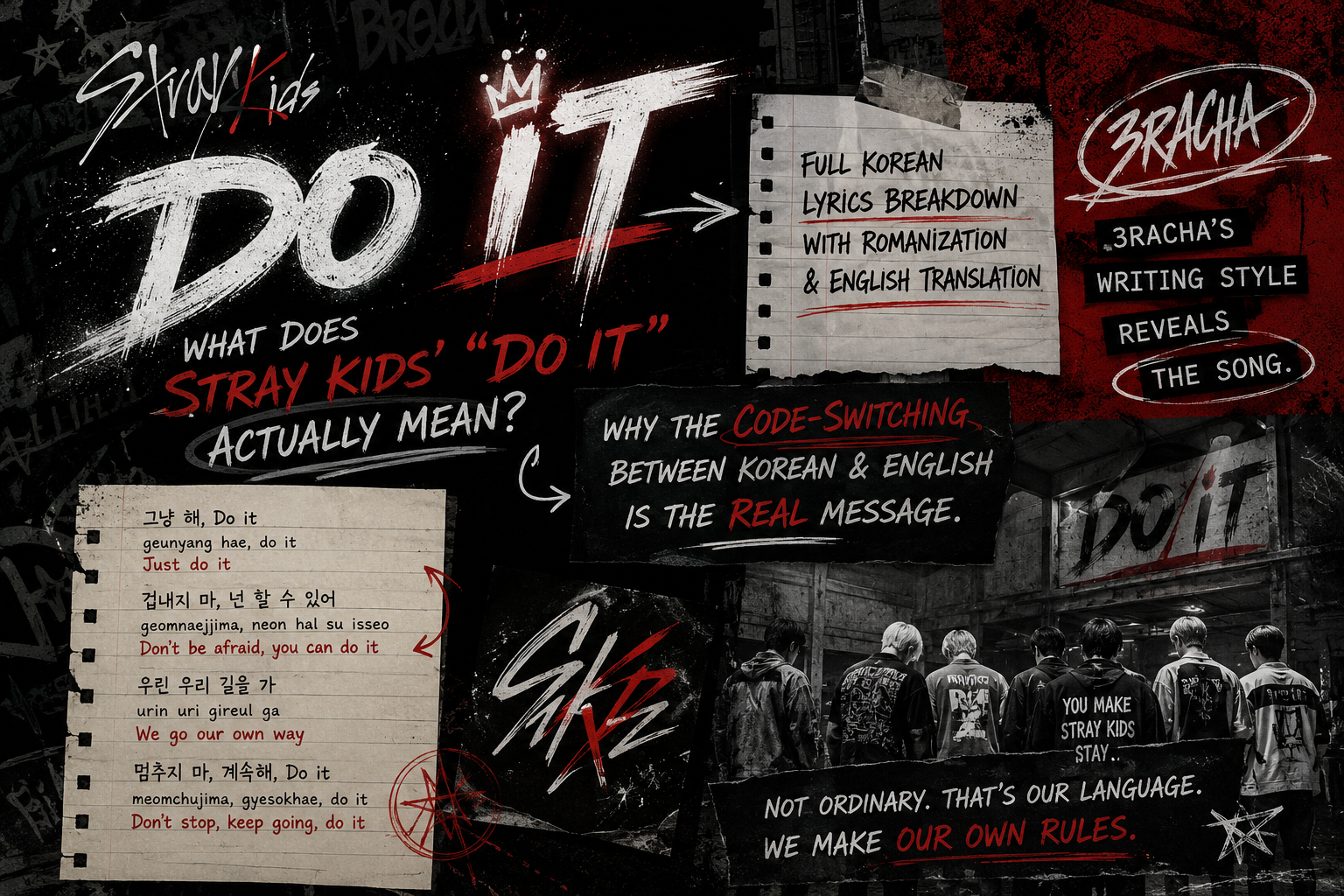
01The Language of “Do It” — Why the Code-Switching Is the Message
“Do It” is not a fully Korean song or a fully English song. It is a precisely engineered bilingual text, and the alternation between Korean and English is not decoration — it is the primary vehicle for the song’s emotional logic. Understanding which moments land in which language is essential to understanding what the song is actually saying.
그냥 해
Go get it, Go digging
실패 과정의 다른 이름 “flawless”
There ain’t no time for thinking / Leave it all behind we’re gonna do it baby
제발 간 보기 좀 그만해
In “Do It,” the pattern is consistent: Korean carries the emotional interior — the frustration, the direct address to the self, the philosophical reframe — while English carries the external energy, the imperatives, the hooks that reach across borders. The two languages are not interchangeable. Each carries a specific emotional register, and switching between them is a compositional decision, not a translation convenience.
02Key Lyrics — Korean, Romanization & English Translation
The following four passages carry the most lyrical and thematic weight in the song. Each advances a specific argument — and together they form a complete philosophical position about action, failure, and identity.
The Central Reframe
| Korean | 실패 과정의 다른 이름 “flawless” |
| Romanization | Silpae gwajeong-ui dareun ireum “flawless” |
| English | Another name for the process of failure is “flawless” |
This is the most conceptually precise line in the song. It does not say failure leads to success — that is a cliché. It says the process of failure is itself flawless: exactly right, exactly what it needed to be. The word 과정 (gwajeong — process, course) is doing crucial work. The failure is not redeemed by what comes after it. It is affirmed in the moment it is happening.
실패 (failure) and 성공 (success) are among the most discussed concepts in Korean achievement culture, where academic and professional pressure places enormous weight on measurable outcomes. Using 실패 here — plainly, without softening — and then redefining it rather than apologizing for it is a pointed cultural gesture. The song is not just about personal motivation. It is pushing back against a specific social environment.
The Exasperated Plea
| Korean | 제발 간 보기 좀 그만해 내가 하려던 거 나 아니면 누가 해 |
| Romanization | Jebal gan bogi jom geumanhae Naega haryeodeon geo na animyeon nuga hae |
| English | Please, stop testing the waters already The thing I was going to do — if not me, who will do it? |
The second line is the emotional pivot of the song. “내가 하려던 거 나 아니면 누가 해” — if not me, who? — transforms the song from external motivation to internal ownership. The narrator is no longer speaking to a hesitant listener from outside. They are the listener, asking themselves the question that cannot be escaped. The rhetorical structure (a question with no possible answer except action) makes an argument the listener cannot argue back against.
The Identity Claim
| Korean | 이게 game이라 하면 I’m a star player Play my life on mono and stereo |
| Romanization | Ige game-ira hamyeon I’m a star player Play my life on mono and stereo |
| English | If this is a game, I’m a star player Play my life on mono and stereo |
The game metaphor is common in hip-hop, but “mono and stereo” lifts it. Mono is the single channel — focused, direct, singular perspective. Stereo is dual-channel — awareness of multiple dimensions simultaneously. Playing life on both means being fully in it and aware of it at the same time. The line claims total commitment plus total clarity.
The Bridge Declaration
| Korean | 멈추는 건 foolish yeah / 하는 게 더 영리해 부딪히며 얻어내 hint / 어차피 할 거 불평 shut it |
| Romanization | Meomchuneun geon foolish yeah / Haneun ge deo yeongni hae Budichhimyeo eoreottae hint / Eochapi hal geo bulpyeong shut it |
| English | Stopping is foolish, yeah / Doing it is smarter You get hints by crashing into things / If you’re going to do it anyway, shut the complaining |
The bridge is the most compressed argument in the song. Four lines that flip a common assumption: that caution is intelligent and recklessness is foolish. Here, 영리하다 (yeongni hada — to be clever) is assigned to action, not deliberation. And the final instruction — shut the complaining if you were going to do it anyway — removes the last psychological escape route. There is no position left except forward.
033RACHA — The Producing Unit Behind the Song
Understanding “Do It” requires understanding who wrote it and why the structure of their creative unit is unusual in K-pop.
3RACHA stage name: CB97. Australian-born, trained at JYP for 7 years. Primary architect of Stray Kids’ sonic identity — structures tracks, workshops hooks and melodies. 216+ KOMCA-registered compositions.
3RACHA stage name: SpearB. Known for rapid-fire, technically precise rap and direct lyrical voice. Drives rhythm and aggression. 185+ KOMCA credits. The directness “Do It” channels in its bridge is his fingerprint.
3RACHA stage name: J.One. Known for emotional honesty and poetic introspection. Shapes melodic flow between rap and sung sections. 178+ KOMCA credits. His fingerprints are in the vulnerability underneath the song’s confidence.
Co-production and arrangement on the DO IT album, working alongside 3RACHA’s creative direction.
The name 3RACHA is a play on “sriracha” — three members, three-alarm heat. They began producing music under this name on SoundCloud in 2017, before Stray Kids debuted, and have remained the creative engine of every album since. In K-pop, where production is almost always handled externally, having the group’s own members write and produce the majority of their discography is structurally rare.
Within their dynamic, roles are distinct: Bang Chan structures the overall track architecture. Changbin writes his verses with a direct, aggressive lyrical style. Han leans into emotional complexity and melodic flow. “Do It” is a fusion document — the aggression is Changbin’s, the emotional logic is Han’s, the production architecture is Bang Chan’s.
KOMCA (한국음악저작권협회) is the Korean Music Copyright Association — the body that formally registers songwriters and composers. Having hundreds of KOMCA credits means 3RACHA are recognized as professional composers under Korean intellectual property law, not just performers. This is why “Stray Kids’ music is personal” is not a marketing claim — it is a legal and creative fact.
04SKZ IT TAPE — What the Format Means
Billboard 200 — 8th consecutive
First-day Hanteo sales
Spotify pre-saves — 1st K-pop album ever
The “SKZ IT TAPE” label was coined specifically for this release to differentiate it from Stray Kids’ regular studio albums. Where albums like Karma are full-length statements with elaborate concepts, the IT TAPE format is meant to be more immediate: a snapshot of what 3RACHA sounds like at a specific moment in time, seven years into their career.
Do It
Title Track
DIVINE
Title Track
Holiday
Photobook
Do It (Festival Version)
The decision to release two title tracks simultaneously — “Do It” and “DIVINE” — positions them as a duality. “Do It” is the external energy: movement, action, go. “DIVINE” is the internal declaration: identity, confidence, where they come from. Together they are two sides of the same statement about Stray Kids in 2025.
The IT TAPE concept also follows directly from the previous “SKZhop Hiptape” series. HOP (2024) was explicitly genre-labeled: Stray Kids’ hip-hop music, pure. The IT TAPE is less genre-specific — the name suggests a different question: not “what genre are we doing?” but “what are we doing right now?” The answer in “Do It” is: exactly this, without apologizing for it.
053RACHA’s Songwriting Signatures — How to Read Their Work
3RACHA has been writing together since 2016. Over eight years and hundreds of registered compositions, certain patterns have emerged that are immediately recognizable — and all of them appear in “Do It.”
Action Over Analysis (The Anti-Paralysis Pattern)
Across their discography, 3RACHA returns again and again to the problem of overthinking — the gap between knowing what to do and doing it. Songs like “Miroh,” “Side Effects,” and now “Do It” address this from different angles: sometimes as anxiety, sometimes as external pressure, here as pure impatience. The internal monologue about hesitation is a recurring subject because it is a lived experience for the members, all of whom navigated intense trainee environments and public scrutiny before and after debut.
The Direct Address
3RACHA lyrics rarely speak in the third person or in the abstract. They address “you” — sometimes the listener, sometimes themselves. In “Do It,” the song collapses the distance between those two: the “you” the song is talking to is often indistinguishable from the person singing it. This creates the sensation that the song is personal even for listeners who are not K-pop performers, because the underlying emotional situation — wanting to do something and not doing it — is universal.
Idioms as Weapons
The use of 간 보다 (to test the waters / to cautiously probe) is characteristic of how 3RACHA handles Korean idioms. Rather than avoiding them in a bilingual song that will be consumed globally, they lean in — knowing that Korean fans will feel the idiom’s full weight, and that international fans will hear the frustration in the delivery even without the specific cultural baggage.
The Pep Talk That Means It
Perhaps the most consistent structural feature of 3RACHA writing is that the motivational songs feel internal rather than performed. The song is a conversation between the writer and themselves, and the listener is overhearing it. “Do It” makes this explicit in the second verse, where the narrator transitions from speaking to an imagined hesitant listener to asking themselves “나 아니면 누가 해” — if not me, who?
| 3RACHA Signature | Example in “Do It” | Effect on Listener |
|---|---|---|
| Korean idiom in bilingual context | 간 보기 좀 그만해 | Native speakers feel the full exasperation; international fans hear the tone |
| Conceptual reframe | 실패 과정의 다른 이름 “flawless” | Redefines a known word; creates a new mental model |
| Rhetorical question | 나 아니면 누가 해 | Closes off all alternatives except action |
| Code-switch for tone shift | Korean = interior / English = exterior momentum | Language alternation mirrors emotional alternation |
| Compressed bridge argument | 멈추는 건 foolish / 하는 게 더 영리해 | Four lines, complete logical argument — no room to disagree |
06Key Vocabulary — Words Worth Knowing
| Korean | Romanization | Meaning & Notes |
|---|---|---|
| 그냥 해 | Geunyang hae | Just do it / Just go ahead — 그냥 implies “without overthinking,” a casual dismissal of hesitation |
| 실패 | Silpae | Failure — loaded in Korean achievement culture; the song deliberately refuses to soften it |
| 과정 | Gwajeong | Process / course — used to reframe failure not as outcome but as essential path |
| 간 보다 | Gan boda | To test the waters / probe cautiously before committing — the idiom the song tells you to stop doing |
| 영리하다 | Yeongni hada | To be clever, intelligent — the bridge assigns this quality to action, not caution |
| 부딪히다 | Budichhida | To crash into / to collide with — the bridge’s method of learning: you get hints by hitting things |
| 나다움 | Nadaum | My-ness / being myself — 나 (I/me) + 다움 (the quality of being); a distinctly Korean way of naming authentic selfhood |
| 어차피 | Eochapi | Anyway / regardless — used in the bridge to strip away the last excuse: “if you’re going to do it anyway…” |
The word 나다움 appears in the first verse and is one of the most specifically Korean emotional concepts in the song. It is constructed from 나 (I / me) and the suffix 다움, which denotes “the quality of being [X].” 나다움 therefore means “the quality of being me” — authentic selfhood, acting in accordance with who you genuinely are. When the song says to act from 나다움, it is not saying “be comfortable” — it is saying “the thing that makes you you is the foundation, not an obstacle.”
— Why “Do It” Works
“Do It” is a short song with a simple instruction. Its power comes not from complexity but from precision. Every line does exactly one thing — removes one more excuse, closes one more escape route, narrows the space between where you are and the action you already know you need to take.
3RACHA have been writing about the fear of failure and the cost of hesitation since their SoundCloud mixtapes in 2017. What “Do It” adds — eight years into that project — is a certain maturity of impatience. They are no longer asking the question gently. They have done the thing. They know it was survivable. They know the hesitation costs more than the attempt.
나다움 — being yourself — is what the first verse names as the ground to act from. The song’s argument, built over three minutes of reggaetón beats and bilingual urgency, is that this ground already exists under your feet. You don’t have to create it. You have to stop testing it and stand on it.
그냥 해. Just do it. Eight words in Korean and English. Eight years in the making.